

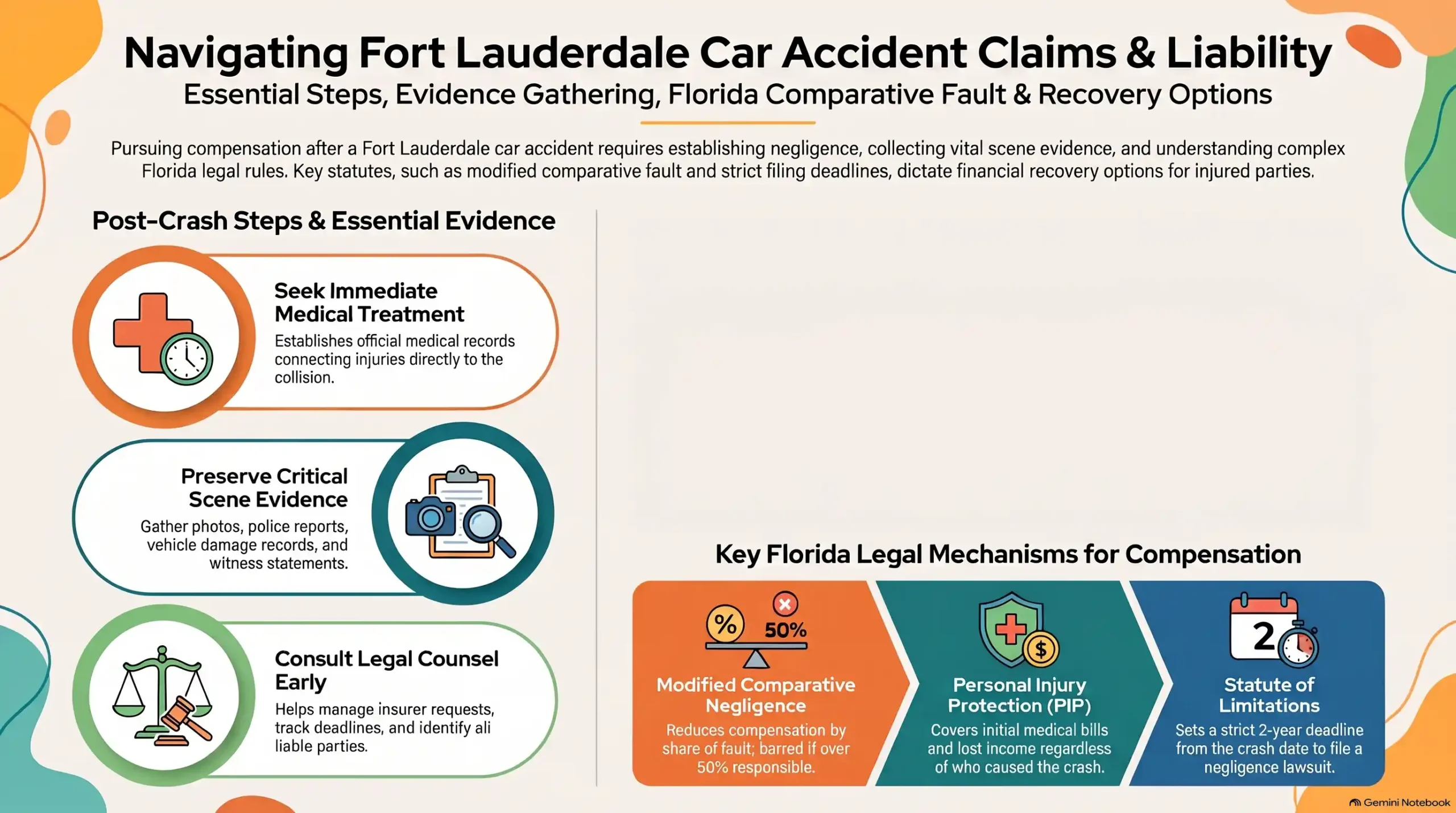
The Law Offices of Anidjar and Levine can investigate which drivers, employers, vehicle owners, or other parties may have contributed to a Fort Lauderdale car accident. Police reports, photographs, witness accounts, medical records, and available video may help establish negligence and document injuries. Florida’s comparative negligence law may reduce compensation based on an injured person’s share of fault, and recovery is generally barred if that share exceeds 50 percent. Learn more from a Fort Lauderdale Personal Injury Lawyer.
Main Takeaways
- A Fort Lauderdale car accident lawyer can investigate which drivers, employers, vehicle owners, or organizations may be legally responsible.
- Liability depends on evidence that a party’s negligence caused the collision and resulting injuries.
- Crash reports, witness statements, vehicle damage, photographs, video, and medical records can help establish fault.
- Florida’s comparative negligence rules may reduce compensation based on your share of fault; recovery is generally barred if you are more than 50% responsible.
- Preserve evidence, seek prompt medical care, and consult a lawyer to understand potential claims and deadlines.


How We Can Help With Your Fort Lauderdale Car Accident At-Fault Parties Injury Claim
After a Fort Lauderdale car accident, identifying every party whose negligence contributed to an injury can be essential to pursuing compensation. A legal team can help manage the claim with careful preparation, steady guidance, and respect for the challenges an injured person may face. Counsel can review available records, organize relevant documents, and explain the steps involved so clients can make informed decisions.
A thoughtful Claim strategy is shaped around the client’s circumstances and goals. Attorneys can assess potential sources of recovery, address insurer requests, and prepare clear, supported communications on the client’s behalf. They can also track deadlines and handle procedural tasks, allowing clients to focus on treatment, family responsibilities, and recovery.
Consistent client communication helps ensure questions get timely answers and that important developments are explained clearly. The legal team can discuss options without pressure and provide updates as the matter progresses. By combining diligent advocacy with attentive service, counsel can help clients pursue a fair resolution while treating each person with professionalism and care.
OUR CONSULTATIONSARE FREE
START YOUR FREE CASE REVIEW

Understanding Fort Lauderdale Car Accident At-Fault Parties Injury Cases
Fort Lauderdale car accident injury cases can involve more than one at-fault party when several people or organizations contribute to a collision. Determining responsibility requires a careful review of the available evidence, the parties’ actions, and how those actions relate to the injuries. Depending on the circumstances, responsibility may extend beyond a driver to an employer, vehicle owner, or another organization. Assess each potential party’s role separately rather than assuming it from the crash’s location or severity.
Broward County crash statistics provide useful context about roadway safety, but they do not establish fault in an individual case. Fort Lauderdale traffic patterns may also help explain the setting in which a collision occurred, but incident-specific evidence remains crucial. A thorough investigation can clarify how to allocate responsibility and what compensation may be available. This process supports injured people and their families as they seek accountability and recovery resources.
Common Causes of Fort Lauderdale Car Accident At-Fault Parties
Common causes of Fort Lauderdale car accidents include distracted driving, speeding, and other reckless behavior that can prevent drivers from responding safely to road conditions. Impaired driving can also compromise judgment and coordination, increasing collision risk. Failure to yield is another common factor, especially when drivers ignore traffic signals or another vehicle’s right of way.
Distracted Driving
Distracted driving occurs when a motorist’s attention shifts away from the road, reducing the ability to notice hazards and respond safely. In Fort Lauderdale, common distractions include texting, checking navigation, eating, and adjusting music or climate controls. Even brief visual, manual, or mental distractions can prevent a driver from recognizing changing traffic conditions or a pedestrian entering a crosswalk.
Hands-free technology may reduce the need to handle a phone, but it does not eliminate cognitive distraction. Dashboard interfaces can also draw a driver’s eyes and attention from surrounding traffic. Motorists must use devices only when it is safe and lawful. When distraction contributes to a collision, evidence such as phone records, witness accounts, and available video may help clarify how the crash occurred and who may be accountable.
Speeding and Reckless Driving
When drivers exceed safe speeds or disregard traffic laws, they have less time to respond to hazards and may lose control of their vehicles. In Fort Lauderdale, speeding can increase collision force and the risk of serious injury to occupants, pedestrians, and other road users. Reckless conduct may include aggressive lane changes, tailgating, or ignoring signals. Investigators may review crash reports, witness accounts, vehicle damage, and available camera footage to determine how a driver’s actions contributed to a collision. Speed enforcement technology, including radar and traffic cameras, can document violations when used properly. Florida law also imposes reckless driving penalties, including fines and other consequences. Identifying responsible parties can help injured people pursue compensation and support safer roads for the wider community.
Impaired Driving
Impaired driving can increase the likelihood of a Fort Lauderdale car accident by slowing a driver’s reactions, weakening judgment, and reducing coordination. Alcohol, cannabis, prescription medications, and other substances may affect a person’s ability to operate a vehicle safely. Even when a driver believes they are unimpaired, observable signs or test results may help establish whether impairment contributed to a collision.
After a crash, investigators may review witness accounts, police observations, chemical test results, and available video. Sobriety checkpoint procedures and the circumstances of a traffic stop may also be relevant when evaluating evidence. Florida law can impose criminal and civil consequences for impaired driving, while ignition interlock requirements may apply to certain offenders. A person injured by an impaired driver may seek compensation for documented losses. Careful evidence preservation can support accountability and help protect affected families.
Failure to Yield
Failure to yield occurs when a driver does not give another road user the right of way required by traffic laws or road conditions. In Fort Lauderdale, this conduct may cause collisions at busy intersections, while entering traffic, or when turning across another vehicle’s path. Intersection right-of-way rules help determine which driver must proceed and which must wait, but signs, signals, and roadway conditions also matter. Drivers making left turns generally must yield to approaching traffic when required. A failure to yield can injure motorists, pedestrians, cyclists, and passengers who had no reasonable chance to avoid impact. Investigators may review traffic controls, witness accounts, vehicle damage, and available video to assess responsibility. Careful fact-finding can support injured people seeking fair compensation and accountability.
Don’t Wait. Call Our Florida Personal Injury Lawyers Now!


Legal Rights of Fort Lauderdale Car Accident At-Fault Parties Injury Victims
Even if a driver is found partly or primarily at fault in a Fort Lauderdale car accident, they may still have important legal rights after being injured. Fault does not automatically eliminate access to insurance benefits or prevent a person from seeking a fair review of available coverage. Each claim depends on the policy terms, applicable law, and the collision circumstances.
An injured driver may have options such as:
- Seeking personal injury protection benefits for eligible medical expenses and lost income, subject to Florida’s rules and any PIP coverage exceptions.
- Reviewing uninsured motorist claims if an applicable policy provides benefits for injuries caused by an uninsured or underinsured driver.
- Consulting a qualified attorney to assess fault allocation, preserve evidence, and explain deadlines and potential recovery.
Florida’s comparative negligence rules may reduce compensation according to the injured person’s share of responsibility, and a person found more than 50 percent at fault generally cannot recover damages from another party. Prompt, informed guidance can help injured people understand their rights and make decisions that support their families and communities.
Why Do Fort Lauderdale Car Accident At-Fault Parties Injuries Happen?
Fort Lauderdale car accident injuries occur when a collision exposes drivers and passengers to sudden forces, regardless of who caused the crash. The body may be thrown forward, sideways, or against interior surfaces, causing injuries that range from bruises and fractures to head, neck, and spinal trauma. Severity often depends on impact speed, vehicle size, restraint use, and the direction of the collision.
Crashes can result from distracted driving, speeding, impaired operation, unsafe lane changes, or failure to yield. Heavy traffic, sudden stops, and limited visibility may increase the likelihood of impact. Roadway design can also contribute when confusing intersections, obstructed sightlines, poor lighting, or inadequate signs make hazards harder to recognize. In some cases, vehicle defects, such as faulty brakes or defective safety equipment, may worsen a collision or its consequences.
Understanding these contributing factors helps explain how injuries occur and why responsibility may involve more than one party. Careful examination of the circumstances can support a fair assessment of the harm suffered.
What Should You Do After a Fort Lauderdale Car Accident At-Fault Party Injury?
After an injury in a Fort Lauderdale car accident, prompt medical care can help protect your health and document your injuries. When it is safe, the injured party should document the scene, including vehicle damage, road conditions, and witness information. A car accident lawyer can clarify your legal options and help preserve important evidence.
Seek Medical Care
Prompt medical care should be a priority after a Fort Lauderdale car accident, even when injuries appear minor or symptoms have not yet developed. An injured person should accept an Emergency contact’s help getting to a hospital or urgent care facility, and call 911 for severe pain, bleeding, confusion, breathing difficulty, or loss of consciousness. Medical professionals can identify hidden injuries, recommend appropriate treatment, and explain what warning signs require immediate attention. Following their instructions supports recovery and helps prevent complications. If symptoms emerge or worsen after an initial evaluation, the person should seek care again without delay. Consistent symptom monitoring is especially important in the days following a collision, since some conditions may not be apparent at first. Prompt, attentive care also helps individuals remain available to support family members and others who depend on them.
Document The Scene
When it is safe, document the collision scene to preserve details that may help clarify how the crash occurred and who was involved. Safe positioning and hazard awareness should guide every step. If traffic, fire, leaking fluids, or damaged power lines create danger, move to a secure location and leave evidence gathering to responders. Otherwise, photographs can record vehicle positions, damage, road conditions, traffic signs, skid marks, and visible injuries. Images should capture both the wider scene and relevant details without obstructing emergency crews. You can also note names and contact information for drivers and witnesses, along with vehicle descriptions and insurance details. A brief written account made soon afterward can preserve observations while they’re still clear. These records support accurate reporting and help others evaluate the incident.
Contact A Lawyer
After you address immediate safety measures and document the scene, you may benefit from contacting a Fort Lauderdale car accident lawyer to understand your options. A lawyer can assess how the collision occurred, identify potentially responsible parties, and explain steps for preserving evidence and pursuing compensation. Prompt legal guidance may also help protect the injured person’s interests when insurers request statements or records. Many firms offer a Free initial consultation, allowing the person to discuss the circumstances and ask questions without an immediate commitment. Before retaining counsel, the injured person should review the attorney fee structure, including whether fees depend on recovery and which case expenses may apply. Clear terms support informed decisions and help the person focus on medical care, family responsibilities, and supporting others affected by the crash.
Don’t Wait. Call Our Florida Personal Injury Lawyers Now!
Critical Evidence in a Fort Lauderdale Car Accident At-Fault Parties Injury Case
A strong injury claim may depend on evidence documenting how the crash occurred, who witnessed it, and the resulting losses.
Essential materials include:
- Photographs of the crash scene and vehicle damage
- Police accident reports and witness statements
- Medical records and bills establishing treatment and expenses
These records can help clarify fault and substantiate the injured person’s damages.
Crash Scene Photographs
Photographs taken at a Fort Lauderdale crash scene can preserve details that may later help establish how a collision occurred and which parties may be responsible. Images may show vehicle positions, damage, skid marks, debris, traffic signs, road conditions, and nearby obstacles before the scene changes. When safe, photographs from several distances and Camera angles can provide context and close views of relevant details. A person documenting the scene should avoid entering traffic or delaying emergency care. Images of visible injuries may also help record their condition, while later photographs can show changes during recovery. Metadata preservation, including original files and timestamps, can support the images’ reliability. Store copies securely and share them only with appropriate representatives. Careful documentation may assist those seeking accountability and fair treatment for everyone affected.
Police Accident Reports
Police accident reports can provide important evidence in a Fort Lauderdale car accident injury case by recording the responding officer’s observations, statements from involved parties and witnesses, and details about the vehicles and scene. The report may also document road conditions, apparent damage, citations, and the officer’s initial assessment of contributing factors. These details can clarify how the collision occurred and identify issues that require further investigation. Report accuracy matters because incomplete or incorrect entries may affect how insurers assign responsibility. A person reviewing the document should check names, dates, locations, vehicle information, and descriptions for errors, then seek correction through the appropriate agency when needed. Report access procedures vary, and obtaining a copy may require requesting it from the investigating department or another authorized records office. The report is useful evidence, but it does not alone determine fault.
Witness Statements
Witness statements can provide vital evidence in a Fort Lauderdale car accident injury case by describing what people saw, heard, or observed immediately before and after the collision. Independent accounts may clarify vehicle movements, traffic signals, road conditions, and the timing of events. These details can help identify which parties may have contributed to the crash and support a fair assessment of responsibility.
Witness credibility depends on factors such as the person’s vantage point, ability to observe, consistency, and relationship to those involved. Prompt statement preservation can reduce the risk that important details will be forgotten or altered over time. Record contact information, and ask witnesses to describe their observations in their own words. A careful, respectful approach helps preserve reliable evidence while recognizing each witness’s perspective and privacy.
Medical Records and Bills
When injuries follow a car accident in Fort Lauderdale, medical records and bills can provide important evidence of the harm suffered and the care required. Records document diagnoses, treatment, medications, and follow-up recommendations, helping connect injuries to the collision. Bills show the cost of emergency care, rehabilitation, and other services, supporting a claim for financial losses. Consistent treatment and accurate documentation can also clarify the injury’s severity and its effect on daily activities.
An attorney may review these materials for gaps, inconsistent information, or provider billing errors that could weaken or delay a claim. Patients can request corrections and keep copies of statements, referrals, and insurance explanations. When a medical lien applies, medical lien negotiations may help resolve repayment obligations from a settlement. Careful review supports fair compensation while protecting resources needed for continued treatment and recovery.
Long-Term Effects of Fort Lauderdale Car Accident At-Fault Parties Injuries
Injuries caused by a Fort Lauderdale car accident may lead to chronic pain and lasting limits on mobility. Some individuals also experience cognitive or emotional changes that affect daily activities and relationships. These effects may require ongoing medical care and create continuing financial needs.
Chronic Pain And Mobility
Chronic pain and limited mobility can persist long after a Fort Lauderdale car accident, affecting a person’s ability to work, manage daily tasks, and maintain independence. Spinal, joint, or soft-tissue injuries may cause ongoing discomfort, stiffness, and reduced range of motion. These limitations can make walking, lifting, driving, or caring for family members more difficult. A coordinated treatment plan may include physical therapy, medication, and other Pain management strategies tailored to the person’s condition. When appropriate, mobility aids such as canes, walkers, or braces can support safer movement and help preserve independence. Regular medical evaluations can document symptoms, track progress, and identify changes in functional ability. With appropriate care and practical accommodations, injured individuals can keep contributing to their households and communities while adapting to lasting physical limitations.
Cognitive And Emotional Changes
A serious car accident in Fort Lauderdale can lead to lasting cognitive or emotional changes, particularly after a head injury or traumatic event. These effects may influence how an injured person communicates, makes decisions, and participates in family or community life. Memory difficulties, reduced concentration, and slower information processing can make familiar responsibilities more challenging. Mood swings, anxiety, irritability, or persistent sadness may also affect relationships and daily routines. These changes aren’t always immediately apparent, and symptoms can develop or become clearer over time. A person’s behavior may reflect an injury rather than a lack of concern or effort. Supportive family members, coworkers, and caregivers can help by listening without judgment and noting changes that interfere with ordinary activities. Careful documentation and timely professional assessment can clarify the nature and impact of these lasting changes.
Ongoing Medical And Financial Needs
When injuries from a Fort Lauderdale car accident cause lasting impairments, medical care and related expenses may continue long after the initial treatment. Survivors may need expert visits, rehabilitation, prescription medication, assistive equipment, or help with daily activities. These needs can change over time, so future care planning is important for identifying appropriate services and estimating how long they will be needed. Financial forecasting can help assess projected treatment costs, reduced earning capacity, and household expenses associated with long-term limitations. Accurate records of medical recommendations, bills, work absences, and functional changes can support this assessment. When another party’s negligence caused the collision, documentation may also help establish the losses connected to the injuries. A careful evaluation can guide compensation decisions while accounting for future needs and preserving resources for ongoing care and family responsibilities.
Proving Liability in Fort Lauderdale Car Accident At-Fault Parties Injury Cases
Proving liability in a Fort Lauderdale car accident case requires evidence that another party acted negligently and that the conduct caused the crash and resulting injuries. A careful investigation can identify responsible drivers and other parties whose actions contributed to the collision. Relevant evidence may include photographs, vehicle damage, traffic camera footage, witness statements, and police reports. Medical records can connect the injuries to the crash and document their effects.
Accident reconstruction may help clarify how vehicles moved, where impact occurred, and whether a driver had time to avoid the collision. Investigators may also examine road conditions, vehicle maintenance, and compliance with traffic laws. This evidence can support a clear account of what happened and recognize the harm injured people experienced.
Florida’s comparative negligence rules may affect how responsibility is allocated when more than one party contributed to a crash. Establishing each party’s conduct and its connection to the injuries helps ensure liability is assessed fairly and supported by reliable evidence.
Dealing With Insurance Companies After a Fort Lauderdale Car Accident At-Fault Parties Injury
After evidence identifies the parties responsible for a Fort Lauderdale car accident, insurance companies typically assess claims and determine whether coverage applies. Each insurer may review the policy, crash reports, medical records, and other relevant evidence. Anyone seeking compensation should provide accurate information and preserve documents supporting the reported injuries and losses.
Insurance adjusters may request recorded statements, question the cause or extent of an injury, or make an early settlement offer. These requests warrant careful consideration because statements or agreements can affect the recovery available. An injured person may consult a qualified attorney before responding or signing documents.
Disputes can also arise when several parties share responsibility or when damages exceed available coverage. Policy limit disputes may require close review of applicable policies and the evidence supporting each claim. Clear, timely communication can help protect injured people and their families while insurers evaluate coverage and responsibility.
What to Expect During a Fort Lauderdale Car Accident At-Fault Parties Injury Claim Process
A Fort Lauderdale car accident injury claim typically begins with a case evaluation and an investigation to identify all potentially at-fault parties. We then gather evidence to support liability and document the injured person’s losses. The claim may end in a negotiated settlement or go to trial if the parties cannot agree.
Initial Case Evaluation
During an initial case evaluation, a Fort Lauderdale car accident lawyer reviews how the collision occurred, the injuries involved, and the available evidence to identify potentially responsible parties. At the Initial Consultation, the injured person can describe the event, explain current medical concerns, and share records such as photographs, treatment notes, and insurance correspondence. The lawyer may ask focused questions to clarify the timeline, the impact on daily activities, and any steps already taken to address the injuries. This discussion helps establish what information is available and what additional documentation may be useful. A preliminary Case Valuation considers factors such as medical expenses, lost income, and the reported effects of the injury, while recognizing that estimates can change as treatment and evidence develop. The evaluation also gives the person an opportunity to understand the claim process and make informed decisions.
Identifying At-Fault Parties
Determining who may be legally responsible for a Fort Lauderdale car accident requires examining how the collision occurred and what evidence supports each account. Investigators may consider driver conduct, traffic signals, road conditions, and witness statements. In some cases, responsibility may extend beyond a driver to an employer, vehicle owner, or maintenance provider. Commercial vehicle liability may arise when a company’s employee causes a crash while performing job duties, subject to the facts and applicable law. Vehicle maintenance negligence may also be relevant if a preventable mechanical failure contributed to the collision. Multiple parties can share legal responsibility, and each party’s role must be assessed separately. This review clarifies who may be accountable and supports a fair process for people affected by the crash.
Building Your Claim
Once you identify the responsible parties, building an injury claim means documenting the crash, injuries, and resulting losses. A thorough record may include the police report, photographs, witness details, medical records, and proof of missed work. Consistent claim documentation helps show how the collision caused specific injuries and affected daily responsibilities. Medical evaluations and treatment records can clarify the nature, duration, and likely consequences of those injuries. Damage calculations may account for reasonable medical expenses, lost income, vehicle damage, and other supported losses. The injured person’s cooperation in providing accurate information helps counsel assess the claim and respond to insurer questions. Preserve and update records as treatment progresses, since later findings may change the documented impact. Careful preparation supports a clear, evidence-based presentation of the losses and circumstances.
Settlement or Trial
With the evidence and losses documented, the claim may proceed through settlement negotiations or, if the parties do not reach an acceptable agreement, to trial. During settlement negotiations, the parties assess liability, medical costs, lost income, and other documented harm. The insurer may make an offer, which the parties can review against the claim’s evidence and future needs. Negotiations may involve counteroffers and requests for additional records. A settlement becomes binding when the injured person accepts the terms and completes the required release. If negotiations do not produce a fair resolution, the case may move to court. Trial Preparation can include organizing records, identifying witnesses, preparing testimony, and developing arguments about fault and damages. At trial, each side presents evidence, and a judge or jury determines responsibility and any compensation. The process requires careful preparation and informed decisions.
Compensation for Fort Lauderdale Car Accident At-Fault Parties Injury Damages
In Florida, an at-fault driver may be responsible for injury damages that exceed the driver’s personal injury protection coverage. When another person’s negligence causes a crash, an injured individual may pursue compensation from the responsible driver or an applicable insurer. A claim generally requires evidence establishing fault, the connection between the collision and the injuries, and the extent of harm. Medical records, crash reports, witness accounts, and other documentation can help clarify these issues.
Available compensation depends on the circumstances and applicable law. In cases involving especially egregious conduct, Punitive damages may be considered to address misconduct and discourage similar behavior. If a collision results in a fatal injury, eligible surviving family members may pursue a wrongful death claim under Florida law. Each matter requires careful review, since deadlines, insurance limits, and disputed facts can affect recovery. Legal guidance may help injured people and families understand their options and pursue accountability while protecting their ability to focus on recovery and vital responsibilities.
Economic vs Non-Economic Damages in Fort Lauderdale Car Accident At-Fault Parties Cases
In Fort Lauderdale car accident cases, damages generally fall into economic and non-economic categories. Economic damages cover measurable financial losses, while non-economic damages address harm such as pain, emotional distress, and reduced quality of life. Proving either category requires reliable evidence linking the claimed losses to the accident.
Economic Damages
After a Fort Lauderdale car accident, economic damages may compensate an injured person for measurable financial losses caused by the crash. These losses can include medical expenses, rehabilitation costs, prescription charges, and necessary transportation to treatment. A claim may also cover property damage, such as repairing or replacing a vehicle and damaged personal belongings. You may recover lost wages if injuries prevent you from working during recovery. If those injuries limit future employment or reduce earning capacity, you may also claim diminished earning capacity. Documentation helps establish the amount and connection of each claimed expense, including bills, wage records, repair estimates, and professional assessments. Careful evaluation helps ensure financial recovery reflects the practical costs of an accident and supports an injured person’s needs during recovery and beyond.
Non-Economic Damages
The effects of a Fort Lauderdale car accident may extend beyond financial losses to include physical pain, emotional distress, and disruption to daily life. Non-economic damages address these personal effects, which differ from measurable expenses such as medical bills or lost wages. Pain and suffering may include ongoing discomfort, anxiety, or the emotional strain associated with recovery. Loss of enjoyment may arise when injuries prevent someone from participating in hobbies, family activities, or community service that previously gave daily life meaning. These harms can affect relationships, independence, and a person’s ability to contribute to others. Florida law may allow compensation for qualifying non-economic losses in an accident claim. Their value depends on the injury’s effects and circumstances, not a fixed amount. Such damages recognize the human consequences of a collision beyond its financial costs.
Proving Your Losses
Establishing the value of a Fort Lauderdale car accident claim requires evidence linking the at-fault party’s conduct to both economic and non-economic losses. Economic damages include measurable expenses and income losses. Medical bills, pharmacy receipts, repair estimates, and Paycheck documentation can show costs incurred and wages missed. Records of reduced work hours or diminished earning capacity may also support a claim. Household services, such as paid help with cleaning or childcare, may be recoverable when injuries prevent someone from completing necessary tasks.
Non-economic damages address harm without a fixed price, including pain, emotional distress, and reduced enjoyment of daily activities. Medical records, treatment notes, and consistent accounts from the injured person and those familiar with their routine can help document these effects. Organized evidence gives insurers and courts a clearer basis to evaluate the losses and determine fair compensation.
Don’t Wait. Call Our Florida Personal Injury Lawyers Now!
When a Fort Lauderdale Car Accident At-Fault Parties Injury Case Goes to Trial vs Settlement
When liability, damages, or a claim’s value remains disputed, a Fort Lauderdale car accident injury case may go to trial rather than settle. Settlement allows the parties to resolve a claim without presenting evidence in court. It can provide a more predictable outcome and reduce the time, expense, and uncertainty associated with litigation. A negotiated resolution may also help an injured person focus on recovery and maintain responsibilities to family or community.
If negotiations do not produce an acceptable agreement, trial gives each side an opportunity to present evidence and question witnesses before a judge or jury. The outcome is less predictable, and the process may require substantial preparation. Jury deliberation dynamics can affect how jurors assess testimony, evidence, and claimed losses. The possibility of trial may affect settlement leverage, but neither side can guarantee a specific outcome. A lawyer can assess the case, explain available options, and help the injured person make an informed decision based on individual goals and circumstances.
Florida Laws That May Affect Your Fort Lauderdale Car Accident At-Fault Parties Case
Although fault may seem straightforward after a crash, Florida law can affect how courts determine responsibility and compensation in a Fort Lauderdale car accident case. Several rules can shape who is accountable and what losses an injured person may pursue.
- PIP coverage rules: Florida’s no-fault system generally requires drivers to seek initial medical expense and lost-income benefits through personal injury protection coverage, subject to policy limits and eligibility requirements.
- Comparative negligence standard: A person’s compensation may be reduced by that person’s share of responsibility. Under Florida’s modified system, recovery is generally barred when the person is more than 50 percent at fault.
- Insurance and liability rules: Evidence may support claims against drivers or other responsible parties, while available coverage and the facts of the collision affect potential recovery.
These laws can influence negotiations and case strategy. Careful documentation of injuries, expenses, and crash circumstances can help clarify responsibility and support a fair assessment, especially when an injured person is focused on family or community obligations.
The Statute of Limitations for Fort Lauderdale Car Accident At-Fault Parties Injury Cases
Florida law sets strict deadlines for filing a car accident injury lawsuit, and missing the applicable statute of limitations can prevent an injured person from pursuing compensation in court. For most negligence-based injury claims, the general Limitations deadline is two years from the crash date. A separate deadline may apply to wrongful death actions, which generally must be filed within two years of the date of death. These time limits make prompt attention important for injured people and families seeking to protect their legal rights while managing recovery or loss.
The deadline may differ depending on the claim, the parties involved, or when an injury could reasonably have been discovered. Certain filing exceptions may pause or extend the period, including circumstances involving minors or defendants who cannot be located, but exceptions are limited and fact-specific. Government-related claims may also require advance notice and shorter procedural deadlines. Because delays can affect both legal options and evidence availability, affected individuals should confirm the applicable timeframe promptly. Missing a deadline can bar a claim, even if it’s valid.
How a Fort Lauderdale Car Accident At-Fault Parties Lawyer Can Help You
A Fort Lauderdale car accident lawyer can help an injured person evaluate a claim, identify potentially responsible parties, and pursue compensation under Florida law. Counsel may review crash reports, medical records, witness accounts, and other evidence to assess how the collision occurred. This work can clarify whether liability extends beyond the drivers involved and support a fair, evidence-based claim.
A lawyer may also investigate third-party liability, including claims involving employers, vehicle owners, or commercial defendants. Depending on the facts, the responsible party may have duties to preserve records, explain safety practices, or provide insurance information.
Legal guidance can help an injured person and family understand these issues while protecting their ability to seek appropriate recovery.
- Examine evidence to identify each potentially liable party.
- Coordinate with medical providers to document injuries and related expenses.
- Communicate with insurers and present supported compensation demands.
When to Contact a Fort Lauderdale Car Accident At-Fault Parties Lawyer
Prompt legal guidance may matter when a Fort Lauderdale car accident involves disputed fault, serious injuries, or multiple potentially responsible parties. An early consultation can help preserve key information, clarify deadlines, and identify questions that may affect a claim. Consider contacting counsel once you’ve addressed immediate medical needs, especially if an insurer requests a recorded statement or offers a settlement before the full extent of your injuries is known.
Prompt attention may also be appropriate when a commercial vehicle, government entity, employer, or vehicle owner could share responsibility. These matters may involve different records and notice requirements, so waiting can make relevant evidence harder to obtain. When choosing counsel, consider the lawyer’s communication practices, availability, and familiarity with injury claims involving multiple parties. A prospective client can ask about fees, expected steps, and who will handle the matter. Timely advice doesn’t require pursuing litigation; it can support informed decisions while allowing you to focus on recovery and family responsibilities.
Why You Need an Experienced Fort Lauderdale Car Accident At-Fault Parties Lawyer
When liability is disputed, or several parties may have contributed to a crash, an experienced Fort Lauderdale car accident lawyer can help identify the evidence and legal issues that may shape a claim. An attorney’s experience matters when reviewing police reports, witness accounts, vehicle damage, and other records to determine how the collision occurred. A lawyer may also examine whether a driver, vehicle owner, employer, or another party contributed to the injuries.
Local knowledge can help counsel understand Florida’s traffic laws, court procedures, and regional conditions relevant to a case. This perspective may support timely evidence gathering and clear communication with insurers and other involved parties. By organizing the facts and explaining available legal options, counsel can help injured people pursue accountability while reducing the burden on families already managing medical care and recovery. Careful legal analysis can also prevent unsupported assumptions from obscuring each responsible party’s contribution.
How to Choose the Right Fort Lauderdale Car Accident At-Fault Parties Lawyer for Your Case
Choosing the right Fort Lauderdale car accident lawyer involves evaluating the attorney’s experience with disputed liability and claims involving multiple potentially responsible parties. A careful selection process can help injured people pursue fair treatment while protecting the interests of those who depend on them.
Attorney credentials provide a useful starting point. A prospective client can review the lawyer’s licensing, professional standing, and experience handling collisions involving multiple drivers, vehicle owners, or businesses. Relevant experience may help counsel identify evidence, assess competing accounts, and determine which parties may bear responsibility. The attorney should also explain the proposed approach clearly without promising a particular outcome.
Communication style matters throughout a claim. The lawyer should listen carefully, respond within reasonable timeframes, and present updates in language the client can understand. During an initial consultation, the client can ask who will handle the case, how questions are addressed, and what information is needed. Comparing these factors can help a person choose representation suited to the case’s needs and the responsibility of seeking accountability.
About The Law Offices of Anidjar & Levine
The Law Offices of Anidjar & Levine represents people injured in car accidents in Fort Lauderdale and throughout Florida.
The firm assists clients with claims involving negligent drivers and other potentially responsible parties.
Its attorneys investigate collisions, gather records, communicate with insurers, and explain available legal options.
This work helps injured people understand the steps to pursue compensation while they focus on recovery.
The firm’s history reflects its development in representing individuals and families facing the consequences of serious injuries.
The firm handles personal injury matters and provides clients with clear information about their cases, legal procedures, and key decisions.
Its approach emphasizes preparation, direct communication, and attention to each client’s circumstances.
Community involvement also shapes the firm’s public presence.
Through service and outreach efforts, the firm aims to support people and organizations across Florida.
Those seeking counsel can review the firm’s experience, services, and communication practices when considering whether its representation fits their needs.
Frequently Asked Questions
Can Multiple Parties Share Responsibility for a Fort Lauderdale Car Accident?
Yes, multiple parties can share responsibility for a Fort Lauderdale car accident. Shared fault allocation may involve drivers, vehicle owners, employers, or other parties whose actions contributed to the collision. Under Florida’s comparative negligence rules, the court assesses each party’s responsibility, and an injured person’s compensation may be reduced based on their share of fault. A careful investigation can identify relevant evidence, clarify each party’s role, and support a fair assessment of damages and accountability.
Can a Vehicle Manufacturer Be Liable for an Accident Caused by a Defective Part?
Yes. A vehicle manufacturer may be liable when a defective part causes or contributes to an accident. Defective component liability may arise if a design flaw, manufacturing error, or inadequate safety warning made the vehicle unreasonably dangerous. Manufacturer negligence claims may also apply when a company failed to use reasonable care in designing, testing, or inspecting the part. Evidence linking the defect to the crash and resulting injuries is generally crucial to establishing responsibility.
What Happens if the At-Fault Driver Was Driving a Rental Car?
If the at-fault driver was operating a rental car, the driver may remain responsible for injuries and property damage, while available rental car insurance or the driver’s personal policy may cover losses. The rental agreement and insurance terms determine which coverage applies. Rental company liability is generally limited, but may arise if the company negligently maintained the vehicle or rented it despite a known safety defect. An injured person can seek legal guidance.
Can a Business Be Responsible for an Employee’s Crash While Working?
A business may be responsible for an employee’s crash when the employee was acting within the scope of employment. Employer liability may arise if the worker was performing assigned duties, making a work-related delivery, or traveling for a business purpose. A company is generally less likely to be responsible when an employee was on a personal errand unrelated to work. The specific facts, insurance coverage, and applicable Florida law determine responsibility and potential recovery.
Who May Be Liable When an Uninsured Driver Causes a Fort Lauderdale Accident?
Liability may extend beyond the uninsured driver if another person or entity contributed to the collision, such as an employer when the driver was working or a vehicle owner who negligently entrusted the car. Injured people may seek benefits through personal injury protection, which generally covers certain medical expenses regardless of fault. Their own uninsured motorist coverage may also provide compensation, subject to policy terms, available limits, and applicable Florida law. A careful investigation can identify responsible parties and support a fair claim.
—————————
Determining who caused a Fort Lauderdale car accident requires a careful review of the evidence, applicable law, and each party’s conduct.
Injured victims may have limited time to protect their rights and pursue compensation, so prompt legal guidance can be important.
The Law Offices of Anidjar and Levine can assess the circumstances, identify potentially responsible parties, and explain available options.
Learn more about working with a Fort Lauderdale Personal Injury Lawyer.
A thorough approach can help claimants make informed decisions while their recovery and financial interests remain at stake.

