
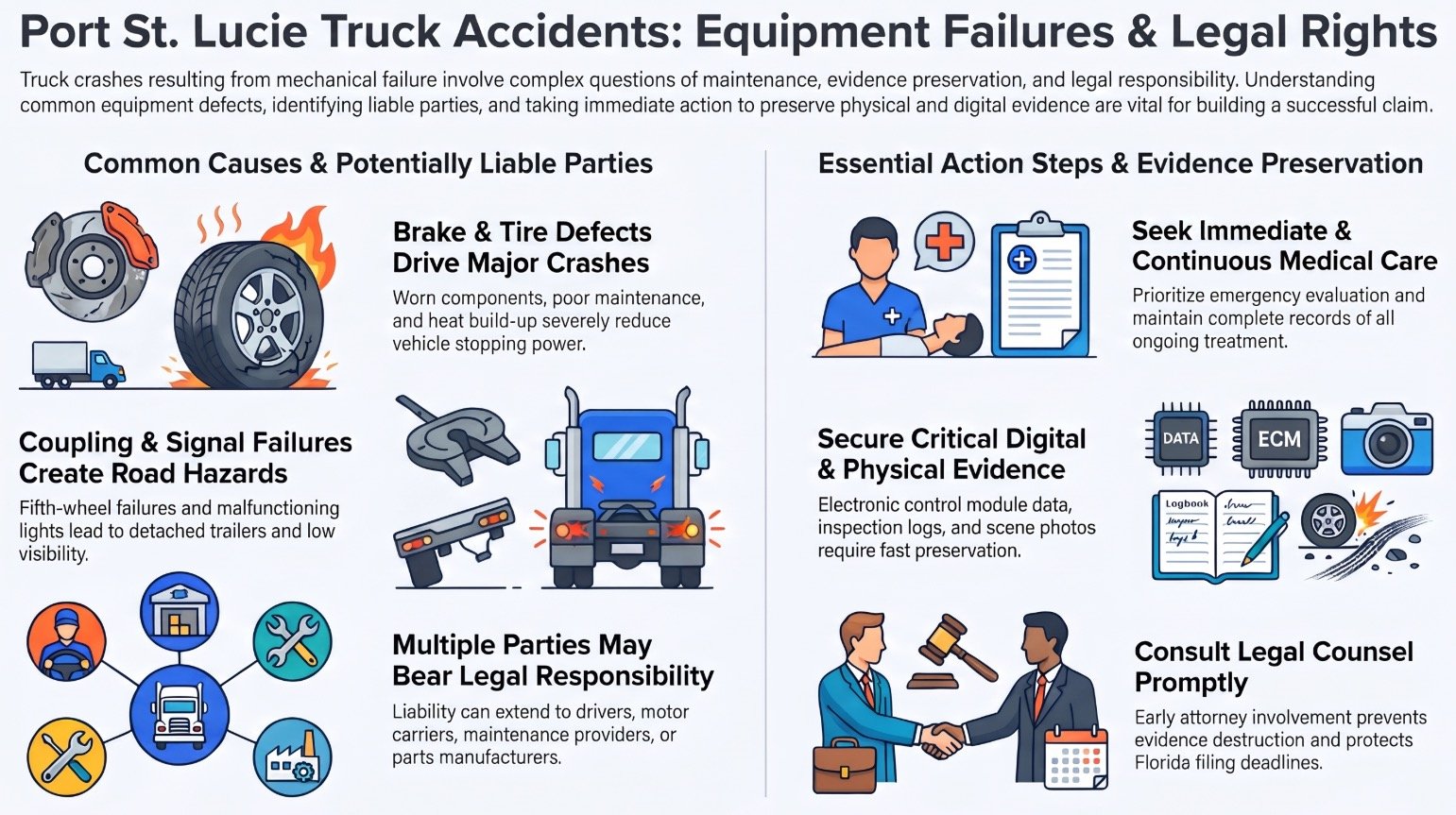
A Port St. Lucie truck accident equipment failures lawyer from The Law Offices of Anidjar and Levine can investigate whether faulty brakes, damaged tires, coupling problems, or poor maintenance contributed to a crash. The investigation may examine the truck, maintenance and inspection records, electronic data, loading practices, and witness accounts to identify potentially responsible parties. Injured people may pursue compensation for medical care, lost income, rehabilitation, and other documented losses. Prompt evidence preservation matters. Learn more from a Port St. Lucie Personal Injury Lawyer.
Main Takeaways
- A Port St. Lucie truck accident lawyer can investigate whether faulty equipment or neglected maintenance contributed to a crash.
- Potential failures include defective brakes, blown tires, broken lights, damaged suspension, or improperly secured trailer couplings.
- Evidence may include maintenance records, inspection logs, repair invoices, photographs, witness accounts, and available electronic data.
- Responsibility may involve the driver, motor carrier, vehicle owner, maintenance provider, or equipment manufacturer, depending on the evidence.
- Seek medical care first, preserve relevant records, and consult a lawyer promptly about evidence preservation and legal options.
How We Can Help With Your Port St. Lucie Truck Accident Equipment Failures Injury Claim
A truck accident involving defective or poorly maintained equipment can leave an injured person facing medical expenses, lost income, and uncertainty about who is responsible. A lawyer can help organize the claim, communicate with insurers, and explain available options in clear terms. This support allows the injured person to focus on treatment while important deadlines and requests receive attention.
The legal team can gather records, coordinate with relevant professionals, and document how the injuries affect daily life and work. It can also assess settlement proposals and advise whether they reasonably address the documented losses. Throughout the process, the Claim timeline should be explained, including crucial steps, expected decisions, and potential delays, so the client can make informed choices.


Practical guidance can also help relatives understand how to assist without taking control of the injured person’s decisions. Family support may ease the burden of appointments, paperwork, and recovery needs. With consistent communication and careful preparation, counsel can pursue a fair resolution while treating the client and family with respect.
Don’t Wait. Call Our Florida Personal Injury Lawyers Now!
Understanding Port St. Lucie Truck Accident Equipment Failure Injury Cases
OUR CONSULTATIONSARE FREE
START YOUR FREE CASE REVIEW

When a truck’s brakes, tires, lights, guiding components, or other safety equipment fail, the resulting crash may raise questions about maintenance, inspection, and responsibility. An equipment malfunction can cause serious injuries and disrupt the lives of drivers, passengers, and families. Understanding these cases requires examining how the failure relates to the collision and whether a responsible party had a duty to prevent the harm.
Potentially responsible parties may include a trucking company, vehicle owner, maintenance provider, or equipment manufacturer. Evidence may help establish who controlled the truck, what inspections were performed, and whether the failed component met applicable safety standards. Records, physical evidence, and qualified technical analysis can clarify how the failure occurred and whether mechanical negligence contributed to the crash.
In Port St. Lucie, injured people may seek compensation for medical care, lost income, and other documented losses. A careful review can support accountability while helping affected individuals and families understand their legal options and make informed decisions during recovery.
Common Causes of Port St. Lucie Truck Accident Equipment Failures


Common equipment failures in Port St. Lucie truck accidents include defective brake systems and tire blowouts, both of which can impair a driver’s ability to control or stop a vehicle. Faulty trailer couplings may cause a trailer to separate or shift, creating hazards for nearby traffic. Malfunctioning lights and signals can also reduce visibility or prevent drivers from communicating their actions to others on the road.
Brake System Defects
Brake system defects can prevent a commercial truck from slowing or stopping safely, turning a routine traffic situation into a serious collision risk on Port St. Lucie roads. Worn brake components, poor adjustment, and inadequate maintenance may reduce stopping power, especially when a truck carries a heavy load or travels through frequent traffic. Brake fade can develop when repeated braking causes excessive heat, leaving the system less responsive when the driver needs it most. Hydraulic leaks may also weaken braking pressure, while damaged lines or faulty valves can interfere with reliable operation. These failures can place nearby motorists, passengers, and pedestrians at risk. Inspection records, repair histories, and maintenance practices may help identify whether a defect contributed to a crash and support accountability for those affected.
Tire Blowouts
A truck tire blowout can cause a driver to lose control, particularly at highway speeds or while carrying a heavy load. Tire failures may result from underinflation, excessive heat, overloading, worn tread, or damage from road hazards. Tire tread separation can also occur when a tire is defective or poorly maintained, causing a sudden loss of stability and debris that endangers nearby motorists.
Carriers and drivers can reduce these risks through regular inspections and blowout-prevention practices. They should check tire pressure, tread depth, sidewalls, and load limits before trips, and remove damaged tires from service promptly. Maintenance records may help establish whether required checks were performed. When a blowout contributes to a Port St. Lucie truck crash, investigators may examine the tire, vehicle condition, inspection history, and loading practices to identify contributing failures and support affected road users.
Faulty Trailer Couplings
Faulty trailer couplings can cause a trailer to detach or shift unexpectedly, putting nearby motorists at risk. Coupling separation may occur when a locking mechanism is worn, improperly engaged, or damaged. A fifth wheel failure can also interrupt the connection between a tractor and trailer, causing the trailer to swing or break free. These failures may result from inadequate inspections, poor maintenance, defective parts, or incorrect coupling procedures. Drivers and motor carriers have a responsibility to confirm that coupling equipment is secure and in serviceable condition before travel. Regular checks can identify worn components and keep unsafe equipment off public roads. After a crash, investigators may examine maintenance records, inspection practices, and the coupling assembly to determine how the failure occurred. Establishing the cause can help clarify responsibility and support safer trucking practices.
Lighting and Signal Failures
Truck lighting and signal failures can make large commercial vehicles difficult to see or understand, increasing the risk of collisions on Port St. Lucie roads. Headlight malfunctions may reduce a driver’s ability to identify hazards at night or in poor weather, while failed brake lights can prevent following motorists from recognizing that a truck is slowing. Turn signal defects may leave nearby drivers uncertain about lane changes or turns, creating dangerous conflicts at intersections and highway exits. These problems can result from damaged wiring, worn bulbs, inadequate maintenance, or defective components. Commercial carriers and drivers must inspect required lighting systems and address known defects before a trip. After a crash, maintenance records, inspection reports, and vehicle evidence may help determine whether a lighting or signal failure contributed to the collision.
Legal Rights of Port St. Lucie Truck Accident Equipment Failure Injury Victims
When defective brakes, tires, or other truck equipment contribute to a crash, injured people in Port St. Lucie may have Legal Rights to seek compensation from parties whose negligence or product defects caused their losses. Victim Protections include access to legal counsel, fair treatment by insurers, and the ability to pursue a claim without surrendering control of medical decisions. A careful review can help identify available remedies and preserve evidence.
- Compensation: Eligible claimants may seek payment for medical care, lost income, rehabilitation, and pain and suffering.
- Responsible parties: A claim may involve a trucking company, equipment manufacturer, maintenance provider, or another legally responsible party.
- Evidence and deadlines: Records, inspection reports, and witness accounts can support a claim; Florida filing deadlines may limit when a lawsuit can begin.
- Fair process: Injured people may review settlement offers, request documentation, and decline terms that do not adequately address their losses.
Prompt legal guidance can help protect a claim while supporting an informed, orderly recovery.
Why Do Port St. Lucie Truck Accident Equipment Failures Injuries Happen?
Understanding why equipment failures occur can help clarify how responsibility is established after a Port St. Lucie truck accident. These incidents may result from worn brakes, defective tires, directional control problems, or damaged suspension components. When a carrier or maintenance provider skips inspections or delays necessary repairs, a truck may become unsafe to operate. Manufacturing defects can also cause a part to fail despite reasonable maintenance.
Other conditions can increase crash risk. Improperly secured loads may shift during travel, creating cargo instability that affects balance and control. Faulty tie-downs, overloaded trailers, or uneven weight distribution can contribute to rollovers and falling cargo. Poorly maintained lights or reflective equipment may reduce visibility, while mechanical breakdowns can leave a truck stopped in traffic and create roadway hazards.
Injuries often occur when these failures cause a collision, force another driver to swerve, or expose people nearby to debris. Identifying the failure’s cause helps determine which parties may bear responsibility for resulting harm.
What Should You Do After a Port St. Lucie Truck Accident Equipment Failure Injury?
After a truck accident involving equipment failure, an injured person should seek prompt medical care, even if symptoms seem minor at first. When safe, they should document the suspected failure by photographing the equipment and preserving relevant records. A truck accident lawyer can help clarify your options and protect evidence related to the incident.
Seek Medical Care
Anyone injured in a Port St. Lucie truck accident involving equipment failure should seek medical care promptly, even if symptoms appear minor. The force of a collision can cause injuries that aren’t immediately apparent, and timely evaluation helps identify conditions that need attention. If the person has severe pain, difficulty breathing, bleeding, confusion, or another urgent symptom, Emergency Treatment should take priority. Emergency responders can assess the situation and arrange transport to an appropriate facility. For less urgent concerns, a physician or urgent care provider can evaluate the injury and recommend treatment. Follow Up Care is also important, since some symptoms may develop or worsen after the initial examination. Keeping scheduled appointments and following medical instructions supports recovery and helps providers monitor changes. Medical needs should remain the primary concern after a collision.
Document Equipment Failures
Once immediate medical needs have been addressed, documenting suspected equipment failures can help preserve information about how the Port St. Lucie collision occurred. If it is safe, injured people or witnesses can photograph the truck, its tires, brakes, lights, coupling devices, cargo, and visible damage. Images should show both close details and the vehicle’s overall position, without disturbing parts or entering hazardous areas. You may also record witness names and contact information, the date, location, weather, and observations about unusual sounds or handling. Medical records and official incident documents can help establish the timeline. Equipment Preservation is important because damaged components may be repaired, moved, or discarded. Avoid touching or removing suspected defective parts. Accurate records can support later Failure Reconstruction and help clarify whether a mechanical problem contributed to the injury.
Contact a Truck Accident Lawyer
When should an injured person contact a truck accident lawyer after a Port St. Lucie truck accident involving equipment failure? Promptly, once urgent medical needs are addressed. Early legal guidance can help preserve vehicle components, maintenance records, inspection reports, and electronic data before they change or are lost. A lawyer can also identify potentially responsible parties, including the driver, carrier, maintenance provider, or equipment manufacturer, and explain how deadlines may affect a claim.
The injured person should gather available photographs, witness details, medical records, and insurance communications, and avoid speculating about fault. A Free consultation can provide an opportunity to discuss the incident, potential evidence, and possible next steps without an initial fee. Before choosing counsel, the person should review attorney credentials, relevant truck accident experience, and the proposed fee arrangement. Timely, informed action can support accountability and protect the injured person’s ability to seek compensation.
Critical Evidence in a Port St. Lucie Truck Accident Equipment Failures Injury Case
Establishing how an equipment failure contributed to a truck accident requires timely collection and careful review of reliable evidence.
Crucial materials may include:
- Maintenance and repair records
- Electronic control module data
- Inspection and recall documents
- Photographs and witness statements
Together, these records can help clarify the equipment’s condition, the events surrounding the collision, and whether warning signs were overlooked.
Maintenance and Repair Records
Maintenance and repair records can reveal whether a truck’s equipment failure resulted from a sudden defect or from known, reported, or unaddressed problems. These documents may include inspection checklists, driver defect reports, work orders, repair invoices, and parts replacement histories. Collectively, they can show when a concern was identified, what action followed, and whether the repair addressed the reported condition. Record retention practices also matter because missing or incomplete files may limit the ability to determine how a vehicle was maintained before a collision. Investigators may compare records from the carrier, repair facilities, and parts suppliers to identify inconsistencies or recurring failures. Preserving these materials can support a reliable review of responsibility and help injured people pursue fair treatment while protecting others from preventable equipment hazards.
Electronic Control Module Data
Alongside maintenance and repair records, electronic control module (ECM) data can help explain how a truck operated before and during a collision. Depending on the truck’s equipment, the module may record speed, braking, engine activity, and other vehicle information. This evidence can help clarify whether a mechanical problem affected the driver’s ability to respond or contributed to the crash.
Prompt ECM data retrieval can matter because recorded information may be overwritten, lost, or altered as a vehicle continues operating. Qualified professionals can preserve the data and analyze the event recorder to interpret relevant readings in context. The findings may support a clearer account of the collision and help identify safety concerns that could affect others on the road. Because access and interpretation can involve technical and legal issues, careful handling helps protect the evidence’s reliability.
Inspection and Recall Documents
When a truck’s equipment may have failed, inspection and recall documents can help show whether the defect was identified, reported, or addressed before the collision. These records may include routine inspection logs, repair orders, maintenance histories, and communications between the carrier, driver, and service providers. They can reveal recurring problems, delayed repairs, or a component returned to service despite unresolved concerns. Recall notices may show that a manufacturer warned of a safety issue and explain the recommended corrective action. Comparing the notice with service records can help determine whether the truck received the required repair before it was operated. Preserving these documents promptly matters because records may be altered, lost, or routinely discarded. A careful review can clarify responsibility and support efforts to secure fair compensation for injured people and their families.
Photographs and Witness Statements
Photographs and witness statements can provide a direct account of equipment conditions and events surrounding a Port St. Lucie truck accident. Images may document damaged brakes, failed tires, broken lights, leaking components, roadway marks, and vehicle positions before repairs or cleanup alter the scene. Photo preservation should include original files, timestamps, and available metadata, with copies stored securely and edits avoided. Investigators may also photograph inspection labels, warning indicators, cargo, and visible defects from multiple angles.
Witness recollections can help establish what occurred before, during, and after the collision. Drivers, passengers, nearby motorists, and responders may describe unusual sounds, equipment behavior, speed, or actions taken after impact. Prompt, respectful interviews can preserve details while memories remain clear. Comparing these accounts with photographs and maintenance records may help clarify how a failure contributed to injuries and support a careful, evidence-based evaluation.
Long-Term Effects of Port St. Lucie Truck Accident Equipment Failures Injuries
Injuries caused by truck equipment failures may have lasting effects that continue well beyond initial treatment. Chronic pain and mobility limitations can interfere with daily activities, independence, and work. Emotional trauma may also persist, affecting a person’s well-being and recovery.
Chronic Pain
Chronic pain can persist long after a Port St. Lucie truck accident caused by equipment failure, even when initial injuries appear to have recovered. Damaged nerves, fractures, and soft-tissue injuries may produce ongoing pain that affects concentration, mood, and daily responsibilities. Symptoms can vary in intensity, making consistent medical evaluation important. A treating provider may recommend Pain management through medication, physical therapy, counseling, or other evidence-based approaches, depending on the diagnosis and individual needs. Keeping records of symptoms, treatment, and changes in daily functioning can help providers assess progress and coordinate care. Sleep disruption is also common when pain worsens at night, potentially increasing fatigue and emotional strain. Timely support can help injured people maintain stability and participate in family, work, and community life while managing long-term effects responsibly.
Mobility Limitations
When a Port St. Lucie truck accident involves equipment failure, resulting injuries may limit a person’s ability to walk, stand, or manage routine tasks. Spinal, pelvic, or leg injuries can require extended rehabilitation and ongoing assistance. These restrictions may affect employment, household responsibilities, and access to medical care, particularly when a home or workplace is not designed for changing physical needs.
Practical adjustments can help preserve independence and support daily participation. Wheelchair Accessibility may require ramps, wider doorways, modified bathrooms, or safer entryways. Adaptive Transportation can enable injured individuals to attend appointments, return to work, and maintain vital community connections. Caregivers and service providers may need to coordinate these arrangements as recovery progresses. Documenting mobility needs, treatment recommendations, and related expenses can clarify the long-term support required after a serious collision.
Emotional Trauma
After a Port St. Lucie truck accident caused by equipment failure, emotional trauma may persist long after physical injuries receive treatment. Survivors can experience anxiety, depression, sleep disruption, or post-traumatic stress that interferes with work, relationships, and daily responsibilities. Emotional triggers may include truck noise, traffic, medical appointments, or reminders of the collision. These reactions are not signs of weakness; they can reflect the lasting effects of a frightening event and serious injury.
Consistent care can help survivors regain stability and participate in family and community life. Mental health professionals may recommend counseling, medical evaluation, or coping strategies suited to each person’s needs. Support from relatives, caregivers, and colleagues can also reduce isolation while respecting the survivor’s pace. Documenting symptoms and treatment may clarify the injury’s ongoing effects and support informed decisions about recovery and legal claims.
Don’t Wait. Call Our Florida Personal Injury Lawyers Now!
Proving Liability in Port St. Lucie Truck Accident Equipment Failure Injury Cases
Proving liability in a Port St. Lucie truck accident equipment failure case requires evidence connecting a defect or maintenance lapse to the collision and resulting injuries. Investigators may examine the truck, failed component, maintenance records, inspection logs, repair invoices, and driver reports. These materials can help establish whether a responsible party knew, or reasonably should have known, about a dangerous condition.
Potentially responsible parties may include the driver, motor carrier, maintenance provider, parts manufacturer, or another entity that controlled the equipment. Their duties depend on applicable liability standards and the facts of the case. Evidence must show that a party breached a duty and that the breach contributed to the harm.
Expert testimony can explain how a component failed, whether inspections or repairs met accepted practices, and how the failure affected vehicle control. Prompt preservation of the truck and related records may be important because evidence can change or disappear. Careful documentation supports a fair assessment of responsibility and helps injured people pursue accountability.
Dealing With Insurance Companies After a Port St. Lucie Truck Accident Equipment Failure Injury
Insurance companies may contact injured people soon after a Port St. Lucie truck accident involving equipment failure. Their representatives may request details about the collision, injuries, and treatment while the injured person is still recovering. Careful communication can help protect the person’s interests without delaying reasonable cooperation.
Before providing Recorded Statements, an injured person may benefit from understanding how the statement could be used and whether it is required. Answer questions accurately, but avoid speculation about the cause of a mechanical failure or the extent of future medical needs, as it can create confusion. Preserve relevant records, including repair documents and medical bills, and share them through appropriate channels.
An insurer may also discuss Policy Limits, which can affect the potential sources of compensation. Those limits do not necessarily reflect the full value of an injury or the available coverage. A person seeking to support family or community responsibilities should review proposed communications carefully and avoid signing releases before understanding their scope.
What to Expect During a Port St. Lucie Truck Accident Equipment Failures Injury Claim Process
A truck equipment failure injury claim typically begins with an initial case evaluation to review the accident, injuries, and available records. Evidence collection and liability assessment then help establish how the failure occurred and which parties may be responsible. The claim may conclude through settlement negotiations or, if necessary, litigation.
Initial Case Evaluation
During an initial case evaluation, a Port St. Lucie truck accident equipment failures lawyer reviews the collision circumstances and the injured person’s account. The discussion may cover the equipment involved, reported symptoms, medical care received, and how the injury affects daily responsibilities. This early review helps clarify the person’s goals and identify questions that require further attention.
Claim viability depends on whether the available information supports a legally recognized injury claim and whether filing deadlines or other procedural concerns may apply. Liability screening considers potential responsibility, including whether a truck operator, carrier, maintenance provider, or equipment manufacturer may warrant review. The lawyer can explain possible legal options, expected claim stages, and practical considerations without promising an outcome. This evaluation also gives the injured person an opportunity to ask questions and make informed decisions about seeking accountability.
Evidence Collection
What evidence can establish that a truck equipment failure contributed to a collision? Investigators may examine the vehicle, damaged components, maintenance records, inspection reports, and electronic data. Photographs, measurements, and witness accounts can document the scene and preserve details that might otherwise be lost. Scene preservation is important because vehicles may be repaired, moved, or released before a claim is resolved. When possible, qualified professionals should inspect relevant parts and record their condition without altering them. Records from the trucking company, repair facilities, and equipment manufacturers may also help clarify the truck’s history. A careful chain custody for physical and digital materials supports their reliability and helps prevent questions about handling. Prompt, organized evidence collection allows injured people and their representatives to present a clear account of the event and its effects.
Liability Assessment
When a truck equipment failure may have contributed to a collision, liability assessment focuses on identifying which parties had responsibility for the defective component, its inspection, or its maintenance. Investigators may examine service records, inspection reports, repair invoices, and applicable safety requirements to determine whether a driver, motor carrier, maintenance provider, or manufacturer failed to meet a duty of care. The assessment also considers how each act or omission contributed to the crash and resulting injuries. In some cases, third-party liability may apply when a repair shop, parts supplier, or equipment maker played a role. Comparative negligence may also be relevant if the injured person’s conduct is alleged to have contributed to the incident. A careful, evidence-based review helps clarify each party’s potential responsibility and supports a fair evaluation of the injury claim.
Claim Resolution
After assessing liability, the claim resolution process focuses on documenting the injuries, losses, and evidence linking the equipment failure to the collision. Medical records, repair reports, employment information, and witness statements can help establish the full impact of the crash. The insurer may review maintenance logs, inspection records, and vehicle data before evaluating responsibility and damages. Settlement timelines vary according to injury severity, evidence availability, and the number of parties involved. A prompt offer may not account for future treatment or lasting work limitations, so the injured person should carefully assess their needs before accepting compensation. Review any proposed agreement for release terms, including whether it ends all claims related to the collision. If negotiations do not produce a fair resolution, filing a lawsuit may preserve the opportunity to seek compensation through court proceedings.
Compensation for Port St. Lucie Truck Accident Equipment Failure Injury Damages
Compensation for injuries caused by truck equipment failures may include payment for medical care, lost income, reduced earning capacity, and pain and suffering. In Port St. Lucie, the amount available depends on the injuries, their effects, and the evidence connecting them to the equipment failure. Healthcare provider records can document treatment, rehabilitation, medication, and anticipated Future care. Pay statements, employer records, and work restrictions may help establish Lost wages and explain how an injury affects a person’s ability to return to work.
A claim may also address lasting limitations, needed assistance with daily activities, and the physical discomfort or emotional strain associated with recovery. The injured person’s needs should remain central, particularly when the harm affects family responsibilities or the capacity to contribute at work and in the community. Preserve documentation, including medical records, repair and inspection information, and proof of expenses. A careful assessment can help guarantee that requested compensation reflects the injury’s practical consequences and supports appropriate recovery.
Economic vs Non-Economic Damages in Port St. Lucie Truck Accident Equipment Failures Cases
Damages in truck accident equipment failure cases may include economic losses, such as medical expenses, lost income, and future care costs. Non-economic damages may address pain, emotional distress, and reduced quality of life. To establish both categories, you must provide evidence linking the losses and harm to the equipment failure and resulting collision.
Economic Losses
A truck equipment failure can create both immediate financial costs and lasting personal harm for people injured in a Port St. Lucie collision. Economic losses are measurable expenses and income reductions linked to the crash. They may include emergency care, surgery, rehabilitation, prescription medication, medical equipment, and future treatment recommended by qualified providers. Repair or replacement costs for a damaged vehicle and other property may also be recoverable with supporting evidence. Lost wages can reflect time missed during treatment and recovery, while diminished earning capacity may apply when lasting injuries limit a person’s ability to work or advance professionally. Pay records, invoices, medical documentation, and employer statements can help establish these losses. Careful documentation allows an injured person and their representatives to present a clear, evidence-based account of financial harm.
Non-Economic Harm
Beyond measurable financial losses, a truck equipment failure may cause substantial non-economic harm that affects an injured person’s daily life. These damages address personal consequences that do not have a direct price, including physical pain, emotional distress, and reduced independence. A person may experience anxiety, sleep disruption, or lasting fear of travel after a serious collision. Loss of enjoyment can arise when injuries prevent participation in hobbies, family activities, or community service that once provided purpose and connection. Damaged relationships may also result when pain, stress, or changed responsibilities affect communication and shared routines with loved ones. Unlike medical bills or lost wages, these harms are not measured by invoices. Their recognition reflects the broader impact of an equipment-related crash on a person’s well-being, dignity, and ability to remain engaged with others.
Proving Damages
When a truck’s defective or poorly maintained equipment contributes to a collision, proving damages requires evidence that connects the crash to the injured person’s losses. Economic damages include measurable costs such as treatment, rehabilitation, lost wages, and reduced future earning capacity. Medical expense documentation, including invoices, treatment records, and physician assessments, can show the care required and its relationship to the collision. Employment records and expert evaluations may help establish income lost during recovery and the effect of lasting limitations on future work.
Non-economic damages address less readily measured harm, including pain, emotional distress, and loss of daily activities. Consistent medical records and accounts from the injured person, family members, or coworkers can support these claims. Evidence of the equipment failure and resulting impact helps clarify responsibility, while careful documentation allows decision-makers to assess the full extent of harm.
When a Port St. Lucie Truck Accident Equipment Failures Injury Case Goes to Trial vs Settlement
Whether a Port St. Lucie truck accident equipment failure injury case goes to trial or settles depends on the evidence, the parties’ positions, and the injured person’s needs. Settlement negotiations may provide a more predictable path to compensation and avoid the time and uncertainty of a courtroom. A negotiated resolution can also allow the injured person to focus on recovery and maintain the ability to support family or community responsibilities.
Trial may become necessary when the parties dispute responsibility, the extent of the harm, or the value of a claim. At trial, each side presents evidence and arguments, and a judge or jury makes the decision. Jury deliberations can take time, and a verdict is not guaranteed to match either side’s expectations. Preparation may involve reviewing maintenance records, inspection reports, and testimony about the failed equipment. An attorney can assess the available proof, explain potential outcomes, and help the injured person weigh resolution options without promising a particular result.
Don’t Wait. Call Our Florida Personal Injury Lawyers Now!
Florida Laws That May Affect Your Port St. Lucie Truck Accident Equipment Failure Case
Florida law can shape a Port St. Lucie truck equipment failure claim by defining responsibility, evidence, and available compensation. Applicable rules may include state negligence principles and Federal regulations governing commercial vehicles. Their interaction can help clarify which parties must answer for unsafe equipment and related harm.
- Comparative negligence: Florida generally reduces a claimant’s damages according to that person’s share of fault. A finding that the claimant bears more than half the responsibility may bar recovery in a negligence action.
- Maintenance duties: Trucking companies and owners must follow applicable inspection and repair requirements. Maintenance records can help establish whether a defect was identified, ignored, or improperly corrected.
- Federal regulations: Rules addressing brakes, tires, lighting, and vehicle inspections may provide relevant safety standards. A violation can support a claim, though it does not automatically establish liability.
- Product liability: If a defective component contributed to the collision, a manufacturer, distributor, or seller may also face responsibility under Florida law.
A careful review can support accountability and protect others from preventable equipment-related crashes.
The Statute of Limitations for Port St. Lucie Truck Accident Equipment Failure Injury Cases
Because filing deadlines can determine whether an injury claim proceeds, the statute of limitations is a critical issue in a Port St. Lucie truck accident equipment failure case. Florida law generally gives an injured person two years from the date of an accident to file a negligence lawsuit. A wrongful death claim generally must be filed within two years of the death. Missing the applicable deadline can prevent a court from considering the claim, regardless of the seriousness of the harm.
Filing deadlines may vary when a government entity is involved or when other legal circumstances affect the case. Equipment defects may also go undiscovered for a long time. Discovery rules can affect when a limitations period begins in certain claims, but they do not automatically extend the deadline. The applicable rule depends on the claim and its facts. Preserving records and identifying when you learned of an injury and its possible cause can help clarify timing. Prompt attention to deadlines supports fair claim consideration and accountability for preventable harm.
How a Port St. Lucie Truck Accident Equipment Failures Lawyer Can Help You
When a truck’s brakes, tires, control system, or other equipment fail, determining how the failure occurred can require careful investigation. A Port St. Lucie truck accident equipment failures lawyer can help identify responsible parties and organize evidence while protecting the injured person’s interests.
The work may include:
- Reviewing maintenance records, inspection reports, and repair histories to assess whether required care was provided.
- Preserving physical evidence and coordinating qualified experts to examine failed components and explain their role in the collision.
- Evaluating whether the driver, motor carrier, maintenance provider, manufacturer, or another party may bear responsibility.
- Documenting medical expenses, lost income, and other losses to support a fair claim and inform negotiations.
An Attorney consultation can clarify available legal options and the information needed to assess the matter. Counsel can develop a case strategy suited to the evidence, applicable law, and the client’s needs. By managing communications and presenting supported claims, a lawyer may help clients focus on recovery and maintain stability for their families and community.
When to Contact a Port St. Lucie Truck Accident Equipment Failures Lawyer
Prompt legal guidance may help preserve evidence after a suspected truck equipment failure, particularly if the vehicle or a failed component could be repaired, moved, or discarded. A person injured in a Port St. Lucie collision may consider contacting a lawyer once immediate medical needs are addressed and the circumstances suggest a mechanical defect, such as brake, tire, steering, or lighting failure. Early consultation can help identify time-sensitive records and physical evidence before routine repairs or disposal make them harder to examine.
Contact may also be appropriate when the trucking company, insurer, or repair provider requests a statement, inspection, or document signature. A lawyer can explain the implications of those requests without interfering with medical care or official investigations. Legal deadlines may limit the time available to bring a claim, and the applicable period can depend on the facts and parties involved. Because delays can affect both evidence and legal options, prompt attention may also support accountability and safer practices for other road users.
Why You Need an Experienced Port St. Lucie Truck Accident Equipment Failures Lawyer
An experienced Port St. Lucie truck accident equipment failures lawyer can help injured people and families pursue accountability while protecting their ability to recover. Equipment-related crashes may involve defective brakes, tires, steering systems, or maintenance practices, and identifying the cause often requires prompt investigation. A lawyer can preserve records, obtain inspection and repair histories, and coordinate qualified experts to examine the truck and relevant components before evidence is lost or altered.
Technical knowledge matters because trucking cases can involve federal safety rules, manufacturer responsibilities, and complicated questions about how a failure contributed to a collision. Counsel can assess potential claims against drivers, carriers, maintenance providers, or manufacturers and explain how each party’s conduct may affect the case. Local counsel may also understand St. Lucie County procedures and the practical needs of people seeking treatment, income stability, and household support. By managing legal demands and communicating with insurers, an experienced lawyer can help clients focus on recovery and informed decisions.
How to Choose the Right Port St. Lucie Truck Accident Equipment Failures Lawyer for Your Case
Choosing the right Port St. Lucie truck accident equipment failures lawyer requires careful attention to experience, communication, and investigative resources. The attorney should understand how defective brakes, tires, steering systems, or other components can contribute to a collision and know how to preserve evidence before it is lost. Relevant case experience can help identify responsible parties, including a driver, carrier, maintenance provider, or manufacturer.
Review attorney credentials alongside the lawyer’s approach to client service. A prospective client can ask who will handle the case, how often the firm provides updates, and how the legal team evaluates technical evidence. Clear answers help families make informed decisions while managing the demands that follow a serious crash.
Fee arrangements should also be explained in writing, including any costs that may arise during the investigation. Comparing these terms and evaluating the attorney’s responsiveness can help injured people choose representation aligned with their needs and priorities.
About The Law Offices of Anidjar & Levine
For those evaluating legal representation, the Law Offices of Anidjar & Levine handles personal injury matters, including truck accident claims involving equipment failures. The firm represents people injured in collisions and families affected by serious losses. Its work may include investigating maintenance records, identifying potentially responsible parties, and communicating with insurers while clients focus on recovery and family responsibilities.
Firm history provides context for understanding the practice’s experience and service approach. The firm has represented injury clients in Florida for many years and handles cases involving a range of accident circumstances. Prospective clients can review its public information to understand the firm’s practice areas and procedures.
Attorney credentials are also relevant when evaluating counsel. Individuals may ask about a lawyer’s education, licensing, courtroom experience, and familiarity with commercial vehicle claims. Clear communication about case strategy, fees, and expected next steps can help clients make informed decisions. The firm’s role is to evaluate available evidence and pursue appropriate legal remedies, while each claim’s outcome depends on its specific facts and applicable law.

Frequently Asked Questions
What Types of Truck Equipment Failures Can Cause an Accident?
Truck accidents can result from failures in braking, steering, tires, lighting, or coupling systems. Brake failures may prevent a driver from slowing or stopping safely, while tire blowouts can cause sudden loss of control. Defective steering components may make a truck difficult to direct, and failed lights can reduce visibility or leave other road users unaware of its movements. Broken trailer connections can also cause cargo or equipment to detach, creating serious hazards.
Can a Truck Manufacturer Be Responsible for a Defective Part?
Yes. A truck manufacturer may face manufacturer liability when defective components cause a collision and resulting harm. Responsibility can arise if a part was improperly designed, manufactured, or accompanied by inadequate safety warnings. Investigators typically examine maintenance records, the failed component, and the vehicle’s history to determine the cause. Evidence must connect the defect to the crash, and applicable laws may affect who can pursue compensation and what remedies are available.
What if the Truck’s Maintenance Records Are Missing?
Missing truck maintenance records do not automatically establish fault, but they may complicate the investigation and raise questions about whether required inspections and repairs occurred. Investigators can seek records from the carrier, repair facilities, and drivers, then compare them with inspection reports, electronic data, and physical evidence. Strong maintenance recordkeeping supports accountability; missing documentation may warrant further review and, where legally appropriate, an adverse inference. An attorney can help preserve evidence and assess available remedies.
Can I Pursue a Claim if I Was a Passenger in the Truck?
Yes, a truck passenger may pursue a claim for injuries caused by negligent driving, unsafe equipment, or inadequate maintenance. Passenger Injury Rights generally allow recovery from a responsible driver, trucking company, vehicle owner, or other liable party, subject to evidence and applicable deadlines. Shared Fault Rules may affect compensation if the passenger’s own conduct contributed to the harm. Prompt medical care and preservation of relevant records can help protect the passenger’s interests and support a fair review.
How Are Truck Black Box Data and Diagnostic Codes Preserved?
Truck black box records and diagnostic codes are preserved through prompt, documented steps that prevent routine overwriting or alteration. Black Box Data Preservation may require securing the vehicle, identifying the event data recorder, and obtaining a qualified download before repairs or disposal. Diagnostic Code Preservation involves recording fault codes, freeze-frame information, and maintenance records before clearing or resetting systems. Counsel may send a formal preservation notice to the carrier and other responsible parties to support a reliable investigation and accountability.
—————————
Truck equipment failures can cause severe injuries, and determining responsibility may require careful investigation of maintenance records, inspection reports, and applicable safety requirements. Injured people in Port St. Lucie should preserve relevant evidence, document losses, and seek medical care promptly. The Law Offices of Anidjar and Levine can review the circumstances, explain legal options, and pursue compensation when the evidence supports it. Learn more from a Port St. Lucie Personal Injury Lawyer. A timely consultation can help protect important rights and clarify the next steps in a claim.