
The Law Offices of Anidjar and Levine can investigate how a truck accident occurred, identify potentially responsible drivers or companies, and pursue compensation for documented injuries and losses. A claim may include medical expenses, lost income, reduced earning capacity, pain and suffering, and reasonably anticipated future care. Evidence such as driver logs, maintenance records, photographs, and electronic data can help assess fault. Deadlines and shared responsibility may affect recovery; the following sections explain important considerations for victims and their families. Learn more from a Naples Personal Injury Lawyer.
Main Takeaways
- A Naples truck accident lawyer can review your crash, explain legal options, and help identify potentially responsible parties.
- Liability may involve a truck driver, carrier, vehicle owner, maintenance provider, cargo loader, or manufacturer.
- Evidence such as crash reports, driver logs, maintenance records, and truck data can help establish how the collision occurred.
- Claims may seek compensation for medical costs, lost income, reduced earning capacity, pain and suffering, and future care.
- Filing deadlines may apply; comparative negligence can reduce compensation but does not necessarily prevent recovery.
Don’t Wait. Call Our Florida Personal Injury Lawyers Now!
How We Can Help With Your Naples Truck Accident Claims & Liability Injury Claim
After a truck accident in Naples, an attorney can help injured people assess their legal options and pursue compensation from the parties responsible. The attorney provides attentive guidance while clients focus on medical care, family responsibilities, and recovery. A thorough Case Evaluation can clarify the scope of the client’s needs, identify available records, and establish practical priorities for moving forward.
The legal team can coordinate communication, organize relevant documents, and clearly explain important decisions. It can also help clients understand how proposed resolutions compare with their documented losses and future concerns. A considered Claim Strategy should reflect each person’s circumstances, goals, and need for dependable support, rather than follow a uniform approach. Throughout the process, the attorney can respond to questions, monitor developments, and help reduce avoidable stress. This service gives injured people a reliable point of contact and allows their concerns to receive careful attention. By offering informed, respectful assistance, counsel can help clients make decisions with greater confidence and pursue a fair outcome.
Understanding Naples Truck Accident Claims & Liability Injury Cases


Understanding a Naples truck accident claim starts with identifying how the collision occurred and who may bear legal responsibility. A careful review considers the injuries, available evidence, and the relationships among the driver, trucking company, vehicle owner, and other potentially responsible entities. Liability depends on the facts and applicable law, rather than the severity of the outcome alone.
OUR CONSULTATIONSARE FREE
START YOUR FREE CASE REVIEW

Commercial trucking regulations may shape the analysis by establishing duties for drivers and companies. Records such as inspection reports, electronic data, and delivery documents can help clarify whether those duties were met. Naples roadway risks may also affect how an incident is evaluated, including traffic conditions and the location of the collision.
A claim generally seeks compensation for documented losses, including medical care, lost income, and ongoing needs. Prompt evidence preservation supports an accurate assessment and reduces uncertainty. A lawyer can explain procedural requirements, communicate with insurers, and help injured people pursue a fair resolution while respecting others’ needs.
Common Causes of Naples Truck Accident Claims & Liability


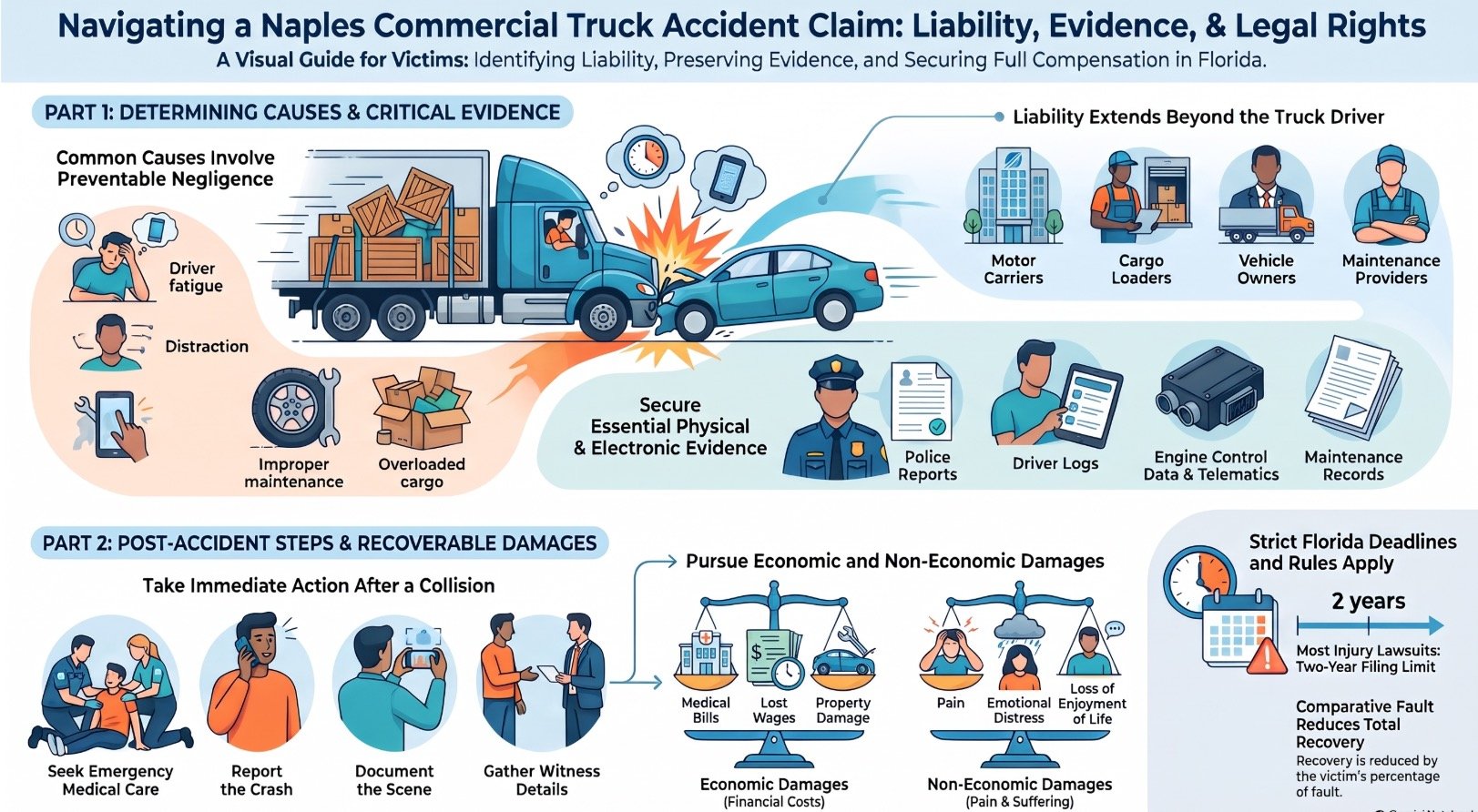
Common causes of truck accident claims in Naples include driver fatigue and distracted driving, both of which can impair a driver’s ability to respond safely to changing road conditions. Improper maintenance can also lead to mechanical failures, while overloaded cargo can reduce a truck’s stability and increase stopping distance. Identifying the cause is an important step in determining liability.
Driver Fatigue
Driver fatigue can impair a truck driver’s attention, judgment, and reaction time, increasing the risk of a serious collision on Naples roads. Long shifts, overnight routes, and inadequate rest can leave commercial drivers less able to respond safely to changing traffic conditions. Circadian disruption, which occurs when work schedules conflict with natural sleep patterns, may further reduce alertness. Federal hours-of-service rules limit driving time and require rest periods, but violations or poor scheduling can still contribute to fatigue-related crashes.
Trucking companies may be responsible for monitoring schedules, maintaining accurate records, and supporting appropriate fatigue detection. After a collision, investigators may review driver logs, dispatch records, and other evidence to determine whether fatigue or inadequate rest played a role. Establishing how the crash occurred can help injured people pursue accountability and protect others sharing Naples roads.
Distracted Driving
When a truck driver’s attention shifts from the road, even briefly, the vehicle may travel a significant distance before the driver can react. Distracted driving can involve visual, manual, or cognitive distractions, each of which may reduce a driver’s ability to identify hazards and respond safely. In Naples, common examples include texting, handling navigation devices, eating, or reaching for items inside the cab. Hands-free violations may also create risk when a driver uses a phone in a way prohibited by law or lets a conversation divert attention from traffic. Dashboard distractions, including complicated controls or alerts, can draw a driver’s eyes away from the roadway. After a collision, investigators may review phone records, witness statements, and vehicle data to determine whether distraction contributed to the crash and any resulting harm.
Improper Truck Maintenance
Because commercial trucks depend on properly functioning brakes, tires, lights, and control systems, inadequate maintenance can create serious hazards on Naples roads. Carriers and maintenance providers must keep vehicles safe for drivers and the public. Maintenance inspection failures may let defects go undetected, including worn brakes, damaged tires, faulty lights, or steering problems. When an essential component fails, a truck may be difficult to stop or control, increasing the risk of a collision. Inspection, repair, and service records can help establish whether required maintenance was performed and whether known problems were addressed. After a crash, investigators may examine these records and the vehicle’s condition to identify potential causes. Evidence of neglected repairs can be relevant to determining liability and supporting an injured person’s claim.
Overloaded Cargo
Overloaded cargo can make a commercial truck harder to control and increase collision forces on Naples roads. Excess weight can lengthen stopping distances, strain tires and brakes, and increase rollover risk, especially during sudden turns or emergency maneuvers. Improper weight distribution can shift a truck’s center of gravity or place excessive pressure on particular axles, affecting stability and directional control. Cargo securement also matters: loads that are not properly restrained may move or fall, creating hazards for nearby drivers and pedestrians. Federal and state rules limit truck weight and require safe loading practices. When a crash involves suspected overloading, investigators may review shipping records, scale tickets, inspection reports, and loading procedures. These details can help determine whether a carrier, driver, or loading company contributed to the collision.
Legal Rights of Naples Truck Accident Claims & Liability Injury Victims
Truck accident victims in Naples have legal rights that may allow them to seek compensation from parties whose negligence caused their injuries. Depending on the evidence, responsible parties may include a driver, trucking company, or another entity. A claim may address medical expenses, lost income, reduced earning capacity, and pain and suffering. Prompt legal guidance can help preserve records and protect a victim’s ability to pursue a fair recovery.
Victims may have the right to:
- Obtain crash reports, medical records, and photographs documenting the collision and injuries.
- Seek compensation for current treatment and reasonably anticipated future care.
- Challenge an insurer’s assessment when it understates losses or assigns unsupported fault.
Filing Deadlines can limit how long an injured person has to bring a claim, so delay may jeopardize legal options. Comparative Negligence rules may reduce compensation when a claimant shares responsibility, but they do not necessarily bar recovery. A careful review of evidence helps clarify potential liability and supports an accurate account of losses. Pursuing accountability can also encourage safer practices that protect other road users and the wider Naples community.
Why Do Naples Truck Accident Claims & Liability Injuries Happen?
When a commercial vehicle collision causes serious harm, the resulting claim often reflects a chain of preventable decisions rather than a single mistake. In Naples, truck crashes may stem from driver fatigue, distraction, speeding, or inadequate training. Tight delivery schedules can encourage unsafe choices, while poor vehicle maintenance may leave brakes, tires, or steering components unable to perform reliably.
Blind spot collisions occur when truck operators fail to check areas obscured by the vehicle’s size, particularly during lane changes or turns. Intersection hazards also arise when drivers misjudge stopping distances, ignore signals, or turn across the path of smaller vehicles. Other contributing factors may include improperly secured cargo, overloaded trailers, and unsafe road or weather conditions.
Responsibility can extend beyond the driver to a motor carrier, maintenance provider, cargo loader, or vehicle manufacturer. Identifying how these circumstances combined helps explain why an injury occurred and which parties may bear responsibility. Careful investigation can clarify preventable failures and support fair accountability for those harmed.
What Should You Do After a Naples Truck Accident Claims & Liability Injury?
After a Naples truck accident, injured individuals should first check for injuries and seek emergency medical care when needed. Report the crash to law enforcement, and those involved should provide accurate information without speculating about fault. Photographs, witness details, and relevant records can help preserve evidence for a later claim.
Check for Injuries
Immediately after a truck collision, check everyone involved for injuries, even if no one reports pain or visible symptoms. A calm, careful assessment can help protect passengers, other drivers, and bystanders while you arrange professional assistance. If anyone is unconscious, struggling to breathe, bleeding heavily, confused, or experiencing severe pain, these Emergency symptoms require immediate attention from emergency medical services. A person should avoid moving anyone who may have a head, neck, or spinal injury unless an immediate danger makes movement necessary. When it is safe, someone trained in first aid may provide basic care, such as applying pressure to serious bleeding, without exceeding their training. Others can offer reassurance, keep the injured person warm, and monitor changes in condition. Even seemingly minor symptoms should receive prompt medical evaluation.
Report the Crash
After assessing injured people and arranging emergency care, report the crash to law enforcement. A prompt report allows officers to address immediate hazards and establish an official account of the collision. If the scene is dangerous or anyone needs urgent help, someone at the scene should contact Emergency dispatch and provide the exact location, the number of vehicles involved, and any known injuries.
Those present should follow the dispatcher’s instructions and avoid entering active traffic or creating further risks. When officers arrive, involved parties can provide factual information and answer questions clearly. Accurate communication helps authorities assess road safety, manage traffic, and decide whether they need additional responders. A report may also document the event for later insurance or legal review. If officers cannot respond, the parties should ask how to file a report through the appropriate agency.
Preserve Evidence
What evidence can help explain how a truck accident occurred? Photographs of vehicle damage, road conditions, traffic signals, and visible injuries can document the scene before it changes. Witness names and contact information may help clarify what happened, while medical records can connect injuries to the collision. The injured person should retain repair estimates, receipts, and communications with insurers.
Evidence preservation also includes protecting electronic records. Commercial trucks may contain event data recorders, onboard cameras, and electronic logs that can capture speed, braking, and driver activity. A lawyer can promptly request that the trucking company preserve these materials, along with inspection and maintenance records. This step supports spoliation prevention because some information may be overwritten or discarded under routine policies. Careful documentation helps investigators assess responsibility and support a fair claim while respecting everyone affected.
Critical Evidence in a Naples Truck Accident Claims & Liability Injury Case
Key evidence can help establish how a Naples truck accident occurred and who may be responsible. Relevant records and accounts may include police reports, driver logs, vehicle data, and witness statements. Each source can offer a distinct view of what happened before, during, and after the collision.
- A police report documenting the scene, roadway conditions, and initial findings
- Driver logs and vehicle data showing work hours, speed, braking, or other operating details
- Witness statements describing the collision and its immediate aftermath
Police Reports
How can a police report affect a Naples truck accident claim? A responding officer’s report may preserve important details about the collision, including its location, the parties involved, witness statements, road conditions, and any citations issued. Insurers and attorneys may use these observations to assess liability, but the report does not determine fault by itself. Consequently, review its accuracy and completeness alongside photographs, medical records, and other available evidence.
Report access procedures vary by agency, and you may request a copy from the department that investigated the crash. If a report contains a factual error, report corrections may be requested through the appropriate agency process. Corrections are not guaranteed, and opinions or disputed conclusions may require separate supporting evidence. Prompt review helps injured people and those assisting them preserve reliable information and responsibly address inaccuracies.
Driver Logs
Driver logs can provide important evidence in a Naples truck accident claim by documenting a commercial driver’s hours, duty periods, and rest breaks. These records may help establish whether fatigue or excessive driving contributed to a collision. Federal rules generally limit driving hours and require qualifying rest periods, while electronic logging devices record duty status for many commercial drivers. Investigators can compare log entries with dispatch records, bills of lading, and other documents to identify inconsistencies. Potential logbook violations may indicate that a driver exceeded permitted hours, failed to record required breaks, or inaccurately reported time on duty. Preserving these records promptly is important because carriers may retain them for limited periods. Careful review can help clarify responsibility and support a fair claim for injured people and their families.
Vehicle Data
Vehicle data can help explain how a commercial truck was operated in the moments before and during a collision. Electronic systems may record speed, braking, acceleration, steering activity, and other vehicle functions. Engine Control modules can preserve information about engine performance and certain driving conditions, although the data available varies by truck model and system. Telematics Records may include location, speed, harsh braking events, and vehicle alerts transmitted through fleet technology. Collectively, these sources can help clarify whether the truck slowed, changed direction, or experienced a mechanical problem before impact. Their interpretation may require qualified technical analysis, and records should be preserved promptly because information can be overwritten or lost. In a claim, reliable vehicle data can support a careful assessment of liability and help establish the circumstances relevant to injured people’s recovery.
Witness Statements
Alongside electronic records, witness statements can provide an independent account of a Naples truck collision and the events leading up to it. Witnesses may describe traffic conditions, vehicle movements, warning signs, and actions taken after impact. Their observations can clarify disputed facts and help determine whether a driver or company failed to act with reasonable care. Witness credibility depends on factors such as visibility, distance, attention, consistency, and any relationship to those involved. Investigators may compare each account with physical evidence, vehicle data, and other testimony. Statement timing also matters. Prompt interviews may preserve accurate recollections before details fade or outside information influences memory. A careful record of each witness’s contact details and exact observations can support a fair assessment of responsibility, help injured people pursue appropriate compensation, and protect the interests of others affected.
Long-Term Effects of Naples Truck Accident Claims & Liability Injuries
Truck accident injuries may have lasting effects that continue well beyond initial treatment. Chronic pain and mobility limitations can interfere with daily activities, employment, and independence. Some individuals also experience ongoing emotional effects, including anxiety or distress related to the collision.
Chronic Pain
Chronic pain can persist long after a Naples truck accident, even when visible injuries have recovered. It may stem from damaged nerves, soft-tissue trauma, or other conditions that require continued medical attention. For injured people who support families, coworkers, or communities, persistent pain can complicate daily responsibilities and reduce their ability to serve others. Consistent evaluation helps providers identify changes, adjust treatment, and document the condition’s effects.
Pain management may involve medication, therapy, counseling, or coordinated care tailored to the patient’s needs. Treatment records can show how symptoms develop and whether the patient follows recommended care. Sleep disruption is also common, as discomfort can make it difficult to rest and may affect concentration or mood. These lasting effects may affect a truck accident claim, especially when medical evidence links them to the collision.
Lasting Mobility Limitations
When a Naples truck accident causes lasting mobility limitations, routine activities such as walking, climbing stairs, or standing for extended periods may become difficult. Spinal, joint, or limb injuries can restrict movement and make household tasks, employment, and community participation harder to manage. Recovery may require ongoing rehabilitation, adaptive equipment, or changes to a home or workplace. Assistive technology, including mobility devices and modified controls, can help an injured person maintain greater independence and continue contributing to family and community life. Accessible transportation may also be necessary for medical appointments, work, and necessary errands. In a truck accident claim, treatment records, functional limitations, and related expenses can help establish the long-term effects of these injuries. Legal counsel may assess available evidence and pursue compensation for documented future needs.
Ongoing Emotional Effects
Emotional effects may persist long after a Naples truck accident, even as physical injuries improve. Survivors may experience anxiety, sleep disruption, irritability, or difficulty concentrating, which can affect work, relationships, and daily responsibilities. Post-traumatic stress may involve intrusive memories, heightened alertness, or avoidance of roads and vehicles. Emotional triggers, such as heavy traffic, engine noise, or emergency sirens, can prompt distress and interfere with a person’s sense of safety.
These effects may emerge gradually and vary in severity. Family, community members, and qualified mental health professionals can support survivors in addressing symptoms and maintaining meaningful connections. Consistent care may also assist with recovery planning and communication about ongoing needs. When emotional injuries follow a collision, documenting symptoms and treatment can help clarify their impact during a liability claim and related discussions.
Don’t Wait. Call Our Florida Personal Injury Lawyers Now!
Proving Liability in Naples Truck Accident Claims & Liability Injury Cases
Proving liability in a Naples truck accident claim requires evidence that identifies how the crash occurred and who was legally responsible. Investigators may examine vehicle damage, roadway conditions, electronic data, photographs, and witness accounts to establish the sequence of events. Medical records can connect the collision to reported injuries and document the resulting harm.
Negligence standards generally require proof that a responsible party failed to use reasonable care and that this failure caused injury. Potentially liable parties may include a truck driver, a carrier, a maintenance provider, or another business whose conduct contributed to the crash. Corporate responsibility may arise when company policies, inadequate training, unsafe scheduling, or deficient vehicle maintenance played a role.
Applicable safety rules and records, such as driver logs and inspection reports, may help clarify whether required duties were met. Careful preservation and review of evidence can support a reliable account of responsibility and help protect injured people’s ability to pursue a fair legal resolution.
Dealing With Insurance Companies After a Naples Truck Accident Claims & Liability Injury
As evidence clarifies how a Naples truck accident occurred, injured people may need to deal with insurers representing the driver, carrier, or other potentially responsible parties. These insurers assess claims while protecting their policyholders’ financial interests, so approach their questions and requests carefully. A person may be asked to provide Recorded statements soon after a collision, before medical treatment and document review reveal the full extent of the harm. Responses given under stress can be incomplete or misunderstood, making it prudent to understand the purpose of a request before answering. Insurers may also seek medical authorizations or information about prior conditions. Relevant records can help establish the connection between the crash and resulting injuries, but broad disclosures may raise privacy concerns. Settlement pressure can arise when an early offer is presented before future care needs and lost income are clear. Careful review helps injured people make informed decisions while preserving resources needed for recovery and continued service to their families and communities.
What to Expect During a Naples Truck Accident Claims & Liability Injury Claim Process
A Naples truck accident claim typically begins with an initial case review, followed by collecting records, witness statements, and other relevant evidence. The available evidence is then assessed to determine liability and the potential value of the claim. Depending on the facts and the parties’ positions, the matter may resolve through settlement or proceed to trial.
Initial Case Review
During an initial case review, a Naples truck accident lawyer examines how the collision occurred, the injuries involved, and the evidence available to identify potential claims and responsible parties. This Initial Consultation gives the injured person an opportunity to explain immediate concerns, describe how the crash has affected daily responsibilities, and ask questions about the legal process. The lawyer may clarify the client’s goals, discuss relevant deadlines, and explain how Florida law may apply to the circumstances. A Case Evaluation considers the apparent severity of the harm, potential sources of liability, and the types of compensation that may be available. It also helps determine whether further investigation or legal action is appropriate. The review provides a structured starting point, allowing the client to make informed decisions while preserving the ability to pursue accountability and support recovery.
Evidence Collection
Once the initial review identifies potential claims and responsible parties, evidence collection helps establish how the truck crash occurred and what harm it caused. Counsel may request crash reports, witness statements, photographs, medical records, and available video footage. Scene photography can document vehicle positions, road conditions, traffic controls, visible damage, and other details that may change or disappear. Investigators may also seek truck-specific records, including electronic data, driver logs, inspection documents, and maintenance histories. Prompt preservation requests can help prevent relevant materials from being lost or altered. Record each item, store it securely, and handle it consistently to maintain a reliable Evidence chain. Medical documentation and expense records can show the injuries and losses requiring attention. Careful collection supports a thorough claim presentation and helps protect the interests of injured people and their families.
Liability Assessment
After reviewing the available evidence, liability assessment examines how the crash occurred and which parties may be legally responsible. Investigators and legal professionals compare witness accounts, vehicle data, inspection records, and applicable traffic rules to identify each party’s conduct. Negligence standards help determine whether a driver, trucking company, maintenance provider, cargo handler, or vehicle manufacturer failed to meet a legal duty and whether that failure contributed to the injuries. The assessment also considers whether company policies, hiring practices, or inadequate training played a role. Under comparative fault, courts may divide responsibility among multiple parties, and an injured person’s own actions may affect the claim. A careful, impartial review supports accountability and helps ensure all relevant causes are considered before the claim moves to the next stage.
Settlement or Trial
What happens next depends on the strength of the evidence, the extent of the injuries, and whether the parties can agree on responsibility and compensation. During negotiations, insurers may review crash reports, medical records, witness statements, and evidence of financial losses. Assess settlement offers against documented expenses, future care needs, lost income, and the impact of the injuries. A prompt offer may not reflect the claim’s full value, so careful review is important before acceptance.
If negotiations do not produce a fair resolution, the injured person may pursue a lawsuit. The case then proceeds through evidence exchange, pretrial preparation, and potentially a jury trial. A sound trial strategy addresses disputed liability, presents credible testimony, and clearly explains the damages. Throughout either path, informed decisions can help protect the claimant’s interests while supporting a fair outcome.
Compensation for Naples Truck Accident Claims & Liability Injury Damages
Compensation in a Naples truck accident claim may cover medical expenses, lost income, reduced future earning capacity, property damage, and the physical and emotional effects of an injury. A claim may include each Medical Expense related to necessary treatment, from emergency care and surgery to rehabilitation and follow-up appointments. Records and bills help establish the services received and their connection to the collision. You may seek lost wages when injuries prevent you from working, and evidence of employment and missed time can support the request. Where recovery limits a person’s ability to perform former duties, the claim may also address the resulting effect on future earnings.
A damaged vehicle and other personal property may qualify for repair or replacement costs. Compensation may also reflect pain, emotional distress, and limitations on daily activities. The available recovery depends on the evidence, the injuries, and applicable law. Careful documentation can help present the full impact of the crash and support a fair resolution.
Economic vs Non-Economic Damages in Naples Truck Accident Claims & Liability Cases
Truck accident claims may include economic damages, such as medical expenses and lost income, as well as non-economic damages for pain, suffering, and other personal impacts. Each category is assessed differently, making accurate documentation important to evaluating the claim. Evidence such as bills, wage records, and medical assessments can help establish the extent of the losses.
Economic Damages
Economic damages in a Naples truck accident claim represent measurable financial losses caused by the collision. These losses may include Medical expenses for emergency treatment, hospital care, rehabilitation, prescriptions, and necessary medical equipment. Records such as bills, treatment notes, and payment statements help establish the amounts incurred and connect them to the crash.
Lost wages may also be recoverable when injuries prevent a person from working. Pay records, employer statements, and tax documents can help demonstrate missed income. If the injuries limit future employment, evidence about work restrictions, earning history, and projected career impact may support a claim for reduced earning capacity.
Other documented costs can include property repair, transportation to medical appointments, and paid assistance with necessary tasks. Careful recordkeeping clarifies the collision’s financial impact and supports a fair assessment of the claim.
Non-Economic Damages
While economic damages measure documented financial losses, non-economic damages address the personal effects of a Naples truck accident, such as physical pain, emotional distress, and reduced ability to enjoy daily activities. These losses recognize that serious injuries can affect a person beyond medical bills or missed income. Pain and suffering may include ongoing discomfort, anxiety, or the strain of adapting to lasting physical limitations. Loss of enjoyment may arise when injuries prevent participation in family routines, community service, hobbies, or other meaningful activities. In truck accident claims, non-economic damages may be considered alongside economic damages when evaluating the harm caused by another party’s negligence. Their purpose is to account for the human consequences of an accident, including changes to relationships, independence, and ordinary life, while acknowledging that these effects vary from person to person.
Proving Your Losses
Establishing the value of a Naples truck accident claim requires evidence that links each loss to the collision and supports its extent. Economic damages are measurable financial costs. Medical Expenses may include emergency care, surgery, rehabilitation, medication, and reasonably anticipated treatment. Bills, provider records, and expert assessments can document these costs. Income Loss may be supported by pay statements, tax returns, employer records, and evidence of reduced future earning capacity. Organized documentation helps show how the crash affected the injured person’s ability to meet obligations and support dependents.
Non-economic damages address less quantifiable harm, including pain, emotional distress, and diminished ability to participate in daily life. Treatment notes, personal accounts, and observations from family or colleagues may help establish these effects. A complete claim presents both categories clearly, allowing insurers or a court to evaluate the losses and their connection to the collision.
When a Naples Truck Accident Claims & Liability Injury Case Goes to Trial vs Settlement
A Naples truck accident claim may settle or go to trial, depending on the evidence, the parties’ positions, and the extent of the injured person’s losses. Settlement can provide a defined recovery without the uncertainty, expense, and delay of a courtroom proceeding. It may also let the parties address the injured person’s needs sooner while avoiding a public dispute.
If negotiations do not produce an acceptable agreement, trial may offer an opportunity to present evidence to a judge or jury. The process requires careful preparation, including organizing records, identifying witnesses, and explaining how the collision affected the injured person’s daily life. Counsel may consider Jury selection strategy to identify impartial jurors and prepare witnesses for courtroom testimony so they can answer questions clearly and accurately.
Neither path guarantees a particular outcome. The decision to settle or proceed to trial depends on the available proof, the proposed terms, and the injured person’s priorities. A measured evaluation can support an informed choice while keeping recovery and practical needs central.
Florida Laws That May Affect Your Naples Truck Accident Claims & Liability Case
Because Florida law governs how fault and damages are assessed, several legal rules may shape a Naples truck accident claim. Florida’s no-fault coverage system generally requires injured people to seek initial medical benefits through their own personal injury protection policies. Those benefits may not cover every loss, and serious injuries can permit a claim against another responsible party.
Florida’s no-fault coverage provides initial medical benefits, but serious injuries may support a claim against another responsible party.
Florida’s comparative negligence rule can also affect recovery. If an injured person shares responsibility, compensation may be reduced by that person’s percentage of fault. Evidence such as photographs, witness accounts, and vehicle data can help clarify how a collision occurred.
Other rules may influence who can be held accountable and which losses may be claimed:
- A damaged truck cab or trailer may reveal the force and direction of impact.
- Driver logs can show hours behind the wheel and possible fatigue.
- Maintenance records may expose neglected brakes or worn tires.
These issues matter when injured people seek fair outcomes, protect their families, and serve their communities.
The Statute of Limitations for Naples Truck Accident Claims & Liability Injury Cases
Along with rules governing fault and damages, Florida’s filing deadlines can determine whether a Naples truck accident claim may proceed. For most negligence claims involving injuries, Florida law generally allows two years from the date the cause of action accrues to file a lawsuit. Missing that deadline can bar recovery, regardless of the seriousness of the injuries or the strength of the evidence.
Different deadlines may apply when a crash causes a death, involves a government entity, or raises other legal issues. Wrongful death actions generally must be filed within two years, while claims against public agencies can require prompt notice and compliance with separate procedures. These requirements may affect an injured person’s ability to pursue compensation and protect the interests of those who depend on them.
Deadline exceptions may apply in limited circumstances. Claim tolling can pause or extend a filing period in certain cases, such as when a claimant is legally incapacitated. Because deadlines depend on specific facts and applicable law, early review can help preserve available legal options.
How a Naples Truck Accident Claims & Liability Lawyer Can Help You
When a truck crash causes serious injuries, a Naples truck accident claims and liability lawyer can help identify responsible parties, preserve evidence, and manage communications with insurers. Counsel may examine driver logs, vehicle maintenance records, cargo documents, and crash reports to determine how the collision occurred and who may be liable.
A lawyer can also coordinate with medical providers and investigators, organize documentation of damages, and explain available legal options. Clear attorney-client communication helps clients understand developments and make informed decisions while focusing on recovery and their families’ needs.
- A damaged truck inspected before repairs alters crucial evidence.
- Driver records and dispatch notes are compared against the crash timeline.
- Medical bills and treatment records arranged to show the injury’s effects.
With these details, counsel can develop a case strategy grounded in evidence, applicable law, and the client’s circumstances. The lawyer may negotiate with insurers or present the claim in court, while keeping the process orderly and protecting the client’s interests. This support can help injured people pursue accountability without losing sight of their responsibilities to loved ones and community.
When to Contact a Naples Truck Accident Claims & Liability Lawyer
The timing of legal guidance can affect how effectively a truck accident claim is investigated and presented. Someone involved in a collision may contact a Naples truck accident claims and liability lawyer as soon as they address immediate medical needs. Early legal consultation can help preserve relevant records, identify reporting deadlines, and clarify what information to share with insurers. Prompt advice may also help families coordinate practical steps while supporting an injured person’s recovery and responsibilities.
Contact is appropriate even when fault remains uncertain, or the full extent of injuries is not yet known. A lawyer can explain the process and outline what documents may be useful, without requiring a person to make premature decisions about a claim. Prospective clients should ask about attorney fee structures, including whether fees depend on recovery and which costs may arise. Clear discussion of these terms allows informed planning. If a deadline is approaching, seeking guidance promptly can help protect your options.
Why You Need an Experienced Naples Truck Accident Claims & Liability Lawyer
Because commercial truck collisions can involve multiple responsible parties and extensive records, an experienced Naples truck accident claims and liability lawyer can help assess how the crash occurred and identify potential sources of liability. Counsel may examine driver logs, maintenance histories, inspection reports, and electronic data to clarify whether a driver, carrier, vehicle owner, or another party contributed to the collision. This careful review can help preserve evidence and establish a reliable account of events.
Local legal insight can also help counsel address Florida procedures, applicable deadlines, and the practical demands of pursuing a claim in the region. An attorney can communicate with insurers, organize supporting documentation, and explain options clearly. This guidance allows injured people and their families to focus on medical care and daily responsibilities while their claim receives informed attention. Through personalized advocacy, counsel can account for the specific harm, financial pressures, and recovery needs involved, supporting a fair assessment of potential compensation and accountability.
How to Choose the Right Naples Truck Accident Claims & Liability Lawyer for Your Case
Selecting a Naples truck accident claims and liability lawyer requires careful consideration of the attorney’s experience with commercial vehicle cases, investigative approach, and communication practices. Prospective clients can review an Attorney’s credentials, including licensing, relevant training, and a record of handling truck collision claims. Experience with federal trucking rules, insurance disputes, and intricate liability questions may help an attorney identify responsible parties and preserve important evidence.
The lawyer’s investigative approach also deserves attention. The attorney should explain how they will review records, vehicle data, witness accounts, and company practices, while setting realistic expectations about the process. Clear communication helps injured people and their families understand developments, ask questions, and make informed decisions. During an initial consultation, prospective clients can ask who will manage the case, how updates are provided, and what assistance may be available with claim-related concerns. Carefully comparing these factors can help a person select counsel whose skills and practices align with the case’s needs and the goal of securing fair accountability.
About The Law Offices of Anidjar & Levine
With a focus on injury claims across Florida, the Law Offices of Anidjar & Levine represents people seeking legal guidance after serious accidents, including truck collisions in Naples. The firm assists injured individuals and families as they assess potential claims, communicate with insurers, and consider available legal options. Its attorneys handle complex liability questions, including crashes involving commercial drivers, trucking companies, or other responsible parties.
Firm history provides context for the practice’s work on behalf of people facing the consequences of serious injuries. The firm’s stated approach emphasizes client communication and attention to the circumstances of each case. For those who value service to others, its work may be understood as helping injured people pursue accountability and seek resources for recovery.
Community involvement is another part of the firm’s public presence. Prospective clients can review its experience, services, and communication practices, then determine whether the firm’s approach aligns with their needs. No particular outcome can be guaranteed.

Don’t Wait. Call Our Florida Personal Injury Lawyers Now!
Frequently Asked Questions
Can I File a Claim if a Truck Accident Aggravated a Preexisting Condition?
Yes, an injured person may file a claim if a truck accident worsened a preexisting condition. The responsible party may be liable for the additional harm caused, even if the person was already vulnerable to injury. Medical Documentation, including records from before and after the collision, can help establish the condition’s prior status and the extent of the aggravation. Prompt medical care and careful recordkeeping can support a clear, fair assessment of damages.
What Happens if the Truck Driver Was an Independent Contractor?
An independent contractor’s status does not automatically shield the trucking company from responsibility after a crash. Carrier Responsibility may arise if the carrier controlled the work, negligently selected or supervised the driver, or violated safety duties that cannot be delegated. Contractor Liability may apply when the driver’s negligence caused the collision. Investigators review contracts, dispatch records, insurance coverage, and federal safety requirements to identify responsible parties and preserve a victim’s compensation options.
Can I Pursue Compensation if the Truck Involved Was Owned by a Government Agency?
Yes, an injured person may pursue compensation when a government agency owns the truck, but special legal rules apply. Sovereign immunity can limit or bar claims unless the agency’s conduct falls within a statutory exception. Notice deadlines are often much shorter than ordinary filing deadlines, and missing them may end the claim. The injured person should promptly preserve evidence, document losses, and consult qualified counsel to identify the responsible agency and required procedures.
How Are Claims Handled When a Truck Accident Causes a Fatality?
When a truck accident causes a fatality, eligible family members or the estate may pursue a wrongful death claim for losses such as funeral expenses, lost financial support, and loss of companionship. A separate survival action may seek damages the deceased could have recovered for injuries and losses before death. Investigators review evidence, identify responsible parties, and assess insurance coverage. Strict filing deadlines may apply, particularly when a government entity is involved.
Can Multiple Injured People Make Claims Against the Same Trucking Company?
Yes. Multiple people injured in one truck crash may each bring a claim against the trucking company if evidence supports its responsibility. Courts evaluate their claims separately, but available coverage may be limited, creating shared insurance limits among injured parties. Settling multiple claims can require careful coordination, especially when injuries differ in severity and losses vary. Each claimant should document medical costs, lost income, and other damages and pursue a fair resolution based on the evidence.
—————————
Truck accident claims in Naples may involve complex liability issues, multiple responsible parties, and serious injuries. Prompt investigation and careful documentation can help preserve evidence and clarify your legal options. An experienced truck accident lawyer can review the circumstances, explain your rights, and pursue compensation supported by the evidence. The Law Offices of Anidjar and Levine represents injured people who need guidance after serious truck collisions. Learn more from a Naples Personal Injury Lawyer. Every claim depends on its evidence, deadlines, and circumstances, so timely legal advice may be important.