The Law Offices of Anidjar and Levine help Orlando car accident victims establish liability, connect head and brain injury symptoms to the crash, and document medical expenses, lost income, and long-term care needs. Counsel may preserve vehicle data, photographs, medical records, witness accounts, and insurance communications while addressing disputed causation or inadequate claim evaluations. Compensation may include treatment costs, diminished earning capacity, pain, and suffering. Prompt medical attention and legal guidance can protect deadlines and preserve evidence. For more information about your legal options, visit an Orlando Personal Injury Lawyer.
Main Takeaways
- An Orlando car accident head and brain injury lawyer evaluates liability, medical evidence, insurance communications, and available recovery options.
- Head injuries may affect memory, concentration, balance, speech, mood, employment, and daily activities, sometimes without obvious external signs.
- Medical records, diagnostic testing, physician restrictions, employment documents, witness statements, and accident evidence can support injury causation and losses.
- Prompt medical evaluation, consistent treatment, and careful symptom documentation help connect concussion or brain injury effects to the collision.
- Legal guidance can address insurer denials, settlement evaluations, evidence preservation, claim deadlines, medical expenses, lost income, and long-term care needs.
How We Can Help With Your Orlando Car Accident Head & Brain Injury Claim
When a car accident causes a head or brain injury, an Orlando personal injury lawyer can help protect the injured person’s legal rights and pursue appropriate compensation. The lawyer may review medical records, accident reports, and communications with insurers to identify the claim’s needs and establish a clear, organized case.
Support can include evaluating liability, coordinating evidence collection, and communicating with insurance representatives so the injured person can focus on medical care. Counsel may also address Insurance denial strategies by examining policy language, documenting improper claim handling, and preparing a measured response to an insurer’s refusal or inadequate offer.


Financial losses require careful proof. Assistance with lost wages documentation can help connect missed work, reduced earning capacity, employment records, and physician restrictions to the injury. The lawyer may consult appropriate professionals when future losses or continuing care require additional analysis.
Through consistent guidance, the legal team helps families understand available options, meet important deadlines, and pursue recovery with dignity, accountability, and service-centered attention throughout the claim process.
Understanding Orlando Car Accident Head & Brain Injury Cases
OUR CONSULTATIONSARE FREE
START YOUR FREE CASE REVIEW

Understanding an Orlando car accident head or brain injury case requires careful attention to both the medical effects and the legal issues surrounding the collision. These injuries may affect memory, concentration, balance, speech, mood, or a person’s ability to work and manage daily responsibilities. Concussion symptoms can appear immediately or develop gradually, making prompt medical evaluation and consistent follow-up important.
A case generally depends on connecting the diagnosed condition to the crash, documenting treatment, and evaluating resulting expenses, lost income, and long-term limitations. Medical records, diagnostic testing, witness accounts, and employment documentation may help establish the extent of harm. Insurance communications also require caution because an insurer may question symptoms, minimize treatment, or make wrongful insurance claims concerning responsibility or coverage. Carefully reviewing applicable Florida law can help protect the injured person’s interests. A knowledgeable legal professional can organize evidence, communicate with insurers, and pursue a fair resolution while supporting the individual and family throughout the process.
Don’t Wait. Call Our Florida Personal Injury Lawyers Now!
Common Causes of Orlando Car Accident Head & Brain Injuries


Common causes of head and brain injuries in Orlando car accidents include distracted driving crashes, impaired driving impacts, and collisions caused by speeding or reckless conduct. Failing to use a seatbelt can further increase the likelihood and severity of these injuries. Examining how each factor contributes to a collision helps clarify potential liability and available legal remedies.
Distracted Driving Crashes
Distracted driving crashes frequently occur when a driver diverts visual, manual, or mental attention from the road, leaving insufficient time to recognize hazards and respond safely. Common examples include texting, adjusting navigation, eating, reaching for objects, and engaging with passengers. Phone distraction myths may lead motorists to believe that hands-free calls or brief glances are harmless, although cognitive distraction can persist after the device is put away. Text message penalties may include fines, license consequences, and increased insurance costs, but legal sanctions do not erase the potential for serious head or brain injuries. Careful documentation can help clarify whether distraction contributed to a collision. Witness accounts, phone records, photographs, and medical evaluations may help injured individuals and their families pursue accountability and necessary support.
Drunk Driving Impacts
Beyond driver distraction, alcohol impairment remains a significant cause of Orlando motor vehicle collisions involving head and brain injuries. Impaired driving risks include delayed reactions, poor judgment, reduced coordination, and difficulty recognizing hazards. These effects can prevent a driver from maintaining awareness of surrounding traffic and responding appropriately to changing conditions. A resulting collision may cause concussions, traumatic brain injuries, skull fractures, or other neurological harm, even when external wounds appear minor. Medical evaluation is important because symptoms can develop gradually and may affect memory, balance, speech, or concentration. BAC evidence, including breath, blood, or chemical testing, may help establish alcohol impairment and clarify collision circumstances. Witness accounts, police observations, and medical records can provide additional context. Supporting injured individuals requires prompt care, careful documentation, and informed legal guidance concerning available remedies.
Speeding And Reckless Driving
High speeds and reckless driving substantially increase the risk of Orlando car accidents involving head and brain injuries. Excessive speed reduces reaction time, lengthens stopping distances, and intensifies the force transferred during a collision. Aggressive maneuvers, unsafe passing, street racing, and distracted lane changes can create sudden impacts that overwhelm a driver’s ability to avoid harm. Although Vehicle safety technologies may provide warnings or assist with emergency braking, these systems cannot reliably compensate for dangerous decisions or extreme speeds. Effective traffic enforcement, including speed monitoring and penalties for reckless conduct, can discourage behaviors that endanger motorists, passengers, bicyclists, and pedestrians. When such crashes occur, injured individuals and their families may require coordinated medical care, financial support, and legal guidance. Attorneys serving Orlando communities can help preserve evidence and pursue accountability.
Failure To Use Seatbelts
When occupants fail to use seatbelts, they face a substantially higher risk of sustaining head and brain injuries in an Orlando car accident. Unrestrained occupants may strike dashboards, windows, or other passengers, or suffer ejection, even when another driver caused the collision. Seatbelt nonuse can complicate Proving Fault because insurers may argue that injuries resulted primarily from the occupant’s choices. However, Florida negligence principles generally distinguish between causing a crash and contributing to injury severity. Attorneys may examine medical records, impact patterns, data forensics, and vehicle inspections to assess causation. Investigators also consider Vehicle Defects, including defective restraints or airbags, that may have worsened injuries. Dashcam Footage, witness accounts, and crash-reconstruction evidence can clarify movement inside the vehicle. A careful evaluation supports fair treatment and informed assistance for injured individuals.
Legal Rights of Orlando Car Accident Head & Brain Injury Victims
Orlando car accident head and brain injury victims may have legal rights to pursue compensation for medical treatment, lost income, reduced earning capacity, pain and suffering, and other accident-related losses. A careful legal evaluation can clarify available claims, responsible parties, and procedural requirements while supporting informed decisions.
Orlando head and brain injury victims may pursue compensation for medical costs, lost income, pain and suffering, and other accident-related losses.
- Medical records can document diagnosis, treatment, and future care needs.
- Employment evidence may establish income loss and diminished earning capacity.
- Evidence preservation strategies can protect photographs, reports, testimony, and electronic records.
- Insurance claim deadlines may restrict recovery if required notices or filings are delayed.
Victims may also have rights to review settlement offers, challenge inadequate evaluations, and seek damages through litigation when negotiations do not provide fair compensation. Because head and brain injuries can involve delayed symptoms and substantial long-term consequences, an attorney may coordinate medical documentation, financial analysis, and communication with insurers. A representative serving the victim’s interests can help preserve evidence, explain legal options, and pursue accountability without placing unnecessary pressure on the injured person or family. Rules vary by claim type and circumstances, making timely legal guidance particularly important.
Why Do Orlando Car Accident Head & Brain Injuries Happen?
Why do head and brain injuries occur in car accidents? They commonly result when sudden forces cause the head to strike a steering wheel, window, dashboard, headrest, or another object. Even without direct contact, rapid acceleration and deceleration can move the brain within the skull, producing concussions or more severe trauma.
A Common crash risk is distracted, impaired, or aggressive driving, which reduces reaction time and increases collision force. Vehicle safety misconceptions also contribute. Airbags and seat belts reduce certain risks but cannot prevent every injury, particularly during rollovers, side impacts, or collisions involving poorly positioned occupants. Defective restraints and inadequate head support may further increase harm.
Motorcycle head injuries often occur because riders have limited physical protection and may be thrown onto pavement or another vehicle. Pedestrian impact factors include vehicle speed, braking distance, roadway visibility, and the person’s point of contact. Understanding these causes helps communities promote safer roads and better protect those affected by serious crashes.
What Should You Do After an Orlando Car Accident Head & Brain Injury?
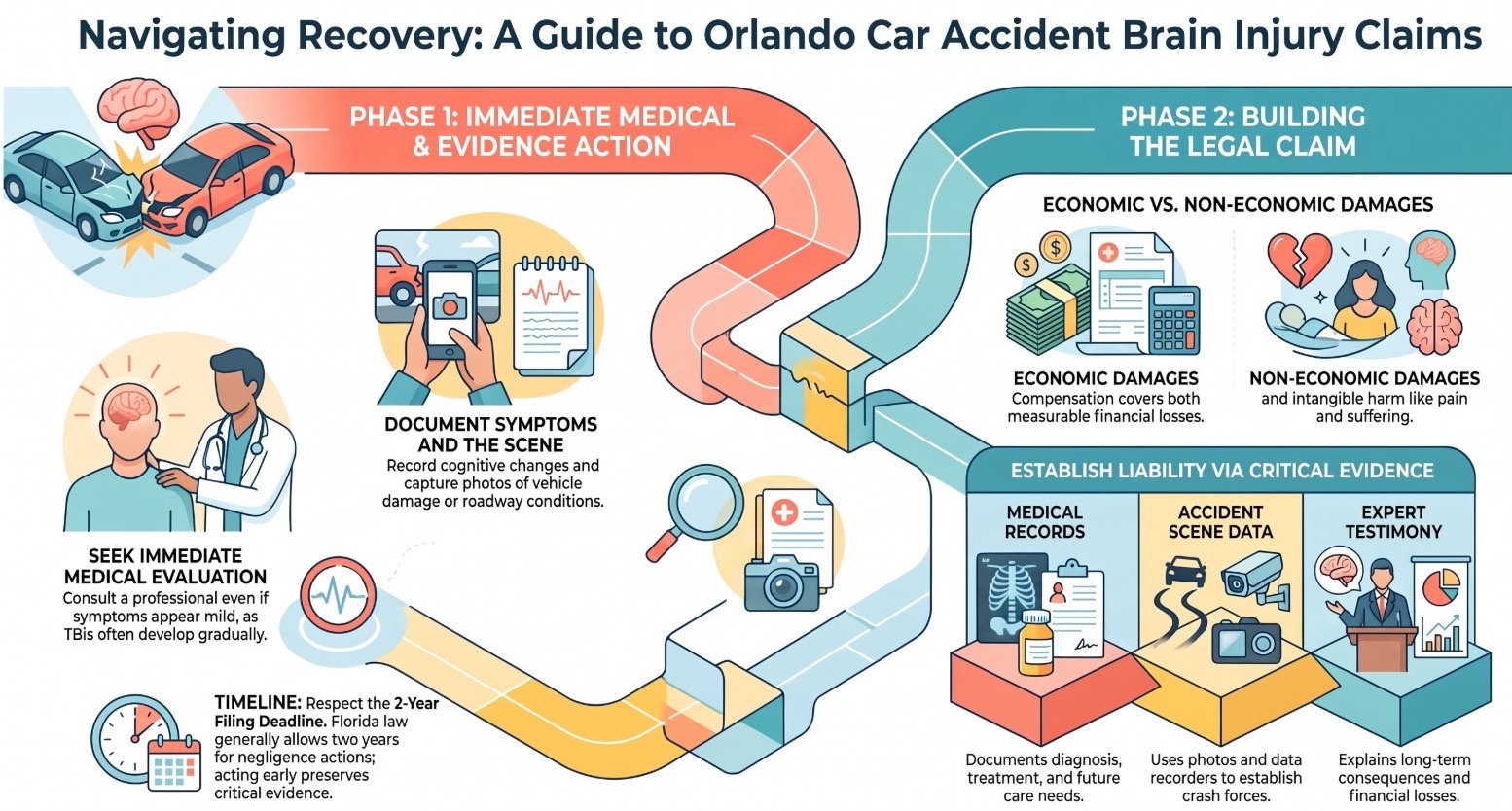
After an Orlando car accident involving a suspected head or brain injury, the individual should seek immediate medical care, even if symptoms initially appear mild. Document accident details, medical records, witness information, and related expenses carefully. Consulting a brain injury lawyer can help protect legal rights and assess potential compensation.
Seek Immediate Medical Care
Prompt medical evaluation should follow any Orlando car accident involving a possible head or brain injury, even when symptoms appear mild or absent. A qualified clinician can assess memory, balance, vision, alertness, and other neurological functions that may change over time. Emergency care is especially important after loss of consciousness, confusion, repeated vomiting, seizures, worsening headache, weakness, slurred speech, or unusual drowsiness. Individuals should not drive themselves if serious symptoms are present. Medical providers may recommend observation, imaging, restricted activity, or other treatment based on the examination. Emergency symptom tracking can help caregivers recognize changes and communicate accurate information to professionals. Follow discharge instructions carefully, including medication limits and activity restrictions. When symptoms persist or develop later, follow-up neurologist visits may support diagnosis, monitoring, and recovery planning.
Document The Accident
Because head and brain injuries may affect memory, concentration, and judgment, accident details should be documented as soon as the injured person is medically stable. When safe, a trusted person can photograph vehicle damage, road conditions, traffic signals, visible injuries, and relevant surroundings. These steps help preserve evidence before conditions change.
Brain injury documentation should include medical symptoms, treatment dates, prescribed limitations, and changes in behavior, memory, speech, or concentration. The injured person or a designated helper should record what occurred while avoiding speculation or altered recollections. Collect eyewitness contact information, including names, telephone numbers, and email addresses, promptly.
Review a copy of the official crash report for accuracy. Errors or omissions should be identified and reported through the appropriate agency’s established process.
Consult A Brain Injury Lawyer
Consulting a brain injury lawyer can help an injured person and the person’s family understand available legal options after an Orlando car accident. A lawyer can explain potential claims, applicable deadlines, and steps that may protect the injured person’s interests during recovery. Early legal guidance can also help preserve liability evidence, including crash reports, photographs, witness accounts, vehicle data, and relevant communications. The lawyer may coordinate with medical professionals to organize medical documentation describing symptoms, diagnoses, treatment, prognosis, and limitations affecting daily activities or employment. Because head and brain injuries can develop or worsen over time, a complete evaluation is important before accepting an insurance settlement. A qualified attorney can communicate with insurers, investigate contributing factors, and pursue compensation intended to support medical care, rehabilitation, lost income, and other accident-related needs.
Critical Evidence in an Orlando Car Accident Head & Brain Injury Case
Critical evidence can establish how the Orlando collision occurred, the extent of the head or brain injury, and the damages sustained.
An attorney may evaluate the following sources to build a reliable, well-supported claim:
- Medical Records: Document diagnoses, treatment, symptoms, prognosis, and future care needs.
- Accident Scene Evidence: Includes photographs, vehicle damage, traffic conditions, and official reports.
- Witness Statements: Provide independent accounts of the collision and its immediate effects.
- Expert Testimony: Helps explain injury mechanisms, long-term consequences, and financial losses.
Medical Records
Medical records provide critical evidence in an Orlando car accident head and brain injury case by documenting the injury, treatment, and effects on the patient’s daily life. Emergency evaluations, diagnostic imaging, specialist opinions, prescriptions, and rehabilitation notes can establish when symptoms appeared and how they progressed. Consistent documentation can support accident timeline reconstruction by linking reported symptoms to examinations and treatment decisions. Records also describe cognitive changes, headaches, balance problems, emotional effects, and limitations affecting work, family responsibilities, or independence. Complete files can help clarify the need for continuing care and distinguish preexisting conditions from accident-related harm. An attorney may review records for gaps, delayed diagnoses, or inconsistencies that insurers could exploit through insurance denial tactics. Preserving every relevant record helps advocates present an accurate, compassionate account of the injured person’s needs.
Accident Scene Evidence
Accident scene evidence can help establish how a collision occurred and whether the forces involved were consistent with a head or brain injury. Photographs of the Crash Scene may document vehicle damage, roadway conditions, debris, skid marks, traffic signals, and airbag deployment. Evidence Preservation is important because vehicles can be repaired, relocated, or sold, while physical conditions may change quickly. Investigators may inspect vehicles, download event data recorder information, and map impact points to evaluate speed, direction, and force. Surveillance footage from nearby businesses, residences, intersections, or transportation systems may clarify timing and vehicle movements. Digital Logs, including dispatch records, telematics, navigation data, and emergency-response timestamps, can provide additional objective information. Prompt collection and secure storage of this material can support accurate evaluation of responsibility and injury causation.
Witness Statements
Several sources of witness testimony may help establish how an Orlando collision occurred and whether the impact could have caused a head or brain injury. Drivers, passengers, pedestrians, nearby residents, and responding personnel may describe vehicle movements, traffic conditions, sounds, and the injured person’s immediate symptoms. Eyewitness credibility depends on the person’s vantage point, attention, distance, lighting, and possible distractions. A prompt, consistent statement may improve accuracy, while later recollections can include understandable gaps or changes. Witness accounts can help organize an accident timeline, including events before impact and observations made afterward. Investigators may compare each account with physical evidence and available records. Investigators assess witness reliability carefully, without assuming confidence alone proves accuracy. Preserving contact information and recording statements promptly can assist those seeking accountability and support for injured individuals.
Expert Testimony
When the cause or extent of a head or brain injury remains disputed, qualified experts may provide evidence that clarifies how an Orlando car accident occurred and whether the collision could have produced the reported harm. Accident reconstruction specialists can analyze vehicle damage, roadway conditions, impact forces, and medical records to develop liability evidence. Neurologists, neurosurgeons, and rehabilitation professionals may explain symptoms, treatment needs, and the relationship between trauma and diagnosed conditions. Neuropsych testing can measure changes in memory, attention, processing speed, and executive functioning, helping distinguish documented impairment from unrelated concerns. Vocational and life-care experts may further address limitations, future services, and financial consequences. Their testimony should remain grounded in reliable methods and complete records, enabling decision-makers to evaluate disputed claims fairly and protect injured individuals’ access to appropriate support.
Long-Term Effects of Orlando Car Accident Head & Brain Injuries
Long-term head and brain injuries may cause persistent cognitive challenges, including difficulties with memory, concentration, communication, and decision-making. Emotional and behavioral changes can also affect relationships, employment, and daily independence. Many injured individuals require ongoing medical care, rehabilitation, and monitoring to address evolving symptoms and support recovery.
Persistent Cognitive Challenges
Persistent cognitive challenges can affect an injured person’s memory, attention, reasoning, language, and ability to complete ordinary tasks after an Orlando car accident. Some individuals experience cognitive fatigue, making sustained mental activity unusually exhausting and limiting productivity throughout the day. Others may have difficulty concentrating, following conversations, processing written information, or shifting between tasks. Memory problems can interfere with appointments, medication schedules, employment responsibilities, and household obligations. Impaired reasoning may make planning, decision-making, or evaluating risks more difficult, while language changes can affect word retrieval and clear communication. These limitations may persist even when visible injuries have recovered. Medical evaluations, rehabilitation, and assistance from supportive family members or caregivers can help identify functional needs and promote safer routines. Documenting ongoing difficulties may also clarify the injury’s long-term impact.
Emotional And Behavioral Changes
Cognitive impairments may also be accompanied by emotional and behavioral changes that affect relationships, employment, and independent living after an Orlando car accident. Traumatic emotional shifts can include persistent irritability, anxiety, depression, apathy, or sudden mood fluctuations. These symptoms may arise from brain trauma, frustration over lost abilities, or difficulty communicating needs. Personality and behavioral changes can cause impulsivity, anger, reduced empathy, social withdrawal, or inappropriate conduct that seems inconsistent with the person’s prior character. Family members and coworkers may misinterpret these effects as intentional, creating conflict and isolation. Documented changes can help clarify the injury’s broader impact on daily functioning and interpersonal responsibilities. Compassionate support from relatives, employers, and community advocates may promote safety, dignity, and appropriate accommodations while preserving the injured person’s participation in meaningful relationships and activities.
Ongoing Medical Care
Ongoing medical care is often necessary after an Orlando car accident causes a head or brain injury, particularly when symptoms affect memory, concentration, movement, speech, or emotional regulation. Treatment may involve neurologists, rehabilitation physicians, therapists, psychologists, and other experts who monitor changes and coordinate services. Rehabilitation planning should identify immediate goals, anticipated limitations, assistive equipment, and follow-up evaluations. Depending on the injury, brain damage therapy may include physical, occupational, speech-language, cognitive, or behavioral treatment. Regular appointments can help clinicians adjust medications, address new symptoms, and measure functional progress. Families may also need education about supervision, safety precautions, and communication strategies. Documented medical recommendations can clarify the duration and cost of needed care, supporting informed decisions about recovery, resources, and long-term support.
Don’t Wait. Call Our Florida Personal Injury Lawyers Now!
Proving Liability in Orlando Car Accident Head & Brain Injury Cases
When a car accident causes a head or brain injury, proving liability requires evidence that connects another party’s negligent conduct to the collision and resulting harm. Preserve evidence promptly, including photographs, vehicle data, medical records, roadway conditions, and communications relevant to the event. Witness coordination can help locate individuals who observed traffic signals, driver behavior, impact forces, or changes in the injured person’s condition. Investigators may examine police reports, surveillance footage, vehicle damage, and expert analyses to clarify how the crash occurred. Fault determination standards generally require proof that a driver or other responsible party owed a duty of care, breached that duty, and caused injuries that produced measurable losses. Negligence proof may also address distracted driving, speeding, impairment, unsafe lane changes, or inadequate vehicle maintenance. Because brain injuries can develop or become more apparent over time, organized documentation helps connect symptoms to the collision and supports an accurate, compassionate evaluation of responsibility.
Dealing With Insurance Companies After an Orlando Car Accident Head & Brain Injury
After you gather liability evidence, communicating with insurance companies becomes a key part of protecting a head or brain injury claim. Adjusters may request recorded statements, medical authorizations, and detailed symptom accounts. Injured individuals should provide accurate information while avoiding speculation about recovery, prior conditions, or fault. Statements that minimize cognitive problems, headaches, memory changes, or emotional effects can create harmful inconsistencies.
Insurers may employ Claim denial strategies, including disputing causation, emphasizing gaps in treatment, or arguing that diagnostic findings do not reflect functional limitations. A representative can help organize medical records, employment documentation, witness information, and other evidence before substantive discussions occur. Medical billing disputes may also arise when insurers question treatment necessity, coding, or charges from multiple providers. Prompt review of explanations of benefits and provider statements helps identify unresolved balances and prevents confusion. Careful communication, complete documentation, and timely responses support fair evaluation while preserving the injured person’s ability to pursue appropriate compensation for ongoing care and related losses.
What to Expect During an Orlando Car Accident Head & Brain Injury Claim Process
The Orlando car accident head and brain injury claim process generally begins with an initial case evaluation to assess liability, damages, and available legal options. Medical evidence is then collected to document the injury’s nature, treatment, prognosis, and effect on daily life, while insurance negotiations address potential compensation. If a fair settlement cannot be reached, the claim may proceed to trial.
Initial Case Evaluation
A thorough initial case evaluation helps determine how an Orlando car accident head or brain injury claim should proceed. During this consultation, an attorney reviews the collision’s circumstances, identifies potentially responsible parties, and considers available insurance coverage. The discussion may address symptoms, functional changes, employment effects, and the assistance required in daily life without analyzing medical records in depth. Insurance deadline awareness is crucial because notice requirements, filing periods, and policy provisions can affect legal options. Counsel also explains evidence preservation basics, including retaining photographs, crash reports, witness information, vehicle records, communications, and an account of events. A careful evaluation clarifies immediate priorities, potential challenges, and what information is still needed. It also helps families understand the process, make informed decisions, and protect the injured person’s interests.
Medical Evidence Collection
When an Orlando car accident involves a suspected head or brain injury, medical evidence collection begins with gathering records that document the condition from the initial evaluation through ongoing treatment. Emergency room documentation may establish symptoms, diagnostic findings, imaging results, and medical instructions issued immediately after the collision. Follow-up records from neurologists, therapists, and primary care providers can clarify progression, limitations, and the need for continued care. A legal representative may also collect prescriptions, billing statements, employment records, and statements concerning functional changes. Consistent documentation helps distinguish accident-related conditions from prior health issues and supports a complete understanding of the injured person’s needs. Prompt collection is especially important because incomplete records can contribute to insurance claim denials and complicate efforts to obtain appropriate compensation for necessary medical services.
Insurance Negotiations
During insurance negotiations, an Orlando car accident head or brain injury claim is considered through medical documentation, liability evidence, and the projected cost of treatment. Insurers may review emergency records, diagnostic testing, physician opinions, rehabilitation needs, and information about lasting cognitive or physical limitations. They also examine accident reports, witness accounts, photographs, and other evidence preservation efforts that clarify responsibility. An adjuster may request recorded statements, authorizations, or additional records before evaluating the claim. Policy limits can affect available coverage, especially when injuries require extended care or reduce earning capacity. A representative may organize documentation, identify incomplete evaluations, and communicate with insurers on the injured person’s behalf. Careful negotiations should protect accurate claim valuation while reducing unnecessary burdens for individuals and families managing recovery.
Settlement Or Trial
Settlement or trial represents the principal paths for resolving an Orlando car accident head or brain injury claim after liability, medical evidence, and damages have been evaluated. A settlement provides defined compensation without courtroom uncertainty, while trial allows you to present disputed facts to a judge or jury. Evaluating risks vs. settlement requires consideration of medical prognosis, future care costs, available insurance, litigation expenses, and the possibility of an unfavorable verdict. Counsel may address insurance delay tactics by documenting deadlines, treatment needs, and supporting evidence. Early settlement leverage can arise when liability is clear, and records demonstrate substantial impairment, although premature resolution may undervalue lasting consequences. Trial outcomes vary based on credibility, expert testimony, evidence, and jury perceptions. A representative serving the injured person’s interests should explain each option, preserve decision-making authority, and prepare thoroughly for either resolution.
Compensation for Orlando Car Accident Head & Brain Injury Damages
Compensation for head and brain injuries sustained in an Orlando car accident may cover medical expenses, lost income, reduced earning capacity, and the ongoing cost of rehabilitation or required personal care. Determining an appropriate recovery requires careful review of medical records, treatment projections, employment documentation, and evidence showing how the injury affects daily responsibilities. An attorney may assess settlement valuation factors, including injury severity, prognosis, documented limitations, and the reliability of supporting evidence. Insurance negotiation tactics can include presenting organized records, obtaining medical opinions, calculating anticipated care costs, and addressing attempts to minimize symptoms or dispute causation. Because head injuries may develop or worsen over time, accepting an early offer without understanding future needs can create significant financial risks. Legal counsel may communicate with insurers, protect claim deadlines, and pursue a resolution aligned with the injured person’s documented needs. This work helps families preserve resources while supporting appropriate care and long-term stability.
Economic vs Non-Economic Damages in Orlando Car Accident Head & Brain Cases
Economic damages may include medical expenses, lost income, rehabilitation costs, and other measurable financial losses caused by a head or brain injury. Non-economic damages address less tangible harm, such as pain and suffering, emotional distress, and diminished quality of life. Calculating total compensation requires evaluating both categories, along with the injury’s long-term effects and available supporting evidence.
Economic Damages Explained
In Orlando car accident head and brain injury cases, economic damages refer to the measurable financial losses caused by the collision and its medical consequences. These losses may include emergency transportation, hospital care, diagnostic testing, medication, surgery, rehabilitation, and follow-up appointments. Records such as invoices, receipts, insurance statements, and medical reports help establish the amount claimed. Economic damages can also include anticipated expenses when injuries require continuing treatment, adaptive equipment, in-home assistance, or specialized care. Careful future treatment planning may help medical professionals estimate necessary services and related costs. If cognitive or physical impairments reduce a person’s ability to work, damages may address lost wages, diminished earning capacity, and vocational rehabilitation costs. A detailed evaluation can help guarantee that responsible parties account for documented past and reasonably predictable future financial needs.
Non-Economic Damages Explained
Beyond documented financial losses, non-economic damages address the personal effects of a head or brain injury that do not have a fixed bill or market price. In Orlando car accident cases, these damages may reflect pain and suffering, emotional distress, reduced enjoyment of life, and disruption of personal relationships. Concussion symptoms can affect concentration, sleep, confidence, and daily independence even when medical records show limited visible injury. Liability proof remains important because testimony, treatment records, and observed changes help connect these experiences to the collision. Comparative negligence may also affect whether an injured person can recover damages when responsibility is shared. Careful documentation allows the person’s dignity, limitations, and ongoing challenges to be presented accurately, helping decision-makers recognize harm beyond invoices and receipts.
Calculating Total Compensation
A total compensation assessment in an Orlando car accident head or brain injury case combines economic and non-economic damages to reflect the full effect of the injury. Economic damages may include emergency treatment, rehabilitation, medication, lost income, reduced earning capacity, transportation, and anticipated future care. Medical evidence helps establish the injury’s severity, treatment needs, prognosis, and financial consequences. Non-economic damages address pain, emotional distress, cognitive limitations, loss of enjoyment, and diminished relationships, although these harms require careful documentation rather than simple invoices. Liability proof connects the losses to the collision and supports responsibility for payment. A sound settlement strategy evaluates present and future damages, applicable insurance coverage, and comparative fault. During insurance negotiation, counsel may present organized records, expert opinions, and a reasoned demand that supports fair compensation while protecting the injured person’s long-term needs.
When an Orlando Car Accident Head & Brain Injury Case Goes to Trial vs Settlement
When an Orlando car accident causes a head or brain injury, the decision to pursue settlement or proceed to trial depends on the strength of the evidence, the extent of the injuries, and the parties’ willingness to accept a fair resolution. Settlement may provide timely support for medical care, rehabilitation, lost income, and other documented needs while avoiding courtroom uncertainty. Negotiations can continue as treatment progresses and the long-term impact becomes clearer.
Trial may be appropriate when liability is disputed, the opposing party denies the injury’s severity, or settlement offers fail to reflect the evidence. Counsel may prepare witnesses, organize medical records, and develop a Courtroom Strategy addressing causation, functional limitations, and future care. Jury Selection also matters because jurors evaluate credibility, medical testimony, and the injury’s effect on daily life. The decision should reflect the injured person’s needs, informed preferences, and ability to endure extended litigation.
Florida Laws That May Affect Your Orlando Car Accident Head & Brain Case
Florida law may affect an Orlando car accident head or brain injury case through rules governing negligence, insurance coverage, comparative fault, and damage recovery. These provisions help determine responsibility and identify resources for medical care, rehabilitation, lost income, and long-term support.
Key issues may include:
- Comparative Negligence can reduce a recovery when an injured person shares responsibility for the collision.
- Florida’s no-fault insurance system may require certain medical expenses to proceed through personal injury protection coverage.
- Serious injuries may support a claim against an at-fault driver when statutory thresholds are met.
- Statute Deadlines and procedural requirements can influence whether a claim remains enforceable.
Other rules may address evidence, uninsured or underinsured motorist coverage, liens, and how future damages are treated. Because head and brain injuries can involve changing symptoms and extensive care, accurate documentation is critical. A qualified legal professional can help families and caregivers understand applicable duties, preserve evidence, communicate with insurers, and pursue a resolution that supports the injured person’s recovery and dignity.
The Statute of Limitations for Orlando Car Accident Head & Brain Injury Cases
How long an injured person has to file a claim can determine whether an Orlando car accident head or brain injury case proceeds at all. Florida’s statute of limitations establishes a filing deadline, and the applicable period may depend on when the crash occurred, the nature of the claim, and whether a government entity is involved. Recent Florida law generally allows two years for many negligence actions, but exceptions and transitional rules may apply.
Head and brain injuries can complicate timing because symptoms, cognitive changes, or long-term impairments may not appear immediately. Delayed diagnosis does not automatically extend the deadline. Certain circumstances, including minority, incapacity, or fraud, may affect how time is calculated, while wrongful-death claims follow distinct rules.
Comparative Negligence may reduce recoverable damages but does not necessarily stop the limitations period. Prompt Evidence Preservation is also important because records, photographs, witness accounts, and vehicle data may become unavailable. Careful deadline assessment protects injured people and supports responsible evaluation of available legal remedies.
How an Orlando Car Accident Head & Brain Lawyer Can Help You
An Orlando car accident head and brain lawyer can help an injured person evaluate liability, document the full extent of the injury, and pursue compensation within the applicable legal deadlines. Counsel may coordinate evidence, communicate with insurers, and protect the client’s interests while medical care continues. Medical documentation strategies can clarify symptoms, treatment requirements, lost income, and potential long-term limitations.
Key assistance may include:
- Investigating crash reports, photographs, witness accounts, and vehicle evidence
- Identifying responsible parties and analyzing applicable insurance coverage
- Organizing medical records, expert opinions, rehabilitation reports, and expense documentation
- Explaining insurance claim timelines, settlement offers, and litigation procedures
A lawyer can also assess how cognitive, emotional, or physical changes affect family responsibilities and future earning capacity. By presenting a carefully supported claim, counsel helps decision-makers understand the injury’s practical consequences rather than relying on incomplete early impressions. Legal guidance may further reduce administrative burdens, allowing the injured person and supportive family members to focus on recovery and continued service to others.
When to Contact an Orlando Car Accident Head & Brain Lawyer
Prompt legal advice is often important after a collision involving a suspected head or brain injury, even when symptoms initially appear minor. A qualified Orlando car accident head and brain lawyer can help preserve relevant records, identify immediate legal concerns, and explain practical next steps without disrupting medical care.
Emergency services should be contacted first when a person experiences loss of consciousness, confusion, repeated vomiting, seizures, severe headache, weakness, slurred speech, or unusual behavior. The question of when to call emergency should never be delayed while waiting for symptoms to resolve. Medical evaluation also creates documentation that may assist later proceedings.
Legal contact is appropriate as soon as possible after treatment, particularly when another driver may be responsible, insurance representatives request statements, or long-term effects remain uncertain. Reporting deadlines and other time limits can affect your ability to pursue compensation, and they vary by circumstance. Early consultation helps you make informed decisions while evidence, witness recollections, and medical information remain available.
Don’t Wait. Call Our Florida Personal Injury Lawyers Now!
Why You Need an Experienced Orlando Car Accident Head & Brain Lawyer
Experience matters when a car accident involves a suspected head or brain injury because these conditions may be difficult to diagnose and may produce lasting physical, cognitive, or emotional effects. An experienced Orlando car accident head and brain lawyer can help protect an injured person’s interests while medical professionals evaluate symptoms and recovery needs.
Such counsel understands how evidence may establish responsibility, including Seatbelt compliance, vehicle damage, witness accounts, and traffic camera footage. This focused review can clarify disputed facts and help address arguments that minimize an injury or shift blame. Experience also supports careful documentation of medical treatment, lost income, rehabilitation, and the assistance required for daily activities.
A knowledgeable lawyer can communicate with insurers, preserve relevant evidence, and pursue compensation consistent with the injury’s seriousness. This guidance lets families focus on recovery and caregiving while their legal rights receive disciplined attention. It also helps ensure that complex claims are presented accurately, respectfully, and without unnecessary delay.
How to Choose the Right Orlando Car Accident Head & Brain Lawyer for Your Case
Selecting the right Orlando car accident head and brain lawyer requires more than reviewing advertising or a firm’s general personal injury experience. A careful evaluation should consider the lawyer’s experience with traumatic brain injuries, medical evidence, insurance negotiations, and claims involving long-term care needs. The attorney should clearly explain legal options, identify potential challenges, and show respect for the client’s recovery process.
Prospective clients may ask about case evaluation procedures, courtroom experience, and the resources available to investigate liability and document damages. Discuss client communication plans at the beginning, including expected response times, preferred contact methods, and who will provide updates. Contingency fee transparency is equally important. The written agreement should explain the fee percentage, litigation expenses, and any costs that could reduce the final recovery.
A suitable lawyer should also listen carefully, avoid unrealistic promises, and provide information needed for an informed decision. Comparing qualifications, communication practices, and fee terms can help families select effective, trustworthy representation.
About The Law Offices of Anidjar & Levine
The Law Offices of Anidjar & Levine represents individuals and families pursuing compensation after serious Orlando car accidents involving head and brain injuries. The firm examines collision evidence, medical records, witness accounts, and insurance documents to help clarify responsibility and identify available legal remedies.
Its attorneys assist clients with claims involving traumatic brain injuries, concussions, skull fractures, and related cognitive or neurological impairments. They explain Florida accident timelines, including filing deadlines and the importance of preserving evidence before crucial information disappears. The firm also evaluates liability insurance coverage, uninsured or underinsured motorist benefits, and other potential sources of recovery.
Because brain injuries may produce delayed symptoms and long-term consequences, the legal team considers future treatment, rehabilitation, lost earning capacity, and necessary support services when reviewing damages. Through case investigation, negotiation, and litigation when appropriate, the offices seek accountability while providing informed guidance. Their work is structured to reduce administrative burdens and help injured individuals and families make decisions during difficult circumstances.
Frequently Asked Questions
Can a Head Injury Occur Without Immediate Symptoms After an Orlando Car Accident?
Yes, a head injury can occur without immediate symptoms after a car accident. Delayed concussion symptoms may develop hours or days later, including headache, dizziness, confusion, nausea, vision changes, unusual fatigue, or difficulty concentrating. Monitor the person closely and have a medical professional evaluate them, even if they feel well at first. Prompt assessment can identify internal bleeding or other dangers and help reduce the risk of a second injury during recovery.
What Medical Specialists Diagnose and Treat Accident-Related Brain Injuries?
Neurologists, neurosurgeons, emergency physicians, and rehabilitation specialists commonly diagnose and treat accident-related brain injuries. Neuropsychological evaluation can measure changes in memory, attention, reasoning, mood, and behavior, while imaging studies may identify bleeding or structural damage. Physiatrists coordinate recovery plans involving physical, occupational, speech-language, and cognitive rehabilitation therapies. Psychologists, social workers, and primary care clinicians may also support long-term monitoring, family education, and safe return-to-work planning.
How Can Families Support Someone Experiencing Personality Changes After a Traumatic Brain Injury?
Families can support someone experiencing personality changes after a traumatic brain injury by responding calmly, avoiding arguments, and recognizing that symptoms may reflect neurological impairment rather than intentional behavior. Caregiver communication should remain clear, respectful, and consistent, with concerns shared among relatives and treating professionals. Structured routines can reduce confusion and frustration. Families should encourage prescribed therapy, monitor safety risks, document changes, and seek guidance promptly when behavior becomes threatening or markedly worsens.
Can Protective Helmets Prevent Brain Injuries in Orlando Vehicle Collisions?
Protective helmets can reduce the likelihood and severity of certain head injuries, particularly for motorcyclists and bicyclists, but they cannot prevent every brain injury in Orlando collisions. Helmet effectiveness depends on proper fit, certified design, correct use, and collision forces. Seat belts, airbags, safe speeds, and attentive driving remain crucial protections for vehicle occupants. After any impact, prompt medical evaluation is important because symptoms may develop gradually and require careful monitoring.
What Accommodations May Help Brain Injury Survivors Return to Work or School?
Brain injury survivors may benefit from workplace supports or school accommodations tailored to documented limitations. Helpful measures can include reduced schedules, flexible deadlines, written instructions, quieter environments, rest breaks, modified workloads, assistive technology, transportation assistance, and gradual increases in responsibility. Employers and schools may also provide designated coordinators, tutoring, rehabilitation referrals, and regular progress reviews. Medical professionals should help identify needs, while qualified advocates can help request reasonable accommodations and protect educational or employment rights.
—————————
Orlando car accident head and brain injuries can lead to serious medical, financial, and personal challenges. Victims may face lasting impairments, extensive treatment, and uncertainty about their legal rights. The Law Offices of Anidjar and Levine can evaluate the circumstances, identify potentially responsible parties, and pursue evidence-based compensation. Consulting an experienced Orlando Personal Injury Lawyer promptly may help preserve important information, address insurance concerns, and support informed decisions throughout the claims process.