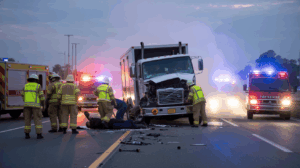
Black box data can make or break your Florida truck accident case because it shows how the truck was actually operated in the seconds before impact.
It may help prove speed, braking, throttle, engine activity, crash timing, and even possible hours-of-service violations tied to fatigue.
That objective evidence can reveal conflicts in the driver’s account, support company liability, and strengthen your claim’s value.
Acting quickly is important, though, because this data can be overwritten or lost.
The Law Offices of Anidjar and Levine can help protect this critical evidence and explain how a Florida Truck Accident Lawyer may assist with your case.
Main Takeaways
- A truck’s black box can record speed, braking, throttle, engine RPM, and timing in the seconds before a Florida crash.
- This data can confirm or contradict the driver’s story by showing whether braking, speeding, or evasive action actually occurred.
- Black box and ELD records can expose hours-of-service violations, fatigue, false logs, and broader safety failures within trucking companies.
- In Florida fault cases, objective electronic data often strengthens proof of liability and can increase the value of an injury claim.
- Black box evidence can be quickly overwritten or lost, so early spoliation letters and forensic retrieval are critical.
What Is a Truck’s Black Box and What Data Does It Record?
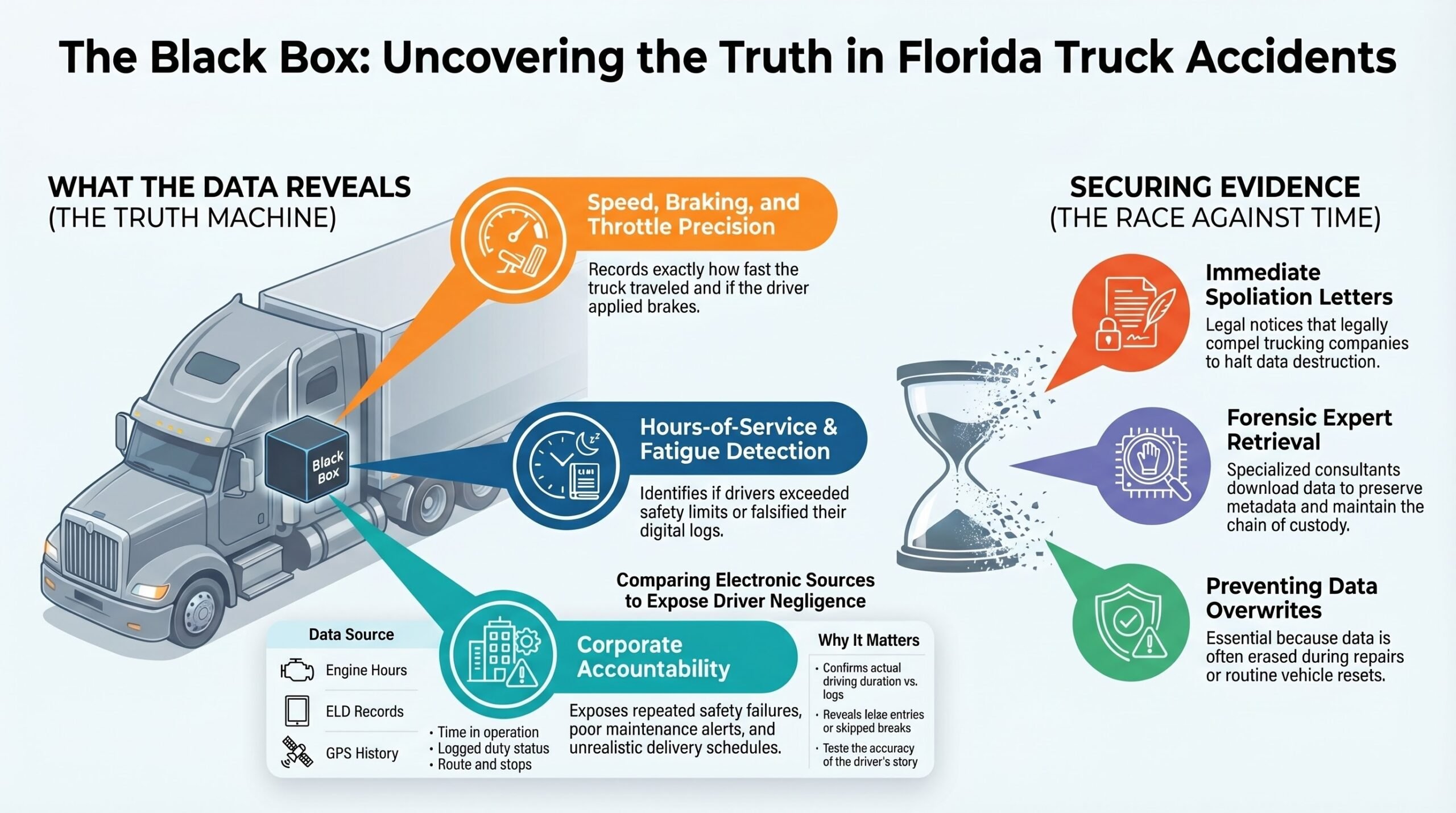
In many Florida truck accident cases, the truck’s “black box” refers to an electronic control module or event data recorder that captures crucial operating information before, during, and after a crash. If you’re seeking answers that protect your family and community, you should understand what this device preserves. A commercial truck event data recorder can log speed, brake application, throttle position, engine RPM, seat belt use, steering input, cruise control status, and sudden changes in motion.
Depending on the truck and system, it may also store hard-braking events, diagnostic trouble codes, hours-of-service-related inputs, and the timing of mechanical warnings. This truck accident black box evidence provides an objective snapshot of how the vehicle performed during critical moments. Because trucking companies control much of this information, you need prompt legal action to identify, request, and preserve it. When you act quickly, you help safeguard evidence that may otherwise be lost, overwritten, or ignored.
How Black Box Data Helps Prove Fault in Florida Truck Accident Cases


You can use black box data to show whether the truck was speeding, when the driver braked, and exactly how the crash unfolded. It can also reveal hours-of-service violations, which helps you connect driver fatigue or noncompliance to the collision. When you pair that evidence with company records, you can prove not just driver error, but trucking company accountability.
Speed And Braking Evidence
Because seconds matter in a truck crash, black box data often becomes some of the strongest evidence in a Florida accident case. You can use it to show exactly how fast the truck traveled, when the driver hit the brakes, and whether the impact occurred before any meaningful slowdown. That timeline helps expose reckless speed, delayed reaction, or failure to brake altogether.
In a semi-truck black box accident investigation, this data can directly challenge a driver’s version of events and support witnesses who tried to help after the crash. When combined with truck crash electronic logging data, speed and braking records provide your legal team with measurable proof, not speculation. If you’re seeking accountability and justice for injured people and families, this evidence can powerfully demonstrate fault and strengthen your claim for fair compensation under Florida law.
Driver Hours Compliance
Black box data does more than show speed and braking—it can also reveal whether the truck driver stayed on the road longer than federal safety rules allow. If fatigue played a role, you can use that data to expose violations and protect others from preventable harm.
| Data Source | What It Shows | Why It Matters |
|---|---|---|
| Engine hours | Time in operation | Confirms driving duration |
| ELD records | Logged duty status | Reveals false entries |
| GPS history | Route and stops | Tests log accuracy |


When black box entries conflict with logbooks, you gain powerful proof of negligence. That evidence can show that the driver ignored rest requirements or that the carrier imposed unsafe schedules. Quickly preserving evidence from trucking company accidents matters because delays can erase pivotal records and weaken your ability to hold every responsible party accountable.
Impact And Crash Timing
Pinpointing the exact moment of impact can reshape a Florida truck accident case. Black box data records timing down to pivotal seconds, showing when the truck slowed, accelerated, or changed handling before the collision. That timeline helps you connect driver actions to the crash instead of relying on conflicting memories or incomplete reports. When seconds matter, objective data gives your claim a stronger footing.
You can also use crash timing data to test whether a driver reacted reasonably once danger appeared. If the record shows delayed braking or no evasive action, that evidence can support a finding of fault. If it confirms a sudden emergency, it can clarify what truly happened. By anchoring your case to measurable events, you protect the truth, strengthen accountability, and improve your ability to pursue fair compensation for those harmed.
Trucking Company Accountability
That same timing data often does more than show what the driver did in the seconds before impact—it can also expose what the trucking company allowed, ignored, or encouraged. If black box records reveal repeated speeding, hard braking, hours-of-service violations, or delayed maintenance alerts, you can connect the crash to corporate decisions, not just driver error.
That matters because trucking companies must supervise drivers, enforce safety rules, inspect equipment, and correct dangerous patterns. When they push unrealistic schedules, overlook logbook problems, or keep unsafe trucks on Florida roads, they put everyone at risk. Black box evidence helps you prove negligence with objective data. It strengthens your claim, widens potential liability, and supports accountability that protects other families, drivers, and communities from preventable harm. That evidence can also pressure insurers to negotiate fairly sooner.
Key Evidence Stored in Commercial Truck Event Data Recorders
You can use a truck’s event data recorder to identify crucial facts the driver and carrier can’t easily dispute. Speed and braking data may indicate whether the truck was moving too fast or the driver reacted too late before impact. Hours and engine logs can also reveal fatigue, rule violations, or inconsistencies that strengthen your claim.
Speed And Brake Data
Because commercial truck crashes unfold in seconds, speed and brake data from a truck’s black box often become some of the most important evidence in a Florida accident case. You can use this data to show whether the driver traveled too fast for traffic, weather, or road conditions, and whether braking happened too late, too hard, or not at all.
Those details matter because they help reconstruct what actually happened before impact. If the truck maintained speed rather than slowing, that could support claims of inattention, unsafe following distance, or reckless operation. If braking began only moments before the collision, you gain powerful proof that the driver failed to respond reasonably to danger. When you’re fighting for accountability and fair compensation, speed and brake data can turn disputed allegations into objective, persuasive facts.
Hours And Engine Logs
When a truck driver’s hours behind the wheel and engine activity come into question, black box data can reveal whether fatigue, missed rest breaks, or log violations played a role in the crash. You can use these records to compare electronic logging entries against actual engine hours, ignition cycles, and idle time. That comparison often exposes falsified logs and strengthens your claim. If a carrier pushed unsafe schedules, these logs help prove a preventable safety failure that harmed you and others.
| Record | Why It Matters |
|---|---|
| Engine hours | Shows actual operating time |
| Ignition and idle logs | Reveals stops, breaks, and possible rule violations |
Why Trucking Companies May Fight to Hide Black Box Evidence
Although black box data can reveal important facts about speed, braking, driver hours, and vehicle performance before a crash, trucking companies often move quickly to limit access to it when that information may increase their liability. If the data shows unsafe driving, poor maintenance, overloaded cargo, or pressure to meet unrealistic delivery schedules, it can strengthen your claim and expose broader safety failures.
You should understand why that resistance matters. A trucking company may fear damages, regulatory scrutiny, higher insurance costs, and reputational harm. It may also want to protect dispatch practices, hiring decisions, training gaps, or supervision failures that black box evidence can help uncover. When a company controls the truck, its records, and its technical systems, it holds a significant advantage unless you act through counsel.
By pursuing this evidence early and aggressively, you help protect not only your case but also the safety of others who share Florida roads with commercial trucks every day.
How Quickly Black Box Data Can Be Lost or Overwritten After a Crash
Even a strong truck accident claim can weaken fast if no one moves to preserve the truck’s black box data. You can’t assume that essential electronic evidence will remain available for long. Depending on the truck’s system, data may be overwritten when the vehicle returns to service, lost during repairs, erased by routine downloads, or corrupted after battery failure. Some event data recorders save only limited pre-crash information, so every delay increases the risk.
That’s why swift legal action matters. When you act quickly, your attorney can send a preservation letter, demand that the trucking company protect the module, and take steps to secure a proper download before the evidence disappears. If you wait, you may lose speed, braking, throttle, and engine-hour data that could help prove what happened. Protecting that information early helps you serve your family, your future, and the broader goal of accountability on Florida roads for everyone.
Using Black Box Data to Challenge a Truck Driver’s Story
Why does black box data matter so much after a Florida truck crash? Because it can expose whether the driver’s version of events matches what the truck actually did in the seconds before impact. You can use speed, braking, throttle, engine, and guidance data to test claims that the driver reacted promptly, traveled safely, or lost control because of sudden conditions. When the story and the data conflict, credibility shifts.
That shift can change your case. If a driver says traffic stopped without warning, the black box data may show no braking at all. If the driver blames the weather, the data may reveal excessive speed despite dangerous conditions. If the driver claims a mechanical problem, electronic records may point instead to human error. By comparing objective truck data with logs, witness accounts, and crash scene evidence, you can challenge excuses and focus attention where it belongs: on accountability, truth, and protecting others from preventable harm.
How Attorneys Preserve Black Box Evidence in Florida Truck Accident Claims
To protect essential black box evidence, your attorney must act quickly by issuing a spoliation letter that puts the trucking company on notice to preserve the data. You also need skilled experts to retrieve the information properly, because mishandling can compromise important proof of speed, braking, and driver conduct. When your legal team moves quickly and uses the right technical support, you strengthen your position from the start of your Florida truck accident claim.
Spoliation Letters
Because black box data can be overwritten, deleted, or lost soon after a crash, your attorney should send a spoliation letter to the trucking company and any other party controlling the truck’s electronic records as early as possible. That letter demands preservation, identifies critical evidence, and warns against destruction. Acting quickly helps protect the truth, accountability, and your ability to seek justice for those who depend on you.
| Purpose | Benefit |
|---|---|
| Preserve records | Stops routine loss |
| Identify sources | Targets all custodians |
| Set legal notice | Creates accountability |
| Support sanctions | Strengthens your claim |
In Florida truck accident claims, a strong spoliation letter can prevent evasive tactics and frame the case early. When you serve others, preserving objective evidence matters because facts, not corporate narratives, should guide recovery.
Expert Data Retrieval
Once a spoliation letter is sent, your attorney should move quickly to secure expert retrieval of data from the truck’s electronic control module and related systems before pivotal information changes or disappears.
You need trained forensic consultants because black box downloads aren’t simple plug-and-play tasks. A qualified expert preserves metadata, verifies the chain of custody, and captures speed, braking, throttle, engine hours, and crash-event details without corrupting the source. Your lawyer should also demand data from GPS units, dash cameras, telematics platforms, and driver logs, then compare those records for inconsistencies.
That analysis can expose fatigue, falsified logs, delayed braking, or reckless operation. When you serve injured people and grieving families, precision matters. Prompt expert retrieval helps your attorney protect the truth, confront trucking companies and insurers, and build a claim grounded in reliable, defensible evidence.
Why Black Box Evidence Can Increase the Value of Your Truck Accident Case
When black box data clearly captures a truck’s speed, braking, engine activity, and hours of operation before a crash, it can substantially strengthen your Florida truck accident claim. That objective record helps you move beyond conflicting stories and prove exactly how the collision happened. If the data shows speeding, delayed braking, fatigue, or mechanical issues, you can tie the truck driver’s conduct and the carrier’s safety failures directly to your injuries.
That matters because stronger evidence often increases the case’s value. You’re in a better position to show clear liability, defeat blame-shifting tactics, and demand compensation that reflects the full harm you’ve suffered. Black box evidence can also support claims for medical expenses, lost income, pain and suffering, and future care when severe injuries disrupt your ability to work and serve your family or community. In serious cases, it may even expose reckless conduct, which can increase pressure on the trucking company to resolve your claim fairly.
Why Choose Anidjar and Levine as Your Florida Truck Accident Lawyers
Strong black box evidence only helps if your legal team knows how to secure it, interpret it, and use it to prove liability, which is why many injured victims turn to Anidjar and Levine for a Florida truck accident case. You need lawyers who move fast, preserve electronic data, investigate thoroughly, and connect every finding to your injuries and losses.
| What you need | What Anidjar and Levine provide |
|---|---|
| Rapid action | Immediate evidence preservation |
| Deep analysis | Tailored case strategy |
| Full support | Lawyers, investigators, experts |
| Client access | 24/7 responsiveness |
| No upfront risk | No fee unless you win |
When you choose this firm, you put people before corporations and insurers. Your team builds a case that shows fault, values your damages, and pursues justice with discipline.
With offices across Florida, plus home or hospital visits, you can get help wherever recovery finds you. That service-centered approach protects your rights and your peace.
—————————
Black box data can determine whether you recover full compensation or face an uphill battle against a trucking company’s version of events.
If you act quickly, you can preserve essential evidence of speed, braking, driver fatigue, and other factors that establish fault.
Don’t let important data disappear or get twisted against you.
With help from the Law Offices of Anidjar and Levine and an experienced Florida Truck Accident Lawyer, you can protect your rights, build a stronger claim, and pursue the financial recovery you need after a serious Florida truck accident.