

If negligent prenatal, delivery, or postpartum care caused or hastened a mother’s death, you can hire the Law Offices of Anidjar and Levine to secure records fast, preserve fetal monitoring strips and medication logs, and manage insurer and hospital communications.
You can pursue Florida wrongful-death damages for medical bills, funeral costs, lost income and household services, and survivors’ mental pain and suffering and loss of companionship.
You can’t miss strict filing deadlines, so act now. Learn more by speaking with a Miami Medical Malpractice Lawyer.
Main Takeaways
- A Miami maternal death injury lawyer explains Florida wrongful-death rights, eligible survivors, and estate claims based on your family structure.
- They identify recoverable damages: pregnancy-related medical bills, funeral costs, lost income, household services, and survivors’ mental pain and suffering.
- They act fast to meet strict Florida filing deadlines, documenting discovery dates and pursuing limited tolling when essential facts weren’t reasonably knowable.
- They investigate liability by securing records, monitoring strips, policies, and witness accounts, then comparing care to obstetric and nursing standards.
- They handle insurers and hospitals, coordinate expert reviews, and pursue settlements, trials, or punitive damages when misconduct is especially reckless.
How We Can Help With Your Miami Maternal Death Injury Claim
When a preventable pregnancy or childbirth complication leads to a mother’s death, you need counsel that can move quickly, preserve evidence, and hold the right parties accountable.
When preventable pregnancy or childbirth complications take a mother’s life, you need counsel that acts fast, preserves evidence, and demands accountability.
You can rely on a team that treats your family’s loss with respect while focusing on disciplined action, clear communication, and measurable progress from day one.
You’ll receive prompt case evaluation, coordination of records, and careful outreach to essential witnesses before details fade.
You can expect strategic engagement with insurers and responsible providers, backed by thorough documentation and organized timelines that support your goals.
You’ll stay informed through regular updates, defined next steps, and guidance on decisions that affect your family’s future.
You can also count on practical support, including Office Accessibility that accommodates your schedule and mobility needs.
If communication barriers exist, you’ll have Language Services to make sure every question is understood and every instruction is clear.
Understanding Miami Maternal Death Injury Cases
Although every pregnancy carries some medical risk, a maternal death claim in Miami typically centers on whether avoidable errors in prenatal care, labor and delivery, or postpartum monitoring caused or contributed to the loss.
To understand your case, you’ll focus on timelines, clinical decisions, and what a reasonably careful provider would have done under similar circumstances.
You can expect a close review of medical records, fetal and maternal monitoring data, hospital policies, and communications among physicians, nurses, and staff.
You’ll also consider how consent discussions, discharge planning, and follow-up instructions aligned with accepted standards and your loved one’s needs.
Because these cases affect families and the broader public, you may choose to connect with Community resources that support survivors and improve access to care.
You can also advocate for Policy reforms that strengthen safety protocols, reporting, and accountability across Miami-Dade healthcare systems.
Common Causes of Miami Maternal Death Injuries
When you evaluate common causes of Miami maternal death injuries, you’ll often see preventable breakdowns in timely diagnosis, coordinated care, and rapid intervention.
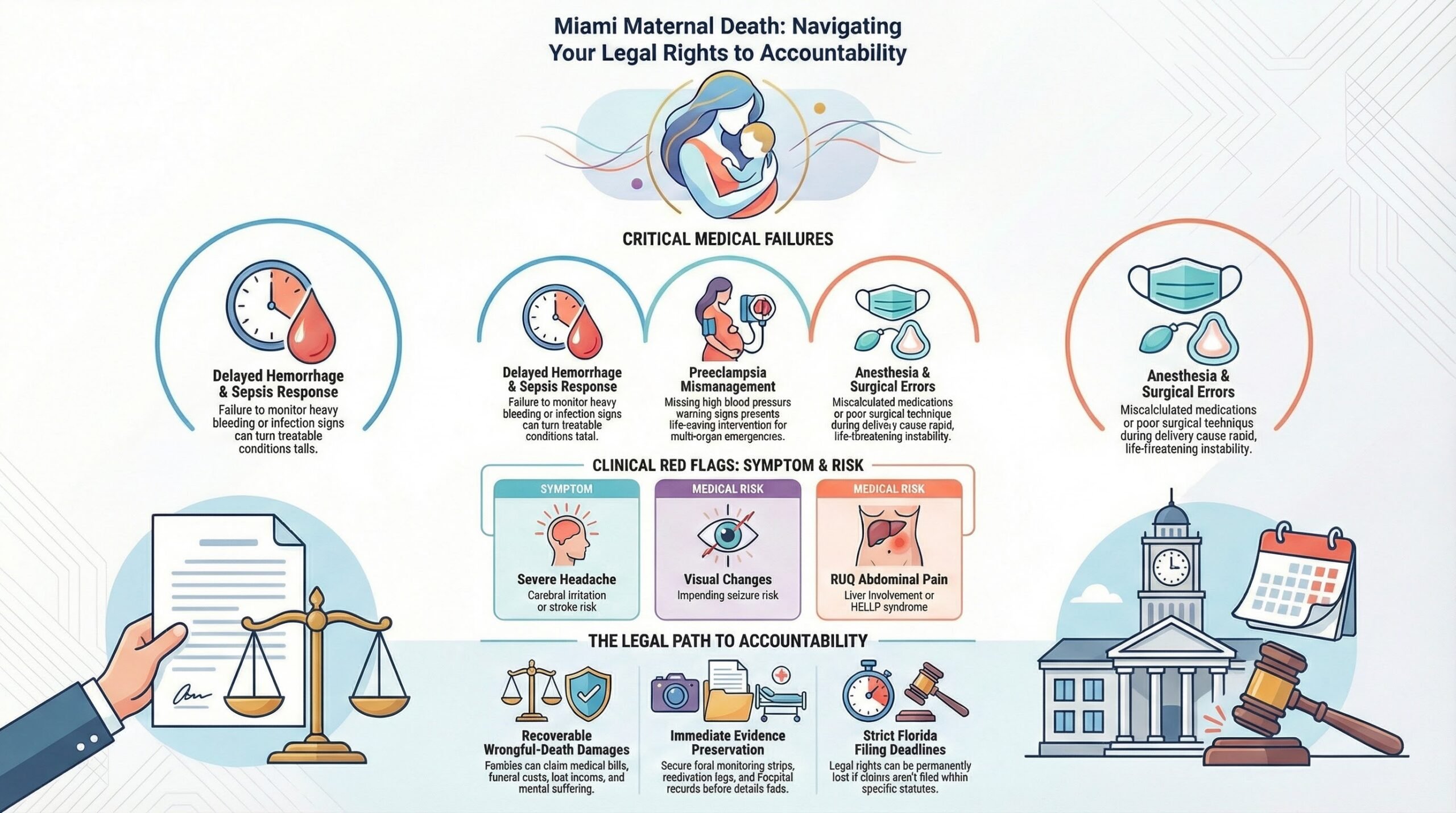
You may encounter cases involving delayed hemorrhage management, preeclampsia and eclampsia that weren’t recognized or treated promptly, and anesthesia or surgical errors during delivery or emergency procedures.
You’ll also see infection and sepsis failures, where warning signs are missed, cultures or antibiotics are delayed, or post-delivery monitoring falls short.
Delayed Hemorrhage Management
Because obstetric hemorrhage can escalate in minutes, delayed management often turns a treatable complication into a catastrophic maternal injury.
When you serve families, you know time is a clinical resource, and a missed warning sign can cost a life.
If staff delay recognizing heavy bleeding, fail to quantify blood loss, or postpone activating a hemorrhage protocol, you may face shock, organ damage, or emergency hysterectomy.
You expect rapid access to uterotonics, blood products, and Tranexamic acid, with clear escalation when bleeding persists.
When surgical control is needed, timely transfer for operative repair or Pelvic embolization can stop hemorrhage while preserving fertility.
You can help by demanding clear communication, documented reassessments, and decisive leadership, so preventable delays don’t become irreversible harm.
Preeclampsia And Eclampsia
If preeclampsia isn’t identified and controlled early, it can progress quickly from elevated blood pressure to a multi-organ emergency that endangers both mother and baby.
You serve families best by recognizing warning patterns and demanding timely escalation of care. Placental pathophysiology can drive endothelial injury, fluid shifts, and reduced organ perfusion, so delays in labs, imaging, or magnesium therapy can be catastrophic.
Ask whether biomarker screening and risk stratification were used, and whether discharge instructions reflected evolving danger.
| What you may notice | Why it matters |
|---|---|
| Severe headache | Cerebral irritation, stroke risk |
| Visual changes | Impending seizure risk |
| RUQ pain | Liver involvement, HELLP concern |
| Sudden swelling | Capillary leak, worsening disease |
| High BP/protein | Diagnostic trigger for action |
Anesthesia And Surgical Errors
Although most cesarean deliveries and labor procedures proceed safely, anesthesia and surgical errors can trigger rapid, life-threatening complications for mothers, and you can’t assume routine care guarantees protection.
If an anesthetic is miscalculated, you may suffer a Medication Overdose that depresses breathing, destabilizes blood pressure, or masks warning signs that demand immediate response.
You also face risk when clinicians fail to monitor oxygen levels, ignore allergic reactions, or delay airway support during an emergency.
In the operating room, an Equipment Failure, poor surgical technique, or uncontrolled bleeding can escalate within minutes, especially when communication breaks down among the team.
Infection And Sepsis Failures
When infection sets in during labor, after a cesarean section, or in the days following discharge, the situation can deteriorate quickly, and you can’t rely on routine checklists to catch every warning sign.
You need prompt assessment of fever, uterine tenderness, foul discharge, shortness of breath, and confusion, because sepsis can progress within hours.
Failures often begin with culture delays, in which staff postpone blood or wound cultures or fail to act while results are pending.
You’re also harmed by antibiotic omissions, such as missed prophylaxis after C-section or delayed broad-spectrum coverage when sepsis is suspected.
When clinicians dismiss symptoms as “normal recovery,” they may overlook rising heart rate and low blood pressure.
If you serve families, insist on escalation, clear documentation, and rapid treatment protocols to protect both mother and newborn.
Legal Rights of Miami Maternal Death Injury Victims


Because maternal death injuries often stem from preventable medical errors, Miami victims and their families have clear legal rights under Florida law to demand accountability and financial recovery.
Many Miami maternal deaths involve preventable errors—Florida law gives families clear rights to accountability and financial recovery.
You can seek justice in a way that honors your loved one’s service to others, while encouraging safer care for future mothers.
Florida’s wrongful death framework allows recovery through spousal rights and estate claims, depending on family structure and losses.
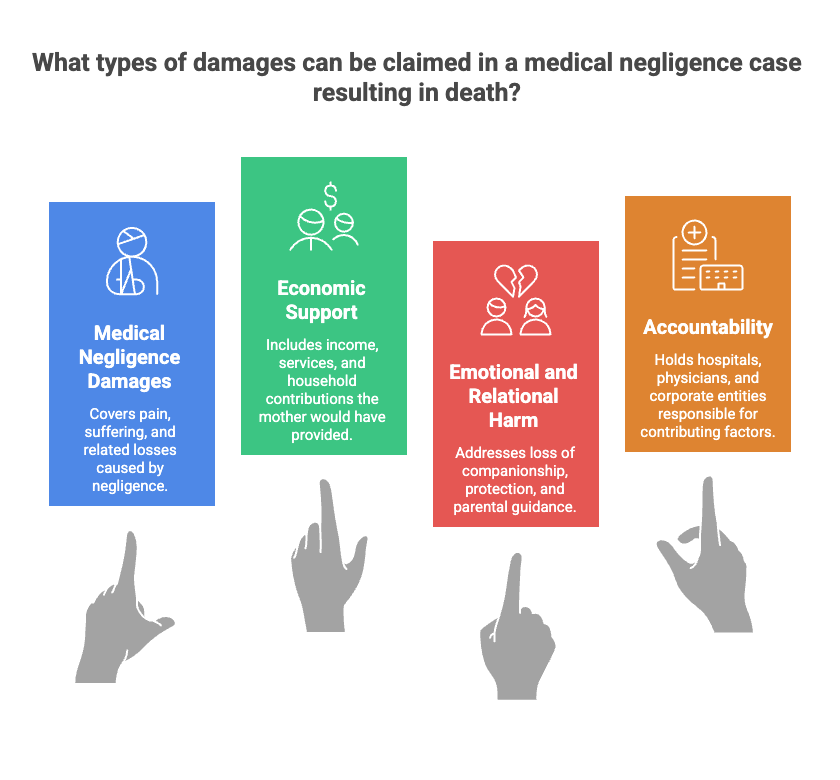
- You may pursue damages for medical negligence that caused or hastened death, including pain, suffering, and related losses.
- You can claim economic support the mother would’ve provided, including income, services, and household contributions.
- You may recover for emotional and relational harm, such as loss of companionship, protection, and parental guidance.
- You can hold hospitals, physicians, and corporate entities responsible when policies, staffing, or supervision contributed to the outcome.
You’re entitled to transparent answers, preservation of records, and fair valuation of every recoverable loss.
Steps to Take After a Miami Maternal Death Injury
After a Miami maternal death injury, you should seek an immediate medical evaluation, even if symptoms seem manageable, because prompt care can protect your health and document essential findings.
You’ll also want to preserve all records and evidence, including discharge papers, prenatal and delivery notes, medication lists, photos, and any written communications with providers.
As soon as you can, consult a maternal death lawyer, so you don’t miss crucial deadlines, and you can take informed steps to protect your family’s legal interests.
Seek Immediate Medical Evaluation
Even if the hospital has already discharged you, you should seek an immediate medical evaluation to identify complications that may not be obvious in the hours following a maternal death incident.
Ask for a thorough assessment, including critical signs, bleeding status, infection screening, and blood pressure checks, because postpartum emergencies can progress quickly.
If you can’t get an in-person appointment right away, use Telehealth Triage to describe your symptoms and receive timely direction.
Bring a Symptom Checklist that notes dizziness, severe headache, chest pain, shortness of breath, fever, worsening abdominal pain, heavy bleeding, or confusion, and update it as changes occur.
If any red-flag symptom appears, go to an emergency department immediately.
Your steady action protects you and supports those depending on your care and leadership.
Preserve Records And Evidence
OUR CONSULTATIONSARE FREE
START YOUR FREE CASE REVIEW

Preserving records and evidence can shape what you’re able to prove later, so you should start as soon as your immediate safety is addressed. Request complete hospital and EMS records, including labs, fetal monitoring strips, medication logs, and discharge instructions, then keep copies in a dedicated Document Inventory.
Photograph visible injuries, medical devices, prescriptions, and the care setting when possible, and write a dated timeline of symptoms, staff names, and statements you heard.
| Item | How you’ll safeguard it |
|---|---|
| Medical records | Download, copy, and label by date |
| Photos and notes | Back up to encrypted cloud and drive |
| Physical items | Seal, tag, and use secure Evidence Storage |
If you’re supporting the family, assign one trusted person to collect materials, limit sharing, and preserve originals.
Consult A Maternal Death Lawyer
Once you’ve secured records, photos, and other evidence, you should consult a Miami maternal death lawyer who can evaluate what happened and protect your family’s legal options. You’ll gain a clear assessment of potential negligence, deadlines, and the parties who may be responsible, so you can act with purpose rather than uncertainty.


During a Free consultation, you can share timelines, symptoms, and communications with providers, and you’ll learn what additional documents could strengthen the case. You should also ask about the Fee structure, including whether representation is contingency-based, how costs are advanced, and what happens if recovery isn’t obtained.
How a Miami Maternal Death Injury Lawyer Can Help You
When a preventable maternal death leaves your family facing unanswered questions, a Miami maternal death injury lawyer can step in quickly to protect your rights and clarify what happened.
You’ll receive guidance grounded in diligence and service, so you can pursue accountability while honoring your loved one’s care and dignity.
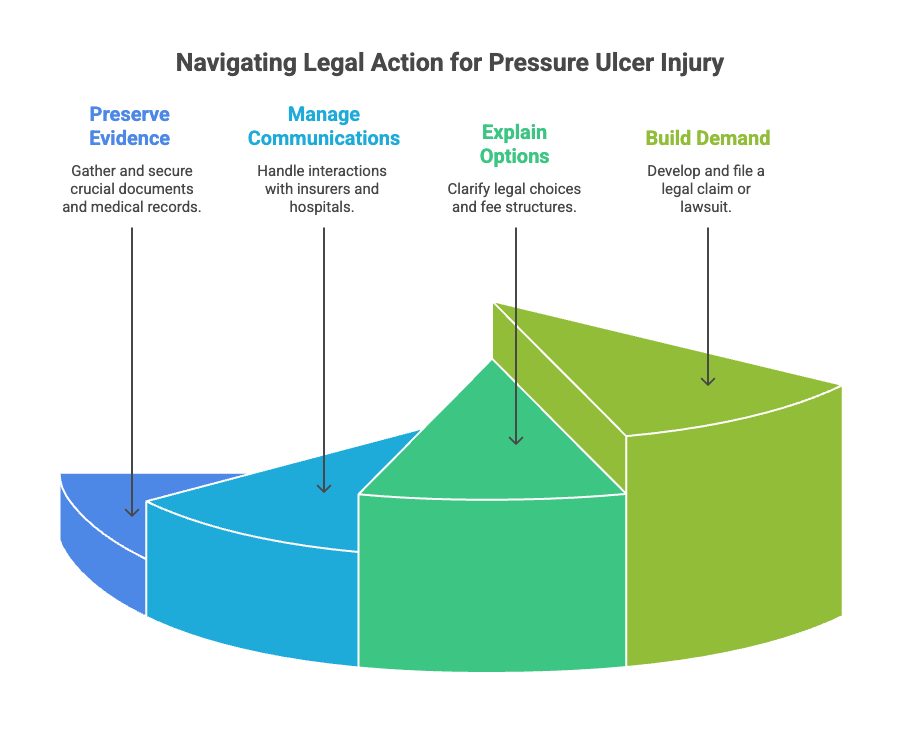
A lawyer can help you by:
- Preserving essential evidence, requesting records, and coordinating qualified medical review before details are lost.
- Managing insurer and hospital communications, setting clear Communication expectations, and reducing avoidable pressure on your family.
- Explaining your options, estimating timelines, and outlining a transparent Fee structure, often through contingency arrangements.
- Building a focused demand or lawsuit, documenting negligence, and pursuing damages consistent with Florida law and court requirements.
You won’t have to manage deadlines, filings, or negotiations alone; your counsel will shoulder the procedural burden and keep you informed at each stage.
Long-Term Effects of Miami Maternal Death Injuries
After a maternal death injury in Miami, you may face chronic physical complications that require ongoing treatment, follow-up care, and lifestyle adjustments.
You’re also likely to experience psychological trauma, which can disrupt your sleep, concentration, and relationships long after the initial crisis.
As these consequences continue, you’ll often confront ongoing financial strain from medical bills, lost income, and the cost of long-term support.
Chronic Physical Complications
Although some birth-related injuries improve with treatment, severe maternal trauma can leave you with chronic physical complications that persist for years and limit daily function. You may live with pelvic pain that disrupts walking, lifting, and caregiving, or urinary dysfunction that causes urgency, leakage, and repeated infections.
Nerve damage can reduce mobility and stamina, while surgical complications may lead to adhesions, hernias, or chronic inflammation that makes routine tasks difficult. You might require ongoing physical therapy, follow-up procedures, and workplace restrictions, even when you’re committed to serving others and staying present for your community.
Careful documentation is important because long-term limitations often emerge after discharge and evolve over time. When clinicians missed warning signs or delayed emergency intervention, you shouldn’t carry the burden alone or in silence.
Psychological Trauma Impacts
Long-term harm from a maternal death injury doesn’t stop with chronic pain or mobility limits, because psychological trauma can persist long after the hospital stay ends.
You may relive alarms, procedures, or moments of fear, and your sleep, concentration, and sense of safety can change for months.
You might also face complicated emotions while supporting others, including guilt, anger, or numbness that interfere with grief processing and daily responsibilities.
If an infant survives, you can experience attachment disruption, especially when separation, medical complications, or depression affect early bonding. These impacts can strain relationships, reduce confidence in caregiving, and make routine healthcare feel threatening.
With timely counseling, peer support, and trauma-informed care, you can stabilize symptoms, rebuild trust, and remain present for your family and community.
Ongoing Financial Strain
When a maternal injury leads to extended treatment, reduced work capacity, or permanent limitations, you can face financial pressure that outlasts the medical crisis. Bills may keep arriving long after discharge, while childcare, transportation, and home health support add steady costs.
If you serve others in your family or community, you may also absorb lost volunteer time, reduced household productivity, and the need to pay for tasks you once handled yourself.
As savings decline, you may face housing instability, missed utility payments, and damaged credit that can affect future opportunities. You should track expenses, request itemized medical statements, and pursue benefit reviews promptly.
Debt counseling can help you prioritize obligations, negotiate payment plans, and protect critical needs. A Miami maternal death injury lawyer can also pursue compensation for long-term losses.
Proving Liability in Miami Maternal Death Medical Malpractice Injury Cases
Because a maternal death case often involves fast-moving decisions and multiple providers, proving liability in a Miami medical malpractice claim requires a disciplined, evidence-driven approach. You’ll focus on what the standard of care required, who controlled each decision point, and how breakdowns in communication or monitoring led to preventable harm.
You should secure complete prenatal, labor, delivery, anesthesia, and postpartum records, then preserve fetal monitoring strips, medication logs, and incident reports before they disappear.
| What you prove | How you support it |
|---|---|
| Duty and breach | Policies, charting gaps, timeline reconstruction |
| Causation | expert testimony, causation analysis, differential causes |
| Accountability | Role mapping across OB, nurses, anesthesia, hospital |
You’ll use qualified experts to explain why a competent team would’ve acted sooner, escalated care, or ordered specific tests. By building a clear chronology and tying each lapse to a medical mechanism, you serve the family and promote safer care for others.
Compensation for Miami Maternal Death Damages
Although no financial recovery can replace a mother, compensation in a Miami maternal death claim can secure stability for the family and hold negligent providers accountable.
You can pursue damages that reflect both economic and human losses, while keeping the focus on protecting children and honoring the mother’s legacy of care.
You may seek recovery for medical bills related to pregnancy and delivery, funeral and burial costs, and the value of lost income and household services the mother provided.
You can also claim non-economic damages, including loss of companionship, guidance, and mental pain and suffering experienced by surviving family members.
If misconduct was especially reckless, you may request punitive damages to deter similar harm.
In many cases, settlements rely on insurance payouts, so you’ll want clear documentation and careful negotiation to prevent undervaluation.
You should also consider tax implications when structuring a resolution, since different categories of damages can be treated differently.
The Statute of Limitations for Miami Maternal Death Injury Cases
Securing full compensation also requires you to act within Florida’s filing deadlines, since a strong case can still fail if it’s brought too late.
Act within Florida’s filing deadlines to protect your claim—because even a strong case can fail if filed too late.
In Miami maternal death injury matters, the statute of limitations can be strict, and you should treat the earliest possible deadline as controlling while facts are confirmed.
Prompt action helps you preserve records, identify responsible parties, and protect a family’s ability to serve one another through stable support.
You may hear about the Discovery Rule, which can affect when the clock starts if essential facts weren’t reasonably knowable at first.
You should still document when you learned pivotal information, because disputes often arise over what you could have discovered with diligence.
Tolling Provisions may also pause or extend deadlines in limited circumstances, yet courts apply them narrowly.
If you delay, you risk losing leverage and, ultimately, the right to file at all.
Why You Need an Experienced Miami Maternal Death Injury Lawyer
When a preventable maternal death follows medical care in Miami, you can’t rely on assumptions or quick explanations to protect your family’s rights.
You need an experienced maternal death injury lawyer who can act quickly, secure records, and identify where care fell below accepted standards, before crucial evidence disappears or narratives harden.
You face intricate medical issues, multiple providers, and institutional defenses that can minimize accountability.
An experienced lawyer coordinates a qualified medical review, builds a clear timeline, and connects errors to the harm, so your claim reflects the full scope of loss.
You also benefit from disciplined case management, careful communications with insurers and hospitals, and a strategy that anticipates common defenses.
Beyond your case, your action can support safer care for others.
A seasoned attorney can align your pursuit of justice with Community Advocacy and Policy Reform, helping promote transparency, improved protocols, and meaningful change in maternal care systems locally.
How to Choose the Right Miami Maternal Death Injury Lawyer for Your Case
How do you choose the right Miami maternal death injury lawyer when hospitals, insurers, and multiple providers may already be shaping the story? You start by prioritizing counsel who listens, acts quickly, and treats your case as a mission to protect families and improve care.
Ask about relevant trial experience, access to qualified obstetric experts, and whether the lawyer can coordinate records from every provider without delay. Insist on fee transparency, including how costs, liens, and contingency terms will be handled.
Use a consultation checklist to consistently compare candidates, and look for clear timelines, prompt communication, and a plan that honors your loved one’s life through accountable advocacy.
| What to Ask | What You Want | Why It Matters |
|---|---|---|
| Similar case results | Specific examples | Shows readiness |
| Expert resources | OB and nursing experts | Proves causation |
| Communication plan | Weekly updates | Sustains trust |
About the Law Offices of Anidjar and Levine
A maternal death case demands a law firm that can respond immediately, preserve critical records, and build a clear liability narrative before providers and insurers control the timeline.
Maternal death cases require immediate action to preserve key records and establish liability before providers and insurers shape the timeline.
When you turn to the Law Offices of Anidjar and Levine, you get a team that acts with purpose, treating your claim as a way to protect other families from preventable harm.
You’ll receive direct communication, organized case planning, and prompt action to secure medical charts, fetal monitoring strips, and witness statements.
You also benefit from the firm’s history of advocating for injured clients across Florida, with a disciplined approach to investigation and negotiation.
The firm’s office locations support accessibility and timely meetings, so you can review developments without delay.
If litigation becomes necessary, you’ll have counsel prepared to present clear medical timelines, retain qualified experts, and pursue full accountability through settlement or trial.
Frequently Asked Questions
Can I File a Claim if My Baby Survived but the Mother Died?
Yes, you can file a claim even if your baby survived, but the mother died.
You’ll typically pursue a wrongful death action and, when appropriate, a separate medical negligence claim on the baby’s behalf.
Act quickly, because statute limitations can bar recovery if you wait.
You must also clarify whose standing and parental rights to represent the child and the estate, especially if guardianship or custody is disputed.
Who Becomes the Personal Representative for a Maternal Death Lawsuit in Florida?
In Florida, you become the personal representative through a court appointment, usually following the mother’s will.
If there’s no will, the probate court typically gives priority to the surviving spouse, or another qualified family member.
You’ll act for the estate, file the lawsuit, and protect the interests of survivors, including the child.
You must meet the eligibility requirements, and the court may require bonding or supervision.
Are Wrongful Death Settlements Taxable Under Federal or Florida Law?
You usually won’t owe tax on a wrongful death settlement, because federal taxation generally excludes compensatory damages for physical injury or sickness.
You must still review each payment category, as interest, punitive damages, and certain wage components may be taxable.
Florida doesn’t impose a state income tax, and Florida exemptions often protect recoveries at the state level.
To serve your family well, request a settlement breakdown before signing.
Can I Pursue a Claim if the Mother Signed Hospital Consent Forms?
Yes, you can still pursue a claim even if she signed hospital consent forms.
You’ll examine consent validity, including whether staff disclosed material risks, alternatives, and likely outcomes in plain terms.
You should also assess undue influence, such as coercion, rushed signing, language barriers, or impaired capacity from pain or medication.
If care fell below professional standards or consent wasn’t truly informed, you can seek accountability and protect others.
What if Medical Records Were Altered or Missing After the Maternal Death?
If medical records were altered or missing, you can still pursue accountability, and you should act quickly.
You’ll request originals, audit access logs, and preserve a strict chain of custody for every document, image, and device.
You can use forensic reconstruction, including lab results, medication records, fetal monitoring strips, and witness timelines, to show what occurred.
You can also seek court sanctions or adverse inferences when spoliation appears intentional.
—————————
If you’re facing the aftermath of a maternal death injury in Miami, you shouldn’t go through the legal process alone.
You can protect your rights by documenting what happened, securing medical records, and acting before crucial deadlines expire.
The Law Offices of Anidjar and Levine can evaluate liability, preserve evidence, and pursue damages through negotiation or litigation, while keeping you informed at each stage.
To learn more, visit our Miami Medical Malpractice Lawyer page.
When you choose carefully and act promptly, you strengthen your claim and your position.

