

At the Law Offices of Anidjar and Levine, we handle Florida T-bone truck accident claims with an immediate, evidence-driven strategy that protects your case from day one.
We investigate intersection timing, right-of-way, signal phases, and sightlines, then preserve dashcam footage, black-box data, driver logs, and carrier records before they’re lost.
We identify every liable party, from the driver and trucking company to maintenance vendors and insurers, and pursue full compensation under Florida law.
Learn more by visiting our Florida Truck Accident Lawyer page, and continue below to see what matters most next.
Key Takeaways
- T-bone truck crashes often hinge on right-of-way, signal timing, visibility, and improper turns at Florida intersections.
- A lawyer quickly preserves critical evidence: dashcams, red-light videos, black-box data, driver logs, and dispatch records.
- Liability may extend beyond the driver to the carrier, broker, shipper, or maintenance vendor under Florida negligence standards.
- Trucking claims involve layered insurance and defense experts, requiring a disciplined strategy to prove causation and maximize settlement leverage.
- Protect your rights by seeking medical care, reporting the crash, limiting statements to basic facts, and avoiding recorded statements before counsel.


How We Can Help With Your Florida T-Bone Truck Accident Claim
Take control of your claim early, because T-bone truck crashes in Florida often involve multiple liable parties and fast-moving insurance investigations.
Take control early—Florida T-bone truck crashes can involve multiple liable parties and fast-moving insurance investigations.
We step in immediately to protect your time, health, and financial stability, so you can focus on supporting your family and community.
We preserve essential evidence, coordinate medical documentation, and handle all insurer communications to prevent misstatements from being used against you.
Our team conducts thorough witness interviews, requests available video footage, and consults qualified experts as needed to build a clear narrative of what happened and how it harmed you.
We carefully calculate present and future losses, including treatment costs, income disruption, and practical household impacts.
Then we drive a disciplined settlement negotiation, presenting a well-supported demand and pushing back on low offers.
If insurers refuse to act fairly, we’re prepared to litigate and pursue accountability through trial.
OUR CONSULTATIONSARE FREE
START YOUR FREE CASE REVIEW

Understanding Florida T-Bone Truck Accident Cases
Because a T-bone truck crash typically happens at an intersection where right-of-way decisions matter, these Florida cases often turn on precise timing, visibility, and vehicle positioning rather than on a single obvious mistake.
We help you understand how investigators reconstruct moments before impact, using signal phases, sightlines, and vehicle angles to determine whose actions were reasonable under the circumstances.
We also evaluate the truck’s commercial context, including log data, onboard electronics, and company policies that may shape what occurred.
When we review driver training records, we’re not assigning blame by assumption; we’re checking whether the carrier set clear expectations and whether the driver followed them.
In parallel, we examine intersection design, such as lane markings, turn bays, and signal placement, because these features can affect decision-making and reaction time.
With this fuller view, we can explain your options plainly, so you can focus on healing while we pursue accountability that serves your family and community.
Common Causes of Florida T-Bone Truck Accidents
When we evaluate Florida T-bone truck accidents, we often see preventable conduct at intersections as the primary trigger.
We’ll explain how failure to yield, red-light violations, distracted truck driving, and improper left turns create the split-second conflicts that lead to severe side-impact collisions.
As we walk through these causes, we’ll show you what to look for in the facts and how liability may be established.
Failure To Yield
Judgment often breaks down at intersections, and a single failure to yield can turn ordinary cross-traffic into a high-impact T-bone truck collision.
We often see this when a driver misjudges a truck’s speed, assumes an opening is safe, or rolls through a turn without fully checking the oncoming lane.
When intersection geometry is confusing, sightlines shrink, and wide truck turns demand more space than passenger vehicles.
Poor signal timing can also pressure drivers to “beat the gap,” especially when short protected phases end and drivers rush to clear the intersection.
We help by examining right-of-way rules, lane markings, and driver decisions, then gathering witness statements, dashcam footage, and scene measurements.
Our goal is accountability that protects the community and supports those harmed.
Red-Light Violations
Right-of-way mistakes don’t always happen in the gray area of gaps and turns; they also occur when a driver runs a red light and cuts directly across a truck’s path.
At intersections in Florida, that single choice can cause a broadside impact because a tractor-trailer requires more distance and time to stop, even at lawful speeds.
We often review crash reports, intersection design, and signal timing to determine whether a driver tried to “beat the light,” misjudged a stale yellow, or entered after the signal changed.
When red light cameras are present, their footage and data can help confirm the sequence of events and support accountability.
By pursuing clear evidence, we help you protect others on the road and seek outcomes that encourage safer, more responsible driving for everyone.
Distracted Truck Driving
Distracted truck driving often turns an otherwise manageable Florida intersection into a high-risk conflict point, because even a brief lapse can keep a commercial driver from recognizing a changing signal or a vehicle entering the crossing lane.
In our experience, driver distraction rarely comes from a single source; it often combines visual, manual, and cognitive distractions that delay braking and steering decisions.
Electronic devices, including dispatch tablets and mobile phones, can pull a driver’s eyes off the road at the worst moment.
We also see pedestrian distraction contribute to harm when drivers fail to notice people stepping into marked crosswalks or approaching a curb.
When we serve injured families, we look for logs, camera footage, and carrier policies that show preventable inattention and accountability.
Improper Left Turns
Even when a truck driver keeps their eyes up, a single improper left turn can still set off a violent T-bone collision at a Florida intersection.
Left turns demand a full yield to oncoming traffic, yet rushed decisions, wide arcs, and illegal turns can place a trailer squarely in another driver’s path.
Turn signal misuse also creates danger, because a late, unclear, or misleading signal invites others to proceed when they shouldn’t.
We often see crashes where a truck turns across multiple lanes, misjudges speed, or follows another vehicle too closely into the intersection.
When that happens, we can help you document right-of-way violations, collect camera footage, and preserve electronic data.
United, we’ll pursue accountability and protect the community from preventable harm.


Legal Rights of Florida T-Bone Truck Accident Victims
When a T-bone truck crash disrupts your life, we can help you understand the legal rights Florida law gives injured victims and their families.
We’ll keep the focus on service, accountability, and restoring stability, while advancing Victim advocacy and supporting Policy reform that improves roadway safety for everyone.
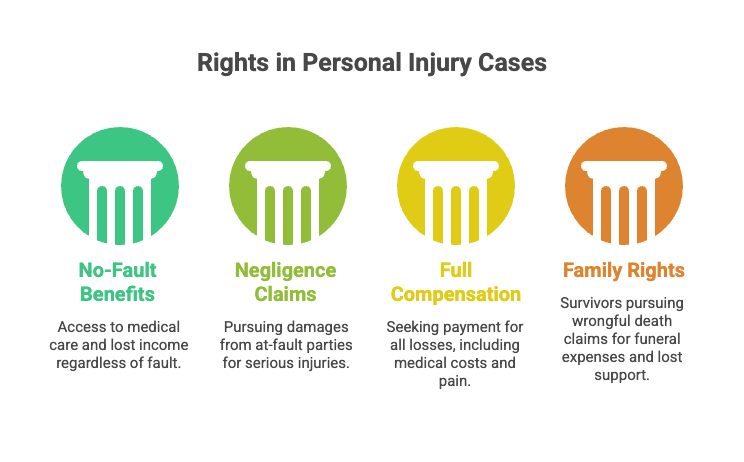
- No-fault benefits: You may access PIP coverage for medical care and lost income, even while liability questions develop.
- Negligence claims: If injuries meet Florida’s serious injury threshold, we can pursue damages from the at-fault driver, trucking company, or other responsible parties.
- Full compensation: You may seek payment for medical costs, future care, lost earning capacity, property loss, and pain and suffering when permitted by law.
- Family rights: If a loved one dies, survivors may pursue a wrongful death claim for funeral expenses, lost support, and companionship.
Steps to Take After a Florida T-Bone Truck Accident
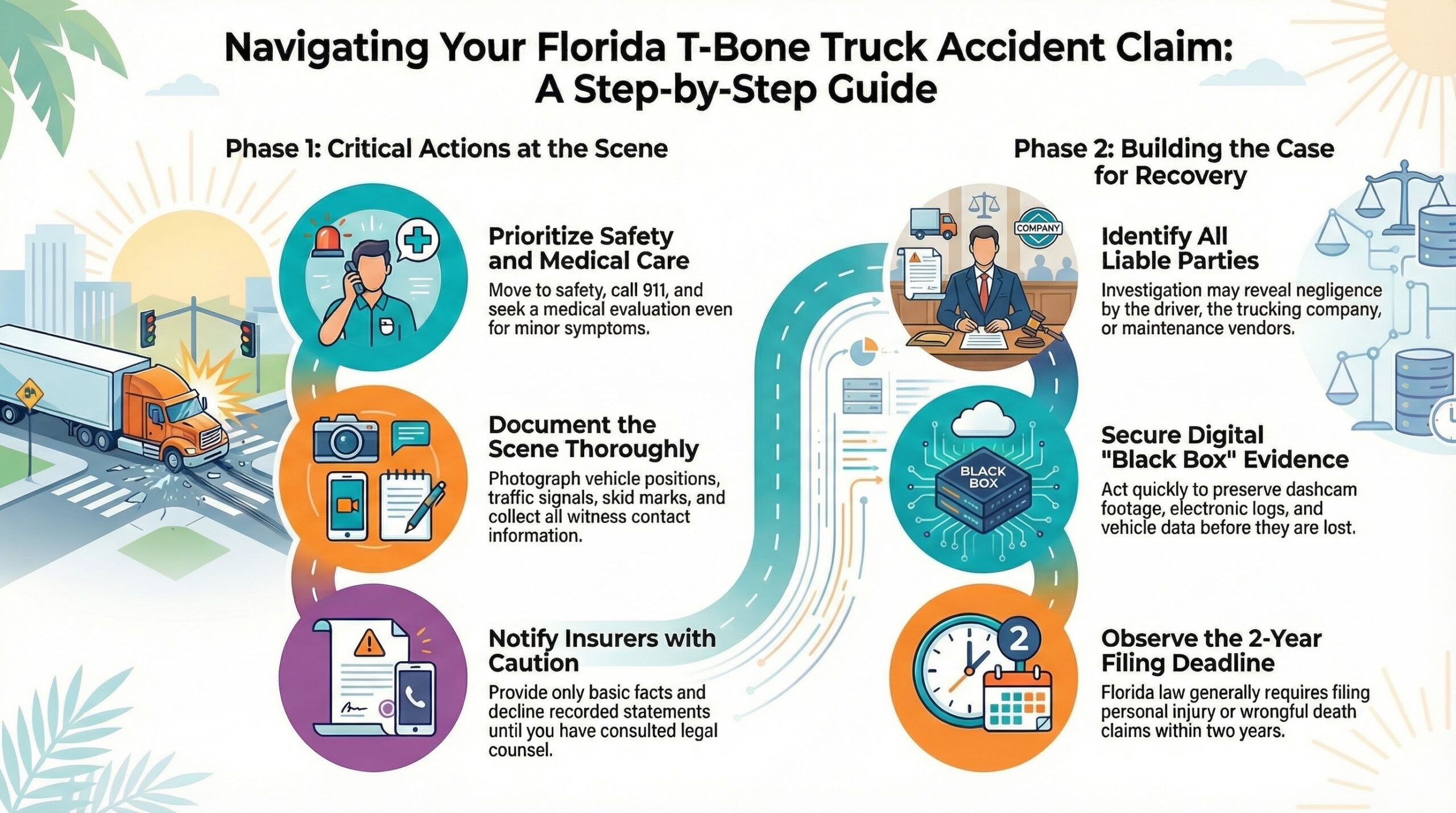
After a Florida T-bone truck accident, we’ll want you to focus first on safety and immediate medical care, even if injuries seem minor.
We should then document the crash scene thoroughly by taking photos, gathering witness information, and preserving any available evidence.
As soon as practical, we’ll notify the appropriate insurers, and we’ll speak with counsel to protect your rights and avoid missteps that can weaken your claim.
Ensure Safety And Medical Care
Although the shock of a Florida T-bone truck collision can make it hard to think clearly, we need to prioritize safety and medical care immediately.
If we can move without worsening our injuries, we should move to a safer location away from traffic and hazards and help others do the same.
We should check seatbelt engagement before moving, since a locked belt can signal hidden strain or injury.
Next, we should call 911, describe the location and injuries, and stay on the line for ambulance coordination.
If someone is unconscious, bleeding heavily, or struggling to breathe, we shouldn’t delay care or attempt risky movement.
We can offer calm reassurance, keep injured people warm, and follow dispatcher instructions until responders arrive, protecting ourselves while serving others.
Document The Crash Scene
In the moments immediately following a Florida T-bone truck crash, we should document the scene as thoroughly as we can without putting ourselves in danger.
If we can do so safely, we’ll use a phone to photograph evidence from multiple angles, including vehicle positions, lane markings, traffic signals, debris fields, and visible damage to the truck and all cars involved.
We’ll also capture close-ups of license plates, company markings, and any cargo spills or road hazards.
When conditions permit, we should measure skid marks and note distances to intersections, signs, or fixed landmarks, as these details may clarify speed and braking.
We’ll write down weather, lighting, and time, and gather contact information from witnesses, serving everyone by preserving accurate facts.
Notify Insurers And Counsel
Once we’ve secured medical care and preserved basic evidence, we should promptly notify our auto insurer and, when applicable, the trucking company’s carrier, giving only accurate, limited facts about the time, location, and vehicles involved.
We should treat this initial notice as a duty of good stewardship, because timely reporting helps protect everyone affected and supports orderly resolution.
We shouldn’t speculate about fault, injuries, or speeds, and we should decline recorded statements until we’ve spoken with counsel.
We should ask for the claim number, the adjuster’s contact information, and written confirmation of coverage inquiries.
We must also track claim timelines, including PIP reporting requirements and any deadlines for property damage or liability claims.
When we retain counsel, we let our lawyer handle communications, preserve our voice, and prevent avoidable misunderstandings.
How a Florida T-Bone Truck Accident Lawyer Can Help You
When a T-bone truck crash leaves us facing serious injuries, mounting bills, and an insurer that won’t play fair, a Florida T-bone truck accident lawyer can step in to protect our rights and take control of the claim.
We can then focus on serving our families and community while counsel manages deadlines, communications, and strategy with discipline and care.
- We gather evidence quickly, obtain crash reports, secure video, and preserve trucking records before they disappear.
- We identify every liable party, including the driver, carrier, broker, or maintenance contractor, and document damages with precision.
- We handle negotiations and, when needed, file suit, present clear demand packages, and push back against low offers.
- We guide resolution, explain liens and recovery options, and plan for post-settlement needs while maintaining client confidentiality.
With steady advocacy, we reduce uncertainty, protect our voice, and pursue fair compensation with integrity.
Long-Term Effects of Florida T-Bone Truck Accident Injuries
After a Florida T-bone truck crash, we often see injuries that don’t end when the initial treatment ends, and you shouldn’t have to shoulder their consequences alone.
We’ll explain how chronic pain and reduced mobility can limit work and daily function, how traumatic brain injuries may affect memory, concentration, and judgment, and how these changes can persist for years.
We’ll also address emotional trauma and PTSD, including sleep disruption, heightened anxiety, and avoidance behaviors, so you can recognize the signs and protect your long-term wellbeing.
Chronic Pain And Mobility
Often, the most disruptive long-term consequence of a Florida T-bone truck crash isn’t the initial emergency treatment, but the chronic pain and mobility limits that follow us into daily life.
When soft-tissue damage, fractures, or spinal injuries heal unevenly, we may experience chronic stiffness, reduced range of motion, and persistent inflammation that interfere with work and home responsibilities.
Pain can intensify with weather changes, prolonged sitting, or lifting, making consistent routines difficult.
Mobility restrictions also create gait challenges that may strain the hips, knees, and lower back and increase fall risk.
We can serve others best when we protect our own stability, so we should document symptoms, follow therapy plans, and seek timely evaluations.
We’ll also track how limitations affect daily tasks and caregiving duties.
Traumatic Brain Injury Impacts
Although a Florida T-bone truck crash may leave no obvious head wound, the force of a side-impact collision can still cause a traumatic brain injury that reshapes our health for years.
We may notice slower processing, reduced attention, or memory lapses that interfere with work, caregiving, and volunteering.
Headaches, dizziness, and sensitivity to light or noise can persist, limiting our ability to serve others safely and consistently.
Many of us also face sleep disturbances that erode concentration and prolong recovery.
With timely evaluation, targeted therapy, and cognitive rehabilitation, we can rebuild routines and regain functional independence, even when symptoms appear mild at first.
We should track changes, follow treatment plans, and seek support services that protect our long-term stability.
Early documentation also strengthens the medical record for future claims.
Emotional Trauma And PTSD
Physical recovery from a traumatic brain injury doesn’t end the harm a Florida T-bone truck crash can cause, because the psychological impact may persist long after we’ve addressed visible symptoms.
You may experience intrusive memories, hypervigilance, or sleep disruption that strains your ability to serve others with steady focus.
PTSD can also appear as irritability, panic, or emotional numbing, and these reactions often intensify when the crash involved severe injuries or loss.
We also see secondary stressors, such as medical bills, job disruption, and family role changes, which can deepen anxiety and depression.
Many survivors develop avoidance behaviors, including refusing certain intersections, driving routes, or conversations about the wreck.
We can help you document these effects, connect you with qualified care, and pursue compensation that supports long-term healing and stability.
Proving Liability in Florida T-Bone Truck Accident Cases
When a T-bone truck crash happens at a Florida intersection, proving liability depends on showing exactly who controlled the right of way and why that control was lost.
We work with you to reconstruct the seconds before impact, focusing on traffic signals, stop signs, turn lanes, and visibility limitations that may have forced a dangerous decision.
We also review whether the truck driver followed commercial safety rules, including speed, following distance, and distraction prohibitions.
To serve you well, we prioritize evidence preservation from day one. We send spoliation letters, secure black-box data, obtain dashcam footage, and gather 911 calls, witness statements, and intersection surveillance video.
We coordinate inspections of vehicle damage patterns and scene measurements, then use expert testimony from crash reconstructionists and trucking safety professionals to connect the facts to Florida negligence standards.
By documenting duty, breach, causation, and foreseeable harm, we strengthen your position for a clear determination of fault.
Compensation for Florida T-Bone Truck Accident Damages
Because a T-bone truck collision can cause sudden, high-impact losses, we build every compensation claim around a complete accounting of your economic and non-economic damages.
We document emergency care, surgery, rehabilitation, medications, and future treatment needs, then connect those costs to the collision through clear medical and financial records.
We also calculate lost wages, diminished earning capacity, and the practical expenses your family takes on while you heal, such as transportation and in-home assistance.
To serve you well, we pursue full value for pain and suffering, disability, scarring, and the loss of enjoyment of life, using credible testimony and day-in-the-life evidence.
We address medical liens early, so reimbursement demands don’t erode your net recovery without scrutiny.
When the trucking company’s conduct shows reckless disregard for safety, we may seek punitive damages to promote accountability and protect others on Florida roads.
The Statute of Limitations for Florida T-Bone Truck Accident Cases
Although a T-bone truck crash can leave you focused on medical care and recovery, Florida law still imposes strict deadlines for filing a lawsuit, and missing them can end your right to seek compensation.
We encourage you to treat time as a vital part of protecting your family’s stability and honoring the help others provide during recovery.
In most Florida personal injury cases, the statute of limitations is two years from the crash date, and wrongful death claims generally follow the same two-year period.
These filing deadlines apply even when insurance discussions continue, so we shouldn’t assume negotiations will pause the clock.
Limited exceptions may extend time in rare situations, including discovery tolling when the facts couldn’t reasonably be known immediately. Even then, courts apply these rules narrowly and expect diligence.
To serve your best interests, we can preserve evidence, document losses, and file on time before options close.
Why You Need an Experienced Florida T-Bone Truck Accident Lawyer
After a Florida T-bone truck crash, we can’t treat the claim like a routine auto accident, since trucking cases turn on focused evidence, layered insurance policies, and multiple parties with competing interests.
We act quickly to preserve driver logs, black-box data, dash-cam video, inspection records, and shipping documents before they are lost or altered.
We also identify every responsible entity, including the driver, carrier, broker, maintenance vendor, and any negligent shipper, so you’re not left pursuing only one policy.
With a service-minded approach, we document the full human cost of harm, medical needs, lost earning capacity, and daily limitations, then present it clearly and credibly.
Experience matters in Trial strategy because trucking defendants prepare their case from day one, often deploying expert teams to shift blame.
It also matters in settlement negotiations, where disciplined valuation and leverage can prevent low offers from becoming the default outcome for your family.
How to Choose the Right Florida T-Bone Truck Accident Lawyer for Your Case
When a Florida T-bone truck collision changes your life, the lawyer you choose should bring more than general injury experience and a polished sales pitch.
We should look for focused truck-crash experience, proven results in complex liability disputes, and a clear plan to quickly protect evidence, including electronic logs and scene data.
In our Client meeting, we should ask who’ll handle the case day-to-day, how often we’ll receive updates, and what resources the firm will use for investigation and experts.
We should also evaluate communication style, because service requires respect, patience, and follow-through when families need stability.
Fee structures must be explained in writing, including contingency percentages, case costs, and the treatment of limited recoveries.
Finally, we should review recent verdicts or settlements in similar T-bone cases, and confirm that the lawyer will prepare for trial, not just quick negotiations.
About the Law Offices of Anidjar and Levine
Because T-bone truck crashes often involve multiple insurers, layered liability, and time-sensitive evidence, we approach these cases with a disciplined process built for commercial-vehicle litigation.
At the Law Offices of Anidjar and Levine, we focus on service, accountability, and clear communication, so you’re never left guessing about next steps.
We secure and review crash reports, trucking records, and electronic data, then coordinate with qualified experts to explain what happened and why it matters.
We also protect your time and energy by handling calls with insurers, scheduling medical appointments when needed, and pursuing damages that reflect your full losses.
Our team measures success by the stability we help restore, not by headlines.
Client testimonials show how we prioritize responsiveness and practical guidance.
Through community outreach, we stay connected with the people we serve and bring that perspective to every decision we make for your case.
Frequently Asked Questions
How Are Attorney Fees Handled in a Florida T-Bone Truck Accident Case?
In a Florida t-bone truck accident case, we typically handle attorney fees on a contingency basis, so you don’t pay upfront, and we’re paid only if we recover compensation.
Our retainer agreement explains the contingency percentage, how it may change if litigation or appeal is required, and which case costs may be advanced and later reimbursed.
We’ll review these terms with you clearly, so you can focus on helping others.
Can I Switch Lawyers if I’m Unhappy With My Current Representation?
Yes, you can switch lawyers if you’re unhappy with your current representation. We can help you change attorneys by reviewing your contract, confirming any lien or fee obligations, and coordinating a smooth file transfer.
Client dissatisfaction often improves when expectations, communication, and strategy become clear, so we’ll also assess whether a reset could resolve concerns.
If not, we’ll guide you through ending representation in writing.
Will My Case Go to Trial, or Can It Settle Without Court?
Your case may settle without going to court, but we can’t guarantee it won’t go to trial. We’ll assess liability, damages, and insurer conduct, then pursue negotiation from a position of strength.
If discovery disputes arise or crucial evidence remains contested, a trial becomes more likely.
Although plea bargaining is typically used in criminal cases, the same disciplined approach to resolution guides our civil settlement efforts. We’ll counsel you to serve others.
How Long Do Truck Accident Settlements Typically Take in Florida?
In Florida, truck accident settlements typically take several months to over a year, depending on injury recovery, liability disputes, and insurance cooperation.
We’ll move faster once the records are complete, but the investigation timeline often extends as we secure logs, black box data, and witness statements.
We also track the statute of limitations to avoid losing leverage or filing rights.
We’ll guide you steadily, serving your needs while protecting your claim.
What Documents Should I Bring to My First Lawyer Consultation?
Bring a clear timeline of events, your driver’s license, and any photos or videos you have.
We’ll also need medical records, bills, and prescriptions, as well as insurance documents such as policy pages, claim numbers, and adjuster letters.
Bring the police report, witness names, and contact details, if available.
We encourage you to include wage records and employer notes so we can help others pursue fair accountability.
————————-
If you’ve been hurt in a Florida T-bone truck accident, the Law Offices of Anidjar and Levine is prepared to protect your rights and pursue full compensation.
We’ll investigate liability, secure crucial evidence, and handle insurer and trucking company demands while you focus on recovery.
Because deadlines and proof requirements can affect your claim, prompt action matters.
We can clearly explain your options, accurately estimate your damages, and advocate for a fair settlement or trial outcome.
Contact a Florida Truck Accident Lawyer to discuss next steps today.

