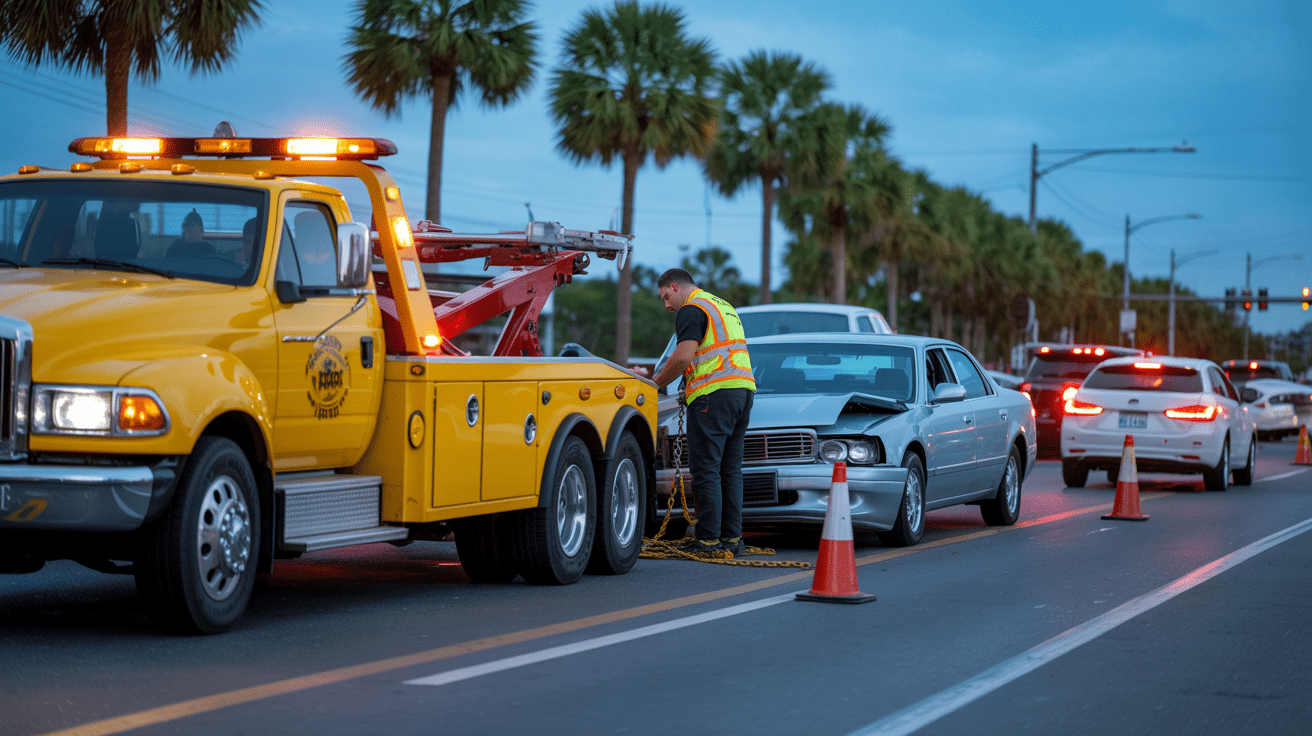
Okay. So we all pretty much know the drill with a standard car crash, right? But what happens when the other vehicle is a tow truck? Well, the aftermath can get way more complicated really fast.
Learn more: Tampa Tow Truck Accident Lawyer
Today, we’re going to break down everything you need to know if you’re ever in a collision with one. So what’s the big deal? Why is a tow truck accident a whole different animal than a regular car crash? You know, at first it might just seem like another accident, but trust me, it’s not.
Getting a handle on these unique complexities is absolutely the first step to protecting yourself. Yeah. These are definitely not your simple fender benders. You’re suddenly dealing with all these different layers of responsibility, not to mention a whole bunch of specific industry rules that make it a completely different ballgame.
Let’s dive into what that really means. See, with a normal crash, it’s usually just you and the other driver. But here, oh, it gets complicated. You could be dealing with the driver, the towing company they work for, maybe even outside contractors.
And each one is tangled up in this web of regulations, and you better believe they might all start pointing fingers at each other. The driver might blame bad equipment. The company blames the driver. It’s a mess.
This means figuring out who’s liable isn’t a straight line, and that’s why identifying every single responsible party is so crucial. Okay. In those first few moments after a crash, everything is just chaos. Right?
Your head’s spinning, and it’s so easy to feel completely overwhelmed. But knowing exactly what to do can make all the difference. Let’s walk through the immediate actions you should take to protect your health and your rights. These three steps are your foundation.
Step one, and this is non negotiable. Your safety. Call nine eleven and get checked out. Even if you feel okay because adrenaline is a powerful thing and can hide serious injuries.
Second, you need to become a bit of an investigator right then and there. Use your phone, take pictures and videos of absolutely everything. The damage, the road, any skid marks, and get contact info from anyone who saw what happened. And third, the clock is ticking.
Getting legal advice within a day or two is so important because crucial evidence can vanish really quick. Alright. Let’s get into the why. Why do these specific accidents even happen?
It’s important because honestly, most of the time it comes down to things that were totally preventable, which usually points straight to negligence.
You know, driving a tow truck isn’t just like driving a big pickup. It’s a seriously skilled job. But sometimes companies cut corners on training. And when a driver doesn’t really get the physics of balancing a heavy load or how to secure a car properly, they’re literally putting all of us on the road at risk. When getting trucks out there fast is more important than proper training, public safety gets put on the back burner. And hey, it’s not always the driver’s fault. Sometimes it’s the gear itself.
Imagine a worn out cable finally snapping or a hydraulic lift failing mid operation. Suddenly you’ve got a two ton vehicle loose in the middle of traffic. These are exactly the kind of mechanical failures that regular simple safety inspections are supposed to prevent, but some operators just don’t do them. This one is huge.
Improper loading. If a vehicle isn’t secured with absolute precision, its weight can shift, maybe during a turn or a sudden stop. This can throw the whole tow truck off balance, making the driver lose control. We’re talking jackknifing or even the towed car just breaking free entirely.
It’s a terrifying and preventable danger that usually comes from rushing the job or just not knowing how to do it right. And of course, there’s the human factor. Tow truck drivers often work incredibly long, grueling hours. So you take someone who is exhausted, maybe sleep deprived, and then you add in the distraction of a smartphone, you’ve got a recipe for disaster.
That combination is dangerous for anyone driving, but it’s especially hazardous when you’re behind the wheel of heavy equipment. So if any of that negligence leads to you getting hurt, it’s not just about what happened, it’s about what you’re owed. And understanding your legal rights here is absolutely essential if you want to navigate the whole claims process and get a fair outcome. Think of these rights as your shield. You have the right to be compensated for everything you’ve lost, the right to have an expert fighting in your corner, and this one’s so important, the right to say no to a lowball offer from an insurance company that’s just trying to protect its profits. These rights are the very foundation of your claim.
So when we talk about compensation, what does that actually mean? It really breaks down into two main buckets. Over on the left, you’ve got economic damages. These are the things you can put a price tag on, like medical bills, lost paychecks, and car repairs. But then on the right, you have noneconomic damages. These are for the impacts that don’t come with a receipt, but are just as real. The physical pain, the emotional trauma, and how the injury affects your ability to just enjoy your life.
Okay, I want you to really pay attention to this number. This right here represents your most critical, absolutely non negotiable deadline. This isn’t a suggestion, it is a hard and fast rule.
This two year period has a legal name: the statute of limitations. Here in Florida, you have exactly two years from the date of the accident to file a lawsuit. And let me be clear: If you miss this window, it doesn’t matter if it’s by a week or by a single day, you could permanently lose your right to seek any compensation at all. The door just slams shut.
Look, trying to go up against massive insurance companies and their legal teams, all while you’re trying to recover from a serious injury, it’s just, it’s a daunting, almost impossible task. The system can be confusing on purpose and this is exactly where getting experienced professional help becomes so incredibly valuable. A good lawyer doesn’t just give you advice. They take the entire burden off your shoulders.
They become your investigator, digging up evidence. They’re your negotiator, handling all the back and forth with the insurance company. They manage all the paperwork, the deadlines, everything. This lets you focus one hundred percent on the only thing that should matter, your health and your recovery.
Now, I know what a lot of people are thinking. How in the world can I afford to hire a lawyer right now? It’s a completely valid concern. But here’s the reality.
Most personal injury lawyers work on what’s called a contingency fee. It’s simple. It means you pay nothing upfront, zero. The lawyer only gets paid if they successfully win compensation for you.
This whole model is designed to make sure that everyone, no matter their financial situation, has access to just it. Recovery really is a marathon, not a sprint. The effects of a bad accident don’t just magically disappear when you leave the hospital. They can ripple out and affect every single part of your life, sometimes for years and years to come.
You know, the long term fallout really tends to land in three big areas. The physical part, like chronic pain or a new disability, the emotional trauma, which can be just as debilitating, and of course the long term financial strain from medical care and not being able to work like you used to. A truly fair compensation claim has to take all of these future impacts into account, not just the bills you have today. And this quote, wow. This really hits the nail on the head. The invisible injuries are often the ones that stick around the longest.
Things like anxiety, PTSD, these aren’t just in your head. They are real, they are serious, and they deserve to be taken just as seriously as any broken bone. So what’s the big takeaway from all of this? It’s this, After a horrible event like a major accident, something that makes you feel totally powerless, knowledge is how you start to take that power back. Being informed, knowing your rights, and understanding the steps you need to take, that is what lets you navigate the path forward and fight for the justice you deserve.