

span style=”font-weight: 400;”>The Law Offices of Anidjar and Levine can assess whether a rear-end, side-impact, or head-on crash may help explain reported injuries and identify evidence relevant to responsibility. Collision photographs, witness accounts, police reports, medical records, and available video may clarify how the crash occurred. The firm can also explain Florida Personal Injury Protection coverage, potential additional recovery, and applicable deadlines. Learn more about working with a Port St. Lucie Personal Injury Lawyer. The sections below outline collision causes, injury documentation, insurance considerations, and options for legal support.
Main Takeaways
- A Port St. Lucie car accident lawyer can assess how a rear-end, T-bone, head-on, or sideswipe collision occurred.
- Collision type alone does not establish fault; police reports, witness accounts, photos, and video may help show responsibility.
- Speeding, distraction, impairment, unsafe lane changes, and failure to yield may contribute to collisions and injuries.
- Prompt medical care and organized treatment records can document injuries, symptoms, and related expenses.
- A lawyer can review available evidence, investigate disputed facts, and explain options for pursuing compensation.


How We Can Help With Your Port St. Lucie Car Accident Collision Injury Claim
After a Port St. Lucie car accident, an injured person may face medical expenses, missed work, and uncertainty about the next steps. A lawyer can help organize the claim, explain available legal protections, and communicate with insurers on the client’s behalf. This support lets the injured person focus on recovery while the lawyer handles the claim with care and diligence.
Counsel can gather records, review relevant documents, identify responsible parties, and assess the evidence-supported losses. The Claim timeline depends on factors such as treatment progress, information availability, and insurer response. Regular updates help clients understand what’s been completed and what remains outstanding.
A lawyer can also explain settlement options, evaluate proposed terms, and discuss whether an offer reasonably addresses documented losses. If negotiations don’t produce a fair resolution, counsel can outline next steps. Throughout the process, clear guidance helps clients make informed decisions and pursue accountability without unnecessary confusion.
OUR CONSULTATIONSARE FREE
START YOUR FREE CASE REVIEW

Understanding Port St. Lucie Car Accident Collision Types Injury Cases
Understanding how a collision occurred can clarify which injuries may be connected to the crash and what evidence may support a claim. Different collision patterns can subject occupants to different forces, helping explain why injuries vary in location and severity. In T-bone collisions, the side of a vehicle may offer less protection than its front or rear, and occupants can sustain injuries to the head, chest, or limbs. Head-on crashes may expose occupants to abrupt forward movement, potentially causing fractures, spinal injuries, or trauma that requires continuing care.
A careful review of medical records, photographs, vehicle damage, and witness accounts can help establish how the impact unfolded and whether reported injuries are consistent with it. This information may also clarify the scope of treatment, recovery needs, and related losses. Each case requires an individual assessment, since injury effects can emerge over time. A lawyer can help organize relevant evidence and pursue a claim that reflects the injured person’s needs.
Common Causes of Port St. Lucie Car Accident Collision Types
Common collision causes in Port St. Lucie include distracted driving, speeding, and reckless behavior, each of which can reduce a driver’s ability to respond safely. Unsafe lane changes may lead to sideswipe or merging crashes, while impaired driving can compromise judgment and vehicle control. Identifying the cause can help clarify how a collision occurred and what evidence may be relevant.
Distracted Driving
Distracted driving occurs when a motorist’s attention shifts from the road, increasing the risk of a collision in Port St. Lucie. This behavior may involve visual, manual, or cognitive distractions, each of which can reduce a driver’s ability to notice changing traffic conditions and respond safely. Phone use is a frequent source of distraction, whether a driver is texting, checking notifications, or placing a call. Dashboard distractions, including navigation systems and vehicle controls, can also draw attention away from nearby vehicles, pedestrians, and signals. Even brief inattention may contribute to rear-end crashes, side-impact collisions, or other serious incidents. Focused drivers help protect passengers and everyone sharing the road. Understanding how distraction contributed to a crash can help affected individuals identify relevant evidence and consider appropriate next steps.
Speeding and Reckless Driving
When drivers exceed safe speeds or disregard traffic laws, they have less time to react and may lose control of their vehicles. In Port St. Lucie, speeding can increase collision force and the risk of serious injuries to drivers, passengers, pedestrians, and others on the road. Reckless conduct, such as aggressive acceleration or ignoring posted limits, may contribute to crashes and complicate efforts to determine responsibility.
Florida law provides speeding penalties, which may include fines and other consequences depending on the circumstances. More serious conduct can lead to Reckless Driving Charges, particularly when a driver’s actions show a willful or wanton disregard for others’ safety. After a crash, evidence such as witness accounts, vehicle damage, and available records may help clarify how speed or reckless behavior contributed. Those affected may need support in understanding their options.
Unsafe Lane Changes
Unsafe lane changes can cause sideswipe and merging collisions when a driver changes lanes without checking blind spots, signaling, or leaving enough space. In Port St. Lucie, these lane changes may endanger people in adjacent lanes, including drivers traveling predictably or making room for others. Blind-spot checks should supplement mirror use because mirrors alone may not show vehicles, motorcycles, and bicycles. Turn signal timing also matters: a signal should provide adequate notice before a vehicle begins moving, not merely announce a lane change already underway. Drivers who change lanes abruptly, cross multiple lanes, or misjudge another vehicle’s speed can force sudden braking or evasive action. Careful lane selection and patient merging help protect everyone sharing the road. When a collision occurs, evidence may clarify whether a driver failed to use reasonable care.
Impaired Driving
Impaired driving can contribute to serious collisions in Port St. Lucie when alcohol, illegal drugs, or certain medications reduce a driver’s judgment, coordination, or reaction time. A driver who fails to recognize hazards or maintain a safe lane may cause a rear-end crash, head-on collision, or other preventable impact. DUI checkpoints are one enforcement measure used to identify suspected impaired drivers and deter dangerous conduct. However, crashes can still occur despite these efforts, leaving injured people and families to manage medical needs, lost income, and other consequences.
After a collision, investigators may review police reports, witness accounts, toxicology results, and available video to determine whether impairment played a role. Depending on the facts, dram shop liability may also arise if an alcohol provider unlawfully served a visibly intoxicated person. Each claim requires careful evaluation.
Don’t Wait. Call Our Florida Personal Injury Lawyers Now!


Legal Rights of Port St. Lucie Car Accident Collision Types Injury Victims
The legal rights of people injured in Port St. Lucie car collisions include seeking appropriate insurance benefits and, when supported by evidence, compensation from responsible parties. Understanding these protections can help injured residents make informed decisions while preserving their ability to support family and community obligations. Florida’s no-fault system generally requires drivers to use Personal Injury Protection coverage for qualifying initial medical expenses and lost income, subject to policy limits and deadlines. Additional recovery may be available when injuries meet legal thresholds.
Florida’s no-fault system provides initial benefits, while qualifying injuries may allow additional recovery from responsible parties.
- Injured people may submit a timely claim under their Personal Injury Protection policy.
- They may pursue an at-fault driver when Florida law permits recovery beyond no-fault benefits.
- Uninsured Motorists coverage may provide benefits when an eligible crash involves an uninsured driver, subject to policy terms.
- They may request relevant records, document losses, and consult a qualified attorney before accepting a settlement.
Rights and deadlines depend on the facts, available coverage, and applicable law. Prompt, careful review can protect a claim.
Why Do Port St. Lucie Car Accident Collision Types Injuries Happen?
Car accident injuries in Port St. Lucie often happen when a collision transfers force to people inside or near a vehicle. Severity depends on impact speed, vehicle size, restraint use, and the angle of the crash. Rear-end collisions may cause sudden neck and back movement, while side impacts can expose occupants to substantial force because less vehicle structure separates them from the point of impact. Head-on crashes may produce serious injuries when vehicles meet at speed.
Several conditions can contribute to these collisions. Distracted driving, speeding, impaired driving, and failure to yield can prevent motorists from responding safely to changing traffic. Road design, including limited visibility, confusing intersections, or inadequate lighting, may also increase risk. In some cases, vehicle defects, such as faulty brakes or tires, can affect a driver’s ability to control a car. Weather and road conditions can further reduce traction or visibility, making careful driving vital to protect everyone on the road.
What Should You Do After a Port St. Lucie Car Accident? Collision Types and Injuries
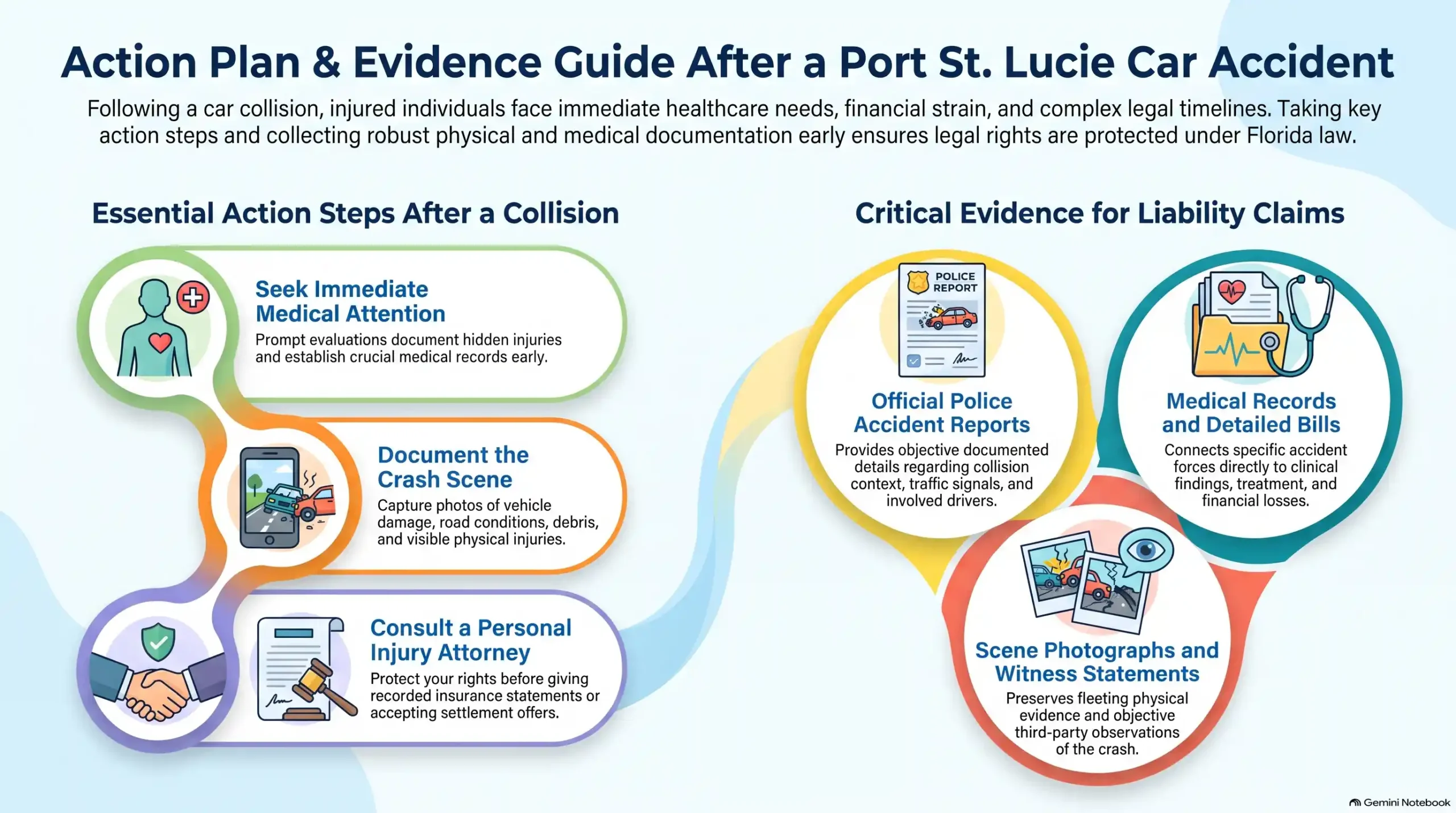
After a Port St. Lucie collision, injured individuals should seek prompt medical care, even if symptoms initially appear minor. They should document the scene, vehicle damage, injuries, and relevant witness information while preserving available records. Contacting a qualified lawyer can help clarify legal options and protect the injured person’s interests.
Seek Medical Care
Because some collision-related injuries are not immediately apparent, anyone involved in a Port St. Lucie car accident should seek medical care as soon as possible. A prompt evaluation can identify injuries that may worsen without treatment, including head, neck, and internal injuries. If symptoms are severe or life-threatening, contact emergency services rather than trying to drive yourself. For less urgent concerns, Urgent Care may provide an appropriate assessment, although a physician can advise whether emergency evaluation is necessary. Even if an initial examination shows no serious injury, consider follow-up care if discomfort develops or persists. Symptom Monitoring helps identify changes such as increasing pain, dizziness, confusion, or limited movement. Clear communication with healthcare providers supports appropriate treatment and helps protect the injured person’s health and ability to recover.
Document the Collision
When it is safe, documenting a Port St. Lucie collision can help preserve an accurate account of what happened. The injured person or a trusted companion may photograph vehicle positions, damage, traffic signals, road conditions, and visible injuries, as long as it does not delay necessary care. Vehicle damage patterns may help clarify the direction and force of impact, while roadway debris analysis can offer context about where vehicles collided or moved afterward. Record witness names and contact details, along with the date, time, and location. Keep copies of medical records, repair estimates, and any incident report. Notes made soon after the crash can preserve details that may otherwise fade. Collect information carefully and share it only through appropriate channels, respecting others’ privacy.
Contact a Lawyer
A Port St. Lucie collision injury can create medical, financial, and insurance concerns that require careful attention. After documenting the crash and seeking appropriate medical care, an injured person may contact a lawyer to understand available options. A lawyer can review collision details, identify potentially responsible parties, explain deadlines, and help preserve records relevant to a claim. Early guidance may also reduce the risk of giving an insurer incomplete or inconsistent information.
During a Free consultation, the injured person can describe the incident, discuss treatment and losses, and ask how the legal process may proceed. Questions about attorney availability, experience with similar collision cases, fees, and communication practices can help determine whether representation is suitable. A lawyer can also explain what documents to gather and how to prioritize recovery while protecting the person’s legal interests.
Don’t Wait. Call Our Florida Personal Injury Lawyers Now!
Critical Evidence in a Port St. Lucie Car Accident Collision Types Injury Case
Reliable evidence can help establish how a Port St. Lucie collision occurred and document the resulting injuries.
Essential materials may include:
- Crash scene photographs
- Police accident reports
- Medical records and bills
- Witness statements
Each item can preserve details that may otherwise be difficult to verify later.
Crash Scene Photographs
Photographs taken at a crash scene can preserve details that may change or disappear before an investigation is complete. Images of vehicle positions, damage, skid marks, debris, traffic signs, and road conditions may help clarify how a collision occurred. Photo angles matter: wide views can show the scene’s layout, while close views can document specific damage or hazards. When safely possible, take images from several directions without disturbing evidence. Timestamp verification can help establish when photographs were created, but check device settings for accuracy. Clear, unedited originals are generally more useful than cropped or enhanced copies. These records may assist injured people, their families, and others seeking a fair account of events. Preserve photographs securely and share them with qualified legal counsel for review.
Police Accident Reports
Beyond scene photographs, a police accident report can provide an official record of a Port St. Lucie collision. Officers may document the date, location, vehicles, involved parties, road conditions, and statements gathered at the scene. The report may also identify witnesses and note apparent factors such as traffic signals or vehicle damage. These details can help clarify how a crash occurred and support a careful review of competing accounts. However, an officer’s conclusions are not necessarily definitive, and a report may contain omissions or factual errors. Injured people or their representatives can ask about report access through the responding agency and review the document promptly. If inaccuracies appear, report corrections may be requested through the appropriate department process. Keeping this record can help ensure a fair evaluation of responsibility and accountability.
Medical Records And Bills
Medical records and bills can help document the injuries and treatment associated with a Port St. Lucie car accident. Physician notes, diagnostic results, prescriptions, and therapy records may show how clinicians assessed and treated collision-related harm over time. These documents can also connect reported symptoms to clinical findings and identify continuing care needs. Organizing medical records helps confirm they are complete, dated, and arranged in a clear sequence. Consistent documentation may assist a claim review and help prevent important treatment details from being overlooked.
Billing statement verification is also important. Itemized statements should be checked against provider records, insurance explanations, and payments to identify errors or duplicate charges. Accurate bills can clarify the costs of emergency care, follow-up visits, medication, and rehabilitation. Careful recordkeeping supports a fair evaluation of damages and helps injured people pursue appropriate resources.
Witness Statements
Alongside medical records and bills, witness statements can help clarify how a Port St. Lucie car accident occurred and how the collision affected those involved. Independent observers may describe vehicle positions, traffic signals, road conditions, and actions taken before impact. Their accounts can support or challenge other evidence, including photographs and the drivers’ descriptions.
Witness credibility depends on factors such as the person’s opportunity to observe, consistency, and possible relationship to a party. A careful review can identify gaps or differences without assuming that any account is conclusive. Preserving statements promptly matters because memories can fade, and contact information can become hard to obtain. When appropriate, witnesses may provide written or recorded accounts for later review. Organized, accurate statements help attorneys assess responsibility and present a clearer account, supporting a fair resolution for injured people.
Long-Term Effects of Port St. Lucie Car Accident Collision Types Injuries
The long-term effects of car accident injuries can include chronic pain and physical limitations that interfere with daily activities and work. Some people also experience lasting brain or nerve problems, depending on the collision’s nature and severity. These effects may contribute to ongoing emotional distress and financial strain.
Chronic Pain And Limitations
How long pain lasts after a Port St. Lucie car accident depends on the injury, treatment, and individual recovery. Some people experience persistent neck, back, shoulder, or joint pain that limits routine activities long after initial care. Collision forces may aggravate existing conditions or cause soft-tissue injuries that mend slowly. Pain flare triggers can include prolonged sitting, lifting, repetitive movement, or changes in activity. Identifying these patterns can help patients and clinicians adjust treatment and daily routines. Mobility adaptations, such as using supportive equipment or modifying household tasks, may help preserve independence while reducing strain. Ongoing symptoms can affect work, caregiving, and community participation. Consistent medical follow-up helps document limitations and guide care. When injuries disrupt daily responsibilities, accurate records can clarify the lasting effects and support informed decisions about recovery and assistance.
Lasting Brain And Nerve Effects
Although some symptoms improve as injuries recover, a Port St. Lucie collision survivor may experience lasting brain or nerve effects. A blow to the head or sudden force through the body can disrupt normal brain function, even when initial symptoms appear mild. Post traumatic headaches may persist or recur, sometimes alongside dizziness, sensitivity to light, or difficulty concentrating. Nerve damage can also cause neuropathic symptoms, including numbness, tingling, burning sensations, or weakness in affected areas. These problems may interfere with sleep, balance, memory, and the ability to complete routine tasks safely. Medical assessment can help identify the source of symptoms and guide appropriate treatment. Keeping records of changes and following clinical recommendations can support continuity of care and help ensure that those providing assistance clearly understand the survivor’s needs.
Emotional And Financial Strain
Beyond physical symptoms, a serious Port St. Lucie car accident can create lasting emotional and financial strain. Persistent pain, disrupted sleep, or reduced independence may contribute to anxiety, depression, and difficulty returning to work. These effects can also alter family routines, as relatives take on caregiving duties or provide practical support. Relationship Stress may develop when responsibilities shift, income declines, or recovery takes longer than expected. Medical appointments, rehabilitation, prescription costs, and lost wages can place sustained pressure on a household. Careful Household Budgeting may help families prioritize necessary expenses and plan for continuing care, but it cannot replace reliable income or address every unexpected cost. Clear communication and access to appropriate professional support can help injured people and their families manage these challenges while preserving stability and dignity throughout recovery.
Proving Liability in Port St. Lucie Car Accident Collision Types Injury Cases
Proving liability in a Port St. Lucie car accident requires evidence showing how the collision occurred and who failed to exercise reasonable care. A careful investigation may examine police reports, witness accounts, photographs, roadway conditions, and relevant vehicle records. Each source can help establish the sequence of events and clarify whether a driver’s conduct contributed to the injuries.
Traffic camera analysis may reveal vehicle positions, traffic signals, speed, or actions immediately before impact. When footage is unavailable, vehicle damage reconstruction can help assess the direction and force of a collision, although conclusions should be supported by reliable physical evidence. Investigators may also compare damage patterns with statements and scene measurements to identify inconsistencies.
Prompt documentation can preserve information before vehicles are repaired or memories fade. Clear records of medical treatment and resulting limitations can connect the collision to the harm suffered. A thorough, evidence-based assessment helps injured people pursue accountability while supporting a fair resolution grounded in the circumstances.
Dealing With Insurance Companies After a Port St. Lucie Car Accident: Collision Types and Injuries
After a Port St. Lucie car accident, injured people may need to communicate with insurers while managing medical care and other responsibilities. Insurers may request information about the collision, injuries, and treatment, but statements should remain accurate and consistent with available records. Before providing Recorded statements, a claimant may benefit from understanding how insurers could use the information to assess responsibility or the extent of an injury. Do not guess about details or minimize symptoms that have not yet been fully evaluated.
Written communications, photographs, medical records, and repair estimates can help clarify the facts. Review documents carefully before signing a release or accepting payment, since some agreements may limit future recovery. If an insurer disputes responsibility, questions the injury, or denies a claim, the claimant can request an explanation and preserve relevant correspondence. Legal guidance can help you identify appropriate responses while protecting your interests and supporting a fair, informed resolution.
What to Expect During a Port St. Lucie Car Accident: Collision Types, Injury Claim Process
A Port St. Lucie car accident injury claim typically begins with an initial case review to assess the collision, injuries, and available legal options. Evidence collection then helps establish how the crash occurred and document the resulting losses, supporting negotiations with the insurer. If the claim is resolved through settlement or another outcome, the final stage addresses the terms of resolution and payment.
Initial Case Review
During an initial case review, a Port St. Lucie car accident lawyer considers how the collision affected the injured person and what support may be needed. This initial case review clarifies the client’s priorities, explains the general claims process, and identifies questions that need further attention. The attorney may discuss the type of collision, reported injuries, medical care to date, missed work, and the challenges the person faces in daily life. A Claim Assessment also considers potential responsibility, available insurance coverage, and deadlines that could affect the claim. The lawyer explains possible paths forward without promising a particular result. This early discussion allows the injured person to make informed decisions and focus on recovery while understanding how the claim may proceed. The lawyer addresses evidence gathering and detailed investigation separately as the process continues.
Evidence Collection
Because evidence can change or become harder to obtain over time, a Port St. Lucie car accident lawyer may begin gathering records soon after reviewing a collision injury claim. Evidence preservation can include securing photographs of vehicle damage, roadway conditions, traffic controls, and visible injuries. The legal team may also collect police reports, medical records, repair estimates, witness accounts, and, when available, electronic data from vehicles. Each item can help clarify how the collision occurred and what harm followed.
Surveillance retrieval may involve identifying nearby businesses, residences, or public agencies with cameras that recorded the crash. Because recordings may be routinely erased, prompt requests matter. Investigators may document the scene, locate witnesses, and organize collected materials for review. Careful collection helps preserve information relevant to the injured person’s account and supports a reliable assessment of the claim’s circumstances.
Claim Negotiations
After reviewing the available evidence and injury records, settlement negotiations may begin with the at-fault driver’s insurer. The injured person’s representative typically presents a demand outlining the collision circumstances, documented losses, and legal basis for compensation. A sound Demand strategy accounts for medical expenses, lost income, future care needs, and how injuries affect daily responsibilities. Insurers may question fault, treatment, or the value of claimed losses, so responses should rely on records and consistent facts. Negotiation leverage may come from clear evidence, credible medical documentation, and a well-supported account of how the collision affected the injured person and those who depend on them. The parties may exchange proposals and supporting information while evaluating disputed issues. Careful communication can keep discussions focused on fair consideration of the claim and its documented impact.
Resolution And Payment
When the parties reach a settlement or a court resolves the claim, the next steps depend on the terms of that outcome and any remaining legal requirements. The settlement timeline may include signing release documents, confirming outstanding medical balances, and allowing the insurer to process payment. These steps can affect when funds become available, so claimants should review deadlines and deductions carefully.
Payment options may include a single payment or, in some cases, structured installments. Before funds are distributed, the recovery may be reduced by applicable liens, legal fees, and case expenses. A claimant should confirm the final accounting and retain copies of settlement documents. If a court enters judgment, payment may require additional procedures, particularly if the responsible party disputes or delays compliance. Clear records help make certain the resolution is handled accurately and fairly.
Compensation for Port St. Lucie Car Accident Collision Types Injury Damages
Compensation after a car accident in Port St. Lucie depends on the collision, resulting injuries, and available evidence. An injured person may seek payment for reasonable medical care, rehabilitation, and future treatment related to the crash. Compensation may also cover lost income during recovery and reduced earning capacity if lasting limitations affect work. Vehicle damage can be included in a claim. You may support vehicle repair costs with estimates, invoices, and photographs, while diminished resale value may apply when repairs leave the vehicle worth less than before the collision. In fatal crashes, eligible relatives may have separate claims under Florida law. A careful assessment should account for the person’s needs and the documented effects of the collision, rather than relying on assumptions about what a claim is worth. Records, witness statements, and professional evaluations can help establish the connection between the crash and claimed losses. Each case turns on its facts, applicable law, and available proof.
Economic vs. Non-Economic Damages in Port St. Lucie Car Accident Collision Types Cases
Car accident damages in Port St. Lucie may include economic losses, such as medical expenses and lost income, as well as non-economic harm, including pain and reduced quality of life. The types and severity of injuries can affect which losses are relevant to a claim. Reliable records and other evidence are crucial to establishing the value of these losses.
Economic Damages
Economic damages are the measurable financial losses caused by a Port St. Lucie car accident. They may include medical bills, rehabilitation costs, prescription expenses, and other reasonable charges related to collision injuries. Records such as invoices, treatment statements, and payment receipts can help establish these amounts. When injuries prevent a person from working, Lost wages may reflect income missed during recovery. If lasting limitations reduce the ability to earn at the former level, you may also consider diminished earning capacity. Documentation from employers, medical providers, and qualified financial professionals can clarify these losses. A careful accounting helps show how the collision affected a person’s financial responsibilities and future stability. In pursuing compensation, an injured person may seek to recover economic losses, while counsel assesses the evidence and applicable law.
Non-Economic Damages
Although they do not appear as bills or receipts, non-economic damages may compensate for the personal effects of a Port St. Lucie car accident. Unlike economic damages, which address measurable financial losses, these damages address how an injury affects a person’s daily life and well-being. They may include Pain and Suffering, such as physical discomfort, emotional distress, or anxiety related to the collision. Loss of Enjoyment may also apply when injuries limit a person’s ability to take part in family activities, community service, hobbies, or other meaningful routines. The nature and extent of these effects can vary according to the collision, injuries, and recovery. Non-economic damages recognize that an accident can cause consequences beyond treatment costs and lost income, allowing a claim to consider an injured person’s broader experience.
Proving Your Losses
To prove losses after a Port St. Lucie car accident, an injured person must connect documented harm to the collision. Economic damages include measurable expenses and income losses, such as medical bills, rehabilitation costs, repair invoices, and missed wages. Paystub analysis, employer records, tax returns, and medical documentation can help establish the amount and duration of lost earnings. Household expense tracking may also show costs for replacement services, transportation, or necessary assistance during recovery. Non-economic damages address less tangible effects, including pain, emotional distress, and reduced ability to participate in daily activities. Treatment records, personal accounts, and statements from people familiar with the injured person’s life may support these claims. Organized evidence helps insurers and courts assess both categories fairly, while careful documentation can serve the broader goal of securing appropriate compensation.
Don’t Wait. Call Our Florida Personal Injury Lawyers Now!
When a Port St. Lucie Car Accident Collision Types Injury Case Goes to Trial vs Settlement
In Port St. Lucie, an injury claim arising from a collision may resolve through settlement or proceed to trial. Settlement allows the parties to negotiate compensation without asking a judge or jury to decide the outcome. It can provide a more predictable resolution and avoid the time, expense, and uncertainty of courtroom proceedings. However, a proposed amount may not reflect the injured person’s documented losses or future needs, so careful evaluation matters.
When negotiations do not produce an acceptable agreement, the parties may consider trial. The parties present evidence, including medical records, collision details, and Trial testimony from witnesses or qualified professionals. Each side may challenge the evidence and explain how the crash affected the injured person. After the presentation of the case, the jury deliberates and decides disputed issues and any award within its authority.
A lawyer can assess the strengths and risks of both paths, explain available options, and support an informed decision focused on the injured person’s recovery and responsibilities.
Florida Laws That May Affect Your Port St. Lucie Car Accident Collision Types Case
Florida law can affect how a Port St. Lucie driver seeks compensation after a collision, including which evidence matters and how responsibility is assessed.
Understanding these rules can help injured people protect their interests while allowing insurers and courts to evaluate claims consistently.
- Negligence: A claimant generally must show that another party failed to use reasonable care and that the failure caused harm. Police reports, witness accounts, and medical records may help establish these points.
- Comparative fault: Florida’s modified comparative fault rule may reduce recovery when an injured person shares responsibility. A claimant found more than 50 percent at fault generally cannot recover damages.
- Insurance requirements: Florida requires many drivers to carry personal injury protection coverage. PIP may pay certain medical expenses and lost wages, subject to policy limits and eligibility requirements.
- Serious injuries: Under Florida law, pain-and-suffering claims generally require proof of a qualifying significant injury.
Careful documentation and informed legal guidance can support fair outcomes and help families focus on recovery and community responsibilities.
The Statute of Limitations for Port St. Lucie Car Accident Collision Types Injury Cases
After a Port St. Lucie car accident, injured people generally have two years from the crash date to file a negligence lawsuit under Florida law. This deadline applies regardless of whether the collision involved a rear-end impact, a head-on crash, or another type of accident. Missing the filing deadline can prevent recovery in court, even when the evidence supports a claim. Prompt attention to dates helps preserve the ability to seek compensation and protect resources that may support family members or others who depend on the injured person.
Limitations: Exceptions may affect how the deadline is calculated. For example, a claim involving a minor, a defendant who cannot be located, or a government entity may raise special timing rules or notice requirements. The facts and applicable law determine whether an exception applies; assumptions can cause costly delays. Insurance negotiations generally do not pause the lawsuit deadline. Accordingly, injured people should confirm the relevant filing period early and retain records showing the crash date and resulting harm.
How a Port St. Lucie Car Accident Collision Types Lawyer Can Help You
A Port St. Lucie car accident collision types lawyer can help an injured person pursue a claim while preserving accurate evidence and addressing the practical effects of a crash. The lawyer’s work may include:
A collision types lawyer can preserve evidence, clarify how a crash occurred, and help an injured person pursue a claim.
- Reviewing reports, photographs, witness accounts, and available video to clarify how the collision occurred.
- Applying Collision pattern analysis to assess vehicle positions, points of impact, and possible contributing actions.
- Using Vehicle damage interpretation and qualified experts to explain how the observed damage relates to the reported sequence of events.
- Organizing medical records, wage information, and other documentation to clearly present losses to insurers or, when appropriate, a court.
This assistance can help ensure a claim reflects both the circumstances of the collision and its consequences. Counsel may also communicate with insurers, evaluate settlement proposals, and explain procedural choices in understandable terms. By coordinating evidence and presenting a consistent account, the lawyer can support a fair resolution while allowing the injured person to focus on recovery and personal responsibilities.
When to Contact a Port St. Lucie Car Accident Collision Types Lawyer
Prompt legal guidance can matter when a Port St. Lucie driver is injured in a rear-end impact, side collision, or another crash. A person may contact a lawyer soon after receiving medical attention, particularly when injuries, disputed fault, or uncertainty about insurance communications complicate the next steps. Early legal consultation can help clarify deadlines and explain what information may be relevant, while allowing the injured person to focus on recovery and responsibilities to family or community.
Contact is also appropriate when an insurer requests a recorded statement, presents a settlement offer, or seeks documents before the full effects of an injury are known. A lawyer can explain available options and outline attorney fee structures, including how fees are calculated and whether costs may apply. Asking these questions early can support informed decisions without requiring an immediate commitment. Timely advice may be especially useful when evidence could change, or witnesses may be difficult to reach.
Why You Need an Experienced Port St. Lucie Car Accident Collision Types Lawyer
Because the legal and insurance issues can vary by crash type, an experienced Port St. Lucie car accident lawyer can identify what evidence matters and how to preserve it. A rear-end collision, intersection crash, or sideswipe may require different methods to establish how the impact occurred and who contributed to it. Counsel can obtain reports, review vehicle damage, and consult qualified professionals when Collision reconstruction may clarify disputed facts.
An attorney can also assess medical records, lost income, repair costs, and other documented losses, then present a supported claim to insurers. Florida’s comparative negligence rules may reduce compensation if an injured person is found partly responsible, so carefully reviewing each party’s conduct matters. Experienced representation helps prevent unsupported assumptions from shaping the claim and keeps attention on evidence and applicable law. By managing legal communications and deadlines, counsel lets injured people focus on recovery and their responsibilities to family, work, and community.
How to Choose the Right Port St. Lucie Car Accident Collision Types Lawyer for Your Case
Choosing the right Port St. Lucie car accident lawyer requires careful comparison of experience, communication, and case preparation. A lawyer familiar with collision types, including rear-end, intersection, and sideswipe crashes, may better identify relevant evidence and liability issues. When selecting an attorney, injured people can ask how the lawyer has handled similar cases, who will manage daily communications, and how they will explain progress. Clear answers help clients make informed decisions and remain focused on their recovery and responsibilities to others.
Review fee structures before representation begins. Many injury lawyers work on a contingency basis, but clients should confirm the percentage, responsibility for case expenses, and what happens if there is no recovery. The written agreement should explain these terms in plain language. Prospective clients may also assess whether the lawyer listens carefully, responds promptly, and treats their concerns with respect. A thoughtful choice can help build a stronger claim and protect the client’s interests throughout the legal process.
About The Law Offices of Anidjar & Levine
The Law Offices of Anidjar & Levine represents people injured in car accidents in Port St. Lucie and throughout Florida.
The firm helps clients find answers after collisions, including rear-end crashes, side collisions, and other roadway incidents.
Its attorneys can explain available legal options, communicate with insurers, and pursue compensation for documented losses when the facts and law support a claim.
The firm’s history reflects a focus on representing injured people and their families.
The firm handles personal injury matters, including claims involving medical expenses, lost income, and continuing care needs.
Because each case depends on its specific circumstances, the legal team reviews relevant records and evidence before advising clients on potential next steps.
Community involvement is another part of the firm’s public presence.
Through service and outreach, the firm supports individuals and families facing difficult circumstances.
Its work emphasizes clear communication and practical guidance, helping clients understand the process while they consider their legal and personal priorities.
Frequently Asked Questions
Which Types of Car Collisions Are Most Common in Port St. Lucie?
In Port St. Lucie, rear-end crashes, intersection collisions, and parking lot crashes are common. Heavy traffic, sudden stops, turning movements, and limited visibility can contribute to these incidents. Collisions may also occur when drivers change lanes or fail to yield. Local crash patterns vary by roadway and season, so drivers should stay alert, obey traffic signals, and leave enough space to reduce risk and protect others.
How Do Rear-End Collisions Differ From Side-Impact Crashes?
Rear-end collisions occur when one vehicle strikes another from behind, while side-impact crashes involve a vehicle hitting another along its side. Rear-end impact mechanics often transfer force forward, causing occupants’ heads and necks to move abruptly. Side-impact injury risks can be greater because vehicle doors provide less protection than front or rear structures, and occupants may be struck by the intruding vehicle or interior components. Prompt medical assessment supports effective care and recovery.
Can a Low-Speed Collision Cause Serious Vehicle Damage?
Yes, a low-speed collision can cause serious vehicle damage, even when the exterior appears largely intact. Hidden structural damage may affect the frame, suspension, or safety systems, while compromised bumper reinforcement integrity can reduce protection in a later crash. A qualified inspection helps identify problems that a visual check may miss. Prompt assessment supports safe repairs and helps vehicle owners make informed decisions that protect passengers and others sharing the road.
What Is a Multi-Vehicle Pileup, and How Does It Happen?
A multi-vehicle pileup is a collision involving several vehicles, often occurring when one crash triggers additional impacts. These chain-reaction crashes may begin when a driver brakes suddenly, loses control, or encounters poor visibility, leaving following motorists too little time to stop. Secondary impacts can involve vehicles pushed into traffic or struck by approaching cars. Prompt emergency response and careful scene management help protect injured people and reduce further harm.
How Can Weather Affect the Type of Collision That Occurs?
Weather can influence both the likelihood and form of a collision by changing traction, visibility, and stopping distance. Rain-related hydroplaning may cause a driver to lose control, resulting in a single-vehicle crash or a side-impact collision. Fog-induced visibility collisions often involve rear-end crashes or multi-vehicle pileups when drivers cannot see stopped traffic in time. Snow and ice can also cause skidding, underscoring the importance of driving more slowly and maintaining greater following distance.
—————————
The type of collision can affect how an injury claim is investigated, but liability, medical evidence, and Florida law remain central to recovery.
People injured in Port St. Lucie should seek prompt medical care, preserve relevant records, and avoid accepting a settlement before understanding the full extent of their losses.
A qualified car accident lawyer can review the circumstances, explain available options, and help protect a claim.
The Law Offices of Anidjar and Levine can assess the case and discuss next steps.
Learn more from a Port St. Lucie Personal Injury Lawyer.

