

The Law Offices of Anidjar and Levine help injured drivers, customers, and workers evaluate liability after delivery accidents at Jacksonville commercial properties. These claims may involve unsafe loading zones, slippery entrances, broken pavement, poor lighting, obstructed walkways, negligent drivers, or inadequate maintenance. A Jacksonville Personal Injury Lawyer can help preserve surveillance footage, incident reports, delivery logs, maintenance records, and witness statements before evidence is lost. The following sections explain important rights, claim steps, and factors that may affect compensation.
Main Takeaways
- A Jacksonville delivery accident lawyer can identify liable parties, including store owners, drivers, vendors, employers, or maintenance contractors.
- Early investigation helps preserve surveillance footage, incident reports, delivery logs, maintenance records, and witness statements.
- Store and premises accidents may involve unsafe loading zones, slippery floors, poor lighting, blocked walkways, or dangerous traffic patterns.
- Comparative negligence and assumption-of-risk defenses should be evaluated early to protect the claim’s value.
- Prompt medical care, incident reporting, and evidence preservation can strengthen a Jacksonville delivery accident claim.


How We Can Help With Your Jacksonville Delivery Accident Stores & Premises Injury Claim
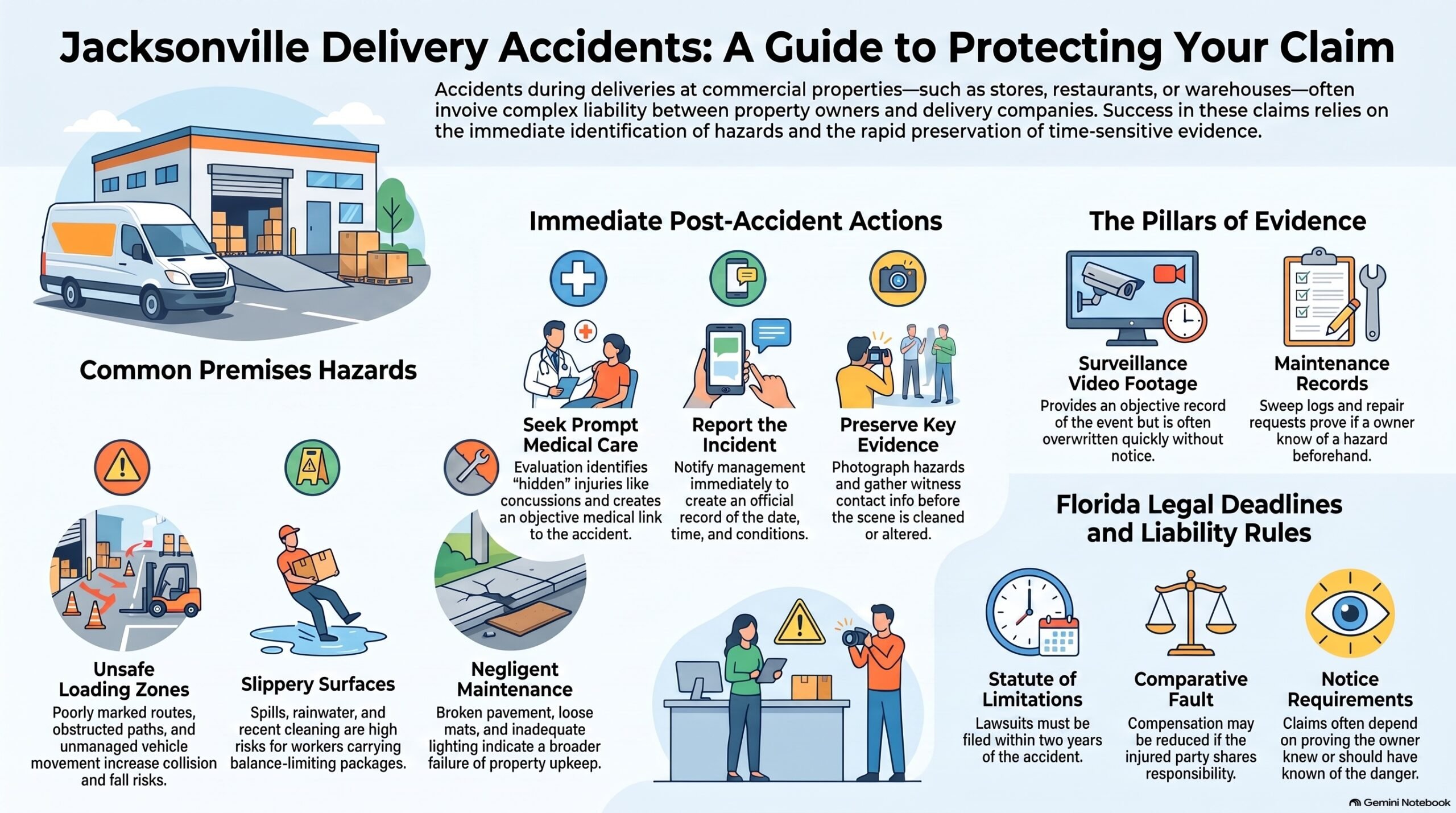
When a delivery accident occurs at a store or other commercial property, the injured person may face questions about who controlled the premises, what caused the hazard, and whether a business, delivery company, driver, or property owner failed to act responsibly. A Jacksonville delivery accident lawyer can help identify responsible parties, preserve records, and coordinate a focused investigation. Counsel may obtain surveillance footage, incident reports, delivery logs, maintenance records, and witness statements before evidence spoliation weakens the claim.
Legal support also includes evaluating Comparative negligence allegations, such as claims that the injured person ignored warnings or entered a restricted area. By addressing insurance disputes early, counsel can press for fair consideration of medical costs, lost income, and long-term limitations. A careful trial strategy may guide negotiations from the beginning, ensuring the claim is prepared for litigation if needed while helping the injured person pursue accountability with dignity, order, and purpose.
OUR CONSULTATIONSARE FREE
START YOUR FREE CASE REVIEW

Understanding Jacksonville Delivery Accident Stores & Premises Injury Cases
A delivery-related injury on commercial property may involve more than a routine slip, fall, or vehicle incident. These cases often require careful review of the injured person’s role, the property owner’s duties, and the relationship between the delivery activity and the premises. In Jacksonville, stores, restaurants, warehouses, and other commercial sites may owe lawful visitors a duty of reasonable care, especially when the visitors’ work supports business operations or public service.
An injury claim may also involve defenses that affect recovery. Assumption of Risk may be raised when a business argues the injured person knowingly accepted a specific danger. Comparative Negligence may apply if responsibility is divided among the property owner, delivery driver, employer, vendor, or another party. A disciplined legal assessment helps identify duties, preserve relevant evidence, and evaluate losses. For those committed to serving others through dependable delivery work, understanding these principles can support a fair and orderly path forward after harm occurs.
Common Causes of Jacksonville Delivery Accident Stores & Premises
Common causes of delivery accidents in Jacksonville stores and on commercial premises include unsafe loading zones, slippery store floors, poorly marked entrances, and negligent premises maintenance. These hazards may expose delivery drivers and other workers to preventable risks during routine pickups, drop-offs, or access to business property. Identifying the specific condition that caused the injury is an important step in evaluating fault and potential liability.
Unsafe Loading Zones
Because delivery activity often occurs near storefronts, service entrances, and shared parking areas, unsafe loading zones can create serious hazards for drivers, workers, pedestrians, and customers. Poorly marked routes, obstructed paths, inadequate lighting, and unmanaged vehicle movement may increase the risk of collisions or falls during routine deliveries. Property owners and businesses serving the public should maintain clear procedures that protect both delivery personnel and visitors. Delivery zone signage can help direct traffic, separate pedestrians from moving vehicles, and reduce confusion during busy hours. Trip-and-fall barriers, when properly placed and visible, may guide safe movement without creating additional hazards. When loading areas are neglected, preventable injuries can result. Careful inspection, planning, and enforcement support safer premises and responsible community service for everyone present.
Slippery Store Floors
When delivery workers enter retail stores, restaurants, or commercial buildings, slippery floors can turn an ordinary drop-off into a serious injury event. Spills, tracked-in rainwater, grease, polished surfaces, and recent floor cleaning may reduce slip resistance, especially when workers carry packages that limit balance and visibility. Property operators serving the public have a duty to monitor walking surfaces, promptly correct hazards, and support traction safety through appropriate mats, maintenance routines, and prompt cleanup. Clear hazard signage should warn delivery personnel before they step onto wet or treated areas, not after a fall occurs. When unsafe flooring causes injuries, records such as cleaning logs, surveillance footage, and incident reports may help determine whether reasonable care was used to protect those lawfully present and performing necessary delivery work within the premises.
Poorly Marked Entrances
At many Jacksonville stores and commercial properties, poorly marked entrances can create preventable hazards for delivery workers who must identify access points quickly while carrying packages, food orders, or equipment. Confusing signage, unmarked service doors, or unclear customer entrances may lead workers into traffic lanes, restricted areas, or dim approaches. Businesses serving the public should consider how visitors, vendors, and delivery personnel safely move through the property, especially during busy hours or nighttime deliveries. Secure lighting near designated entry points helps workers recognize routes without hesitation. Clear directional signs also support exit safety when a delivery worker must leave promptly after completing a drop-off. When entrances are not reasonably identifiable, the risk of falls, collisions, or unsafe detours may increase for those performing key service work in Jacksonville.
Negligent Premises Maintenance
Poorly marked entrances often reflect a broader issue on commercial properties: negligent premises maintenance. Delivery workers depend on safe walkways, stable flooring, adequate lighting, and clear access points while serving customers, businesses, and residents. When property owners fail to repair broken pavement, remove spills, secure loose mats, or address obstructed paths, preventable injuries may occur. Workplace inspection checklists can help identify recurring hazards before drivers, couriers, or store employees are placed at risk. Hazard reporting procedures also provide a structured way for staff and visitors to alert management to unsafe conditions. When these systems are ignored, incomplete, or absent, the property may present unreasonable dangers. In Jacksonville, careful maintenance practices support public safety and reflect the duty businesses owe to those lawfully entering their premises daily.
Don’t Wait. Call Our Florida Personal Injury Lawyers Now!


Legal Rights of Jacksonville Delivery Accident Stores & Premises Injury Victims
Although delivery services are essential to Jacksonville businesses and residents, accidents involving stores, loading areas, sidewalks, parking lots, and other commercial premises can leave victims with serious injuries and significant legal concerns. Injured delivery workers, customers, or pedestrians may have rights under Florida law when a property owner, tenant, vendor, or managing company fails to act with reasonable care.
Understanding the basics of premises liability helps victims recognize when unsafe property conditions may support a claim.
- Victims may seek compensation for medical care, lost income, reduced earning ability, and pain-related losses.
- Slip-and-trip negligence may involve hazardous conditions that responsible parties knew, or should have known, existed.
- Insurance claim tips include reporting the incident promptly, avoiding recorded statements without guidance, and tracking expenses.
- Evidence preservation steps include photographing the scene, identifying witnesses, saving delivery records, and securing incident reports.
These rights help protect injured people while encouraging safer commercial spaces.
Why Do Jacksonville Delivery Accident Stores & Premises Injuries Happen?
Delivery-related premises injuries in Jacksonville often happen when busy commercial operations, pedestrian traffic, vehicle movement, and property hazards intersect without proper safety controls. Stores, restaurants, apartment complexes, and loading areas may place delivery drivers and visitors near wet floors, uneven pavement, blind corners, stacked merchandise, broken lighting, or congested entryways. These conditions can become more dangerous when employees feel rushed, vehicles park in unsafe zones, or property owners fail to correct known hazards.
Some incidents also arise from poor coordination between businesses, delivery companies, contractors, and maintenance providers. Each party may serve the public in a different role, yet shared spaces require shared attention to safety. After an injury, Insurance coverage pitfalls can complicate responsibility when multiple policies, exclusions, or disputed employment relationships are involved. Witness credibility issues may also affect how the event is understood, especially when accounts differ, cameras are missing, or observations were limited.
What Should You Do After a Jacksonville Delivery Accident Stores & Premises Injury?
After a Jacksonville delivery accident in a store or on other premises, the injured person should take prompt, organized steps to protect health and preserve any potential claim. Immediate medical care, a timely incident report, and careful preservation of evidence can help establish the nature and cause of the injury. These actions may also reduce disputes over notice, fault, and the extent of damages.
Seek Immediate Medical Care
In the moments following a delivery accident on a store or business premises, prompt medical evaluation should be a primary concern. Even when injuries appear minor, a physician can identify conditions that may worsen without treatment, such as concussions, soft tissue damage, or internal trauma. Medical care also creates objective records that may support later decisions within the Insurance claim timeline. For delivery workers, customers, or bystanders who serve others through daily responsibilities, protecting health helps preserve stability for families, employers, and the community. The injured person should follow treatment instructions, attend referrals, and keep copies of discharge papers, prescriptions, and diagnostic results. These records are important steps in preserving evidence, showing the nature of the injury, recommended care, and the connection to the premises accident.
Report The Incident
Why should an incident report be completed as soon as possible? Prompt reporting creates an official record of the delivery accident, the location, and the conditions observed at the store or premises. An injured person should notify a manager, property owner, supervisor, or delivery platform representative, depending on the setting. The report should include the date, time, names of involved parties, and a clear description of what occurred. Accurate reporting supports Medical documentation by connecting the injury to the incident without unnecessary delay. It also promotes evidence preservation by alerting responsible parties that the event must be documented properly. Those committed to serving others should encourage calm, truthful reporting, because complete information helps insurers, attorneys, and safety personnel evaluate responsibility and prevent similar harm to others in the future.
Preserve Key Evidence
Evidence should be preserved immediately following a Jacksonville delivery accident at a store or premises because important details can disappear quickly. An injured delivery worker should photograph hazards, damaged flooring, spills, poor lighting, blocked walkways, or misplaced merchandise before conditions are changed. Nearby signs, carts, shelving, loading areas, and weather conditions may also help explain how the injury occurred. It is equally important to preserve receipts, delivery records, order confirmations, route logs, and communications with the store or customer. Witness names and contact information should be gathered when possible, since employees or patrons may later clarify what happened. Clothing, footwear, and damaged equipment should be stored safely. Careful evidence preservation supports accountability, protects truthful reporting, and helps those seeking fair resolution serve their families and communities responsibly.
Critical Evidence in a Jacksonville Delivery Accident Stores & Premises Injury Case
Critical evidence in a Jacksonville delivery accident stores and premises injury case can establish how the incident occurred, who had notice of the hazard, and whether reasonable safety measures were ignored.
Key materials may include:
- Surveillance video footage
- Incident reports
- Witness statements
- Maintenance records
These records can help clarify liability, preserve the sequence of events, and support a stronger injury claim.
Surveillance Video Footage
In a Jacksonville delivery accident involving a store, warehouse, restaurant, apartment complex, or other commercial premises, surveillance video footage can provide a direct and objective record of how the injury occurred. Cameras may capture loading zones, entrances, aisles, parking areas, stairways, or delivery paths, showing hazards that affected the worker’s safety. This footage can assist in creating an incident timeline by identifying when a condition appeared, who was nearby, and how long the danger remained unaddressed. It may also support photos evidence collection by confirming where still images should be taken and what conditions existed before changes occurred. Because video may be overwritten quickly, prompt preservation is important. A careful review helps clarify responsibility, protect injured delivery personnel, and support fair evaluation of a premises injury claim in Jacksonville.
Incident Reports
Surveillance footage may show what happened, but an incident report often explains how a business first documented the event and what it recognized at the time. In a Jacksonville delivery accident involving a store or premises, this record may identify the date, location, surface condition, employee response, and any immediate safety concerns. Incident documentation can help determine whether management knew of a hazard, corrected it, or allowed risk to remain.
A careful review may also show when insurance notification occurred and whether the business described the event consistently. These details can affect responsibility, especially when a delivery driver, customer, or visitor was injured while serving others or completing assigned duties. Accurate reports preserve facts, support accountability, and help evaluate the seriousness of a premises injury claim.
Witness Statements
Witness statements can provide an independent account of how a delivery accident occurred, especially when the injured person was focused on completing a delivery, guiding customers to the store entrance, or moving through a loading area. Employees, customers, vendors, or nearby drivers may describe floor conditions, visibility, warnings, traffic patterns, or the conduct of the parties involved. Prompt interviews support Evidence preservation because memories can fade and witnesses may become difficult to locate. Photo documentation can help confirm what a witness observed, including placement of carts, pallets, mats, spills, or vehicle positions. Attorneys often assess witness credibility by reviewing proximity, opportunity to observe, and possible bias. Statement consistency across multiple witnesses can strengthen a claim, while conflicts may indicate issues that require deeper investigation and careful case evaluation. Accurate statements also guide fair resolution.
Maintenance Records
When a delivery accident occurs on store or commercial property, maintenance records can show whether the premises were reasonably inspected, cleaned, repaired, and monitored before the incident. These records may include sweep logs, repair requests, spill reports, lighting inspections, and contractor notes. In a Jacksonville premises injury case, such documentation helps clarify what the property owner or manager knew, when it was known, and whether timely action followed. This evidence is especially important when evaluating slip-and-fall vs negligence, because a fall alone does not prove fault. Records may reveal ignored complaints, missed inspections, or delayed repairs involving signage and lighting hazards. For injured delivery workers, careful review of maintenance records supports accountability, protects workplace service roles, and helps determine whether safer conditions should have been provided to all lawful visitors.
Long-Term Effects of Jacksonville Delivery Accident Stores & Premises Injuries
Long-term effects of Jacksonville delivery accident stores and premises injuries may include chronic pain conditions, reduced mobility, and permanent disability. These outcomes can affect a person’s ability to work, manage daily tasks, and maintain physical independence. Ongoing medical costs, including treatment, rehabilitation, and future care needs, often become central issues in evaluating the full impact of the injury.
Chronic Pain Conditions
After a delivery accident in a store or on premises property, chronic pain can become one of the most disruptive and difficult injuries to evaluate. Persistent back, neck, shoulder, or nerve pain may continue long after bruises repair, affecting concentration, sleep, and the ability to complete critical tasks. For delivery workers who serve businesses and households, these conditions can interfere with reliability and daily responsibilities. Medical records, diagnostic findings, treatment notes, and pain management plans often help explain the severity and duration of symptoms. Workplace safety policies may reveal whether hazards were preventable, while liability evidence collection can preserve incident reports, photographs, witness statements, and maintenance records. Careful documentation supports a clearer understanding of how unsafe premises conditions contributed to lasting pain and ongoing treatment needs.
Mobility And Disability
Although some injuries appear manageable at first, mobility limitations and disability can develop into serious long-term consequences of delivery accidents on Jacksonville store or premises property. Falls, vehicle impacts, and loading area hazards may impair walking, balance, lifting, or standing for extended periods. These limitations can affect work duties, caregiving responsibilities, and community involvement, especially for individuals who serve customers, patients, or vulnerable neighbors.
A lasting disability may require changes to daily routines, safer parking lot access, modified entrances, or Accessible accommodations within employment and public settings. Reduced mobility can also increase dependence on others for transportation, errands, and household tasks. When premises conditions contribute to these outcomes, the resulting impairment merits careful evaluation, because functional loss may shape a person’s independence long after the initial injury.
Ongoing Medical Costs
The financial burden of medical care may continue well beyond the initial treatment for injuries caused by delivery accidents on a Jacksonville store or premises property. Long-term needs may include surgery, physical therapy, pain management, mobility equipment, counseling, and follow-up evaluations. These expenses can strain households, especially when injuries limit the person’s ability to work or serve family and community obligations.
A clear record of care helps establish the full cost of recovery. Providers, caregivers, and injured parties should understand how to document symptoms, including pain levels, limitations, medication effects, and changes in daily function. Medical bills, treatment plans, and expert opinions may support estimates for future care. Accurate lost wages calculations also help show how ongoing treatment, reduced hours, or permanent restrictions affect financial stability.
Don’t Wait. Call Our Florida Personal Injury Lawyers Now!
Proving Liability in Jacksonville Delivery Accident Stores & Premises Injury Cases
When a delivery accident occurs at a store, apartment complex, restaurant, or other Jacksonville premises, liability often depends on whether the injured person can prove that a complicated act or unsafe property condition caused the harm. Evidence may show that a delivery driver failed to watch for pedestrians, used excessive speed, or ignored designated loading areas. In other cases, the property owner or manager may have allowed hazards such as poor lighting, broken pavement, faulty signage, obstructed walkways, or unsafe traffic patterns.
Proving liability requires connecting these facts to the injury through photographs, incident reports, witness statements, surveillance footage, and medical documentation. A careful review may reveal driver negligence, inadequate maintenance, or a failure to warn visitors and workers about foreseeable dangers. For those committed to serving customers, residents, and guests safely, identifying responsibility helps promote accountability and encourages better practices on Jacksonville premises where deliveries occur.
Dealing With Insurance Companies After a Jacksonville Delivery Accident Stores & Premises Injury
After liability evidence is identified, insurance companies often become the next major obstacle in a Jacksonville delivery accident involving a store, apartment complex, restaurant, or other premises. Adjusters may appear cooperative, yet their role is to limit the insurer’s payments, not to protect the injured person’s recovery. Statements, medical authorizations, and early settlement offers should be reviewed carefully because each may affect the value of the claim.
Insurers may request an Independent medical evaluation to challenge the extent of injuries or question whether treatment is related to the incident. Accurate records, consistent medical care, and evidence preservation help prevent unfair disputes over causation and damages. When delivery companies, property owners, and contractors all have separate insurers, communication can become fragmented. A measured legal approach keeps attention on documented harm, responsible parties, and fair compensation, while allowing the injured person and supportive family members to focus on recovery, service, and daily responsibilities.
What to Expect During a Jacksonville Delivery Accident Stores & Premises Injury Claim Process
A Jacksonville delivery accident stores and premises injury claim typically begins with prompt incident reporting, followed by careful documentation of injuries, hazards, and related evidence. The process then focuses on determining whether the store, property owner, delivery company, or another party failed to meet a legal duty of care. Once liability and damages are evaluated, the claim may proceed to negotiations to secure fair compensation for injuries.
Reporting The Incident
Report the incident promptly to the store manager, property owner, delivery company, or other responsible party, because early notice helps create a clear record of how and where the injury occurred. A written report should identify the date, time, location, parties involved, and basic description of the unsafe condition or delivery-related event. The injured person may request a copy or report number, while remaining respectful to employees who are assisting. This step supports liability documentation, helps preserve evidence, and may assist counsel in tracking Legal deadlines that affect a claim. If names are available, witness contact information should be noted in the report or shared with the appropriate representative. Accurate reporting allows responsible parties to respond, correct hazards, and participate fairly in the claim process.
Gathering Injury Evidence
During the early stages of a Jacksonville delivery accident claim, evidence should be gathered in a careful and organized manner to show how the injury occurred, who may be responsible, and what damages resulted. Evidence timelines help preserve details before conditions change, memories fade, or records become difficult to locate. A clear photography checklist may include the delivery area, floor surface, lighting, warning signs, footwear, damaged products, and visible injuries. Prompt witness contact is also important, as employees, customers, drivers, or bystanders may provide observations that support an accurate account. Medical record accuracy should be reviewed with care, including symptoms, treatment dates, work restrictions, and physician recommendations. Organized evidence allows the claim process to proceed with greater service, fairness, and attention to the injured person’s documented needs.
Determining Store Liability
Once injury evidence has been preserved and organized, the claim often turns on whether the store, property owner, delivery company, or another party failed to exercise reasonable care. Liability review may examine maintenance protocols, inspection logs, employee reports, vendor procedures, and whether warning signage was visible before the incident. For those committed to serving injured community members, this step clarifies who had control over the unsafe condition and who had time to correct it. Premises security may also matter when inadequate lighting, unsafe loading areas, or poor access control contributed to harm. Comparative negligence is considered when an injured person’s conduct may have played a role, though that issue does not automatically defeat a claim. Each fact is measured against legal duties and foreseeable risks under Florida law.
Negotiating Injury Compensation
Many injury claims reach a stage where liability evidence, medical documentation, wage-loss information, and projections for future care are used to calculate a fair settlement demand. In Jacksonville delivery accident, store, and premises cases, this process should reflect the injured person’s losses and the responsible party’s duty to maintain safe conditions. Settlement documentation may include incident reports, photographs, witness statements, treatment records, and expert opinions regarding long-term limitations. Insurance adjuster tactics can involve low initial offers, requests for unnecessary statements, or attempts to minimize pain, lost income, and future medical needs. A careful negotiation strategy responds with organized proof, clear damages analysis, and measured advocacy. The objective is to secure compensation that supports recovery, preserves dignity, and helps restore stability after a preventable premises-related injury.
Compensation for Jacksonville Delivery Accident Stores & Premises Injury Damages
After an injury at a store, warehouse, restaurant, or other delivery-related premises in Jacksonville, compensation may depend on how the accident occurred, who controlled the property, and whether unsafe conditions contributed to the harm. A claim may require careful review of delivery routes, loading areas, spill response, lighting, flooring, security practices, and employee reports. When premises negligence is alleged, evidence should establish a causal link between the hazardous condition and the injury and show that the responsible party knew or should have known about the danger.
Medical documentation helps establish the nature of the injuries, the required treatment, and the limits of recovery. Wage proof may also support claims for losses related to missed work or reduced earning capacity. Property owners, tenants, contractors, insurers, or delivery companies may raise liability defenses, including arguments about notice, comparative fault, or independent contractor status. A thorough evaluation allows injured individuals and their advocates to pursue accountable recovery while encouraging safer practices for workers, customers, and the broader community.
Economic vs Non-Economic Damages in Jacksonville Delivery Accident Stores & Premises Cases
In Jacksonville delivery accident, stores, and premises cases, damages are often divided into economic and non-economic categories. Economic damages may include medical bills and lost income, while non-economic damages address harms such as pain and suffering. This distinction helps clarify the full scope of compensation that may be available after an injury.
Medical Bills
When a delivery accident occurs in a Jacksonville store, parking lot, or other premises, medical bills often become the most immediate and measurable part of an injury claim. These expenses may include emergency care, diagnostic testing, surgery, rehabilitation, follow-up visits, and prescribed treatment. Medication documentation can help confirm the nature, duration, and seriousness of the injuries. In premises-related delivery cases, medical records also support proving fault by connecting the injury to the unsafe condition or negligent conduct. Witness interviews may further explain how the incident occurred, strengthening the relationship between treatment and liability. During insurance negotiations, complete billing records allow a fair assessment of economic damages. Careful organization of these expenses helps protect injured delivery workers while supporting responsible recovery and accountability.
Lost Income
Medical bills show the cost of treatment, but lost income reflects how a delivery accident can disrupt a person’s ability to work and maintain financial stability. In Jacksonville stores and premises cases, lost income may include missed wages, reduced hours, lost tips, diminished commissions, or interrupted self-employment earnings. Documentation often includes pay stubs, tax records, employer statements, schedules, and medical restrictions connecting the absence to the accident.
Prompt action can be important when the loss of video evidence affects proof of how the incident occurred. Insurance claim delays may also place pressure on injured workers and families who depend on steady income. Careful evaluation helps distinguish verified economic losses from other damages. This approach supports fair accountability while helping injured individuals preserve resources needed to serve their households and communities.
Pain And Suffering
Although economic damages address measurable financial losses, pain and suffering reflects the human impact of a Jacksonville delivery accident on an injured person’s daily life. In stores and premises cases, these non-economic damages may include physical discomfort, loss of mobility, sleep disruption, emotional distress, and a reduced ability to participate in family, work, or community responsibilities. Such harm is not shown through invoices alone, but through medical records, testimony, treatment history, and the observable effects of injury over time. A careful evaluation considers the severity of the accident, the duration of symptoms, and the demands of long-term recovery. For those committed to serving others, recognizing pain and suffering affirms that justice must address financial repair, human dignity, and meaningful restoration after preventable harm.
When a Jacksonville Delivery Accident Stores & Premises Injury Case Goes to Trial vs Settlement
Because settlement and trial involve different risks, costs, and timelines, a Jacksonville delivery accident store and premises injury case must be evaluated based on the strength of the evidence, the extent of damages, and the parties’ willingness to negotiate in good faith. Settlement may serve injured delivery workers and affected families by providing earlier financial relief, reducing uncertainty, and preserving resources for medical care, wage loss, and recovery needs.
A trial may become necessary when liability is disputed, damages are undervalued, or an insurer refuses to reach a fair resolution. Evidence may include incident reports, surveillance footage, witness accounts, maintenance records, photographs, and medical opinions. Comparative negligence defenses may affect negotiations, especially when a property owner, store operator, delivery company, or injured person disputes responsibility. Premise risk factors, such as poor lighting, unsafe walkways, cluttered aisles, or inadequate warnings, may also influence whether settlement is reasonable or trial advocacy is required.
Don’t Wait. Call Our Florida Personal Injury Lawyers Now!
Florida Laws That May Affect Your Jacksonville Delivery Accident Stores & Premises Case
The decision to settle or proceed to trial is shaped not only by the facts of the accident but also by Florida law governing premises liability, negligence, insurance, and damages. In Jacksonville delivery injury claims, these rules help determine who owed a duty, whether that duty was breached, and how losses should be allocated fairly and accountably.
- Negligence standards: Florida evaluates whether a store, property owner, driver, or contractor acted reasonably under the circumstances, including known hazards and preventable risks.
- Comparative fault: Damages may be reduced if evidence shows the injured delivery worker shared responsibility for the incident.
- Premises liability exceptions: Certain defenses may apply when hazards were open and obvious, recently created, or outside the owner’s control.
- Third-party liability considerations: A claim may involve vendors, maintenance companies, drivers, or employers whose conduct contributed to the harm, affecting service-oriented recovery planning.
The Statute of Limitations for Jacksonville Delivery Accident Stores & Premises Injury Cases
When a delivery accident occurs at a Jacksonville store, warehouse, loading area, or other commercial premises, the statute of limitations sets a strict deadline for filing an injury lawsuit. In most Florida negligence cases, an injured delivery driver, customer, employee, or visitor must file suit within 2 years of the incident. Missing this deadline can bar recovery, even when injuries are serious and the condition of the premises was unsafe.
Timely action also supports accurate records, witness accounts, inspection reports, and medical documentation. Insurance claim timing matters because early notice may affect coverage review, evidence preservation, and settlement discussions, but an insurance claim does not usually extend the court filing deadline. Comparative fault rules may also influence the value of a case if the injured person, store operator, property owner, or delivery company shares responsibility. Understanding these time limits helps injured people protect their rights while maintaining fairness and accountability.
How a Jacksonville Delivery Accident Stores & Premises Lawyer Can Help You
After a delivery accident on commercial property, a Jacksonville stores and premises lawyer can evaluate how the incident occurred, identify responsible parties, and determine whether unsafe conditions contributed to the injury.
This support can help injured delivery workers, customers, or bystanders pursue accountability while preserving their ability to continue serving others with dignity.
- Investigating hazards, including spills, broken flooring, poor lighting, unsafe loading areas, or obstructed walkways.
- Reviewing store policy compliance, employee practices, maintenance records, and incident reports to assess preventable failures.
- Gathering evidence from surveillance footage, witness statements, delivery logs, medical records, and property inspection materials.
- Handling Insurance adjuster negotiations, damage documentation, and communications with property owners, vendors, or corporate representatives.
When to Contact a Jacksonville Delivery Accident Stores & Premises Lawyer
Prompt timing can materially affect the strength of a premises-related delivery accident claim, particularly where evidence may be altered, repaired, erased, or disputed. Contact should be considered soon after a delivery worker is injured at a store, restaurant, warehouse, apartment complex, or other commercial property. Early action may help preserve surveillance footage, incident reports, witness information, maintenance records, and photographs of hazardous conditions.
A lawyer may also be contacted when a property owner, manager, insurer, or delivery platform questions the circumstances of the accident. Slip-and-fall defenses often focus on notice, the visibility of the hazard, footwear, distraction, or whether the injured person should have avoided the danger. Because Florida’s comparative negligence rules may reduce compensation based on assigned fault, prompt guidance can help protect an injured worker’s interests.
Contact is also appropriate when injuries require medical care, work is missed, symptoms worsen, or responsibility remains unclear after the incident.
Why You Need an Experienced Jacksonville Delivery Accident Stores & Premises Lawyer
An experienced Jacksonville delivery accident attorney can evaluate how property conditions, delivery procedures, and Florida premises liability rules apply to a worker’s injury. Delivery accidents often occur in loading areas, on slick floors, in obstructed walkways, under poor lighting, or due to unsafe traffic patterns around stores. A lawyer can identify responsible parties, preserve records, and assess whether Store safety training was adequate to prevent foreseeable harm.
This guidance is valuable when injured delivery workers, businesses, and families need orderly support during a difficult period. Counsel can review incident reports, surveillance footage, maintenance logs, vendor agreements, and witness statements to build a clear account of what occurred. An informed insurance dispute strategy may also be necessary when insurers question fault, minimize injuries, or shift blame between a store, delivery company, contractor, or property owner. Experienced legal representation helps ensure that service-minded workers are treated fairly, that claims are properly developed, and that available remedies are pursued diligently under Florida law.
How to Choose the Right Jacksonville Delivery Accident Stores & Premises Lawyer for Your Case
Choosing the right Jacksonville delivery accident stores and premises lawyer begins with evaluating whether the attorney has specific experience handling injuries that occur during deliveries at retail stores, warehouses, restaurants, apartment complexes, and commercial properties. A suitable lawyer should understand how unsafe loading areas, negligent maintenance, poor lighting, spills, or blocked walkways may contribute to harm.
The selection process should also consider the lawyer’s ability to gather evidence quickly, including video footage, incident reports, delivery records, and testimony. Witness impact can be vital when employees, customers, drivers, or property managers provide details about the hazardous condition or the response after the accident. The lawyer should also recognize insurance tactics designed to reduce compensation, shift blame, or question the severity of injuries.
For those focused on serving injured workers, drivers, or visitors with dignity, the right attorney should communicate clearly, act promptly, and pursue accountability with disciplined attention to the facts and applicable premises liability law.
About The Law Offices of Anidjar & Levine
The Law Offices of Anidjar & Levine represents injured individuals in Jacksonville delivery accident cases involving sophisticated commercial properties, retail locations, restaurants, apartment complexes, and other premises where unsafe conditions may lead to harm.
The firm evaluates how property owners, delivery companies, vendors, and insurers may share responsibility when preventable hazards injure workers, drivers, customers, or visitors.
Its attorneys emphasize client-focused communication, ensuring each person receives clear updates, practical guidance, and respectful attention throughout the legal process.
This approach supports clients who value service, accountability, and careful stewardship of their claims.
Through disciplined case strategy planning, the firm reviews incident reports, surveillance footage, maintenance records, witness statements, and applicable insurance coverage.
Its legal team prepares claims with attention to liability, damages, and long-term consequences.
The Law Offices of Anidjar & Levine works to pursue fair compensation while helping injured clients move forward with stability and dignity.
Frequently Asked Questions
Can Delivery App Terms Affect My Store Injury Claim?
Yes, delivery app terms can affect a store injury claim, especially when terms clauses address arbitration, liability limits, or contractor status. They may also impose notice requirements that influence deadlines or evidence preservation. A careful advocate would review the app agreement, store policies, incident reports, and applicable state law. These provisions rarely erase a valid premises claim, but they can shape where, when, and how an injured person seeks relief.
Are Store Employees Treated Differently Than Independent Delivery Drivers?
Yes. Store employees and independent delivery drivers are often treated differently under injury and negligence law. Employment classifications affect available benefits, responsible parties, and proof requirements. Employees may pursue workers’ compensation, while independent drivers often rely on premises liability or third-party claims. Liability differences can determine whether the store, delivery platform, or another party bears responsibility. Careful review helps protect injured workers and supports fair service to all affected individuals.
Can I Sue if Another Customer Caused the Accident?
Yes, a claim may be possible when another customer caused the accident. Liability may depend on third-party liability, store awareness, and whether reasonable steps could have prevented harm. Under Florida’s comparative negligence rules, liability may be apportioned among the customer, the business, and the injured person. Careful review of evidence, including video, witness accounts, and incident reports, helps determine accountability and supports fair recovery for those harmed.
What if the Delivery Company Denies the Driver Was Working?
If the delivery company denies that the driver was working, the issue turns on proof gathered promptly and carefully preserved. Evidence of employment may include company records, dispatch messages, driver GPS logs, delivery app data, uniforms, vehicle markings, and wage documents. A court may examine whether the driver served the company’s business at the time. Those seeking accountability should secure records quickly, because delayed requests can allow crucial proof to disappear.
Do Jacksonville Stores Have to Preserve Surveillance Footage?
Yes, Jacksonville stores may have a duty to preserve surveillance footage once they know, or reasonably should know, it may relate to an injury claim. Florida retention laws do not impose one universal storage period, so prompt video evidence requests are important. A store that destroys relevant footage after notice may face court sanctions. Those assisting injured individuals should act quickly, document requests, and seek legal guidance.
—————————
Delivery accidents on store and business premises can cause serious injuries, raise complex liability questions, and result in significant financial losses.
A Jacksonville Personal Injury Lawyer can assess the evidence, identify potentially responsible parties, and pursue fair compensation under Florida law.
The Law Offices of Anidjar and Levine offer focused legal guidance for injured victims and their families.
Acting promptly can help preserve evidence, protect legal rights, and support a stronger claim for recovery.

