

The Law Offices of Anidjar and Levine investigates the causes of motorcycle collisions, identifies negligent drivers, roadway entities, vehicle manufacturers, or other responsible parties, and evaluates available insurance coverage. Counsel preserves police reports, photographs, witness accounts, motorcycle damage documentation, medical records, and financial documentation before the evidence disappears. The attorney may address insurer communications, comparative fault, settlement negotiations, and litigation while calculating medical expenses, lost income, property damage, and future care needs. Learn more from a Groveland Personal Injury Lawyer about your legal rights, evidence, and how to select qualified representation.
Main Takeaways
- Investigate whether distracted driving, speeding, failure to yield, impaired driving, or defective components caused the Groveland motorcycle accident.
- Examine road conditions, construction zones, weather, lighting, and vehicle maintenance for additional contributing factors.
- Gather police reports, photographs, witness statements, vehicle data, and surveillance footage before evidence disappears.
- Review medical records, treatment needs, lost income, property damage, and other losses supporting compensation.
- Protect your claim by promptly addressing insurers, comparative fault, deadlines, settlement offers, and potential litigation.


How We Can Help With Your Groveland Motorcycle Accident Causes Injury Claim
When a motorcycle accident in Groveland results from another party’s negligence, an experienced attorney can help the injured rider pursue full and fair compensation. A qualified legal team can provide dependable guidance while protecting the rider’s interests throughout the claim process.
Counsel may investigate the collision, identify responsible parties, and collect records concerning medical treatment, lost income, property damage, and continuing care needs. Prompt evidence preservation is vital because photographs, witness accounts, surveillance footage, vehicle data, and physical damage can become unavailable over time. An attorney can also communicate with insurers, evaluate settlement offers, and address attempts to minimize the rider’s losses.
Understanding Insurance claim timelines helps prevent missed deadlines and supports organized decision-making. Legal counsel can prepare required documents, track applicable filing periods, and pursue negotiations or litigation when appropriate. By handling procedural demands, the attorney allows the injured rider and family to focus on recovery while seeking accountability and resources needed for rehabilitation, stability, and long-term support.
OUR CONSULTATIONSARE FREE
START YOUR FREE CASE REVIEW

Understanding Groveland Motorcycle Accident Injury Cases
Groveland motorcycle accident injury cases generally involve determining how the collision occurred, which parties contributed to it, and the extent of the rider’s resulting losses. A careful evaluation may address liability, insurance coverage, and whether the available facts support a lawful claim for compensation. The process often begins with evidence preservation, including photographs, witness information, vehicle records, official reports, and relevant electronic data. Prompt preservation can help prevent important information from being lost or altered.
Medical record review provides another important component. Treatment notes, diagnostic results, rehabilitation records, and physicians’ opinions may establish the nature of the injuries, the required care, the prognosis, and the relationship to the accident. Financial documentation can further clarify wage loss, medical expenses, and other measurable damages. Each case requires individualized attention because injuries, circumstances, and available evidence differ. A thorough, service-oriented review helps ensure that the injured rider’s interests are presented accurately while respecting the needs of families, witnesses, and other affected parties.
Common Causes of Groveland Motorcycle Accidents
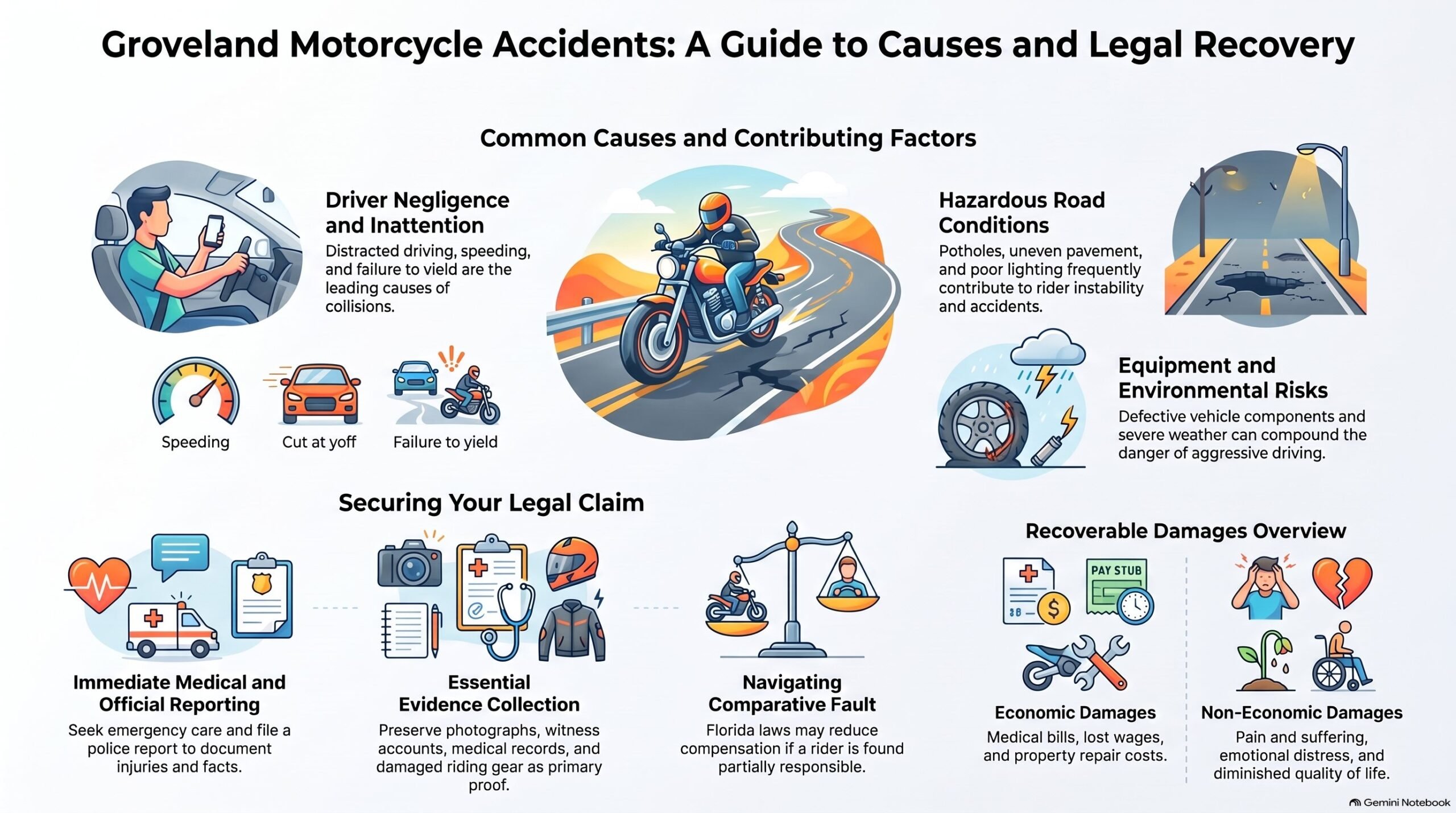
Common causes of motorcycle accidents in Groveland include distracted driving, speeding, and other reckless conduct. Collisions also frequently result from drivers’ failure to yield the right of way or recognize motorcycles in traffic. Poorly maintained roads, including potholes and inadequate surfaces, may further contribute to dangerous riding conditions and accident liability.
Distracted Driving
Although distracted driving can occur in seconds, it may prevent a motorist from noticing a motorcycle, judging its distance, or responding to changing traffic conditions. Distracted Driving commonly involves visual, manual, or mental diversion from the roadway. Cell Phone Use, including texting, dialing, navigation, or reading notifications, can substantially reduce a driver’s awareness of nearby riders. Other distractions may include adjusting music, eating, reaching for objects, or engaging with passengers. Because motorcycles occupy less visible space than passenger vehicles, even brief inattention can interfere with detection at intersections, during lane changes, or in heavy traffic. Responsible motorists should secure phones, limit nonessential activities, and maintain focused attention. Recognizing these risks can help families, witnesses, and injured riders preserve relevant information and support efforts to promote accountability and safer roads.
Speeding And Reckless Driving
When motorists exceed posted speed limits or operate vehicles aggressively, they reduce the time available to identify motorcycles, assess traffic conditions, and respond safely. Excessive speed also increases stopping distances and impact forces, potentially transforming a minor roadway error into severe injuries. Reckless behaviors may include rapid lane changes, racing, tailgating, abrupt acceleration, or driving while impaired by alcohol or drugs. Such conduct can become especially dangerous when weather-related hazards, including rain, fog, standing water, or strong winds, reduce visibility and traction. In some cases, vehicle defects, such as defective brakes, worn tires, or malfunctioning alternative components, may compound unsafe speed and aggressive operation. A careful investigation can examine driver conduct, roadway conditions, vehicle maintenance, and available evidence to clarify contributing factors and support injured individuals seeking appropriate assistance.
Failure To Yield
Failure to yield is a frequent factor in Groveland motorcycle accidents, particularly at intersections, in turn lanes, and at merging points, where motorcycles may be overlooked or misjudged. Drivers may turn across a motorcyclist’s path, enter traffic without adequate observation, or assume a motorcycle is farther away than it appears. These errors can lead to severe collisions because motorcycles offer less physical protection than passenger vehicles. Investigators may review traffic signals, right-of-way rules, witness statements, vehicle damage, and available surveillance footage when determining what occurred. Insurance carriers may raise liability disputes when each party provides a different account of the movement. They may also present comparative negligence arguments, alleging that the motorcyclist contributed to the collision through speed, positioning, or delayed braking. Careful preservation of evidence supports a fair evaluation for all involved.
Poor Road Conditions
Poor road conditions can contribute substantially to Groveland motorcycle accidents by reducing traction, disrupting a motorcycle’s balance, or limiting a rider’s ability to avoid a hazard. Potholes, uneven pavement, loose gravel, standing water, and inadequate roadway lighting may create dangerous conditions, particularly for riders who have less stability than enclosed vehicles. Negligent maintenance by a municipality, property owner, or contractor can allow these hazards to develop or remain unrepaired. In some cases, poor signage or obstructed warnings may prevent a motorcyclist from responding safely. Although a rider’s failure to yield can contribute to a collision, roadway defects may also affect reaction time and navigation. Investigators may examine maintenance records, inspection reports, photographs, witness statements, and roadway design to determine whether unsafe conditions contributed to the accident and resulting injuries.
Don’t Wait. Call Our Florida Personal Injury Lawyers Now!


Legal Rights of Groveland Motorcycle Accident Injury Victims
Victims injured in Groveland motorcycle accidents may have legal rights to pursue compensation from parties whose negligence caused or contributed to the collision. Potential recovery may include medical expenses, lost income, property damage, and non-economic losses, depending on the evidence and applicable law.
An injured person may protect those rights by:
- Obtaining prompt medical evaluation and following prescribed treatment.
- Recording facts, photographs, witness information, and other Evidence preservation steps.
- Avoiding recorded statements or settlements before understanding the claim’s full value.
- Using Insurance dispute strategies when an insurer delays, undervalues, or denies payment.
Florida’s comparative fault rules may reduce compensation if the injured person is found partly at fault. Insurance coverage, roadway responsibility, vehicle maintenance, and other liability issues may require careful investigation. Legal representatives can communicate with insurers, identify responsible parties, calculate damages, and preserve claims before filing deadlines expire. They may also help protect clients from pressure while coordinating medical documentation and financial records. Prompt consultation supports informed decisions and allows evidence to be evaluated before it becomes unavailable.
Why Do Groveland Motorcycle Accident Injuries Happen?
Understanding the causes of Groveland motorcycle accident injuries helps identify negligence, responsible parties, and available sources of compensation. Collisions commonly result from distracted driving, speeding, unsafe lane changes, impaired operation, or failure to yield. Road defects, inadequate lighting, defective motorcycle components, and poorly maintained construction zones may also contribute. Weather and visibility can increase risk, but they do not necessarily excuse careless conduct. The severity of harm often reflects a motorcycle’s limited structural protection, making Bike helmet safety and protective clothing important injury-prevention measures, although safety measures cannot eliminate another person’s negligence. Investigators may examine traffic cameras, witness statements, vehicle data, roadway conditions, and medical records to determine causation. Such evidence can support responsibility assessments and clarify damages, including treatment costs, lost income, and long-term care. Insurance claim timelines and settlement negotiation steps may affect recovery, but each case depends on applicable law, evidence, and the actions of all involved parties.
What Should You Do After a Groveland Motorcycle Accident Causes Injury?
After a Groveland motorcycle accident causes injury, the motorcyclist should seek immediate medical care, even if symptoms initially appear minor. The accident should be reported to law enforcement, and relevant details should be preserved through photographs, witness information, and official records. Medical evaluations and ongoing treatment should also document the injuries and their effects, providing important evidence for any subsequent claim.
Seek Immediate Medical Care
Prompt medical evaluation should be obtained after a Groveland motorcycle accident, even when injuries initially appear minor. Some conditions, including head trauma, internal bleeding, and spinal damage, may develop symptoms gradually. A qualified medical professional can identify hidden injuries, recommend appropriate treatment, and establish a reliable record of the harm suffered. The injured person should follow all care instructions, attend recommended appointments, and promptly report worsening pain, dizziness, numbness, or other concerning changes. Medical documentation may later help explain the injury’s severity and necessary recovery services. If the individual cannot arrange transportation safely, emergency assistance or a trusted support person should be contacted. While health remains the immediate priority, a companion may document evidence collection and preserve witness contact, without delaying emergency treatment or interfering with medical personnel.
Report The Accident
The motorcycle accident should be reported to the appropriate law enforcement agency as soon as it is safe to do so, particularly when it causes injury, property damage, or a dispute about what occurred. A responding officer may secure the scene, identify involved parties, interview witnesses, and prepare an official report. The injured motorcyclist should provide accurate facts without speculating about fault. If emergency personnel transport the rider for Emergency room treatment, another person may notify law enforcement and preserve relevant contact information. The accident report can assist medical providers, insurers, and legal representatives in understanding the event. Prompt reporting also supports compliance with insurance claim timelines, which may require notice within a specified period. The rider should request the report number and follow the instructions to obtain a copy.
Document Your Injuries
Medical documentation should begin as soon as possible when a Groveland motorcycle accident causes injury. The injured person should seek prompt evaluation, even if symptoms initially appear minor. Some conditions, including concussions, internal injuries, and soft-tissue damage, may develop gradually. Following medical advice and attending recommended appointments can support recovery and help establish a reliable record of treatment.
To gather medical documentation, the person should retain emergency reports, physician notes, diagnostic images, prescriptions, invoices, and discharge instructions. Records should identify the injury, the treatment provided, the limitations, and the expected prognosis. The person should also keep injury diary entries describing pain, mobility changes, sleep disruption, emotional effects, and missed activities. Photographs of visible injuries, bruising, property damage, and repair progress may provide additional context. These organized records can help caregivers, insurers, and legal representatives understand the scope of the injury and its ongoing consequences.
Critical Evidence in a Groveland Motorcycle Accident Causes Injury Case
A Groveland motorcycle accident injury case may depend on preserving and evaluating several forms of evidence:
- Police accident reports
- Medical treatment records
- Witness statements; and
- Motorcycle damage evidence.
Together, these materials can help establish how the collision occurred, identify responsible conduct, and document the resulting injuries and losses.
Police Accident Reports
When a motorcycle collision occurs in Groveland, the responding officer’s accident report may provide critical evidence regarding how the incident happened and who may be responsible. The report can identify involved drivers, describe road and weather conditions, document apparent traffic violations, and summarize statements made at the scene. Officers may also record skid marks, vehicle positions, visible damage, and citations issued after their investigation. Although a report is not conclusive proof of fault, it can help establish a reliable timeline and direct further fact-finding. Witness insurance tactics, including efforts to shift blame or minimize observations, may be assessed against the officer’s contemporaneous documentation. Preserving the report, related photographs, and accident scene photos can support a careful evaluation of liability and assist those seeking accountability for injured motorcyclists.
Medical Treatment Records
Because motorcycle injuries may develop or worsen after the crash, treatment records can provide critical evidence in a Groveland motorcycle accident injury case. Records from emergency departments, physicians, experts, therapists, and pharmacies can document diagnoses, symptoms, diagnostic testing, prescribed care, and recovery progress. They may connect physical limitations to the collision and show whether treatment recommendations were followed. Consistent records can also clarify preexisting conditions and distinguish earlier complaints from newly reported injuries. Timely collection helps counsel evaluate Insurance claim timelines, preserve accurate damages calculations, and respond to requests for medical authorization. Gaps, delayed visits, or inconsistent descriptions may prompt insurers to question causation, although context remains important when judging witness credibility factors. Organized records support fair compensation and help responsible advocates present the injured person’s medical needs accurately.
Witness Statements
Witness statements can supplement medical treatment records by preserving firsthand accounts of how the Groveland motorcycle accident occurred and how the injured rider appeared afterward. Accounts from drivers, pedestrians, passengers, and responding personnel may clarify traffic signals, roadway conditions, vehicle movements, and the sequence of events. An attorney may evaluate an eyewitness’s credibility by examining the witness’s vantage point, consistency, relationship to the parties, and ability to perceive relevant details. Promptly recorded statements can help preserve observations before memories change or witnesses become unavailable. They may also identify third-party liability factors, including negligent motorists, commercial vehicle operators, roadway maintenance entities, or other responsible parties. Careful interviews should remain respectful and accurate, allowing witnesses to describe what they personally observed without pressure or speculation. Such evidence can assist fair investigations and support accountability for injured riders.
Motorcycle Damage Evidence
Motorcycle damage evidence can help establish how a Groveland collision occurred and whether another party’s conduct caused the rider’s injuries. Photographs should document the motorcycle from multiple angles before repairs, including crushed components, scrape patterns, missing parts, and the locations of debris. These details may help investigators assess the direction of impact, vehicle positions, and whether a mechanical failure contributed to the crash. Repair estimates, tow-yard records, maintenance documents, and preserved parts can further connect the damage to claimed losses. A qualified professional may compare the motorcycle’s condition with witness accounts and traffic evidence; photo lineup relevance may arise when images assist with identifying a vehicle involved. The rider’s equipment also warrants preservation. A helmet safety inspection can reveal impact marks, cracks, or failure patterns that support injury analysis and responsible representation of the injured person’s interests.
Don’t Wait. Call Our Florida Personal Injury Lawyers Now!
Long-Term Effects of Groveland Motorcycle Accident Causes Injuries
Long-term injuries from motorcycle accidents may cause chronic pain, restricted mobility, and lasting limitations on daily activities. Emotional and psychological trauma, including anxiety or post-traumatic stress, can also affect recovery and quality of life. Ongoing medical expenses may include treatment, rehabilitation, medication, assistive equipment, and future care.
Chronic Pain and Mobility
Chronic pain and restricted mobility can persist after injuries sustained in a Groveland motorcycle accident, even when initial treatment appears successful. Fractures, nerve damage, spinal trauma, and soft-tissue injuries may limit walking, lifting, driving, or performing routine tasks for months or years. Ongoing medical evaluations can document symptom progression, treatment needs, and functional limitations. Physical therapy, assistive devices, medication, injections, or corrective procedures may become necessary, creating continuing financial obligations. For individuals who serve others through work, caregiving, or community responsibilities, reduced mobility can affect their independence and earning capacity. During liability disputes, Surveillance footage and technology-aided evidence may clarify how the collision occurred and whether conduct contributed to the injuries. Medical records, employment documentation, and witness credibility analysis can help establish the accident’s lasting effects and support an accurate assessment of damages.
Emotional and Psychological Trauma
Beyond physical limitations, a Groveland motorcycle accident can produce lasting emotional and psychological trauma that affects daily functioning and personal relationships. Survivors may experience anxiety, depression, irritability, sleep disruption, or recurring memories of the collision. Some develop heightened fear around traffic and motorcycles, making work, transportation, and community involvement difficult. These reactions can also affect family members who provide support as they adapt to changing responsibilities.
Traumatic stress coping often requires counseling, stable routines, compassionate communication, and evaluation by qualified mental health professionals. Treatment may help survivors process frightening experiences, rebuild confidence, and regain participation in valued activities. The emotional recovery timeline differs for every individual and may extend well beyond visible recovery. Documenting symptoms, treatment recommendations, and effects on relationships can help clarify the injury’s ongoing impact and support compassionate service.
Ongoing Medical Expenses
When injuries from a Groveland motorcycle accident require continued treatment, medical expenses may persist long after the initial emergency care. Rehabilitation, prescription medication, follow-up examinations, surgery, assistive equipment, and future care can create substantial financial obligations. A complete assessment should account for expected treatment, diminished earning capacity, transportation needs, and potential complications rather than focusing solely on current bills. Medical records, provider statements, treatment plans, and insurance claim documentation can help establish the nature and projected cost of necessary care. Families serving injured individuals may also need to coordinate benefits, preserve receipts, and seek professional guidance before accepting a settlement. Although a motorcycle safety checklist may help prevent future collisions, it does not eliminate existing losses. Careful documentation supports a fair evaluation of long-term damages and available recovery.
Proving Liability in Groveland Motorcycle Accident Causes Injury Cases
Establishing liability in a Groveland motorcycle accident injury case requires evidence showing that another party’s negligence caused the collision and resulting harm. Relevant proof may include crash reports, photographs, surveillance recordings, vehicle damage, eyewitness statements, and testimony from accident reconstruction professionals. Medical records can link the collision to documented injuries and demonstrate the extent of the resulting impairment.
A claimant generally must show that the responsible party owed a duty of reasonable care, breached that duty, and caused recoverable damages. Potentially liable parties may include negligent drivers, vehicle owners, employers, manufacturers, or governmental entities, depending on the facts. Comparative negligence may reduce compensation when the injured motorcyclist contributed to the incident. Careful fault allocation requires examining speed, visibility, traffic signals, lane positioning, helmet use, and other relevant circumstances without relying on assumptions about motorcyclists.
Understanding the basics of insurance coverage can help identify available policies and responsible parties, while preserving evidence supports a fair evaluation and service for injured individuals.
Dealing With Insurance Companies After a Groveland Motorcycle Accident Causes Injury
Insurance communications often influence how a Groveland motorcycle accident injury claim is evaluated and resolved. An injured motorcyclist should provide accurate basic information while avoiding recorded statements, settlement discussions, or medical conclusions without informed guidance. Adjusters may seek details that minimize fault or suggest that symptoms resulted from prior conditions, so responses should remain factual and limited.
Important evidence includes photographs, medical records, repair estimates, witness information, employment records, and communications concerning the collision. Prompt documentation can support the injury claim and protect against disputed facts. Practical evidence preservation tips include saving original photographs, retaining damaged equipment, recording treatment dates, and maintaining a secure file for claim correspondence.
A carrier’s requests should be reviewed carefully, particularly broad medical authorizations or releases. Insurance company bad faith may arise when an insurer unreasonably delays investigation, misrepresents coverage, or refuses a properly supported claim. Counsel can communicate with insurers, protect the claimant’s interests, and encourage a fair, service-oriented resolution without premature concessions.
What to Expect During a Groveland Motorcycle Accident Causes Injury Claim Process
A Groveland motorcycle accident injury claim typically begins with an initial assessment of the incident, injuries, and available insurance coverage. The process then involves gathering accident evidence, documenting medical losses, and negotiating appropriate compensation for injuries. If negotiations are unsuccessful or complete, the claim may proceed toward formal resolution through settlement or litigation.
Initial Claim Assessment
When a Groveland motorcycle accident injury claim begins, the initial assessment focuses on determining how the collision occurred, who may be legally responsible, and the extent of the rider’s losses. A representative typically reviews the client’s account, known medical concerns, employment impact, and immediate legal objectives. Evidence preservation is identified as an early priority, although detailed collection may occur later. The liability investigation considers potential actions by drivers, roadway conditions, and other responsible parties without prematurely assuming fault. An insurance coverage review examines available policies, applicable limits, and possible coverage disputes. During damages calculation, the assessment considers treatment costs, lost income, property damage, continuing care, and other measurable losses. This structured evaluation helps the injured rider understand potential claim issues, practical next steps, and the assistance required throughout the process.
Gathering Accident Evidence
Establishing how a Groveland motorcycle accident occurred requires timely collection and preservation of evidence from the crash scene, involved vehicles, witnesses, and official records. Investigators may photograph roadway conditions, traffic controls, skid marks, debris patterns, and visible injuries before conditions change. Preserving physical evidence can include securing damaged helmets, protective clothing, motorcycle components, and electronic data that may clarify speed, braking, or impact forces. Witness interviews should document observations while memories remain reliable, including statements about vehicle positions, lighting, weather, and driver conduct. Medical records and treatment notes can connect injuries to the collision and establish their progression. Reports, surveillance footage, photographs, repair estimates, and roadway maintenance records may also be reviewed. Building case timelines from these sources helps identify inconsistencies, clarify causation, and support an accurate claim evaluation.
Negotiating Injury Compensation
Although insurance carriers may present an initial settlement as a reasonable resolution, negotiating injury compensation requires a careful evaluation of the motorcycle crash’s full financial and personal impact. The injured rider or representative typically reviews medical expenses, lost income, rehabilitation needs, property damage, and documented limitations affecting daily life. Evidence Preservation remains important because photographs, medical records, witness statements, and employment documentation can support the claimed losses. Police Report Accuracy also merits attention, since factual errors or omissions may influence an insurer’s assessment of fault and damages. A demand package may include information on liability, treatment, prognosis, and the requested amount. Insurers may respond with questions, counteroffers, or requests for additional documentation. Careful communication and organized records help protect the claimant’s interests while supporting a fair, service-oriented evaluation.
Resolving Your Motorcycle Claim
Resolving a motorcycle injury claim typically involves establishing liability, documenting damages, negotiating with the relevant insurer, and determining whether settlement or litigation is appropriate. Insurance claim timelines vary according to the accident’s intricacy, available evidence, medical recovery, and insurer practices. During this period, the injured person may provide statements, authorize the release of records, and respond to settlement proposals through counsel. Medical bill documentation should include invoices, payment records, treatment summaries, prescription costs, and evidence of continuing care. A complete file also addresses lost income, property damage, pain, and future medical needs. If negotiations result in fair compensation, the claimant reviews the release terms before accepting payment. When liability or damages remain disputed, litigation may become necessary. Careful guidance helps protect the claimant’s interests while supporting an efficient, respectful resolution for all involved.
Compensation for Groveland Motorcycle Accident Causes Injury Damages
Compensation for injuries caused by a Groveland motorcycle accident may include medical expenses, lost wages, reduced earning capacity, property damage, and pain and suffering. A thorough claim should document emergency treatment, rehabilitation, medication, follow-up care, and other accident-related needs. Records from employers and medical professionals may help establish how injuries affect work and future employment.
An injured rider may pursue compensation from a negligent driver, vehicle owner, manufacturer, roadway entity, or another responsible party, depending on the facts. Insurance coverage, comparative fault, and evidence of unsafe conduct can influence the available recovery. Liability disputes may require accident reports, witness statements, photographs, and qualified testimony to clarify responsibility.
When an accident causes a fatality, surviving relatives may explore wrongful death claims for permitted losses and related support. Prompt legal review can help preserve evidence, identify applicable deadlines, and communicate with insurers. A careful process also supports clients and families seeking accountability while addressing their long-term medical, financial, and personal needs.
Economic vs Non-Economic Damages in Groveland Motorcycle Accident Cases
Economic damages generally cover verifiable financial losses, including medical expenses, lost income, and property damage. Non-economic losses address less tangible harm, such as pain, emotional distress, and diminished quality of life. Comparing these categories helps determine the full compensation potentially available in a Groveland motorcycle accident case.
Economic Damages Explained
When a motorcycle accident in Groveland results from another party’s carelessness, the injured person may pursue both economic and non-economic damages. Economic damages compensate for objectively documented financial losses caused by the collision. They may include emergency treatment, hospital care, medication, rehabilitation, future medical services, and necessary transportation for appointments. A Lost wages calculation can account for income lost during recovery, reduced earning capacity, and lost employment benefits. Documentation such as pay records, tax returns, employer statements, and medical restrictions may help establish these amounts. Property damage valuation covers the repair or replacement costs of the motorcycle, protective equipment, and other damaged belongings. Estimates, receipts, photographs, and ownership records can support the valuation. Careful evidence collection helps ensure that compensation reflects the full measurable financial impact of the accident and assists those seeking recovery.
Non-Economic Losses Considered
Beyond documented financial losses, a Groveland motorcycle accident claim may address non-economic damages arising from the physical pain, emotional distress, and reduced quality of life caused by the collision. These losses can include ongoing discomfort, disfigurement, loss of enjoyment, sleep disruption, anxiety, and limitations on family, social, or community participation. Evidence may come from medical records, treatment histories, testimony from relatives, and accounts describing changes in daily functioning. A claimant’s credibility and consistent documentation can help establish the seriousness of these effects. Insurance representatives may question subjective harm, making careful preparation important for a fair evaluation. Contributory negligence or comparative fault allegations may also influence whether recovery is available or reduced. Legal guidance can help injured individuals present their experiences respectfully while protecting their ability to pursue appropriate compensation.
Comparing Damage Categories
A Groveland motorcycle accident claim generally separates damages into economic and non-economic categories, each requiring different forms of proof and evaluation. Economic damages include medical bills, rehabilitation costs, lost wages, property damage, and projected expenses supported by records, expert opinions, and evidence of Medical necessity. Future treatment, including pain management, may require testimony explaining expected duration and cost. Non-economic damages address pain, emotional distress, reduced enjoyment of life, and permanent limitations, which cannot be calculated from invoices alone. Insurance disputes often involve challenges to causation, the necessity of treatment, or the claimed severity of symptoms. A careful settlement strategy compares documented financial losses with the broader human effects of injury, while accounting for liability evidence and future needs. This approach helps representatives pursue fair compensation and serve injured individuals responsibly.
When a Groveland Motorcycle Accident Causes Injury Case Goes to Trial vs. Settlement
Although many Groveland motorcycle accident injury claims resolve through settlement, some proceed to trial when the parties cannot agree on liability, damages, or fair compensation. Settlement can provide a predictable resolution, reduce litigation expenses, and deliver assistance sooner to an injured rider and the rider’s family. Negotiations may address medical costs, lost income, rehabilitation needs, and other documented losses without requiring testimony in open court.
Trial becomes more likely when an insurer disputes fault, challenges the severity of injuries, or presents Comparative negligence defenses. Each side may exchange evidence, depose witnesses, consult medical professionals, and prepare legal arguments before a judge or jury. Florida trial timelines vary depending on court schedules, case complexity, discovery disputes, and available evidence. A verdict may provide greater compensation than an offer, but it also carries uncertainty and may be appealed. Careful case evaluation helps determine whether settlement serves the injured person’s needs or whether trial is necessary to pursue accountability and meaningful recovery.
Florida Laws That May Affect Your Groveland Motorcycle Accident Causes Case
Florida law can materially affect how a Groveland motorcycle accident causes case is investigated, negotiated, and litigated. Several rules may shape liability, available damages, and the evidence needed to support an injured person or grieving family.
Florida law can shape how a Groveland motorcycle accident case is investigated, negotiated, and litigated.
- Comparative Negligence: A claimant’s recovery may be reduced by the percentage of fault assigned to that claimant. Evidence concerning speed, lane positioning, visibility, helmet use, and traffic violations can play a significant role.
- No-Fault Limits: Florida’s automobile insurance framework may interact with motorcycle claims differently than it does with other vehicle accidents. Insurance coverage must be examined carefully, including bodily injury, uninsured motorist, and medical payment provisions.
- Damage Proof: Medical records, rehabilitation evaluations, wage documentation, and testimony regarding future care can support claims for economic and non-economic losses.
- Wrongful Death: When a crash is fatal, eligible survivors may pursue damages recognized by Florida law, while the personal representative manages the estate’s related claims.
A careful legal review can help protect clients, clarify responsibilities, and promote fair treatment throughout the process.
Don’t Wait. Call Our Florida Personal Injury Lawyers Now!
The Statute of Limitations for Groveland Motorcycle Accident Causes Injury Cases
Because strict filing deadlines apply, anyone pursuing a Groveland motorcycle accident injury claim must identify the applicable statute of limitations as soon as possible. In Florida, personal injury claims generally must be filed within two years after the accident, although exceptions can alter that period. Claims involving wrongful death, governmental entities, minors, or delayed discovery may follow different rules and notice requirements. Missing the applicable deadline can permanently bar recovery, regardless of the severity of the injuries or the strength of the evidence.
Prompt attention also preserves information needed to evaluate liability and damages. An Accident Scene Investigation may document roadway conditions, vehicle positions, visibility, and witness accounts before evidence disappears. Medical records should reflect diagnoses, treatment, and future care needs. A Comparative Fault Analysis may affect the amount recoverable when multiple parties share responsibility. Because deadlines and exceptions are fact-dependent, careful review of the accident date, parties, and governing law supports informed decisions and protects the interests of injured individuals and their families.
How a Groveland Motorcycle Accident Causes Lawyer Can Help You
A Groveland motorcycle accident causes lawyer can provide structured legal guidance from the initial investigation through settlement negotiations or trial. The lawyer may help injured riders and their families pursue accountability while preserving resources needed for recovery and community support.
- Evidence review: Counsel can examine crash reports, photographs, medical records, road conditions, and witness statements to identify contributing causes and responsible parties.
- Liability analysis: The lawyer can assess negligence, defective equipment, roadway hazards, and comparative-fault arguments before presenting a focused claim.
- Insurance dispute strategies: Counsel can challenge inadequate valuations, disputed coverage, delayed responses, and attempts to shift responsibility through documented legal and factual arguments.
- Settlement timeline planning: The lawyer can organize medical documentation, damage calculations, negotiations, and litigation preparation to ensure decisions reflect the client’s long-term needs.
Representation may also include communication with insurers, coordination with experts, and preparation of persuasive filings. By managing procedural demands, counsel allows clients to concentrate on restoration, family responsibilities, and serving others without sacrificing the careful pursuit of lawful compensation.
When to Contact a Groveland Motorcycle Accident Causes Lawyer
When should an injured motorcyclist contact a Groveland motorcycle accident causes lawyer? Contact should occur as soon as medical needs are addressed, particularly when injuries, disputed facts, or significant property damage are present. Early guidance can help protect deadlines and organize communications without interfering with necessary treatment.
A lawyer may be appropriate when an insurer requests a recorded statement, offers a quick settlement, or questions fault. Legal assistance can also support Insurance denial appeals when coverage or liability is challenged. Prompt consultation becomes especially important if another driver left the scene, multiple vehicles were involved, or roadway conditions may have contributed to the crash.
Families and injured riders should document symptoms, treatment, expenses, and missed work. They should follow practical evidence-preservation tips, including photographing the vehicles and the scene, retaining damaged equipment, identifying witnesses, and securing relevant medical records. Timely contact allows counsel to evaluate available information while it remains accessible and helps the injured person make informed decisions during recovery.
Why You Need an Experienced Groveland Motorcycle Accident Causes Lawyer
An experienced Groveland motorcycle accident causes lawyer can evaluate the crash beyond the initial account and identify evidence that may establish liability. This review may include roadway conditions, vehicle damage, witness statements, traffic-camera footage, and available electronic data. A lawyer can also examine whether distracted driving, speeding, unsafe lane changes, defective equipment, or inadequate roadway maintenance contributed to the collision.
Experienced representation helps preserve Liability evidence before it is lost, altered, or overlooked. It also provides a structured assessment of medical records, lost income, property damage, and other consequences affecting the injured person and family. By connecting the facts to applicable legal duties, counsel can present a clear claim against responsible parties and their insurers.
A thoughtful negotiation strategy may reduce pressure on an injured person while seeking fair compensation. If discussions do not produce an appropriate resolution, a lawyer can prepare the matter for litigation and protect the client’s interests throughout the process, allowing the injured party to focus on recovery and serving personal responsibilities.
How to Choose the Right Groveland Motorcycle Accident Causes Lawyer for Your Case
Choosing the right Groveland motorcycle accident causes lawyer requires careful consideration of the attorney’s experience, investigative methods, communication practices, and record of handling comparable claims. A suitable lawyer should understand motorcycle dynamics, roadway conditions, visibility issues, and how driver conduct may contribute to a collision. The attorney should also identify available evidence, including crash reports, medical records, photographs, witness statements, and electronic data.
Client Communication merits particular attention. A lawyer who provides clear updates, explains legal options, and responds within reasonable timeframes can help an injured person make informed decisions while focusing on recovery and family responsibilities. Prospective clients should ask how the lawyer evaluates liability, manages deadlines, and prepares cases for negotiation or trial.
The Fee Structure should be explained before representation begins, including contingency percentages, case expenses, and potential charges if the claim does not succeed. Comparing consultations, questions, and written agreements can help individuals select counsel prepared to serve their interests responsibly and diligently.
About The Law Offices of Anidjar & Levine
The Law Offices of Anidjar & Levine is a personal injury firm serving individuals who have suffered harm in motorcycle collisions and other accidents.
Its legal team examines crash circumstances, identifies potentially responsible parties, and helps injured clients understand available legal remedies.
The firm may assist with claims involving negligent drivers, hazardous road conditions, defective equipment, and other contributing factors.
Attorneys at the firm typically gather evidence, review medical records, communicate with insurers, and pursue compensation for treatment costs, lost income, property damage, pain, and other legally recognized losses.
When a collision results in a fatality, the firm may also represent surviving relatives in Wrongful death claims. Its approach includes evaluating liability and damages while seeking a resolution consistent with each client’s circumstances.
The firm can further address allegations of insurance bad faith when an insurer unreasonably delays, undervalues, or denies a covered claim.
Prospective clients may consult the firm to discuss case facts, deadlines, and potential next steps.

Frequently Asked Questions
Can I Still Ride My Motorcycle While My Injury Claim Is Pending?
A claimant may legally continue riding while an injury claim is pending, but doing so can create significant medical and legal risks. If riding worsens existing injuries, interrupts medical care, or contradicts reported limitations, insurers may question the claim status and credibility. Medical providers should be consulted first, and documented restrictions should be followed. Before riding, the claimant should discuss potential consequences with legal counsel, particularly when symptoms, treatment, or functional limitations remain unresolved.
Will My Motorcycle Accident Affect My Auto Insurance Rates?
A motorcycle accident may affect auto insurance rates, particularly if the insurer determines that the rider was at fault or if the rider files a claim for covered losses. The claim impact depends on driving history, policy terms, accident severity, and state regulations. Motorcycle insurance is generally rated separately from automobile coverage, although some insurers consider overall risk. A rider should promptly review policy obligations, preserve documentation, and discuss potential consequences with an insurance representative before making statements.
Can Family Members Visit Me During Motorcycle Accident Recovery?
Family members may generally visit during recovery from a motorcycle accident, subject to hospital visitation policies, patient consent, and visiting hours. The patient can usually identify approved visitors and request privacy when needed. Staff may limit visits because of medical procedures, infection risks, or room capacity. Relatives can also provide recovery support options, including transportation, communication assistance, meal preparation, and coordination with healthcare providers, while respecting clinical instructions and the patient’s preferences.
Are Motorcycle Safety Courses Helpful After an Accident?
Motorcycle safety courses can be highly beneficial after an accident, particularly when completed after medical recovery and with professional guidance. They reinforce hazard recognition, braking, cornering, the use of protective equipment, and defensive riding techniques, helping a rider serve others by reducing future risks. Participants should also understand that course attendance does not replace Evidence Preservation or careful review of Insurance Coverage. Documentation and legal consultation may remain important when injuries, liability, or disputed facts arise.
Can I Replace or Repair My Damaged Motorcycle Before Resolving My Claim?
A motorcycle can be repaired or replaced before a claim resolves, but doing so may compromise important evidence. Claim Evidence Preservation requires photographs, repair estimates, damaged components, maintenance records, and insurer inspection before work begins. Motorcycle Mitigation may justify necessary repairs to prevent further damage, provided the costs remain reasonable and are documented. The rider should notify the insurer, obtain written authorization when possible, and consult qualified counsel before disposing of any parts.
—————————
Groveland motorcycle accidents may result from driver negligence, roadway defects, mechanical failures, or unsafe riding conditions, often causing significant physical, financial, and emotional harm.
Victims may have the right to pursue compensation for medical expenses, lost income, property damage, and other losses.
Groveland Personal Injury Lawyer: The Law Offices of Anidjar and Levine can evaluate the circumstances, identify potentially responsible parties, and explain available legal options.
Prompt consultation with an experienced motorcycle accident lawyer may help preserve evidence and protect an injured person’s claim.

