

The Law Offices of Anidjar and Levine can help a Coral Springs car accident traffic violations and speeding lawyer assess whether a driver’s conduct contributed to a collision and organize reports, medical records, photographs, and witness accounts. A citation may support an investigation, but it does not by itself establish civil liability or guarantee compensation. Florida law allows courts to apportion fault among parties, which may affect damages. Learn more from a Coral Springs Personal Injury Lawyer. A lawyer can explain potential next steps, evidence needs, and how claim evaluations typically proceed.
Main Takeaways
- A Coral Springs car accident lawyer can assess whether speeding or another traffic violation contributed to the collision.
- A citation may support a claim but does not automatically establish civil liability or guarantee compensation.
- Lawyers can organize crash reports, medical records, photos, witness accounts, and electronic evidence for insurer discussions.
- Florida comparative negligence may reduce compensation according to the injured person’s share of fault.
- Preserve evidence, seek prompt medical care, and consult a lawyer about potential claims and next steps.


How We Can Help With Your Coral Springs Car Accident Traffic Violations & Speeding Injury Claim
When a Coral Springs car accident involves speeding or another traffic violation, establishing how the conduct contributed to the collision can be central to an injury claim. A legal team can help an injured person organize relevant records, communicate with insurers, and pursue a fair resolution while keeping the person’s recovery needs in view. This support may include reviewing crash reports, medical documentation, photographs, witness accounts, and correspondence related to the incident. Careful preparation can help clarify the losses being claimed and identify information that may require further review.
A Legal Consultation can provide an opportunity to discuss the circumstances, available documentation, and potential next steps. During that discussion, counsel can explain claim eligibility based on the specific facts and applicable requirements, without promising an outcome. The team can also help manage deadlines and information requests, allowing the injured person to focus on treatment and family responsibilities. Clear guidance and attentive case management can make the claims process more understandable and organized.
OUR CONSULTATIONSARE FREE
START YOUR FREE CASE REVIEW

Understanding Coral Springs Car Accident Traffic Violations & Speeding Injury Cases
Speeding and other traffic violations can affect how a Coral Springs car accident occurred and whether a driver’s conduct contributed to resulting injuries. A citation may document an alleged violation, but it does not automatically establish civil liability. Insurance companies and courts may consider the citation alongside physical evidence, witness accounts, and medical records when evaluating how the collision happened and who may be responsible.
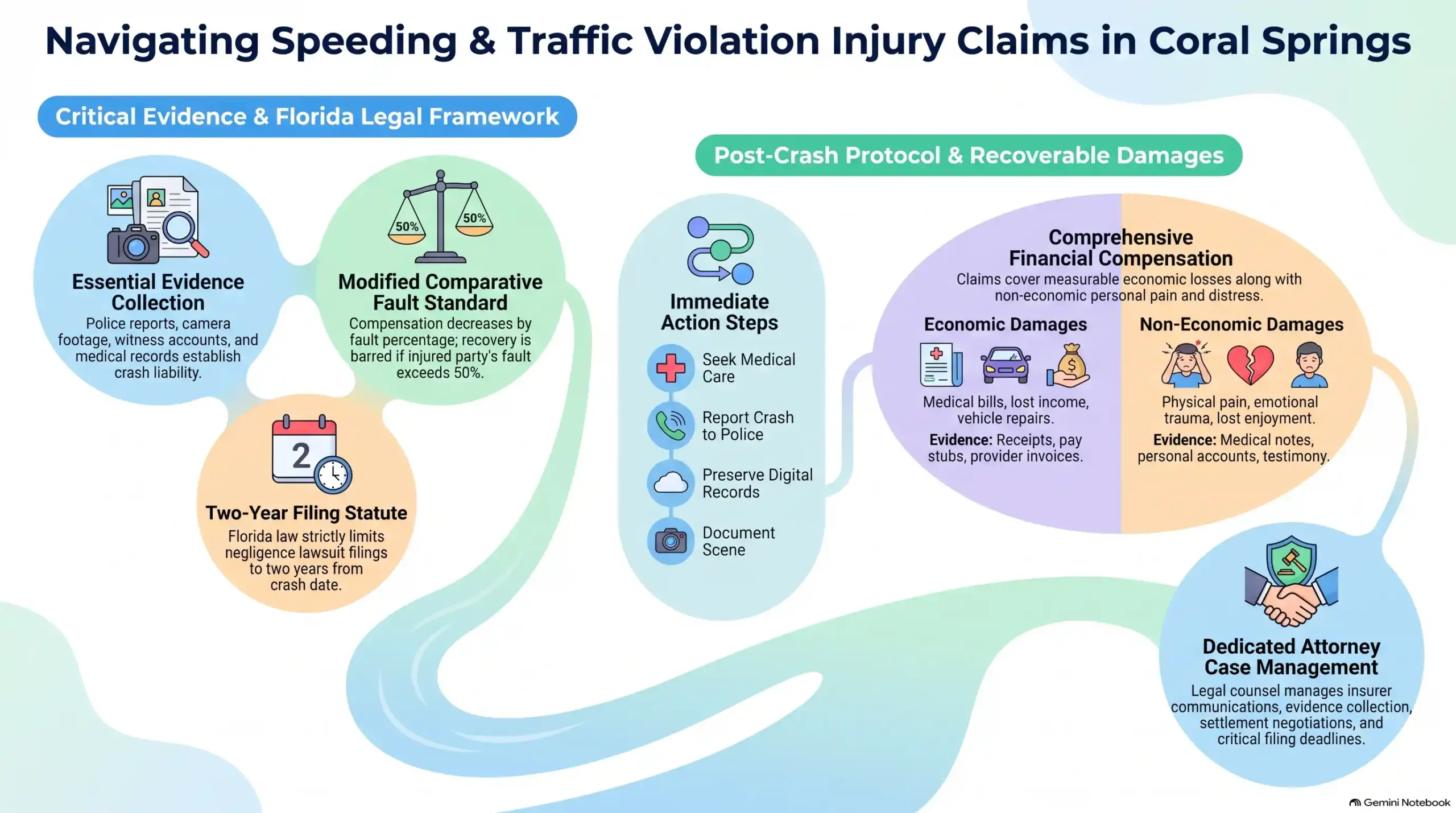
Traffic citation implications can extend beyond a fine or other penalty. A violation may support a claim that a driver failed to exercise reasonable care, while the injured person’s conduct may also be examined. Under Florida’s comparative negligence standards, courts can apportion responsibility among parties, and an injured person’s recoverable damages may be reduced based on their share of fault. The specific effect depends on the evidence and applicable law.
Careful review of these issues can help clarify a claim’s strengths and support fair treatment of injured people seeking compensation for losses and recovery-related needs.
Don’t Wait. Call Our Florida Personal Injury Lawyers Now!
Common Causes of Coral Springs Car Accident Traffic Violations & Speeding
Common causes of traffic violations in Coral Springs include speeding and aggressive driving, which can reduce reaction time and increase collision severity. Distracted driving can keep motorists from noticing changing road conditions, while failing to yield can create hazards at intersections and during lane changes. Running red lights also puts other road users at risk, especially when traffic is moving through an intersection.
Speeding and Aggressive Driving
On Coral Springs roads, excessive speed and aggressive driving reduce a driver’s ability to react and increase collision severity. Posted limits establish legal Speed Thresholds, but safe speeds may be lower when traffic is dense, visibility is poor, or road conditions change. Drivers who travel too fast have less time to stop, yield, or avoid hazards, putting occupants and other road users at risk.
Aggressive Actions, including tailgating, unsafe lane changes, rapid acceleration, and disregarding traffic signals, can further increase collision risks. Such conduct may violate traffic laws and contribute to serious crashes at intersections, along busy corridors, or in residential areas. A careful review of speed, vehicle movement, roadway conditions, and witness accounts can help clarify how a collision occurred and identify whether a traffic violation contributed to the harm.
Distracted Driving
A driver’s attention can shift away from the road in a moment, leaving less time to recognize hazards and respond safely. Distracted driving may involve visual, manual, or mental diversions, each of which can reduce a driver’s ability to monitor traffic and control a vehicle. Phone distraction is a common example, including texting, reading notifications, or handling a device while driving. Even brief interactions can take a driver’s eyes and hands from critical tasks. Cognitive distraction also presents risks when a driver focuses on a conversation, stressful thoughts, or other concerns instead of changing road conditions. These behaviors can contribute to traffic violations and collisions in Coral Springs. Identifying the source of distraction can help clarify how an incident occurred and support efforts to promote safer roads for all community members.
Failure to Yield
When drivers fail to yield, they may enter an intersection or merge into traffic before it is safe, creating a risk of collision. These incidents can occur when a driver overlooks a posted sign, misjudges another vehicle’s distance, or proceeds without checking for pedestrians and cyclists. Yield sign violations may also involve failing to slow down when conditions require caution, even if the roadway appears clear. Understanding intersection right-of-way is crucial, particularly where several vehicles, turning movements, or people crossing share limited space. Drivers who disregard these responsibilities can cause injuries and property damage, affecting people who were traveling lawfully. Careful observation and patient decision-making help protect everyone using Coral Springs roads. When a crash occurs, documenting the scene and seeking appropriate assistance can support an informed review of what happened.
Running Red Lights
Running a red light can turn an otherwise routine trip through a Coral Springs intersection into a serious collision. Drivers may enter after the signal changes because they are distracted, misjudge their stopping distance, or attempt to beat a yellow light. These choices can place pedestrians, cyclists, and occupants of other vehicles at immediate risk, particularly at busy intersections.
After a crash, investigators may review witness accounts, vehicle damage, signal records, and available camera footage to determine how the violation occurred. Red light camera rules govern when automated enforcement may be used and how notices are issued. Signal timing standards also matter when questions arise about whether a driver had adequate time to stop safely. A careful review can clarify responsibility and support fair treatment for everyone affected by the collision.
Don’t Wait. Call Our Florida Personal Injury Lawyers Now!


Legal Rights of Coral Springs Car Accident Traffic Violations & Speeding Injury Victims
Traffic violations and speeding can provide important evidence in a Coral Springs car accident claim, but they do not automatically determine legal responsibility. Injured people may pursue compensation when another party’s negligence causes harm, subject to Florida law and the collision’s facts. Victim Rights include seeking payment for documented medical expenses, lost income, pain, and other legally recognized losses. A traffic citation may support a claim, but it is not a final civil liability decision. Citation Consequences in a separate traffic case also do not guarantee compensation.
A careful claim can help protect the injured person’s interests while supporting fair treatment for everyone affected.
Important steps may include:
- Preserving crash reports, photographs, and witness contact information.
- Keeping medical records and following recommended treatment.
- Promptly reporting relevant insurance information and deadlines.
- Consulting a qualified attorney about liability, damages, and available options.
Florida’s comparative fault rules may reduce recovery if an injured person shares responsibility. Legal guidance can clarify evidence, applicable deadlines, and practical choices without promising a particular outcome.
Why Do Coral Springs Car Accident Traffic Violations & Speeding Injuries Happen?
Understanding how these collisions occur can help explain why traffic violations and speeding often become significant factors in Coral Springs car accident claims. Drivers may exceed posted limits, follow too closely, or run red lights when rushing, distracted, or misjudging traffic around them. These choices reduce reaction time and increase impact force, putting occupants, pedestrians, and cyclists at greater risk of serious injury.
Other conditions can contribute to a crash without excusing unsafe conduct. Road design, including busy intersections, limited sightlines, and changing traffic patterns, may require drivers to adjust speed and attention. When motorists fail to respond appropriately, a minor hazard can develop into a collision. Weather conditions such as heavy rain can reduce visibility and traction, making speeding or abrupt movements especially dangerous.
In some cases, several factors combine, including driver error, roadway conditions, and vehicle performance. Understanding these causes helps clarify how preventable violations can harm people and affect the circumstances surrounding an injury claim.
What Should You Do After a Coral Springs Car Accident Involving Traffic Violations & Speeding?
After a Coral Springs crash involving a traffic violation or speeding, those involved should first check for injuries and request emergency medical assistance when needed. They should report the collision to law enforcement and provide accurate information about what occurred. If it is safe, they should preserve evidence by photographing the scene, vehicle damage, and relevant road conditions.
Check for Injuries
Anyone involved in a Coral Springs car accident should check for injuries before addressing vehicle damage or traffic violations. The first priority is to protect everyone’s safety while avoiding unnecessary movement that could worsen an injury. From a safe position, a person can check for responsiveness by speaking calmly and observing whether anyone answers or appears confused. If someone is unconscious, has difficulty breathing, is bleeding heavily, or reports severe pain, call emergency services immediately and describe the location and apparent condition of those involved. Do not move an injured person unless an immediate hazard makes staying put more dangerous. If trained and able, bystanders can provide basic assistance while waiting for responders, without exceeding their skills. Even when injuries seem minor, prompt medical evaluation can identify problems that are not immediately apparent.
Report the Crash
Once you’ve addressed immediate safety concerns, report the crash promptly to law enforcement, especially if someone is injured, a driver appears impaired, or a traffic violation such as speeding may have contributed. A police report can document the incident and help establish an official account for those affected. If officers do not respond, the involved parties should ask how to file a report with the appropriate agency. Drivers should exchange information, including names, contact details, insurance information, and vehicle registration, while remaining calm and respectful. Notify authorities if a driver leaves, refuses to provide required details, or poses an immediate safety concern. Clear, accurate communication can assist injured people, responding officers, and others who may need to address the crash’s consequences.
Preserve Evidence
When it is safe, people involved in a Coral Springs car accident should preserve evidence that may clarify how the crash occurred, especially if speeding or another traffic violation is suspected. Photographs of vehicle damage, road conditions, traffic signs, skid marks, and visible injuries can document details that may change or disappear. Collect witness names and contact information, and retain relevant messages, receipts, and medical records. Evidence preservation also includes keeping damaged property and, when practical, avoiding repairs until its condition is documented. Drivers should promptly save dashcam footage and ask nearby businesses to preserve surveillance recordings before routine deletion. Secure digital backups can reduce the risk of losing important files. Organized records can help insurers, investigators, and legal professionals assess responsibility and support an injured person’s claim.
Critical Evidence in a Coral Springs Car Accident Tra
Don’t Wait. Call Our Florida Personal Injury Lawyers Now!
Evidence can help establish how a speeding or traffic violation caused a Coral Springs collision and the resulting injuries.
Essential records may include:
- Police accident reports
- Traffic camera footage
- Witness statements
- Medical records and bills
Together, these materials can support an assessment of liability and documented losses.
Police Accident Reports
Police accident reports can be important in a Coral Springs car accident involving alleged traffic violations or speeding. The report may record the responding officer’s observations, statements from drivers and witnesses, roadway conditions, and any citations issued. These details can help clarify how the collision occurred and identify issues that require further investigation. An injured person or authorized representative may request a report through the appropriate law enforcement agency by following its procedures and providing necessary identifying information. Because reports may contain errors or incomplete accounts, affected parties should review them carefully. If you find a factual mistake, you can request corrections through the agency’s established process, with supporting documentation where available. A report is important evidence, but it does not independently determine fault or establish the full extent of an injury claim.
Traffic Camera Footage
Traffic camera footage may help establish how a Coral Springs car accident occurred, particularly when a driver is accused of speeding or violating a traffic signal. Nearby municipal, business, or residential cameras may capture vehicle movement, signal timing, and conditions shortly before or after impact. This evidence can help clarify disputed details and support a careful assessment of injuries and responsibility.
Camera retention policies vary, and recordings may be overwritten quickly. Promptly request the camera owner or responsible agency to preserve relevant material. Review the footage in its original context, paying attention to timestamps, camera position, image quality, and possible gaps in coverage. Authenticating footage may require records or testimony showing how the recording was created and maintained. Proper preservation and review can help those seeking accountability and fair compensation while protecting the evidence’s accuracy.
Witness Statements
When camera footage is unavailable or leaves pivotal moments unclear, witness statements may help explain how a Coral Springs car accident occurred. Independent observers can describe vehicle speed, traffic signals, lane changes, and actions taken immediately before impact. Their accounts may help clarify whether a driver violated traffic laws or failed to respond safely to changing conditions.
Witness credibility depends on factors such as the observer’s location, visibility, attention, and relationship to those involved. Investigators may compare each account with physical evidence and other available information. Statement consistency across interviews can strengthen an account, while differences may require careful review rather than automatic dismissal. Witnesses should report only what they personally observed and avoid guessing about speed, fault, or events outside their view. Promptly recording contact details and preserving accurate accounts helps ensure relevant perspectives remain available during the evaluation of a claim and any related legal proceedings.
Medical Records and Bills
Medical records and bills provide essential evidence in a Coral Springs car accident involving alleged traffic violations or speeding. They document reported injuries, treatment provided, and medical costs incurred, helping establish how the collision affected the injured person. Emergency department notes, imaging results, physician evaluations, and follow-up records may also clarify the timing and severity of symptoms.
Itemized bills can identify charges for appointments, procedures, medication, and rehabilitation. When reviewed alongside treatment records, they help explain whether expenses relate to the crash and support a clear account of damages. Accurate record requests can obtain documents from hospitals, physicians, pharmacies, and insurers, subject to applicable privacy requirements. Consistent documentation may also help address disputes about injury causation or treatment gaps. Careful organization allows legal professionals to assess the evidence and present a reliable, complete claim.
Long-Term Effects of Coral Springs Car Accident Traffic Violations & Speeding Injuries
Traffic violations and speeding can cause injuries with effects that persist long after the collision. Some victims experience chronic pain and reduced mobility, while others face lasting emotional trauma. Ongoing treatment and rehabilitation can also create substantial medical expenses.
Chronic Pain And Mobility
Chronic pain and reduced mobility can persist long after a Coral Springs car accident, particularly when speeding or other traffic violations cause severe injuries. Spinal, joint, nerve, or soft-tissue damage may limit walking, lifting, and other daily activities. Some injured people require ongoing Pain management, which may include medication, medical procedures, and regular evaluation by qualified providers. Mobility rehabilitation can help restore strength, balance, and functional movement through structured therapy tailored to each person’s condition. Progress may be gradual, and treatment needs can change as symptoms develop. Family members, caregivers, and community organizations can support recovery by helping with transportation, household tasks, and access to appointments. Accurate medical records and consistent follow-up also help document lasting limitations and guide decisions about appropriate care and practical assistance.
Lasting Emotional Trauma
After a Coral Springs car accident caused by speeding or another traffic violation, emotional effects may continue long after physical injuries begin to recover. Survivors may experience post-trauma anxiety, recurring distress, sleep disruption, or fear when traveling near the crash location. These reactions can disrupt work, relationships, and daily routines, even when outward signs of injury are no longer apparent. Family members and caregivers may also notice changes in mood, concentration, or confidence and can offer steady, respectful support without minimizing the person’s experience. A qualified mental health professional can assess symptoms and recommend appropriate care, such as counseling or other evidence-based treatment. Emotional recovery often takes time and may involve setbacks. Recognizing persistent distress and seeking help can support well-being and restore a greater sense of safety and independence.
Ongoing Medical Expenses
Emotional recovery is only one part of the long-term impact of a Coral Springs car accident caused by speeding or another traffic violation; ongoing medical expenses may also continue well beyond initial treatment. Injuries involving the spine, brain, or joints can require follow-up appointments, rehabilitation, prescription medication, assistive devices, or additional procedures. These needs may affect a person’s ability to work and meet ordinary household obligations.
Accurate medical expense forecasting helps identify the likely cost of care over time. Providers may document expected treatment, while billing records and expert opinions can clarify the scope of anticipated needs. Future treatment costs should be considered alongside current expenses when evaluating the financial impact of an accident. Careful records help families plan responsibly and support a clear review of collision-related damages.
Proving Liability in Coral Springs Car Accident Traffic Violations & Speeding Injury Cases
Proving liability in a Coral Springs car accident involving speeding or another traffic violation requires evidence that the driver’s conduct contributed to the collision and resulting injuries. Establishing fault may involve reviewing the crash report, witness accounts, photographs, traffic camera footage, and vehicle damage. These details can show whether a driver exceeded the speed limit, failed to yield, ran a red light, or violated another traffic rule.
Negligence standards require evidence that the driver failed to use reasonable care and that this failure caused harm. A traffic citation may support a claim, but it does not automatically establish liability. Investigators may also examine road conditions, visibility, vehicle positions, and available electronic data to reconstruct the collision.
Injury records and testimony can connect the crash to the harm suffered. Florida’s comparative fault rules may affect how liability is allocated when more than one party contributed. Careful evidence preservation helps clarify responsibility and supports a fair assessment of each person’s role.
Dealing With Insurance Companies After a Coral Springs Car Accident Traffic Violations & Speeding Injury
Once evidence clarifies how speeding or another traffic violation contributed to a Coral Springs crash, the injured person may need to respond to an insurance company’s questions and settlement offers. Insurers may request records, statements, or authorization to review medical information. Responses should be accurate and consistent with available documentation, since incomplete or speculative answers can complicate loss evaluation.
A settlement offer may not cover ongoing treatment, lost income, or other documented effects of the collision. Before accepting payment or signing a release, the injured person can compare the proposal with current expenses and reasonably anticipated needs. Available coverage also matters: policy limits may restrict how much an insurer can pay, even when the harm is substantial.
If the insurer disputes responsibility, questions the claimed injuries, or denies the claim, the injured person may benefit from reviewing the stated reasons and supporting records with qualified counsel. Careful, respectful communication helps preserve clarity while protecting the person’s ability to seek fair consideration.
What to Expect During a Coral Springs Car Accident Traffic Violations & Speeding Injury Claim Process
A Coral Springs car accident injury claim typically begins with an assessment of the crash, the alleged traffic violation, and the resulting injuries. Evidence and documentation, including police reports, medical records, and witness accounts, help establish liability and damages during negotiations. If the parties cannot reach a settlement, the claim may proceed to trial.
Initial Case Assessment
During an initial case assessment, a Coral Springs car accident lawyer reviews how traffic violations or speeding may have contributed to the collision and evaluates the available evidence, injuries, and insurance coverage. The Intake Interview gives the injured person an opportunity to explain the crash, describe treatment needs, and identify immediate concerns. Counsel may ask about the other driver’s conduct, any citations, and how the injuries affect daily responsibilities. A Liability Screening then considers whether the known circumstances support a potential claim and whether another party may share responsibility. The lawyer also reviews applicable deadlines, possible insurance issues, and practical options for moving forward. This early evaluation clarifies the claim’s scope and identifies questions that need further review. It can guide decisions while keeping the injured person’s recovery and obligations in view.
Evidence And Documentation
What evidence can clarify how speeding or another traffic violation contributed to a Coral Springs crash? Investigators may review the police report, photographs of vehicle damage and roadway conditions, witness statements, and available traffic or surveillance footage. These materials can help establish vehicle positions, visibility, and events before impact. Medical records and repair estimates can document the resulting harm and property damage.
Preserving evidence matters because video, vehicle data, and physical conditions may change or disappear. A claimant or representative can promptly request relevant records and keep original files, dated photographs, and witness contact details. Documentation Standards also require consistent, accurate records of treatment, expenses, missed work, and communications related to the collision. Organized evidence lets the claim process proceed on a clearer factual basis and helps ensure affected people receive careful, fair consideration.
Injury Claim Negotiations
Once liability and the extent of the injuries are documented, settlement negotiations generally begin with a demand supported by medical records, wage information, repair estimates, and other relevant evidence. The insurer reviews the materials and may question fault, treatment needs, or claimed losses. Demand evaluation compares the offer with documented expenses, anticipated care, lost income, and how injuries affect daily responsibilities. A careful review helps make certain the claim reflects the person’s actual needs rather than an unsupported estimate. If the initial offer is inadequate, a counteroffer strategy may address specific gaps with additional records, clear calculations, and reasoned explanations. Throughout discussions, the injured person can focus on recovery and family or community obligations while counsel manages communications, tracks deadlines, and seeks a fair resolution grounded in the available evidence.
Settlement Or Trial
Whether a traffic violation or speeding allegation leads to settlement or trial depends on the evidence, the injuries, and the parties’ positions on fault and compensation. During settlement discussions, the parties may review crash reports, witness accounts, medical records, and available insurance coverage. A negotiated resolution can provide compensation without requiring injured people to testify, while allowing them to focus on recovery and their responsibilities to family and community. If the parties cannot agree, the claim may proceed to court. The process can include discovery, motions, and jury selection. At trial, witnesses may testify about the collision, injuries, and resulting losses. A judge or jury then evaluates the evidence and determines liability and damages. The outcome depends on the facts presented, and neither settlement nor trial guarantees compensation.
Compensation for Coral Springs Car Accident Traffic Violations & Speeding Injury Damages
When a driver’s traffic violation or speeding causes a crash in Coral Springs, injured people may seek compensation for losses supported by the evidence. Available recovery depends on the injuries, their impact on daily life, and the evidence linking the violation to the collision. Medical expenses may include emergency treatment, hospital care, rehabilitation, medication, and reasonably anticipated future services. Records and provider opinions can help establish the nature and duration of necessary care.
A claim may also address Lost income when injuries prevent someone from working during recovery. If lasting limitations affect the ability to earn a living, the court may consider diminished earning capacity based on evidence about the person’s work and future prospects. Compensation may account for physical pain, emotional distress, and disruption to ordinary activities. Photographs, witness accounts, crash reports, and medical documentation can help clarify the harm and its connection to the crash. Careful evaluation supports a claim that reflects the injured person’s needs and the available evidence.
Economic vs Non-Economic Damages in Coral Springs Car Accident Traffic Violations & Speeding Cases
In Coral Springs speeding and traffic-violation cases, economic damages may cover measurable losses such as medical bills and lost income. Non-economic damages address less quantifiable harm, including pain, emotional distress, and reduced quality of life. Supporting both categories with reliable records and other evidence is crucial to establishing the losses claimed.
Economic Damages
After a Coral Springs car accident involving a traffic violation or speeding, economic damages may include documented financial losses caused by the crash. These losses can include emergency care, hospital treatment, medication, rehabilitation, and other reasonable medical expenses. Receipts, invoices, insurance records, and provider statements can help establish the amounts incurred and connect them to the collision. A claimant may also seek compensation for Lost wages when injuries prevent work, supported by payroll records, employer statements, or tax documents. If injuries limit the ability to perform prior duties or reduce future work opportunities, courts may consider diminished earning capacity based on employment evidence and qualified assessments. Vehicle repair or replacement costs, towing fees, and necessary transportation expenses may also qualify. Careful documentation helps clarify the financial impact and supports an accurate damages calculation.
Non-Economic Damages
Beyond documented financial losses, a Coral Springs car accident claim involving speeding or another traffic violation may include non-economic damages for the injury’s personal effects. These damages address harm without a direct price, recognizing how an injury can affect a person’s daily life, relationships, and well-being. Pain and suffering may include physical discomfort, emotional distress, and the strain of recovery. Loss of enjoyment may apply when injuries prevent someone from participating in valued activities, fulfilling family responsibilities, or serving the community. Unlike medical bills or lost wages, these effects are personal and may continue after treatment ends. Their significance depends on the circumstances and the injury’s impact. A claim may seek compensation for these losses alongside economic damages, reflecting the broader consequences of a traffic-related collision on an injured person’s life.
Proving Your Losses
To prove losses in a Coral Springs car accident claim involving speeding or another traffic violation, an injured person generally needs evidence connecting the collision to the harm suffered. Medical records, treatment bills, and provider opinions can document physical injuries, necessary care, and expected future expenses. Income documentation, such as pay statements, tax records, and employer verification, may establish missed wages or reduced earning capacity. Records of household services can show the cost of assistance with tasks the injured person could previously perform. These economic damages should be supported by clear, organized evidence. Non-economic losses, including pain, emotional distress, and diminished enjoyment of life, may be shown through treatment notes, personal accounts, and testimony from people familiar with the person’s daily limitations. A traffic citation may support the account, but does not alone prove damages.
When a Coral Springs Car Accident Traffic Violations & Speeding Injury Case Goes to Trial vs Settlement
Whether a Coral Springs car accident case involving speeding or another traffic violation settles or proceeds to trial depends on the evidence, the extent of the injuries, and the parties’ willingness to resolve disputed issues. Settlement can provide a more predictable resolution and avoid the time, expense, and uncertainty of a courtroom proceeding. It may also allow injured people to focus on treatment and family responsibilities while the claim concludes.
A trial may be necessary when the parties disagree about fault, the severity of the injuries, or the value of documented losses. Each side presents evidence and witnesses, and a judge or jury evaluates the dispute. Jury Deliberations follow the presentation of the case, but the result cannot be guaranteed. A trial can take longer and add stress, but it can give a claimant the opportunity to seek a jury decision. Counsel can assess settlement terms, trial risks, and Appeal Prospects when advising on available options.
Florida Laws That May Affect Your Coral Springs Car Accident Traffic Violations & Speeding Case
Florida law shapes how a Coral Springs car accident claim involving speeding or another traffic violation is evaluated. The rules determine how insurance benefits apply, how fault is assessed, and what evidence may support a claim. Understanding these principles can help injured people protect their interests while focusing on recovery and family responsibilities.
- No Fault Coverage: Florida’s personal injury protection insurance generally pays specified medical and disability benefits regardless of fault, subject to policy terms and legal requirements.
- Comparative Negligence: A person’s recovery may be reduced by their share of responsibility. Florida’s modified comparative fault rule can bar recovery when that share exceeds 50 percent.
- Traffic violations: A speeding citation or other violation may show negligence, but it does not automatically establish liability. The full circumstances remain relevant.
- Evidence and damages: Police reports, witness accounts, photographs, and medical records can help clarify how the collision occurred and document resulting losses.
These laws may influence negotiations and trial decisions. Careful review helps confirm that claims reflect both statutory requirements and the needs of those affected.
The Statute of Limitations for Coral Springs Car Accident Traffic Violations & Speeding Injury Cases
Because filing deadlines can determine whether an injury claim proceeds, the statute of limitations is an important consideration after a Coral Springs car accident involving speeding or another traffic violation. Under Florida law, an injured person generally has two years from the crash date to file a negligence lawsuit. The applicable Limitations deadline may differ for wrongful death claims, which generally must be filed within two years of death. Missing the deadline can prevent recovery in court, even when evidence shows another driver’s speeding or traffic violation caused serious harm.
Certain tolling exceptions may pause or affect a filing period in limited circumstances, such as when a defendant cannot be located, or the injured person is legally incapacitated. These rules depend on the facts and applicable statutes, and you should not assume they automatically extend time. Prompt attention to deadlines helps preserve the opportunity to seek accountability and support those affected by a preventable collision.
How a Coral Springs Car Accident Traffic Violations & Speeding Lawyer Can Help You
Meeting a filing deadline is only one part of pursuing a claim after a speeding-related crash; a Coral Springs car accident lawyer can also help establish how a traffic violation contributed to the injuries. By organizing evidence and explaining available legal options, counsel can help injured people pursue fair compensation while protecting the interests of others affected by the collision.
A Coral Springs car accident lawyer can connect traffic violations to injuries and help pursue fair compensation.
A lawyer may assist by:
- Reviewing crash reports, witness statements, photographs, and medical records to clarify how the collision occurred.
- Identifying whether speeding or another traffic violation supports a negligence claim and documenting resulting losses.
- Communicating with insurers, responding to disputed liability arguments, and presenting evidence of damages.
- Providing Citation Defense and License Protection guidance when a citation or potential driving consequence accompanies the injury claim.
Counsel can also coordinate information from medical providers and other professionals, helping ensure the claim reflects both current harm and anticipated needs. This organized approach can support accountability, reduce avoidable disputes, and help injured clients access the resources they need for recovery without losing sight of the broader community’s safety.
When to Contact a Coral Springs Car Accident Traffic Violations & Speeding Lawyer
After a crash involving suspected speeding or another traffic violation, contacting a Coral Springs car accident lawyer promptly can help preserve evidence and clarify important deadlines. An early legal consultation may be especially important if someone is injured, a vehicle is seriously damaged, or accounts of the collision differ. Timely guidance can help the injured person understand what information to gather and how to protect records that may later support a claim.
A lawyer may also explain Injury Claim Deadlines, which can vary according to the circumstances and applicable law. Waiting too long can limit options, while early contact gives the person time to ask questions before deciding or signing documents. Prompt communication is also useful when an insurer requests a statement or offers a settlement. Those supporting an injured family member or community member can encourage timely legal advice without pressuring them. A consultation can clarify immediate next steps and help the injured person make informed choices.
Why You Need an Experienced Coral Springs Car Accident Traffic Violations & Speeding Lawyer
An experienced Coral Springs car accident traffic violations and speeding lawyer can help an injured person assess how a suspected violation may relate to the collision and resulting losses. A careful review of citations, crash reports, witness accounts, and available evidence can clarify disputed facts and identify issues that may affect an insurance claim or court proceeding. This support can be especially valuable when an injured person is focused on medical care and recovery while also trying to protect the interests of family members and others who depend on them.
Traffic citation defense may challenge an inaccurate allegation or explain relevant circumstances, while license point mitigation can help address potential effects on driving privileges. Legal guidance can also help preserve records, meet filing deadlines, and communicate with insurers without overlooking important details. By examining both the traffic matter and its connection to the injury claim, counsel can help the injured person make informed decisions, pursue fair compensation, and reduce avoidable legal and financial consequences.
How to Choose the Right Coral Springs Car Accident Traffic Violations & Speeding Lawyer for Your Case
Choosing the right Coral Springs car accident traffic violations and speeding lawyer requires careful consideration of the lawyer’s experience with both traffic matters and injury claims. A qualified attorney should understand how citations, speeding allegations, and crash evidence may affect a client’s case. Reviewing Attorney Credentials can help confirm licensing, relevant experience, and a record of handling comparable matters. The lawyer should also explain the legal process clearly and respond to questions with patience and respect.
A careful selection process includes asking how the attorney investigates collisions, communicates with clients, and coordinates efforts to address both traffic charges and injury-related concerns. Clear communication supports informed decisions and helps clients focus on recovery while the attorney addresses their legal concerns. Prospective clients should also review the Fee Structure, including any costs, payment terms, and circumstances that could affect the total expense. Before deciding, they can compare qualifications, services, and communication practices. The right fit is an attorney with a transparent, attentive approach suited to the case’s specific needs.
About The Law Offices of Anidjar & Levine
The Law Offices of Anidjar & Levine represents people injured in car accidents, including collisions involving traffic violations or speeding allegations.
The firm handles injury claims and helps clients understand the legal process after a crash.
Its attorneys may investigate how a collision occurred, review available evidence, and communicate with insurers on a client’s behalf.
Each case depends on its facts, including the drivers’ conduct and the reported injuries.
The firm’s history provides context for its work and its focus on representing injured people.
The firm’s stated approach emphasizes client service, clear communication, and attention to the practical effects of an accident.
For people seeking to serve others, this work may be understood as supporting individuals and families facing disruption after a serious collision.
Community involvement is another aspect of the firm’s public presence.
Prospective clients can review the firm’s services, attorney information, and community activities to assess whether its experience and approach fit their needs.
No outcome is guaranteed, and legal options depend on each claim’s circumstances.

Frequently Asked Questions
Can a Speeding Ticket Affect My Florida Driver’s License?
Yes, a speeding ticket can affect a Florida driver’s license by adding Florida license points, depending on the violation and circumstances. Accumulated points may trigger suspension thresholds: generally, 12 points within 12 months, 18 within 18 months, or 24 within 36 months. The length varies by point total. A driver should review the citation, verify its accuracy, and consider available options promptly to protect driving privileges and support safe roads.
What Happens if I Receive a Traffic Citation After a Coral Springs Crash?
A traffic citation after a Coral Springs crash may require payment, a court appearance, or a timely election to contest the alleged violation. The cited driver should review the notice carefully and meet all citation deadlines, since missing them can lead to added costs or license consequences. Crash scene evidence, including photographs, witness accounts, and reports, may help clarify what occurred. Promptly preserving records and responding through proper channels protects the driver’s rights and supports fair resolution.
Can I Contest a Speeding Ticket if the Radar Reading Was Inaccurate?
Yes, a driver can contest a speeding ticket by challenging the reliability of the radar reading. Relevant evidence may include Radar calibration records, maintenance history, and documentation showing the device was used correctly. Officer training and the officer’s observations may also be examined. The driver should preserve the citation and related records, meet court deadlines, and present specific evidence. A qualified traffic attorney can assess the circumstances and explain available options.
Will a Traffic Violation Appear on My Driving Record?
A traffic violation may appear on a driving record if the driver is found responsible or pays the ticket, though rules vary by state and violation type. How long it remains depends on local law and the offense; record duration may differ from the period insurers consider. Insurance reporting can affect premiums, while Employer checks may reveal violations for roles requiring driving. A driver can review the record and seek correction of errors.
Can I Attend Traffic School to Avoid Points After a Speeding Citation?
A driver may be able to attend traffic school to avoid points after a speeding citation, but eligibility depends on Florida law, the driver’s record, and whether the driver has completed a course before. Confirm traffic school eligibility before choosing this option, since some citations or circumstances may not qualify. The driver must also complete the course by the deadline and submit proof as instructed. Missing required steps can result in points or additional penalties.
—————————
A Coral Springs crash involving speeding or another traffic violation can leave an injured person facing medical costs, lost income, and difficult insurance decisions.
Prompt legal guidance can help preserve evidence, assess liability, and pursue fact-based compensation.
The Law Offices of Anidjar and Levine represent people injured in motor vehicle collisions and can explain available options.
Learn more from a Coral Springs Personal Injury Lawyer.
Because each case depends on its circumstances, timely review can help protect important rights and support informed decisions.

