

The Law Offices of Anidjar and Levine can investigate the circumstances of a motorcycle crash, preserve photographs, medical records, witness accounts, and electronic evidence, and evaluate available insurance coverage.
Counsel may assess comparative negligence, helmet-related injury arguments, lane-position issues, and other contributing factors without assuming automatic rider responsibility.
Legal support can help document treatment costs, lost income, property damage, and future care needs while addressing insurer communications, deadlines, and settlement offers.
Learn more by speaking with a Brevard County Personal Injury Lawyer.
Main Takeaways
- A Brevard County motorcycle injury lawyer investigates fault using traffic signals, witness statements, vehicle damage, surveillance, and electronic evidence.
- Potential at-fault parties may include negligent drivers, impaired motorists, employers, vehicle manufacturers, or parties responsible for dangerous roadway conditions.
- Florida’s comparative negligence rules may reduce compensation when multiple parties contributed to the motorcycle crash.
- Helmet use can affect injury-severity arguments but does not excuse another party’s negligent driving or determine crash responsibility.
- Counsel can preserve evidence, evaluate insurance coverage, document damages, handle insurers, and monitor Florida’s claim deadlines.


How We Can Help With Your Brevard County Motorcycle At-Fault Parties Injury Claim
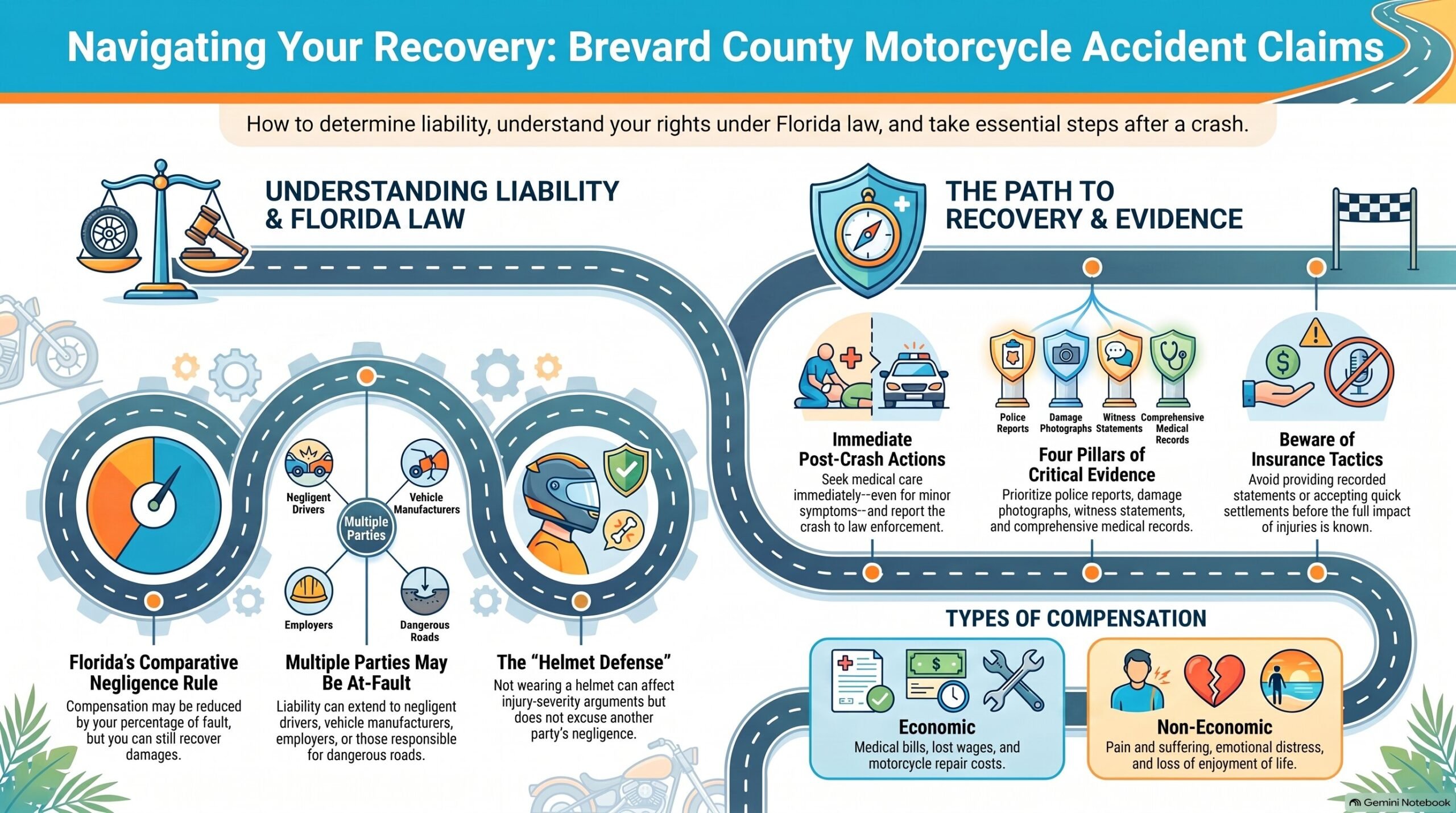
When a motorcycle crash in Brevard County results from another party’s negligence, an injury law firm can provide structured legal guidance from the initial investigation through resolution of the claim. Counsel may preserve photographs, medical records, witness statements, and other evidence while evaluating available insurance coverage. This process helps establish how the collision occurred and documents losses, including treatment costs, lost income, property damage, and ongoing care needs.
A legal team can communicate with insurers, prepare a demand supported by reliable documentation, and monitor Insurance claim timelines so that important deadlines receive appropriate attention. Attorneys may also explain Comparative fault rules and evaluate how any alleged rider conduct could affect recovery, without allowing unsupported accusations to control negotiations. Throughout the matter, counsel can provide regular updates, coordinate with medical providers when appropriate, and pursue a fair settlement or prepare for litigation if necessary. The firm’s role remains focused on protecting the injured person’s interests while seeking accountability through an orderly, evidence-based process.
OUR CONSULTATIONSARE FREE
START YOUR FREE CASE REVIEW

Understanding Brevard County Motorcycle At-Fault Parties’ Injury Cases
Brevard County motorcycle at-fault parties’ injury cases require a careful evaluation of the collision, the conduct of each involved party, and the injuries sustained. Liability may depend on traffic signals, roadway positioning, witness accounts, vehicle damage, and available video or electronic evidence. Florida’s comparative negligence framework can affect recovery when more than one person contributed to the incident. Investigators may also examine Helmet safety compliance, because helmet use can influence arguments concerning injury severity without necessarily determining responsibility for the crash.
The circumstances surrounding lane-splitting rules may likewise require review, particularly when motorcycle movement between lanes is alleged to have affected visibility, timing, or vehicle control. Medical records, treatment recommendations, and long-term limitations help establish the nature and value of claimed damages. A careful case assessment seeks an accurate account while respecting the interests of injured individuals, families, and other affected members of the community. Timely preservation of evidence supports fair, informed resolution.
Common Causes of Brevard County Motorcycle At-Fault Parties
Common causes of motorcycle crashes in Brevard County include distracted driving, speeding, and other reckless conduct that reduces a driver’s ability to respond safely. Collisions may also result when motorists fail to yield the right of way, particularly at intersections and during lane changes. Driving under the influence further increases the risk of impaired judgment, delayed reactions, and serious motorcycle injuries.
Distracted Driving
Distracted driving is a significant cause of motorcycle collisions in Brevard County, particularly when motorists divert their attention from traffic, roadway conditions, or nearby riders. Cell Phone Use, including texting, calling, or reviewing navigation applications, can delay recognition of motorcycles and interfere with timely responses. Other distractions include adjusting vehicle controls, eating, conversing with passengers, or looking away from the roadway. These actions may cause drivers to overlook motorcycles in adjacent lanes, fail to check mirrors, or turn without recognizing an approaching rider.
Proper Lane Discipline requires consistent awareness of surrounding traffic, careful mirror checks, and appropriate signaling before changing position. When distraction contributes to a crash, injured motorcyclists may need medical care, evidence preservation, and informed legal guidance. Accountability can help protect affected riders and promote safer decisions on Brevard County roads.
Speeding And Reckless Driving
Excessive speed and reckless driving can turn an otherwise manageable traffic situation into a severe motorcycle collision in Brevard County. Drivers who exceed posted limits have less time to recognize hazards, control their vehicles, or respond safely to changing traffic conditions. Aggressive maneuvers, abrupt lane changes, and road rage incidents can further endanger motorcyclists, especially when combined with lane-position errors. Effective Intersection safety requires reduced speeds, attentive scanning, and respect for motorcycles’ limited protection.
Although helmet compliance may lessen the severity of certain injuries, it cannot prevent all consequences of a high-impact crash. Investigators may examine surveillance footage, vehicle damage, witness statements, and driving histories to determine whether excessive speed or reckless conduct contributed to the collision. Clear evidence can help injured individuals pursue appropriate support and accountability.
Failure To Yield
When motorists fail to yield the right of way, motorcyclists may be forced to brake suddenly, take evasive action, or collide directly. At intersections, drivers may overlook an approaching motorcycle while turning, crossing traffic, or entering a roadway. Such conduct can create uncertainty concerning the intersection right of way and increase the likelihood of severe injuries. Traffic control errors, including disregarding signs, signals, or marked yield points, may also place riders in immediate danger.
Investigations may identify lane violation patterns involving abrupt turns, unannounced lane changes, or encroachment into motorcycle travel paths. Improper merging is another frequent factor, particularly when a driver enters an occupied lane without adequately checking mirrors and blind spots. Witness statements, roadway evidence, and vehicle damage can help clarify responsibility and support injured individuals seeking appropriate assistance after a crash.
Driving Under The Influence
Driving under the influence can seriously impair a motorist’s judgment, reaction time, coordination, and ability to recognize motorcycles in nearby lanes. Alcohol, prescription medication, and illicit substances may cause unsafe lane changes, delayed braking, or disregard for traffic signals, increasing the likelihood of a severe collision. Officers may administer a Field sobriety evaluation and pursue chemical testing when impairment is suspected. Medical records, witness accounts, surveillance footage, and crash-scene observations can help establish how intoxication contributed to the incident.
Prompt evidence preservation is important because video recordings may be overwritten and physical conditions may change. An impaired driver may face criminal charges, license consequences, and other legal penalties, while an injured motorcyclist may seek compensation through an insurance claim or civil action. Careful investigation supports accountability and informed assistance.
Don’t Wait. Call Our Florida Personal Injury Lawyers Now!


Legal Rights of Brevard County Motorcycle At-Fault Parties Injury Victims
Motorcycle injury victims who may bear partial or primary responsibility for a collision still retain important legal rights under Florida law. Responsibility does not automatically eliminate access to compensation, medical care, or fair legal procedures.
Comparative Negligence may reduce an award according to the victim’s percentage of fault, but it does not necessarily bar recovery.
- Victims may seek compensation for medical expenses, lost income, disability, pain, and other legally recognized damages.
- They may challenge inaccurate fault allegations through witness statements, photographs, records, and qualified testimony.
- Evidence Preservation is crucial, and includes maintaining medical documentation, damaged equipment, scene photographs, and communications with insurers.
- Victims may consult counsel before providing recorded statements or accepting settlement offers that could undervalue their losses.
Florida deadlines can restrict the time available to bring a claim. Prompt legal guidance helps protect procedural rights, clarify potential liability, and support honest, informed decisions. Attorneys can also promote respectful communication among injured parties, insurers, medical providers, and families while pursuing an appropriate resolution.
Don’t Wait. Call Our Florida Personal Injury Lawyers Now!
Why Do Brevard County Motorcycle At-Fault Parties Injuries Happen?
Brevard County motorcycle at-fault party injuries often happen because traffic collisions involve multiple contributing factors rather than a single careless act. Motorists may fail to notice motorcycles during turns, lane changes, or merging, while riders may misjudge speed, following distance, or roadway conditions. Helmet compliance can also affect injury severity, although helmet use does not eliminate collision risks or excuse another road user’s conduct.
Lane filtering, where permitted or attempted, may create limited visibility and unpredictable spacing, particularly in congested traffic. Traffic signal confusion can produce dangerous conflicts when drivers or riders misunderstand changing lights, turn arrows, or right-of-way rules. Weather, debris, inadequate lighting, mechanical problems, and distraction may further reduce reaction time.
Liability misconceptions sometimes lead observers to assume that a motorcycle rider is automatically at fault because motorcycles are less visible or more vulnerable. In reality, responsibility depends on the specific conduct and circumstances involved, requiring careful, impartial evaluation of all contributing evidence.
What Should You Do After a Brevard County Motorcycle At-Fault Party’s Injury?
After a Brevard County motorcycle injury, the injured person should seek immediate medical care, even if symptoms initially appear minor. The crash should also be reported to law enforcement, with medical records and incident details carefully preserved. Consulting an experienced injury lawyer can help protect legal rights and assess potential claims against responsible parties.
Seek Immediate Medical Care
When a motorcycle collision causes injury, the rider should obtain immediate medical care, even if symptoms initially appear minor or develop later. Emergency room triage can identify internal bleeding, head trauma, fractures, and other conditions that may not be obvious at the scene. Prompt evaluation also creates a reliable medical record connecting reported symptoms with the collision. The injured rider should provide complete information about pain, dizziness, numbness, weakness, breathing difficulty, and changes in concentration.
Documenting symptoms accurately helps healthcare professionals assess developing conditions and determine appropriate treatment. If safe and permitted, Photo documentation of visible injuries, swelling, bruising, or damaged medical equipment may preserve useful information for later review. Following discharge instructions, attending scheduled appointments, and promptly reporting worsening symptoms support recuperation and help others understand the seriousness of the injury.
Report the Motorcycle Crash
Reporting the motorcycle crash promptly allows law enforcement to secure the scene, document involved parties, and create an official account of the incident. The motorcyclist or a responsible companion should call 911, provide the location, and describe apparent injuries without speculating about fault. Officers can arrange emergency assistance, control traffic, and identify hazards that may endanger other travelers.
Scene documentation may include photographs, roadway conditions, vehicle positions, visible damage, traffic signals, and relevant weather conditions. If injuries permit, a person should preserve this information without interfering with emergency operations. Witness canvassing can help identify individuals who observed the collision, including nearby drivers, pedestrians, and business employees. Their names and contact details should be shared with responding officers. A copy of the crash report should be requested and stored with medical records.
Consult an Injury Lawyer
A motorcycle injury lawyer can assess the crash circumstances, identify potentially liable parties, and explain the legal options accessible to the injured motorcyclist. Prompt consultation may help preserve evidence, secure witness statements, and protect important filing deadlines. The lawyer can review medical records, photographs, traffic citations, and the official crash report to determine whether another driver, vehicle owner, manufacturer, roadway authority, or insurer may bear responsibility.
During the evaluation, the motorcyclist should provide complete and accurate information, including Helmet compliance, prior medical conditions, and communications with insurance representatives. Counsel can also address property damage valuation, lost income, rehabilitation expenses, and potential long-term care needs. A qualified attorney may communicate with insurers on the injured person’s behalf, helping ensure that compensation discussions reflect the full impact of the collision and support the person’s recovery.
Critical Evidence in a Brevard County Motorcycle At-Fault Parties Injury Case
Critical evidence can establish how the collision occurred, identify responsible parties, and document the resulting injuries and losses.
Critical materials include:
- Police accident reports
- Motorcycle damage photos
- Witness statements
- Medical treatment records
Together, these records can support liability and strengthen an injured motorcyclist’s claim.
Police Accident Reports
When a motorcycle crash occurs in Brevard County, the investigating officer’s accident report may become important evidence in an injury claim against the at-fault party. It may identify involved drivers, record statements, describe road conditions, and document citations or apparent traffic violations. Although the report is not conclusive proof of liability, its observations can help establish a dependable account of the collision. An attorney may compare the report with medical records, witness testimony, and other available evidence to identify inconsistencies or challenges to witness credibility.
Promptly obtaining the report can also preserve information before memories fade or accounts change later. When supported by additional evidence, its findings may strengthen negotiations and provide leverage in settlement. A careful review helps ensure that the injured motorcyclist’s claim is presented accurately and responsibly to insurers, opposing counsel, or a court.
Motorcycle Damage Photos
Photographs of the damaged motorcycle can provide important evidence in a Brevard County injury case by showing the location, severity, and apparent force of the impact. Careful damage documentation may help connect visible defects to the collision and support an accurate assessment of repair costs, diminished value, or total loss. Images should be taken before repairs, cleaning, or removal of damaged components whenever safety and storage conditions permit. Evidence preservation also includes retaining original files, maintaining backups, and recording when, where, and by whom each image was created.
Helpful photo tips include using multiple camera angles, capturing wide views of the motorcycle and its surroundings, and photographing close-up details such as bent parts, scrape marks, fluid leaks, and broken equipment. Clear, dated images can assist legal professionals in presenting the claim responsibly.
Witness Statements
Eyewitness statements can provide valuable evidence in a Brevard County motorcycle injury case by describing how the collision occurred, the traffic conditions, and the conduct of the parties involved. Lay Witnesses may clarify whether a driver failed to yield, followed too closely, ignored a signal, or acted carelessly before impact. Their observations can also address visibility, road conditions, vehicle positioning, and events immediately surrounding the crash.
Prompt Statement Collection helps preserve accurate recollections before memories fade or accounts become influenced by later discussions. A legal representative may identify witnesses through crash reports, nearby businesses, passengers, or other individuals present at the scene. Each statement should be obtained respectfully, documented accurately, and evaluated against available physical evidence. This careful process supports a fair assessment of responsibility and helps protect an injured motorcyclist’s interests.
Medical Treatment Records
Medical treatment records provide key evidence in a Brevard County motorcycle injury case by documenting the nature, severity, and progression of the injured motorcyclist’s conditions. Emergency department reports, diagnostic imaging, physician notes, and prescriptions can connect injuries to the collision and establish necessary treatment. EMTs’ documentation may describe the motorcyclist’s condition at the scene, including pain, visible trauma, and immediate medical concerns. Follow-up records can document ongoing symptoms, functional limitations, and adherence to recommended care.
Chiropractic referrals may further support the need for rehabilitative treatment when providers identify musculoskeletal injuries requiring ongoing management. Complete records also help clarify prognosis, future medical needs, and related expenses. Attorneys may review these materials for consistency, while treating professionals can explain their significance to insurers, judges, and juries evaluating responsibility and damages.
Long-Term Effects of Brevard County Motorcycle At-Fault Parties’ Injuries
Motorcycle injuries may produce chronic pain and restricted mobility, affecting a person’s ability to work and perform daily activities. Emotional and psychological effects, including anxiety, depression, and trauma-related symptoms, may also persist long after physical wounds recover. Ongoing medical expenses for treatment, rehabilitation, medication, and assistive care can create substantial long-term financial burdens.
Chronic Pain And Mobility
Chronic pain and reduced mobility can remain long after the initial injuries caused by a motorcycle crash involving an at-fault party have stabilized. Fractures, nerve damage, spinal injuries, and soft-tissue trauma may limit walking, lifting, driving, or performing household tasks. Ongoing medical evaluation can identify functional changes and guide appropriate treatment. Pain management options may include prescribed medication, physical therapy, occupational therapy, injections, assistive devices, and carefully monitored rehabilitation.
A treating team can also recommend modifications that improve safety and preserve independence. Because lasting limitations may affect employment, transportation, and personal care, long-term care planning is often vital. Documentation of symptoms, treatment, equipment needs, and projected limitations may help establish the full scope of damages while supporting access to services for individuals requiring sustained assistance.
Emotional And Psychological Effects
Emotional and psychological effects may persist after physical injuries from a motorcycle crash have stabilized, particularly when pain, disability, disfigurement, or disrupted routines continue to affect daily life. Survivors may experience anxiety disorders, depression, irritability, sleep disruption, or withdrawal from activities once considered ordinary. Some develop posttraumatic stress, including intrusive memories, heightened alertness, avoidance, and distress when encountering motorcycles, traffic, or crash-related reminders.
These conditions can strain family relationships, employment, and confidence in personal safety. Compassionate support from relatives, friends, counselors, and medical professionals may help identify symptoms and encourage appropriate treatment. For injured individuals, records documenting emotional changes, professional evaluations, and effects on daily functioning can clarify the lasting consequences of a collision. Understanding these harms supports informed advocacy and fair recognition of recovery needs.
Ongoing Medical Expenses
A motorcycle crash can create medical expenses that continue long after emergency treatment and initial rehabilitation end. Ongoing care may include surgeries, expert visits, physical therapy, prescription medication, adaptive equipment, and treatment for chronic pain or permanent disabilities. These costs can affect household stability, employment, and access to necessary care.
A careful assessment should consider both current bills and reasonably anticipated future expenses. Treatment plan documentation, including physician recommendations, therapy records, and prognosis statements, can help establish the likely duration and cost of medical services. Workers’ compensation coordination may also be necessary when the injured person was working at the time of the collision or when workplace benefits overlap with other available compensation. Legal professionals can help preserve records, identify responsible parties, and pursue resources that support continued treatment without shifting an unfair financial burden onto the injured individual or family.
Proving Liability in Brevard County Motorcycle At-Fault Parties’ Injury Cases
When a motorcycle collision occurs in Brevard County, the injured rider generally must establish that another party’s negligence caused the crash and resulting losses. Liability may involve a driver, a roadway contractor, a vehicle manufacturer, or another responsible entity, depending on the evidence. The claim typically requires proof of a duty of care, a breach of that duty, causation, and measurable damages.
Useful evidence can include photographs, traffic-camera recordings, witness statements, police reports, vehicle data, medical records, and maintenance histories. Helmet Tracking Technology, when available and legally obtained, may help clarify speed, direction, or impact timing. Accident Scene Reconstruction can further evaluate skid marks, debris patterns, vehicle positions, visibility, and traffic signals. Investigators may also examine whether unsafe lane changes, distracted driving, defective equipment, or hazardous road conditions contributed to the collision. Preserving evidence promptly supports a fair evaluation and helps protect the injured person’s ability to seek accountability for medical needs, lost income, and other legally recognized harm.
Dealing With Insurance Companies After a Brevard County Motorcycle At-Fault Party’s Injury
Insurance companies often begin evaluating a motorcycle injury claim soon after receiving notice of the crash, making prompt and careful communication important. Injured riders should provide accurate facts while avoiding speculation, recorded statements without guidance, or comments that could be interpreted as admitting fault. Medical records, repair estimates, wage information, and photographs should be preserved to support a complete demand for compensation.
Adjusters may attempt to minimize losses, attribute responsibility to the rider, or encourage a quick settlement before the full effects of an injury are known. A qualified attorney can review proposed releases, identify unfair valuation practices, and communicate with insurers on the rider’s behalf. Particular attention may be necessary when the responsible driver has limited coverage, no coverage, or is among Uninsured motorists. Policy limits can restrict available recovery, but other applicable coverage may exist. If an insurer issues a claim denial, counsel can examine the stated reasons, policy language, and supporting evidence before determining an appropriate response.
Don’t Wait. Call Our Florida Personal Injury Lawyers Now!
What to Expect During a Brevard County Motorcycle At-Fault Parties Injury Claim Process
A Brevard County motorcycle injury claim typically begins with an initial case evaluation to assess liability, injuries, damages, and available legal options. The evidence collection process may include obtaining medical records, crash reports, witness statements, photographs, and other documentation, followed by negotiations with the at-fault party’s insurance company. If settlement efforts do not produce a fair resolution, the matter may proceed to trial.
Initial Case Evaluation
During an initial case evaluation, a Brevard County motorcycle injury attorney reviews the accident circumstances, available evidence, medical records, insurance coverage, and the injured motorcyclist’s potential losses. The attorney may explain how liability is assessed and identify possible strategies for resolving liability disputes involving negligent drivers, roadway conditions, or comparative fault. This meeting also helps clarify the claim’s objectives, likely challenges, and applicable deadlines.
The injured person can expect questions about treatment, employment effects, daily limitations, and communications with insurers. Counsel may discuss insurance claim delays, inadequate settlement offers, and the importance of following medical recommendations. No outcome is guaranteed, but an informed evaluation can help protect the individual’s interests and support a responsible path toward compensation. The process should remain respectful, confidential, and focused on the injured person’s recovery.
Evidence Collection Process
Once the initial evaluation is complete, the evidence collection process begins with preserving information that may establish how the motorcycle crash occurred and who may be responsible. Evidence timelines help organize medical records, roadway conditions, witness accounts, photographs, and other materials before details fade. Counsel may request traffic-camera footage, vehicle maintenance records, cellphone data, and insurance documentation relevant to coverage, ownership, or prior communications.
When electronic information is disputed or difficult to obtain, digital forensics professionals can examine devices and data while maintaining a reliable chain of custody. Investigators may inspect the motorcycle, protective equipment, and crash scene, documenting marks, visibility, traffic controls, and weather. An accident reenactment may clarify speeds, positions, and reaction opportunities without replacing physical evidence. Each step supports a careful, service-oriented assessment of responsibility and damages.
Insurance Company Negotiations
When insurers evaluate a motorcycle injury claim, they typically review liability evidence, medical documentation, lost-income records, and the policy provisions that may affect available coverage. A Policy limits review helps identify applicable bodily injury coverage and whether additional policies may exist. Claims personnel may request recorded statements, authorizations, photographs, crash reports, and treatment information before evaluating responsibility. Maintaining a documentation timeline allows the injured person’s representatives to accurately track submissions, responses, medical developments, and communications. Coverage disputes can arise regarding fault, causation, exclusions, delayed treatment, or the relationship between injuries and the collision. A careful settlement strategy at this stage focuses on presenting organized evidence, protecting the claimant’s interests, and responding to insurer inquiries without speculation. Clear communication and timely records can support fair, informed claim evaluation.
Settlement Or Trial
Settlement or trial is generally determined after the available evidence, insurance coverage, medical prognosis, and documented damages have been evaluated. A motorcycle injury attorney may develop a negotiation strategy based on liability findings, treatment records, lost income, and projected needs. The insurer may present a settlement offer, which can be accepted, rejected, or countered after careful review. Strong compensation evidence can support a demand that reflects medical expenses, property damage, diminished earning capacity, and applicable non-economic losses.
If negotiations do not produce a fair resolution, the injured party may pursue litigation. During trial preparation, counsel organizes witnesses, expert opinions, photographs, reports, and testimony to establish fault and damages. The court then determines responsibility and compensation. Throughout either path, informed guidance helps the claimant make decisions that protect recovery and serve long-term interests.
Compensation for Brevard County Motorcycle At-Fault Parties’ Injury Damages
Compensation for motorcycle injury damages in Brevard County may cover medical expenses, lost income, reduced earning capacity, property damage, and pain and suffering, depending on the evidence and circumstances of the crash. A careful assessment considers how the collision affected the injured rider’s treatment, employment, transportation, and daily responsibilities.
A legal representative may help identify responsible parties, document insurance coverage, and present a claim supported by medical records, wage documentation, repair estimates, and witness accounts. Evidence preservation is especially important because photographs, damaged equipment, vehicle data, and crash-scene details can clarify fault and support the requested recovery. Motorcycle-specific valuations may be necessary when determining the value of custom parts, safety equipment, modifications, or a motorcycle deemed a total loss.
The potential award depends on liability, available coverage, documented losses, and applicable Florida law. A qualified advocate can organize the information, communicate with insurers, and pursue compensation intended to address the rider’s needs while serving the interests of the injured person and family.
Economic vs Non-Economic Damages in Brevard County Motorcycle At-Fault Parties Cases
Economic damages may include medical expenses, lost wages, property damage, and other measurable financial losses arising from a motorcycle collision. Non-economic losses, such as pain and suffering, emotional distress, and diminished quality of life, address harms that lack a fixed monetary value. Calculating total compensation requires evaluating both categories, supported by evidence of the injury’s financial and personal consequences.
Economic Damage Categories
When a motorcycle collision is caused by another party’s negligence, recoverable damages in Brevard County may include both economic and non-economic losses. Economic damages represent measurable financial harm supported by records, estimates, and other reliable evidence. Medical expenses may include emergency treatment, hospitalization, surgery, rehabilitation, prescriptions, transportation, and necessary medical equipment. Property damage can cover motorcycle repairs, replacement value, protective gear, and related out-of-pocket costs.
Lost income may be established through pay stubs, tax returns, employer statements, and Lost wages documentation. If injuries limit a person’s ability to work, evidence may also support a reduction in future earning capacity, including projected career advancement and benefits. Household services, vocational evaluations, and anticipated treatment costs may further contribute to the calculation. Careful documentation helps attorneys present a complete, credible claim for injured individuals.
Non-Economic Losses
Beyond documented financial losses, an injured motorcyclist may recover non-economic damages for the personal effects of a collision. These losses can include physical discomfort, emotional distress, disfigurement, disability, reduced enjoyment of life, and loss of companionship. Unlike medical bills or lost wages, they do not have a fixed price or a straightforward document trail. Evidence may include treatment records, testimony from family members, statements from employers, and the injured person’s own account of daily limitations.
A careful compensation valuation considers how the injuries affect independence, relationships, sleep, confidence, and participation in ordinary activities. Pain and suffering may continue after visible wounds recover, particularly when trauma produces anxiety or lasting functional changes. An attorney serving injured individuals may present this evidence clearly while ensuring that the claimant’s dignity and privacy are respected.
Calculating Total Compensation
Accurately calculating total compensation requires evaluating both economic and non-economic damages arising from a motorcycle collision. Economic damages may include emergency treatment, rehabilitation, medication, property damage, lost income, reduced earning capacity, and anticipated medical care. Documentation such as invoices, employment records, medical opinions, and repair estimates helps establish these measurable losses.
Non-economic damages address pain, emotional distress, disfigurement, disability, loss of enjoyment, and diminished relationships. Their value depends on the injury’s severity, duration, prognosis, and effect on daily responsibilities. A careful assessment also considers Insurance coverage limits, comparative fault, available assets, and any health-insurance reimbursement claims.
Eligibility for punitive damages is evaluated separately and generally requires proof of particularly reckless or intentional misconduct. A qualified legal professional can organize evidence, identify responsible parties, and present a complete claim that supports fair compensation for injured individuals and their families.
When a Brevard County Motorcycle At-Fault Parties Injury Case Goes to Trial vs Settlement
Although many Brevard County motorcycle injury claims resolve through negotiation, some proceed to trial when the parties cannot agree on liability or fair compensation. Settlement negotiation can provide a faster, more predictable resolution, allowing injured individuals to address medical needs and other obligations without the uncertainty of courtroom proceedings. However, unresolved liability disputes, significant damages, or an inadequate offer may make trial necessary.
Before trial, counsel typically develops a case strategy, organizes medical and financial records, identifies witnesses, and emphasizes the preservation of evidence. This preparation helps establish how the collision occurred and how injuries affected the claimant’s life. If the case reaches court, jury selection begins, followed by opening statements, witness testimony, presentation of physical and documentary evidence, and closing arguments. A judge or jury then determines responsibility and compensation.
Throughout either process, respectful advocacy can protect the injured person’s interests while promoting a fair outcome. The decision to settle or proceed to trial depends on evidence strength, disputed facts, anticipated costs, and the client’s informed objectives.
Florida Laws That May Affect Your Brevard County Motorcycle At-Fault Parties Case
Florida law can greatly influence a Brevard County motorcycle injury claim by determining how fault is assigned, how long the injured party has to file suit, and which damages may be recoverable.
Several rules may affect an effort to protect an injured person’s interests:
- Comparative negligence rules may reduce compensation when the rider contributed to the collision. Evidence concerning speed, lane position, protective equipment, and traffic violations can influence the assigned percentages.
- Florida’s no-fault insurance limits generally apply to motor vehicles, but motorcycles commonly fall outside personal injury protection coverage. Motorcycle operators should examine available policies and potential bodily injury coverage.
- Florida statutes may permit recovery for medical expenses, lost income, property damage, pain, and other losses when supported by reliable documentation and applicable legal standards.
- Helmet requirements, licensing rules, roadway regulations, and evidence standards can affect liability analysis. Careful investigation helps clarify each party’s conduct and supports fair treatment.
An attorney serving Brevard County may coordinate records, consult qualified experts, and communicate with insurers while pursuing an outcome that addresses the injured person’s needs and promotes accountability.
The Statute of Limitations for Brevard County Motorcycle At-Fault Parties Injury Cases
Time limits represent another significant consideration in a Brevard County motorcycle injury claim, because a valid cause of action may be barred if it is filed too late. Florida law establishes deadlines that vary based on the accident date, the parties involved, and the type of damages sought. Recent changes may also affect the applicable period, making timely case evaluation critical. A claimant should identify the governing deadline promptly rather than assume that settlement discussions or insurance coverage negotiations extend it.
Early attention also supports evidence preservation. Medical records, photographs, witness information, vehicle data, and roadway conditions may become difficult to obtain over time. Comparative negligence may influence recovery, but it generally does not eliminate the need to file within the applicable limitations period. Special rules may apply when a governmental entity, a minor, or an estate is involved. A careful review of the accident circumstances and filing requirements helps protect the injured person’s opportunity to seek lawful compensation and serve the interests of all affected parties.
How a Brevard County Motorcycle At-Fault Parties Injury Lawyer Can Help You
A Brevard County motorcycle injury lawyer can help an injured person identify all potentially responsible parties, evaluate available insurance coverage, and pursue compensation under applicable Florida law. Effective representation may include:
- Crash scene documentation: Counsel can preserve photographs, video, vehicle data, witness accounts, and roadway evidence before conditions change. This information may clarify liability and support a disciplined claim.
- Evidence and liability analysis: The lawyer can investigate driver conduct, vehicle maintenance, roadway design, visibility, and other contributing factors, then coordinate qualified professionals when technical opinions are necessary.
- Damages evaluation: Medical records, employment information, and treatment projections can help establish past and future losses, including care needs, income disruption, and other legally recognized damages.
- Negotiating medical liens: Counsel can communicate with health insurers, hospitals, and providers to address reimbursement claims, reduce balances when appropriate, and protect the injured person’s potential recovery.
When to Contact a Brevard County Motorcycle At-Fault Parties Injury Lawyer
Prompt legal guidance can help preserve evidence, guarantee identify responsible parties, and protect an injured motorcyclist’s ability to pursue compensation. A lawyer should be contacted as soon as practical after a collision, particularly when injuries, disputed liability, or multiple vehicles are involved. Early assistance can support timely preservation of photographs, helmet or motorcycle damage, witness information, traffic records, and other relevant materials before they disappear or become difficult to obtain.
Medical documentation importance should be recognized from the beginning. Prompt evaluation and consistent follow-up can establish the nature of injuries, necessary treatment, and potential limitations, while helping ensure that records accurately reflect the accident’s effects. An attorney can also explain Insurance claim timelines, which may involve prompt notice requirements, changing deadlines, and risks associated with recorded statements or settlement offers. Individuals serving injured community members should encourage immediate, informed action without coercing a person to make premature decisions. Early contact supports organized communication, protects available information, and helps preserve options as recovery and claim evaluation proceed.
Why You Need an Experienced Brevard County Motorcycle At-Fault Parties Injury Lawyer
Experienced legal representation can be important in a Brevard County motorcycle injury claim because these cases often involve disputed fault, serious injuries, and insurers focused on limiting payouts. An experienced lawyer can investigate collision evidence, identify all potentially responsible parties, and explain how Florida’s comparative fault rules may affect recovery. This support can be particularly important when medical records, roadway conditions, witness accounts, or vehicle damage contradict an insurer’s position.
Knowledge of Florida helmet law updates and lane splitting legality considerations can also influence liability analysis. Counsel can assess whether an alleged violation actually contributed to the injuries rather than allowing insurers to rely on assumptions. The lawyer may coordinate with medical professionals, preserve essential evidence, address unpaid treatment, and present the injured rider’s losses accurately. By handling these demanding responsibilities, legal representation allows the injured person and family to focus on recovery while pursuing accountability and fair compensation through an informed, service-oriented process.
How to Choose the Right Brevard County Motorcycle At-Fault Parties Injury Lawyer for Your Case
Selecting the right Brevard County motorcycle at-fault parties injury lawyer requires careful attention to the attorney’s experience with motorcycle collisions, disputed liability, and serious injury claims. A qualified lawyer should explain applicable deadlines, potential defendants, insurance coverage, and the evidence needed to establish fault. Prospective clients should ask how the attorney investigates road conditions, vehicle damage, witness accounts, traffic-camera footage, and allegations involving speed or protective equipment.
It is also important to review medical documentation, including emergency records, diagnostic results, treatment plans, and prognosis reports, to determine whether the lawyer understands the injury’s full effect on daily life and future needs. Clients should compare settlement strategies and learn when negotiation may be appropriate versus when litigation is necessary. Clear communication, organized case management, transparent fee terms, and realistic explanations of risks are necessary. A lawyer committed to serving injured people should treat each client with respect while pursuing full, evidence-based compensation from all responsible parties.
About The Law Offices of Anidjar & Levine
The Law Offices of Anidjar & Levine represent individuals injured in motorcycle collisions and other serious accidents throughout Florida, including Brevard County.
The firm’s attorneys evaluate the circumstances of the accident, identify potentially responsible parties, and pursue compensation for medical expenses, lost income, property damage, and other legally recognized losses.
Its legal team may investigate crash reports, witness accounts, photographs, medical records, and insurance coverage to develop an informed claim strategy.
Attorneys also explain Comparative negligence, which can affect a person’s recovery when multiple parties share responsibility for an accident.
They assess how this principle may apply under Florida law and work to present evidence supporting the injured motorcyclist’s position.
Understanding claim timelines is another important aspect of representation.
The firm helps clients recognize filing deadlines, insurance requirements, and procedural steps that may influence a case.
By providing guidance throughout negotiations or litigation, the offices seek to help injured individuals and families make informed decisions while protecting their legal interests.
Frequently Asked Questions
Can I Recover Damages if I Was Not Wearing a Motorcycle Helmet?
A rider may recover damages even if not wearing a motorcycle helmet, although the failure to do so may affect the compensation available. Florida’s Comparative Negligence principles may reduce recovery if helmet noncompliance contributed to the injuries, particularly head or brain trauma. The effect depends on evidence, including medical findings, crash circumstances, and applicable insurance coverage. A careful evaluation can help clarify responsibility, protect the rider’s interests, and support fair treatment while serving all affected parties.
What Happens if the At-Fault Motorcyclist Fled the Accident Scene?
If the at-fault motorcyclist fled, the injured person should seek immediate medical care and report the incident to law enforcement. The police report process may document the scene, vehicle description, direction of travel, surveillance footage, and available evidence. Witness identification efforts can help locate observers who recorded information or saw the collision. Insurance coverage may remain available through uninsured motorist benefits, while legal counsel can assess additional recovery options.
Can a Motorcycle Passenger File a Claim Against the Driver?
A motorcycle passenger can generally file a claim against the driver when the driver’s negligence caused or contributed to the passenger’s injuries. The passenger may also pursue compensation through applicable insurance coverage, even when the driver is a family member or friend. Comparative negligence can reduce recovery if the passenger’s conduct contributed to the harm. Determining party liability requires reviewing evidence, coverage, medical records, and the circumstances surrounding the collision.
Will My Motorcycle Insurance Cover Damage to My Bike?
Motorcycle insurance may cover damage to the bike if the policy includes collision or broad coverage. Collision coverage generally applies after a crash, while broad coverage may address theft, vandalism, fire, or weather-related losses. The insurer will apply the policy’s coverage limits and collision deductible before determining payment. Liability coverage alone typically pays for damage caused to others, not the insured motorcycle. Policyholders should review exclusions, valuation methods, and required documentation promptly with the insurer.
Can Family Members Pursue a Wrongful Death Claim After a Fatal Motorcycle Accident?
Yes. Eligible family members may pursue a wrongful death claim after a fatal motorcycle accident, depending on Florida law, the decedent’s relationship to them, and the case’s specific facts. Counsel can identify liable heirs, determine whether negligence or another party’s conduct caused the death, and calculate available damages, including lost support, medical expenses, funeral costs, and certain non-economic losses. Prompt legal guidance helps protect statutory deadlines and serves affected survivors responsibly.
—————————
Motorcycle injury claims in Brevard County often involve severe damages, contested liability, and complex insurance matters.
A Brevard County Personal Injury Lawyer can investigate the crash, identify every potentially at-fault party, preserve critical evidence, and seek compensation for medical bills, lost wages, property damage, and pain and suffering.
The Law Offices of Anidjar and Levine can evaluate an injured rider’s circumstances and explain the legal options available.
Seeking prompt legal guidance may help protect important rights and support a comprehensive claim.

