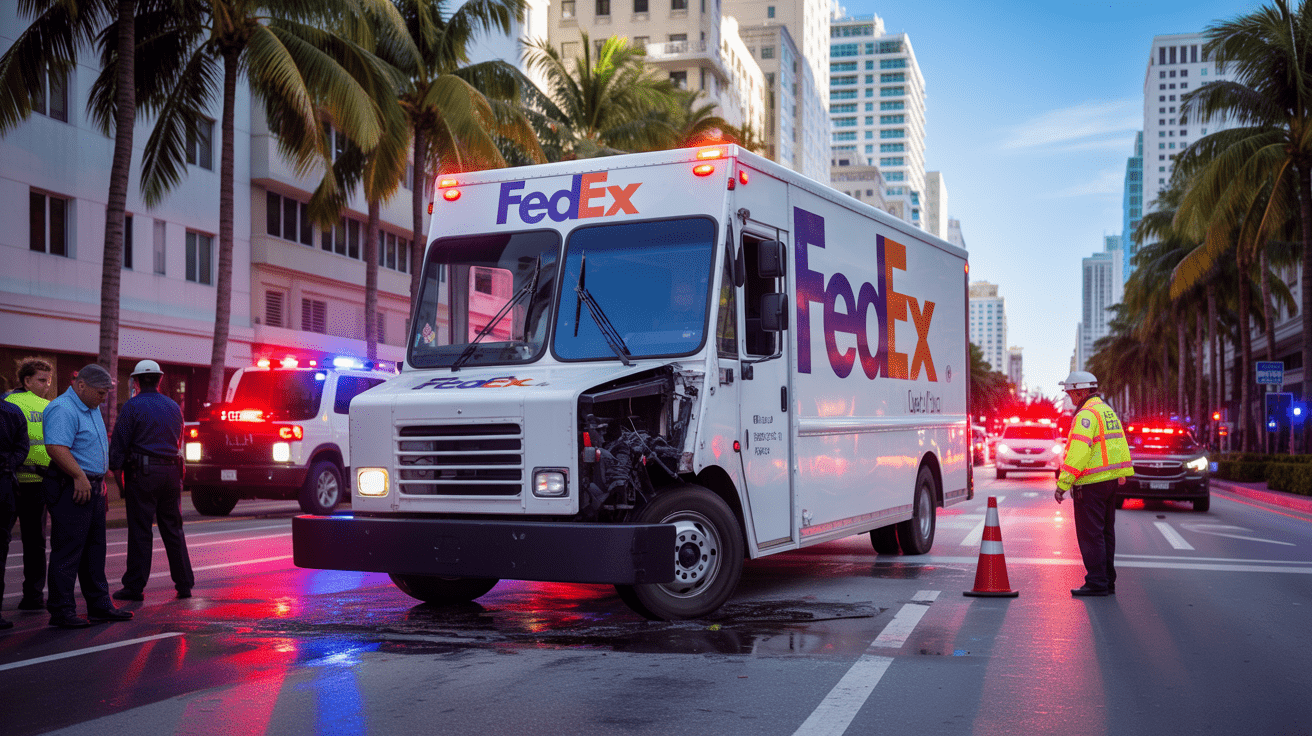
Introduction: The Unique Complexities of Commercial Carrier Litigation
Litigation against commercial carriers like FedEx is fundamentally different; it requires a level of strategic rigor designed to dismantle a sophisticated corporate defense from day one. Due to complex corporate structures, intense pressure from delivery schedules, and proprietary onboard technology, these cases demand a specialized, proactive approach. A failure to act with precision and urgency will result in the permanent loss of critical evidence and fatally compromise a client’s claim.
Learn More About: Miami FedEx Truck Accident Lawyer
This case study serves as a professional reference, outlining a disciplined, evidence-based methodology for identifying liability, preserving critical data, and securing full compensation in a Miami FedEx truck accident case. The following sections deconstruct the strategic lifecycle of a claim, from the initial moments after a crash to its ultimate resolution, providing a clear framework for navigating this complex area of litigation.
——————————————————————————–


1.0 The Initial 72 Hours: Securing the Scene and Protecting the Claim
The strategic importance of the actions taken in the first 72 hours following a commercial truck accident cannot be overstated. This initial phase is a critical window for both mitigating harm and preserving the ephemeral evidence that forms the foundation of the entire case. Decisions made at the scene and immediately after determine the ultimate strength and viability of the legal claim.
1.1 Securing the Scene: Mitigating Harm, Preserving Life Before any investigation can begin, the immediate safety of all involved parties is the paramount concern. The following safety protocols must be implemented:
- Move to a Secure Location: If possible, move vehicles out of active traffic lanes and activate hazard lights to prevent secondary collisions.
- Call 911 Immediately: Report the crash location and any hazards, such as fuel leaks. Request medical evaluation for anyone experiencing pain or dizziness, as many serious injuries are not immediately apparent.
- Administer Basic First Aid: Within the scope of your ability, check for injuries and provide basic first aid while awaiting first responders. Keep passengers calm and guide bystanders away from traffic.
1.2 Marshalling On-Scene Evidence Once the scene is secured, a systematic process of documentation must begin before evidence is cleared away. The objective is to create a comprehensive visual record—an immutable baseline that can refute false narratives and serve as the foundation for accident reconstruction.
- Create a Comprehensive Visual Record: Use a smartphone to photograph everything from multiple angles, capturing vehicle positions, license plates, visible damage, skid marks, debris fields, and surrounding road conditions, including traffic signals.
- Record Witness Information: If safe to do so, speak with witnesses. Obtain their names and contact information, and make a note of their initial observations.
- Create a Written Record: Immediately write down a detailed account of the events, including the time, location, and weather conditions. This contemporaneous record is invaluable as memories fade.
1.3 Controlling the Narrative: Initial Insurer Contact Promptly notifying the relevant insurance carriers is a procedural necessity to preserve coverage. However, this communication must be handled strategically to protect the client’s rights. The protocol involves providing only the core facts of the accident—date, time, location—without speculating about fault or providing a recorded statement. This approach prevents claim denial on procedural grounds while avoiding potentially harmful admissions.
With the scene secured and initial communications controlled, the focus must shift to the equally urgent phase of formal evidence preservation.
——————————————————————————–
2.0 The Preservation Imperative: Securing Perishable Digital and Physical Evidence
In commercial carrier litigation, the battle for evidence is won or lost in the first 48 hours. A significant portion of the most valuable evidence is digital, proprietary, and controlled by the corporate defendant. We operate on the immutable principle that any data not legally secured is data that will be lost to routine data overwrite protocols. Therefore, immediate, formal legal action is non-negotiable to prevent spoliation and secure the facts required to prove liability.
2.1 Identifying Critical Evidence Categories A successful investigation hinges on securing a comprehensive range of evidence. Key categories that must be preserved include:
- Onboard Vehicle Data: “Black box” or Event Data Recorder (EDR) information, telematics data tracking speed and location, dash camera footage, and braking system reports. This provides an objective, second-by-second account of the truck’s actions.
- Operational Records: Electronic logging data (ELD) is crucial for verifying hours-of-service compliance and identifying driver fatigue. Dispatch records, route assignments, and driver qualification files reveal systemic pressures or failures.
- Corporate Policies: Materials governing driver training, route selection, and hours-of-service compliance are essential for establishing whether the company’s own standards—as well as federal regulations—were violated.
- Scene & Witness Evidence: Official police reports, 911 audio recordings, and formal witness statements provide third-party validation of the events and conditions surrounding the accident.
2.2 Executing Preservation Tactics Securing this evidence requires specific legal tools deployed with urgency. The primary tactic is the issuance of formal preservation letters to FedEx, its contractors, and any other potentially liable parties, legally demanding they suspend routine destruction policies. When a party is uncooperative or when data is held by third-party vendors, targeted subpoenas become necessary to legally compel the preservation and production of that information.
A comprehensively preserved body of evidence enables a multi-front investigation into establishing liability.
——————————————————————————–
3.0 Establishing Liability: A Multi-Front Investigation
Liability in FedEx truck accident cases is rarely confined to the driver. Building a comprehensive and defensible liability picture requires investigating the entire operational chain—from the driver behind the wheel to the maintenance provider and the corporate office setting delivery schedules. This multi-front investigation is essential to identifying every responsible party and holding them accountable.
3.1 Analyzing Driver Negligence The investigation often begins with the driver, whose actions are the immediate cause of the collision. Common forms of negligence include:
- Fatigue and Hours-of-Service Violations: Intense delivery pressures and irregular schedules lead to driver fatigue, impairing judgment. Evidence such as electronic logs, dispatch records, and telematics data can definitively prove violations of federally mandated driving limits.
- Speeding and Aggressive Driving: Tight delivery schedules incentivize speeding and unsafe maneuvers. Dashcam footage, witness statements, and vehicle speed data from telematics or the black box are critical for proving this negligent behavior.
While the driver’s actions represent the immediate cause of the collision, a thorough investigation almost invariably reveals that such errors are symptoms of deeper, corporate-level negligence. The intense pressure from delivery schedules, coupled with deficiencies in maintenance or cargo loading, creates the conditions where driver mistakes are not just possible, but probable.
3.2 Investigating Systemic Failures Beyond individual driver error, corporate-level negligence often creates the conditions for an accident to occur.
- Improper Cargo Loading: When cargo is not properly balanced or secured, it can shift during transit, destabilizing the truck and leading to rollovers or jackknife accidents. Bills of lading, scale tickets, and loading bay surveillance are key evidence.
- Vehicle Maintenance Failures: Neglected maintenance on critical systems like brakes and tires can lead to catastrophic equipment failure. A review of maintenance logs and telematics alerts, often combined with forensic testing of failed parts, can establish a direct causal link.
3.3 Extending Liability Beyond the Driver A complete investigation must identify every entity whose negligence contributed to the crash. This requires examining complex corporate and contractual relationships. By analyzing ownership structures, insurance layers, and contractual provisions, liability can be extended to the contracting carrier, the third-party maintenance provider, and the cargo handler.
Once liability is firmly established through this rigorous investigation, the focus shifts to accurately quantifying the full extent of the victim’s damages.
——————————————————————————–


4.0 Quantifying Damages: A Comprehensive Valuation of Client Losses
The strategic objective of the damages phase is to translate human loss into a clear, defensible, and legally compelling financial figure. This process is not a mere accounting of bills; it is a meticulously documented valuation of every loss the victim has incurred and will continue to incur. This is where the case’s value is either solidified or lost.
4.1 Documenting Economic and Non-Economic Losses A complete damages model must account for both tangible and intangible losses.
| Economic Damages | Non-Economic Damages |
| Medical Expenses (past and future) | Pain and Suffering |
| Lost Income and Wages | Loss of Enjoyment of Life |
| Reduced Earning Capacity | Burdens on Caregivers |
| Property Damage | Psychological Trauma |
| Necessary home or vehicle modifications |
4.2 Projecting the Long-Term Human Impact Severe truck accidents often cause injuries with devastating, lifelong consequences. It is critical to document and project these long-term effects to ensure compensation can support the victim’s future needs.
- Chronic Pain Syndromes: These conditions can persist long after initial wounds heal, severely limiting mobility, disrupting sleep, and impacting daily function.
- Lasting Cognitive Deficits: Traumatic brain injuries can result in memory problems and slowed information processing, disrupting a person’s ability to work and maintain independence.
- Psychological Trauma Impacts: Conditions such as Post-Traumatic Stress Disorder (PTSD), anxiety, and depression require long-term care and significantly diminish a person’s well-being.
4.3 Pursuing Punitive Damages In cases involving “egregious misconduct” by a driver or company—such as intentionally falsifying logs or knowingly operating a vehicle with critical safety defects—punitive damages may be pursued. The goal is not to compensate the victim, but to punish the wrongdoer and deter similar reckless behavior.
This comprehensive damages model is then leveraged within the formal legal process, which is governed by strict procedural rules and deadlines.
——————————————————————————–
5.0 Navigating the Legal Process: Strategy, Deadlines, and Resolution
A strong case built on meticulous evidence and a comprehensive damages model can still fail if not managed within the strict confines of the legal system. Success demands strategic case management, assertive negotiation, and unwavering adherence to statutory deadlines that will bar a claim if missed.
5.1 Florida’s Statute of Limitations Florida law sets firm deadlines for filing a lawsuit. Missing these deadlines results in the permanent loss of the right to recover compensation.
- Injury & Wrongful Death Claims: A lawsuit must generally be filed within two years from the date of the crash.
- Property Damage Claims: A claim for damage to a vehicle or other property must generally be filed within four years.
5.2 The Role of the Legal Advocate An experienced legal strategist performs several critical functions to level the playing field against a powerful corporate defendant. These are not merely tasks, but calculated maneuvers designed to control the litigation and maximize value.
- Conducting a thorough case evaluation to identify every liable party—from the driver to the contracting carrier and maintenance vendors—and map all applicable layers of insurance coverage.
- Managing all communications with insurers and corporate representatives to shield the client from harmful admissions and aggressively counter common delay tactics and lowball settlement offers.
- Coordinating with medical, vocational, and life care planning experts to build and validate a comprehensive damages model that projects the full financial and human cost of the injury.
- Building every case for trial from the outset is a non-negotiable principle. This proactive posture creates maximum settlement leverage by demonstrating unwavering readiness to litigate, forcing carriers to evaluate the claim based on their true trial exposure, not on a lowball nuisance value.
- Working on a contingency fee basis, which aligns the attorney’s success with the client’s and ensures access to justice is determined by the merits of the case, not the client’s ability to pay.
Successfully litigating a FedEx truck accident claim requires a potent combination of immediate action, deep investigation, and expert legal navigation.
——————————————————————————–
6.0 Conclusion: Key Pillars of a Successful Commercial Truck Accident Claim
The strategic framework for litigating a FedEx truck accident claim rests on four pillars: immediate evidence preservation, a multi-front liability investigation, comprehensive damage valuation, and disciplined legal execution. By systematically mastering each of these areas, a claim is transformed from a reactive response into a proactive, evidence-driven case for accountability.
This methodical approach is essential to level the playing field against a well-resourced corporate opponent. It ensures that the litigation is dictated not by the carrier’s defense strategy, but by the facts of the case and the true extent of the harm caused. Ultimately, this disciplined framework is the only way to penetrate institutional obfuscation and compel a corporate defendant to provide a recovery that reflects the true measure of the harm caused.
——————————————————————————–
7.0 Frequently Asked Questions (FAQ)
Will My Health Insurance or PIP Cover Treatment Before a Settlement?
Yes. Your Personal Injury Protection (PIP) and health insurance typically serve as the primary payers for necessary medical treatment before a settlement, subject to your policy limits, deductibles, and copays. A legal team can coordinate billing to minimize out-of-pocket costs. After a settlement, these insurers may have a right to be reimbursed. A strategist will handle these lien negotiations to protect your final net compensation.
Can I Repair or Sell My Vehicle Before the Claim Is Resolved?
Yes, but this requires a controlled process. Before any repairs, you must thoroughly document all damage and ensure the at-fault party’s insurer has completed its inspection. Proceeding prematurely can destroy critical evidence related to the vehicle’s valuation. If you sell the vehicle, you must preserve all records of the sale and confirm the insurer’s inspection is complete. Transferring the title is permissible but may complicate a total loss valuation if that issue remains in dispute.
How Do I Preserve Dashcam or Telematics Data After the Crash?
Preserving this data requires immediate, decisive action. For personal dashcams, you must stop any automatic overwrite functions and download multiple copies of the footage to secure storage. For a commercial truck’s telematics and black box data, a legal advocate must send a formal written preservation letter to the carrier, its contractors, and any third-party device vendors. This letter legally obligates them to retain all relevant data and document its chain of custody.
What if the FedEx Driver Was a Contractor, Not an Employee?
Even if the driver was an independent contractor, FedEx or its contracting carrier can often be held liable. While direct employer liability may be limited, a legal claim can be built by examining the degree of contractual control, branding, and dispatch practices that FedEx exerted. The investigation will also focus on potential negligent hiring or supervision claims against the carrier and will identify all applicable insurance policies, including the contractor’s commercial policy and any policies held by the carrier.
Can I Recover Wages if I’m Self-Employed or Paid in Cash?
Yes, recovering lost income is possible even without traditional pay stubs, but it requires meticulous documentation. Income can be established using bank deposits, tax returns, 1099 forms, client contracts, and reconstructed records of invoices or booked work that you could not complete due to your injuries. Credible projections based on prior earnings, seasonal trends, and corroborating records can be used to build a strong, defensible claim for your interrupted livelihood.