A Daytona Beach crash can upend your health, your income, and your ability to show up for the people who need you — we handle the insurers, preserve the evidence, and fight for every dollar of your full recovery.
The Law Offices of Anidjar & Levine can help protect an injury claim by preserving evidence, managing insurer communications, and monitoring crucial deadlines. Florida no-fault benefits may cover initial medical care and some lost income, while serious injuries may support a claim against the at-fault driver. Evidence such as police reports, medical records, witness statements, photos, and video can affect liability and compensation.
The sections below explain important claim issues, accident causes, and available legal options for anyone seeking a Daytona Beach Car Accident Lawyer.
What Is a Car Accident Personal Injury Claim?
A car accident personal injury claim is a legal action filed by a person harmed in a vehicle collision caused by another driver’s negligence, recklessness, or intentional conduct. In Florida, the no-fault personal injury protection (PIP) system requires every driver to carry at least $10,000 in coverage that pays 80% of medical expenses and 60% of lost wages regardless of who caused the crash — but this coverage has significant limitations. To pursue damages beyond PIP limits — including pain and suffering, full lost wages, and future medical care — an injured person must meet Florida’s serious injury threshold, meaning the crash caused a permanent injury, significant and permanent disfigurement, or death.
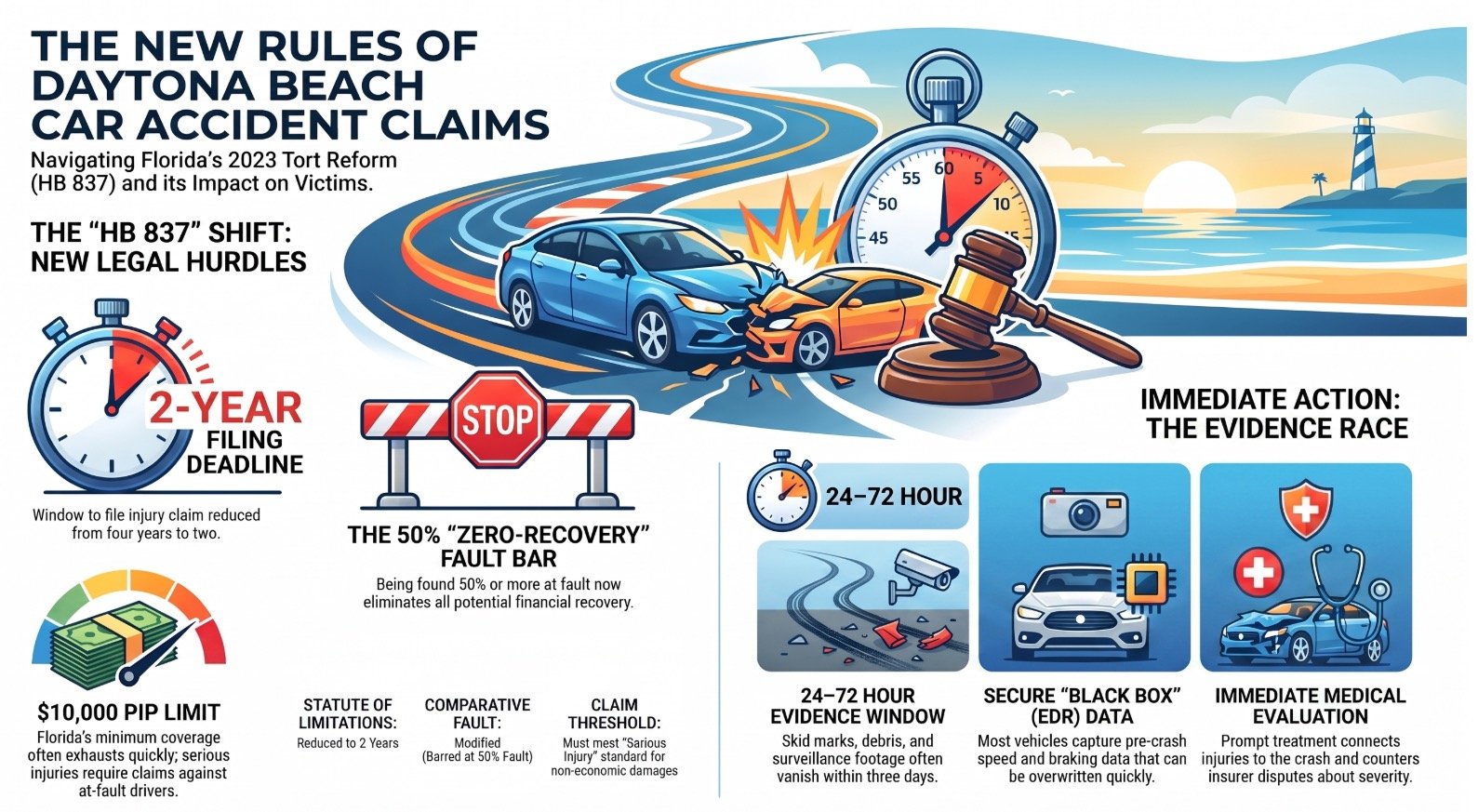
When that threshold is met, a full liability claim may be pursued directly against the at-fault driver’s insurance. Florida’s 2023 tort reform (HB 837) reshaped these claims in three important ways: it reduced the filing deadline from four years to two years; it replaced pure comparative fault with modified comparative fault that bars all recovery at 50% or greater shared fault; and it heightened the importance of early evidence preservation, because insurers now have both more legal tools and more financial incentive to challenge every element of a claim from day one.
Main Takeaways
- A Daytona Beach car accident lawyer can review evidence, insurance coverage, liability, and potential compensation after a crash — identifying every available source of recovery and protecting your rights from the earliest stage.
- Florida no-fault benefits may cover initial medical care and some lost income after a car accident, but the $10,000 PIP limit is often exhausted quickly after serious crashes.
- Serious injuries may allow claims against the at-fault driver for medical expenses, lost wages, pain, and other losses beyond what PIP covers — but only when the serious injury threshold is met.
- Prompt medical treatment, photographs, witness details, police reports, and repair estimates can strengthen an injury claim and counter insurer efforts to minimize your injuries.
- An attorney can manage insurer communications, monitor deadlines, protect statements, and pursue fair compensation through negotiation or litigation — freeing you to focus on recovery.
How We Can Help With Your Daytona Beach Car Accident Injury Claim
After a serious collision, an injured person may need legal guidance to manage insurance issues, medical documentation, liability disputes, and the financial consequences of missed work. A Daytona Beach car accident lawyer can provide structured assistance by reviewing available evidence, communicating with insurers, and protecting the claimant from statements that may weaken the claim.
The legal team may help track the insurance claim timeline, ensuring deadlines are monitored and required materials are submitted with care. This support can reduce confusion for families focused on recovery and practical needs. We may also assist with documenting injuries, including treatment records, physician opinions, therapy notes, and proof of ongoing limitations.
Through organized preparation, we evaluate damages, address disputed responsibility, and pursue fair compensation through negotiation or litigation when necessary. This guidance allows injured individuals and those supporting them to make informed decisions while preserving their rights under Florida law.
For a foundational understanding of how Florida’s no-fault PIP system works, read: Florida PIP Insurance Explained.
Understanding Daytona Beach Car Accident Injury Cases
A clear understanding of Daytona Beach car accident injury cases begins with recognizing how these claims are shaped by the facts of the crash, the severity of the injuries, and the insurance coverage available to each party. Each case requires careful review of medical records, wage losses, property damage, and the long-term effect on daily life. This process helps ensure that injured individuals, families, and those supporting them can make informed decisions with dignity and care.
Florida’s no-fault coverage often provides initial benefits for medical treatment and certain lost income, regardless of who caused the collision. However, serious injuries may allow a claim against the at-fault driver. Comparative fault rules can also affect recovery when more than one party shares responsibility. Accurate documentation, timely medical care, and disciplined communication with insurers are crucial. These principles help protect the injured while supporting fair, service-centered resolution of lawful claims.
Daytona Beach Car Accident Injuries: What the Numbers Tell Us About Local Crash Risk
Daytona Beach’s combination of year-round tourism, coastal thoroughfares, high-volume commercial corridors, and special event traffic creates crash risk that persists throughout every season. According to the FLHSMV 2022 Florida Traffic Crash Facts, Florida recorded 401,523 total crashes statewide, with more than 253,888 injuries — and Volusia County, home to Daytona Beach, consistently ranks among Florida’s top crash counties by volume. NHTSA data shows that distracted driving killed 3,308 people nationally in 2022, and the concentrated phone use, navigation activity, and tourist unfamiliarity with local roads that characterize Daytona Beach traffic make distraction a persistent contributor to local collisions.
Florida’s 2023 tort reform (HB 837) reshaped every car accident claim by shortening the filing window to two years and introducing a 50% comparative fault bar that eliminates all recovery when the claimant reaches or exceeds that threshold — giving insurers a powerful incentive to challenge both fault and injury severity in every case. Physical evidence at the crash scene — skid marks, debris, surveillance recordings, and event data recorder readings — can vanish within 24 to 72 hours, making immediate evidence preservation the most time-sensitive action after any Daytona Beach car accident.
Common Causes of Daytona Beach Car Accident Injuries
Car accidents in Daytona Beach often result from preventable conduct, including distracted driving, speeding, recklessness, and impaired driving. Drunk driving crashes can cause severe injuries, while poor road conditions may contribute to collisions by reducing traction, visibility, or driver control. Identifying the cause of a crash is crucial, as it can affect liability, insurance claims, and the legal options available to an injured person.
Distracted Driving
While many collisions develop within seconds, distracted driving often begins well before a driver loses control. In Daytona Beach, distractions may include phone use, navigation adjustments, eating, grooming, or conversations that divide attention from traffic conditions. Even brief inattention can prevent a driver from noticing pedestrians, cyclists, stopped vehicles, or changing signals. For those committed to serving injured people, identifying distraction can be crucial to understanding how preventable harm occurred.
Florida law addresses certain forms of distraction, including texting penalties designed to discourage dangerous conduct behind the wheel. Evidence may include witness statements, vehicle data, call records, photographs, and traffic camera footage. A careful review can help determine whether a driver failed to maintain proper attention and whether that failure contributed to the crash, injuries, and losses.
Speeding and Recklessness
Beyond driver distraction, excessive speed and reckless conduct are frequent factors in serious Daytona Beach car accidents. When motorists exceed posted limits or drive too fast for traffic, weather, or roadway conditions, they reduce the time available to notice hazards and protect others. High speeds also increase crash forces, making injuries more severe for occupants, pedestrians, cyclists, and roadway workers.
Reckless behavior may include aggressive tailgating, racing, weaving through traffic, traffic signal violations, and improper lane changes. Each action can create confusion for careful drivers who are trying to share the road responsibly. In legal reviews, investigators may examine skid marks, vehicle damage, camera footage, and witness statements to determine whether unsafe speed or reckless conduct contributed to the collision and resulting losses.
Drunk Driving Crashes
When alcohol impairs a driver’s judgment, coordination, and reaction time, the risk of a serious Daytona Beach collision increases substantially. Drunk driving crashes often involve unsafe lane changes, delayed braking, wrong-way travel, or failure to yield, placing motorists, passengers, pedestrians, and cyclists in danger. For those committed to protecting others, recognizing impaired driving as a preventable hazard is crucial to community safety.
Law enforcement may use sobriety checkpoints, field observations, and BAC testing to identify intoxicated drivers and document evidence after a crash. These records can help clarify fault, support injury claims, and show whether a driver violated Florida’s impaired driving laws. Injured people may face medical expenses, lost income, and lasting harm, making careful investigation and timely legal guidance important after alcohol-related collisions in Daytona Beach.
Poor Road Conditions
Driver behavior is not the only factor that can cause serious collisions in Daytona Beach, as unsafe road conditions may also contribute to loss of control, sudden braking, or unexpected impact. Potholes, uneven pavement, missing signs, poor drainage, faded lane markings, and malfunctioning traffic signals can create hazards for careful motorists, cyclists, and pedestrians. When public agencies or contractors fail to maintain roadways responsibly, injured people may need careful guidance to identify liable parties and preserve evidence. These cases can involve maintenance records, prior complaints, construction logs, and accident reconstruction.
Severe crashes may lead to catastrophic injuries or wrongful death claims, particularly when hazards remain uncorrected despite known risks. Poor road design or neglect may also trigger insurance coverage disputes requiring diligent legal review.
Your Legal Rights After a Daytona Beach Car Accident Injury
Injured people in Daytona Beach have legal rights that may allow them to seek compensation after a car accident caused by another party’s negligence. These rights can support recovery for medical expenses, lost income, pain, and other documented losses. Comparative negligence may affect the amount recovered when fault is shared, while insurance coverage often shapes the available sources of payment.
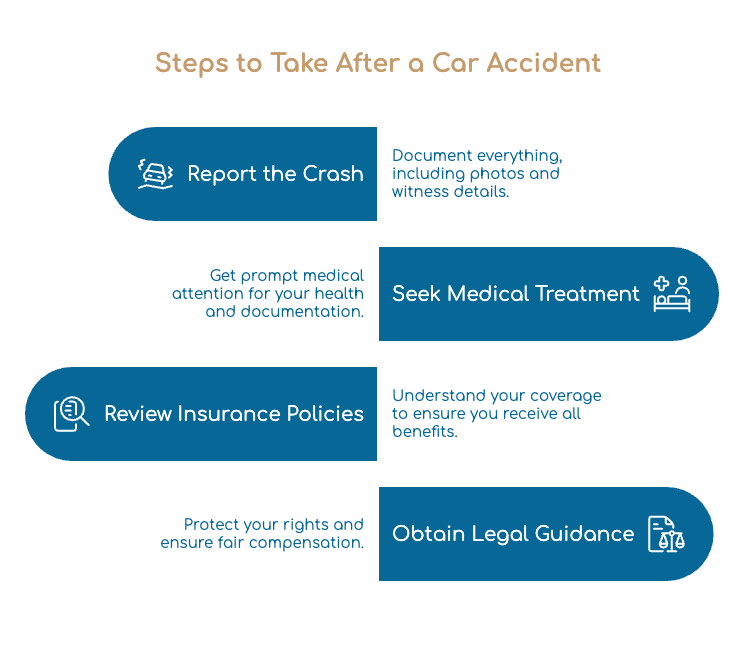
- You may report the crash and preserve records — photographs, witness details, and repair estimates — that support your claim and counter early insurer challenges to fault and injury severity.
- Medical treatment should be sought promptly, both for your health and for the documentation that connects your injuries to the collision and supports future treatment needs.
- Claims may involve personal injury protection, liability insurance, uninsured motorist coverage, or other applicable policies — and a thorough coverage review ensures no available benefit is overlooked.
- Legal guidance can help protect deadlines, communications, and settlement decisions — ensuring you do not accept an offer before the full extent of your injuries and losses is known.
For individuals committed to caring for families, workplaces, and communities, understanding these rights can provide stability after a disruptive injury. A careful, timely response may help preserve lawful remedies and support responsible accountability for preventable harm.
Why Do Daytona Beach Car Accident Injuries Happen?
Daytona Beach car accident injuries often happen because preventable risks converge on busy roads, including distracted driving, speeding, impaired operation, unsafe lane changes, and failure to yield. Heavy tourism, beach traffic, motorcycles, pedestrians, and sudden weather changes can intensify these hazards, leaving little time for drivers to react responsibly.
Injuries also arise when motorists disregard traffic controls, follow too closely, or fail to adjust to congestion near intersections, bridges, and commercial areas. These conditions can cause rear-end collisions, side-impact crashes, rollovers, and pedestrian impacts, each capable of producing lasting harm.
For those committed to serving injured community members, understanding causation helps clarify insurance claims, medical bills, and the reimbursement process. Accurate analysis of how an injury occurred may influence liability decisions and support a negotiation strategy grounded in evidence. Careful attention to road conditions, driver conduct, and vehicle movement helps explain why preventable collisions continue to harm Daytona Beach residents and visitors.
What Should You Do After a Daytona Beach Car Accident Injury?
After a Daytona Beach car accident injury, an injured person should prioritize medical care, even when symptoms appear minor. If it is safe to do so, documenting the scene can help preserve important details related to fault, vehicle damage, and roadway conditions. Promptly contacting an attorney may also protect the person’s rights, particularly when insurance companies begin requesting statements or records.
Seek Medical Care
When a crash causes pain, visible trauma, or even mild discomfort, prompt medical evaluation should be treated as a priority. Some injuries, including concussions, internal bleeding, and soft-tissue damage, may not present fully at the scene. An emergency room assessment can identify urgent conditions, direct necessary treatment, and create a reliable medical record. For those committed to caring for family members, coworkers, or others who depend on them, early treatment supports both recovery and responsible decision-making. Medical providers assist by documenting symptoms, treatment needs, physical limitations, and follow-up recommendations. These records may later help explain how the collision affected the injured person’s health and daily responsibilities. Delaying care can complicate recovery and create uncertainty about whether the crash caused the injury. Timely evaluation protects both health and accountability.
Document the Scene
If it is safe to remain at or near the collision site, documenting the scene can help preserve important details before vehicles are moved, debris is cleared, or weather conditions change. A responsible person may gather dashcam footage, note nearby cameras, and record witness contact information when appropriate. Clear images should show vehicle placement, lane markings, traffic signals, skid marks, debris fields, and visible injuries. Useful photography includes wide shots, close views, and photos from several angles, without entering traffic or interfering with responders. Hazard documentation may include poor lighting, standing water, road defects, obscured signs, or construction materials. These records can support an accurate account of what occurred, assist insurance review, and help protect the interests of injured people and their families.
Contact an Attorney
An injured person may face medical needs, family responsibilities, and community obligations while evidence begins to fade. Contacting an attorney can provide prompt legal advice focused on protecting rights and reducing preventable mistakes. We may assist with evidence preservation, including photographs, witness information, vehicle data, and medical documentation.
We can also help develop an insurance strategy before recorded statements, settlement discussions, or claim forms create avoidable risk. This guidance supports fair communication with insurers while the injured person concentrates on recovery and service to others. We explain the case timeline, important deadlines, and possible next steps. Early contact helps ensure decisions are informed, organized, and aligned with the injured person’s long-term interests.
Critical Evidence in a Daytona Beach Car Accident Injury Case
Evidence in a Daytona Beach car accident injury case helps establish fault, prove damages, and support the injured person’s claim. Important materials may include police accident reports, witness statements, medical records, crash scene evidence, event data recorder data, and photos or videos from the scene. Each category can clarify how the collision occurred, who may be legally responsible, and how the injuries affected the claimant’s health and finances.
For a detailed explanation of why medical records form the foundation of every successful injury claim, read: Why Medical Records Matter in Personal Injury Cases.
Police Accident Reports
After a collision in Daytona Beach, the police accident report often becomes one of the earliest and most important records in a car accident injury case. It may identify drivers, vehicles, insurance details, roadway conditions, citations, and the officer’s initial assessment of contributing factors. For injured people and those assisting them, this report can guide prompt action, including medical follow-up and insurance notice. A Daytona Beach car accident lawyer may review the report for errors, missing facts, or inconsistencies that could affect responsibility. The report can also help locate dashcam evidence, preserve nearby video, and shape a witness interview strategy without replacing later investigation. Although not always conclusive, it provides a structured foundation for serving the client’s needs with accuracy, diligence, and accountability.
Witness Statements
When a serious collision occurs in Daytona Beach, witness statements can serve as an independent account of what happened before, during, and immediately after impact. These accounts may clarify traffic signals, vehicle speed, lane position, weather conditions, evasive actions, and driver behavior. In an injury claim, eyewitness trustworthiness depends on proximity, attention, consistency, and the absence of bias. A neutral bystander who observed the crash from a clear vantage point may offer helpful details that support fair evaluation of responsibility. Statement reliability also strengthens when accounts are gathered promptly, before memory fades or outside influence occurs. Attorneys often compare witness observations with photographs, video footage, roadway evidence, and official reports. Careful preservation of these statements helps ensure that injured people, families, and community members are treated with accuracy and respect.
Medical Records
In the aftermath of a Daytona Beach collision, medical records often provide the clearest documentation of physical harm, treatment needs, and the connection between the crash and a person’s injuries. These records may include emergency evaluations, diagnostic imaging, physician notes, surgical reports, therapy plans, and medication histories. They help establish whether symptoms appeared promptly, progressed over time, or required expert care. For those serving injured individuals, careful review supports fair assessment of present and future needs, including chronic pain management and emotional trauma support. Consistent documentation can also address disputes about pre-existing conditions, treatment gaps, or the seriousness of impairment.
When organized and interpreted properly, medical records become a dependable foundation for demonstrating damages and guiding compassionate, evidence-based advocacy throughout the injury claim process.
Crash Scene Evidence
At the scene of a Daytona Beach collision, physical evidence can reveal how the crash happened before memories fade or vehicles are moved. Careful preservation of roadway conditions, debris fields, traffic signals, lighting, weather, and final vehicle positions may help establish fault and protect an injured person’s claim. Vehicle damage photography can show points of impact, crush patterns, and the severity of force involved. Skid mark documentation may assist in evaluating speed, braking, and avoidance efforts. When recorded promptly, this evidence can support police findings, witness statements, and later accident reconstruction. A lawyer serving an injured client may also seek nearby surveillance footage, 911 records, and scene measurements. Thorough crash-scene evidence helps ensure that the harmed person’s circumstances are understood accurately, with dignity, and with legal seriousness.
Event Data Recorder (EDR) Evidence in Car Accident Cases
Most passenger vehicles manufactured after 2012 are equipped with an Event Data Recorder (EDR) — the vehicle’s black box — that captures pre-crash speed, braking force, throttle input, steering angle, seat-belt status, and airbag deployment timing in the seconds before impact. In Daytona Beach car accident claims, EDR data can resolve the most contested disputes about how fast each vehicle was traveling, whether the driver braked, and what forces the occupants absorbed. This is especially important in cases where the insurer argues low damage means no serious injury — or where comparative fault is raised based on claims about the injured driver’s speed or reaction. We send formal spoliation letters immediately upon retention to prevent ignition cycling from overwriting EDR data.
Learn more: How Black Box Data Can Help Your Car Accident Case.
Federal EDR regulation background: NHTSA Event Data Recorders.
Long-Term Effects of Daytona Beach Car Accident Injuries
Car accident injuries in Daytona Beach may lead to lasting complications, including chronic pain, reduced mobility, and limits on daily activities. Emotional trauma after a crash can also affect concentration, sleep, and overall well-being, even after physical wounds improve. Ongoing medical costs, therapy needs, and future treatment planning often become central issues in evaluating the full impact of an injury claim.
Chronic Pain and Mobility
After a serious collision, chronic pain and reduced mobility can persist long after visible injuries appear to recover. Neck, back, joint, and nerve injuries may limit standing, walking, lifting, or driving, affecting work duties and daily care responsibilities. Some individuals require ongoing therapy, professional evaluations, medication management, and structured activity restrictions to prevent further deterioration. Others require assistive devices, such as braces, canes, walkers, or modified vehicles, to preserve independence and safety.
For those committed to serving family, clients, patients, or the community, these limitations can create practical burdens that warrant careful documentation. Medical records, functional assessments, and treatment plans help show how pain and mobility loss affect earning capacity, household support, and future care needs after a Daytona Beach car accident claim.
According to the Mayo Clinic, concussion complications can include persistent post-concussion symptoms affecting daily function for months — one of many long-term effects that must be documented thoroughly to support a fair injury claim.
Emotional Trauma After Crashes
Survivors may continue to relive the impact, avoid driving, or feel unsafe near intersections resembling the crash scene. These reactions can interfere with caregiving, work, and community service, especially when concentration and patience decline. PTSD symptoms may include intrusive memories, sleep disruption, irritability, heightened startle responses, and emotional numbness. Post-crash anxiety can also make routine travel feel threatening, limiting independence and straining family responsibilities. In Daytona Beach, where daily transportation is often necessary, emotional trauma may quietly shape long-term recovery. Careful documentation from counselors, physicians, and trusted observers can help show how psychological harm affects daily functioning, relationships, and the injured person’s ability to serve others with stability and confidence.
Ongoing Medical Costs
Tracking future treatment needs can be as important as documenting the initial injury because collision-related medical costs often continue well beyond the emergency room visit. Serious crashes may require surgery, rehabilitation, medication, imaging, mobility devices, or professional care for months or years. Careful documentation helps show how these needs affect daily living, family responsibilities, and the ability to serve others reliably.
A complete claim may also consider future wage loss when ongoing treatment limits work capacity or prevents a return to prior duties. Medical projections, provider opinions, and billing records can support a fair assessment of these losses. Although property damage addresses the vehicle and related items, it should be reviewed alongside medical evidence to ensure the full impact of the collision is not understated.
Proving Liability in Daytona Beach Car Accident Injury Cases
Proving liability in a Daytona Beach car accident injury case requires a careful examination of how the crash occurred, who owed a duty of care, and whether that duty was breached through negligent conduct. Attorneys assess police reports, witness statements, vehicle damage, roadway conditions, and available video evidence to determine fault. This process helps protect injured people while promoting accountability for unsafe driving.
Florida negligence standards require showing that a driver failed to act with reasonable care, such as speeding, following too closely, ignoring traffic signals, or driving while distracted. When multiple parties share responsibility, comparative fault may reduce recovery based on each person’s percentage of blame. Careful evidence review is necessary, because even small factual details can affect the outcome.
A Daytona Beach car accident lawyer may also consult accident reconstruction experts or medical professionals to connect the negligent conduct to the injuries claimed. Strong liability proof supports a fair path toward recovery.
For context on how Florida evaluates the full range of car accident claim values, read: Average Car Accident Settlement in Florida.
Dealing With Insurance Companies After a Daytona Beach Car Accident Injury
After a Daytona Beach car accident, dealing with insurance companies often becomes one of the most important and challenging parts of the injury claim process. Insurers may appear cooperative, yet their primary obligation is to limit financial exposure. Injured individuals, families, and caregivers should understand that statements, medical releases, and early settlement offers can affect the value of a claim.
A Daytona Beach car accident lawyer may communicate with adjusters, review policy limits, and identify unfair negotiation tactics that pressure injured parties into accepting less-than-adequate compensation. Careful documentation of medical care, lost income, vehicle damage, and daily limitations helps support a fair evaluation.
Claim denials may arise from disputes over fault, treatment necessity, or coverage terms. When this occurs, legal guidance can help clarify the basis for denial and protect the injured person’s interests. Effective advocacy encourages accountability while allowing injured individuals to focus on recovery and their responsibilities to others.
What to Expect During a Daytona Beach Car Accident Injury Claim Process
A Daytona Beach car accident injury claim typically begins with an initial case evaluation, during which liability, injuries, and available insurance coverage are reviewed. The process then moves into evidence collection and insurance claim negotiations, where medical records, crash reports, witness statements, and financial losses are used to support the claim. If a fair settlement cannot be reached, the case may proceed toward litigation, where a court may determine fault and compensation.
Initial Case Evaluation
During an initial case evaluation, a Daytona Beach car accident lawyer reviews the facts of the collision, the available evidence, the injury history, and any insurance issues that may affect the claim. This meeting helps determine whether another party’s negligence may support recovery and whether the injured person has met important reporting or treatment obligations. The lawyer may discuss insurance coverage limits, medical expenses, lost income, liability concerns, and the practical value of pursuing compensation. A careful witness timeline reconstruction may also be considered to understand how events unfolded without moving into broader evidence gathering. For service-minded clients and families, this evaluation provides structure, answers, and direction during a difficult period. It also helps identify urgent legal deadlines and next steps for protecting the injury claim.
Evidence Collection Process
Once the claim moves beyond the initial review, the evidence collection process focuses on securing reliable proof before records are lost, memories fade, or physical conditions change. A legal team may gather photographs, vehicle damage records, medical documentation, witness statements, traffic camera footage, and scene measurements. This work helps establish how the crash occurred and how injuries affected the injured person’s daily responsibilities, including family, work, and community obligations.
Police report timelines are also monitored because official reports may become available days or weeks after the collision. Insurance coverage verification is completed to identify applicable policies, policy limits, and responsible parties. Each item is organized carefully, preserving accuracy and accountability. This structured process supports a claim grounded in facts, allowing future decisions to rest on dependable documentation.
Insurance Claim Negotiations
Negotiating with the insurance company generally begins after liability evidence, medical records, treatment costs, wage information, and other damages documentation have been assembled into a clear claim presentation. The insurer reviews the demand, evaluates fault, compares injuries to policy limits, and may request clarification before making an offer. In Daytona Beach injury matters, careful communication helps protect the claimant from statements that could reduce compensation. Negotiations may address medical expenses, lost income, pain, future care, and, in severe cases, wrongful death claims. When the at-fault driver lacks adequate insurance, uninsured motorist coverage may become a central source of recovery. A structured negotiation process allows the injured person’s position to be presented firmly, while maintaining respectful advocacy focused on restoring stability, dignity, and practical support for those harmed.
Settlement or Litigation
After insurance negotiations have been fully evaluated, the claim may move toward either settlement or litigation, depending on the strength of the evidence, the insurer’s position, and the injured person’s damages. A settlement may provide timely compensation, reduce uncertainty, and help the injured person focus on recovery, family needs, and community responsibilities. We refine the insurance negotiation strategy by comparing medical records, wage loss proof, liability evidence, and future care needs against the offer presented.
If settlement is not fair, litigation may become necessary. Trial preparation often includes filing the lawsuit, conducting discovery, consulting experts, preparing witnesses, and organizing exhibits. This process encourages accountability while preserving the injured person’s right to pursue full and lawful compensation through the court system.
Compensation for Daytona Beach Car Accident Injury Damages
When a crash causes injuries in Daytona Beach, compensation may include both the immediate financial losses and the long-term effects of the accident. A careful claim review helps identify medical needs, lost income concerns, vehicle-related losses, and support services required during recovery. Attorneys may evaluate records, insurance communications, and liability facts to determine whether available coverage can fairly address the harm caused.
Effective preparation often begins with an evidence preservation checklist, including photographs, witness details, medical documentation, repair estimates, and crash reports. These materials help protect the injured person’s claim and assist those advocating on their behalf. Practical settlement negotiation involves avoiding rushed statements, documenting every expense, reviewing future care needs, and responding to insurers with organized proof. In many cases, compensation discussions require patience, discipline, and clear presentation of the accident’s impact. A Daytona Beach car accident lawyer may guide this process while seeking a resolution that supports recovery and accountability.
Economic vs. Non-Economic Damages in Daytona Beach Car Accident Cases
Car accident damages in Daytona Beach are generally divided into economic and non-economic losses, each addressing a different type of harm. Economic damages cover measurable financial costs, while non-economic damages account for personal losses such as pain, suffering, and reduced quality of life. Proving these losses requires clear evidence, careful documentation, and a well-supported presentation of the accident’s impact on the injured person.
Economic Damages
In Daytona Beach car accident cases, economic damages are the measurable financial losses a person incurs as a result of the crash. These losses may include ambulance bills, emergency treatment, surgery, rehabilitation, prescription costs, and future medical care supported by medical causation proof. They may also include lost wages, reduced earning capacity, vehicle repair, rental expenses, and other out-of-pocket costs tied directly to the collision. Careful documentation helps attorneys, insurers, and courts evaluate what resources are needed to restore financial stability. Insurance coverage limits can affect the amount available for payment, even when losses are well documented. For individuals and families focused on recovery and service to others, identifying economic damages with accuracy helps ensure that practical needs are addressed responsibly and that available compensation reflects provable financial harm.
Non-Economic Damages
Beyond documented financial losses, Daytona Beach car accident claims may also involve non-economic damages, which address the personal harm that does not appear on invoices, pay stubs, or repair estimates. These damages may include physical pain, emotional distress, loss of enjoyment of life, inconvenience, scarring, and the strain placed on family relationships. For individuals committed to serving others, such losses can deeply affect daily purpose, community involvement, and the ability to support loved ones. Florida law allows recovery for these harms when they arise from another party’s negligence, though the amount available may depend on several case factors. Comparative negligence can reduce recovery if the injured person shares fault. Insurance coverage limits may also shape practical compensation, even when the harm is substantial and enduring.
Proving Your Losses
After a serious collision, proving losses requires evidence that connects each claimed harm to the crash and shows how the injury affected the person’s life. Economic damages may be supported through bills, wage records, repair estimates, and receipts for necessary services. Medical documentation is especially important, because treatment notes, diagnoses, prescriptions, and physician opinions help establish the extent, cause, and duration of injuries. Non-economic damages require careful proof as well, including testimony about pain, reduced mobility, disrupted routines, and the loss of meaningful daily activities. In insurance negotiations, clear records can help prevent undervaluation and support a fair assessment of both financial and personal harm. A well-prepared claim allows decision makers to understand the full burden placed on the injured person and family.
When a Daytona Beach Car Accident Injury Case Goes to Trial vs. Settlement
When a Daytona Beach car accident injury case is filed, the path toward settlement or trial often depends on the strength of the evidence, the extent of the injuries, the available insurance coverage, and the willingness of the parties to negotiate in good faith. A settlement may serve injured persons efficiently when liability is clear, damages are well documented, and the offer reflects medical needs, lost income, and future limitations. Emergency medical assessment records and insurance documentation often guide these discussions, helping counsel present the claim with accuracy and care.
Trial may become necessary when the insurer disputes fault, minimizes injuries, or refuses to value the harm responsibly. In that setting, testimony, medical opinions, photographs, repair records, and witness accounts are organized for presentation to a judge or jury. A lawyer’s role is to prepare thoroughly while seeking an outcome that supports the injured person’s recovery, stability, and dignity after the collision.
Florida Laws That May Affect Your Daytona Beach Car Accident Case
Understanding Florida law is important in a Daytona Beach car accident case, because state rules can directly affect liability, compensation, filing deadlines, and insurance recovery. A careful review of these laws helps injured people, families, and service-minded caregivers make informed decisions after a crash.
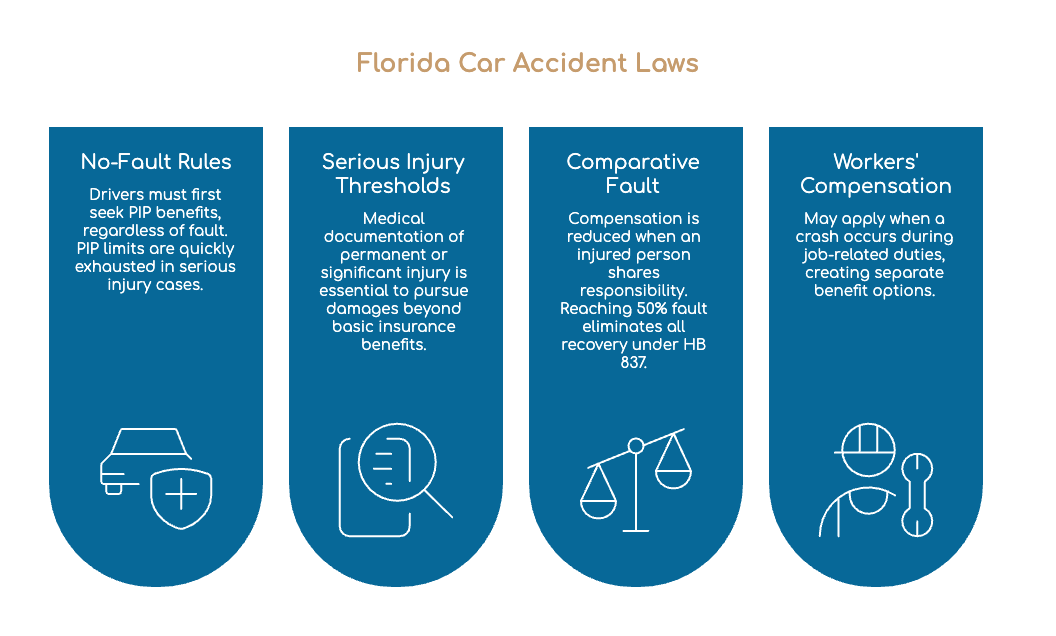
Florida law shapes liability, deadlines, insurance recovery, and compensation after a Daytona Beach car accident — and the 2023 tort reform made every one of these elements more consequential.
- Florida’s no-fault rules generally require drivers to first seek Personal Injury Protection benefits, regardless of who caused the collision — but PIP limits are exhausted quickly in serious injury cases.
- Serious injury thresholds may determine whether an injured person can pursue damages beyond basic insurance benefits — making thorough medical documentation of permanent or significant injury essential.
- Comparative fault principles can reduce compensation when an injured person shares responsibility for the accident — and under HB 837, reaching 50% fault eliminates all recovery.
- Workers’ compensation may apply when a crash occurs while an employee is performing job-related duties, creating separate benefit options that interact with the personal injury claim.
A Daytona Beach car accident lawyer may assess these laws, coordinate available benefits, and help protect the injured person’s right to fair recovery.
The Statute of Limitations for Daytona Beach Car Accident Injury Cases
For Daytona Beach car accident injury cases, the statute of limitations sets a strict deadline for filing a lawsuit in court. Under Florida law, most negligence-based injury claims arising from vehicle collisions must be filed within two years from the date of the crash under HB 837 (effective March 24, 2023). If a person dies from accident-related injuries, a wrongful death action generally must also be filed within two years, measured from the date of death.
These deadlines matter because courts usually dismiss late claims, regardless of the harm suffered. This can affect recovery for medical expenses, lost income, property damage, and emotional damages connected to pain, distress, or diminished quality of life. Families seeking accountability and stability after a serious collision should understand that time can affect both legal rights and available evidence. Prompt attention to filing deadlines helps preserve the opportunity to pursue lawful remedies while supporting the broader purpose of responsibility, care, and service to injured individuals.
How a Daytona Beach Car Accident Lawyer Can Help You
After the filing deadline is considered, the next concern is how an injured person can protect a claim while managing medical care, insurance issues, and financial disruption. A Daytona Beach car accident lawyer can organize the legal process so the injured person and family can focus on recovery and continued service to others.
- Investigates the crash, including dashcam review, witness statements, scene evidence, and police reports — connecting careless conduct to the specific injuries and losses you have suffered.
- Communicates with insurers, reducing pressure from adjusters and helping prevent damaging statements before you fully understand the extent of your injuries.
- Evaluates medical bills, lost income, property damage, and future care needs with careful documentation — calculating damages that reflect the full impact of the crash on your life.
- Prepares settlement demands and, when necessary, litigation materials that present the claim clearly — including expert testimony, medical opinions, and organized evidence to support trial if needed.
Through these tasks, we help preserve evidence, measure damages, and pursue fair compensation. This support can bring order to a difficult period while maintaining dignity, accountability, and practical direction.
When to Contact a Daytona Beach Car Accident Lawyer
Contact should occur as soon as immediate medical needs are addressed, particularly when injuries, lost income, vehicle damage, or disputed fault are involved. Early assistance helps protect service-minded families from overlooking aftermath deadlines that may affect insurance claims or court rights.
Prompt action also supports accurate medical documentation, since treatment records often connect injuries to the collision and clarify ongoing needs. We may help ensure crash photo preservation, witness information, repair estimates, and police reports are gathered before evidence becomes unavailable. This timing is important when insurance tactics arise, including quick settlement offers, recorded statement requests, or questions designed to limit payment.
Even when a crash appears minor, delayed pain or unclear liability can change the situation. Seeking guidance early allows the injured person to make careful decisions while focusing on recovery, responsibilities, and the well-being of others affected.
Why You Need an Experienced Daytona Beach Car Accident Lawyer
Because car accident claims often involve medical evidence, insurance negotiations, and fault disputes, an experienced Daytona Beach car accident lawyer can provide essential guidance from the start. Legal counsel helps injured people understand their rights while allowing families, caregivers, and community members to focus on recovery and support. Experience matters because insurers may question treatment, minimize losses, or shift blame before the full impact of an injury is known.
A lawyer can manage the insurance claim timeline, preserve evidence, calculate damages, and communicate with adjusters in a disciplined manner. This steady approach may reduce costly errors, missed deadlines, and incomplete documentation. At Anidjar & Levine, that experience is backed by Glen Levine’s Board Certification in Civil Trial — the Florida Bar’s highest designation — and the firm’s AV Preeminent rating from Martindale-Hubbell. We also evaluate settlement strategy options, including when to negotiate, when to provide additional proof, and when litigation may be necessary. For those committed to helping an injured person regain stability, experienced representation can bring structure, accountability, and informed advocacy to a process that is often stressful and complicated.
How to Choose the Right Daytona Beach Car Accident Lawyer for Your Case
The decision should begin with experience handling motor vehicle claims in Florida, including crashes involving serious injuries, disputed liability, or uninsured drivers. A suitable lawyer should explain the legal process clearly, assess damages carefully, and show readiness to protect the client’s interests through negotiation or litigation.
The injured person should also consider contingency fee options, since this arrangement may allow representation without upfront legal fees. Reviewing communication preferences is equally important — some clients value frequent updates, direct access to staff, or written explanations of case progress. A lawyer who respects these preferences can reduce confusion and support informed decisions.
Professional reputation, case preparation methods, and responsiveness should also be weighed. Ask about Board Certification in Civil Trial and an AV Preeminent rating — independently verified marks of serious litigation capability. The right choice is a lawyer who combines legal skill with service-oriented guidance, helping the injured person pursue recovery with confidence and dignity.
Real Reviews From Our Clients!
Christopher Kull ★★★★★
“I was in a T-bone collision near the Daytona Beach International Airport and ended up with a back injury that kept me out of work for two months. I did not know what to do, and the at-fault driver’s insurance company started questioning my story almost immediately. Anidjar & Levine took over right away, secured all the camera footage and police records before anything was lost, and handled every insurer communication while I recovered. They fought hard for a settlement that covered everything — my medical bills, my lost income, and the pain I went through. I could not have navigated this alone.”
Evan Cadet ★★★★★
“A drunk driver hit my car on LPGA Boulevard and I walked away thinking I was okay — until I woke up the next morning barely able to move my neck. The insurance process felt completely overwhelming, and I had no idea how quickly evidence and deadlines could disappear. Anidjar & Levine explained everything clearly from the very first call, moved fast to preserve what mattered, and took on every conversation with the insurer so I could focus on healing. Their dedication to getting me a fair result made a genuinely difficult experience feel manageable. I am grateful for every person on their team.”
Anna T. ★★★★★
“After a hit-and-run near Daytona Beach Shores, I was left dealing with medical bills, a damaged car, and an insurance company that was not returning my calls. A friend recommended Anidjar & Levine and it was the best decision I made. They identified uninsured motorist coverage I did not even know I had, gathered all the evidence, and turned what felt like a hopeless situation into a resolved case with real compensation. They were always honest with me, always responsive, and they treated my situation with real care. I would recommend them without hesitation to anyone in Daytona Beach who needs help after a crash.”
About The Law Offices of Anidjar & Levine
Founded in 2005 by Marc Anidjar and Glen Levine, the firm began as a two-person operation working out of a construction office conference room. Over the past 20 years, that modest start has grown into one of Florida’s most recognized personal injury practices — with more than $1 billion recovered in settlements on behalf of injury clients across the state. We bring that same determination and depth of experience to every car accident case we handle.
Marc Anidjar — Senior Partner
Marc Anidjar oversees the day-to-day operations of the firm and has settled thousands of cases — including car accident matters involving distracted driving, drunk driving, and complex multi-vehicle crashes — across nearly two decades of practice. He earned his Bachelor of Science from the University of Florida in 1999 and his Juris Doctor from Nova Southeastern University, Shepard Broad School of Law in 2003. His client-centered approach ensures that every injured person who comes to the firm receives attentive, organized, and results-focused representation from the first consultation through final resolution.


Glen Levine — Senior Partner
Glen Levine is a founding partner who oversees all of the firm’s litigation. In 2019, Mr. Levine became Board Certified in Civil Trial — the highest level of evaluation by the Florida Bar, denoting excellence in the field of civil trial litigation. He is consistently AV Rated by Martindale-Hubbell, the highest preeminence designation the service awards, reflecting top-tier legal ability and professional ethics. AVVO has rated Mr. Levine 10 out of 10 (“Superb”). He received the “Lawyer of Distinction” designation in 2017, 2018, and 2019; was named to Florida Trend Magazine’s “Legal Elite” list in 2017; was recognized by the Miami Herald as a Top Rated Lawyer in South Florida in 2015; and was a finalist in the personal injury category for “South Florida Leaders in the Law” in 2013.
With more than 50,000 clients served and 419 years of combined legal experience across our team, we have the resources and depth to handle even the most contested car accident claims. Our results reflect that commitment: we recovered more than $20 million for a single family in Jacksonville and secured more than $6 million for another family in a separate case. We also obtained a recovery for a family in Broward County that was recognized as one of the top ten settlements of the year in Florida.
Our team includes lawyers, investigators, and medical and legal support professionals who thoroughly investigate each case and pursue the full value of every client’s losses. With two board-certified civil trial lawyers on staff, your car accident claim is backed by the highest credentials Florida law allows. We are available 24 hours a day, 7 days a week, with offices in Fort Lauderdale, Miami, West Palm Beach, Fort Myers, Tampa, Orlando, and Jacksonville.
We are also deeply invested in the communities we serve. For 15 years, we have participated in Christmas on Las Olas, and we proudly sponsor the KISS Cares radiothon, raising money for Joe DiMaggio Children’s Hospital. We also support the Scripps Howard Foundation’s “If You Give a Child a Book” campaign, MADD, the Jewish Federation, Special Compass, and dozens of other local causes across Florida. We proudly sponsor the Miami Dolphins, Miami Heat, Florida Panthers, and Tampa Bay Lightning.
Past results do not guarantee a similar outcome in future cases. Each case is evaluated individually based on its unique facts and circumstances.
Frequently Asked Questions
Will a Prior Car Accident Affect My Daytona Beach Injury Claim?
Yes, a prior car accident can affect an injury claim, particularly when insurers argue that current symptoms existed before the new crash. Medical records, treatment gaps, and expert evaluations help distinguish old conditions from new harm. Negligence admissions may also influence liability analysis. Insurance coverage limits, prior settlements, and documented recovery status can shape compensation. A careful review ensures the injured person is treated fairly and responsibly.
Can Tourists File Car Accident Claims in Daytona Beach?
Yes, tourists may file car accident claims in Daytona Beach when another party’s negligence causes injury or loss. Tourist eligibility generally depends on fault, documented damages, and compliance with Florida insurance rules. Claim timelines remain important, as reporting, medical care, and legal deadlines can affect recovery. Visitors serving family or community obligations should preserve evidence, obtain records, and seek qualified guidance promptly, ensuring their claim is handled with diligence and accuracy.
What if My Accident Involved a Rental Car?
If an accident involved a rental car, the injured party may still seek compensation, but rental coverage must be reviewed promptly. Liability may involve the driver, rental company, personal insurer, or credit card benefits. The claim process often requires accident reports, rental agreements, insurance disclosures, and medical documentation. A careful approach helps protect rights, preserve evidence, and support fair recovery for those affected and those committed to serving their needs.
Can I Switch Lawyers During My Car Accident Case?
Yes, a person may switch lawyers during a car accident case, provided the shift protects deadlines and case progress. Choosing a new attorney should involve reviewing experience, communication practices, and commitment to client service. The former lawyer may have a claim for completed work, and fee agreement changes should be examined carefully. A responsible transfer includes securing the file, notifying insurers, and ensuring continuous representation for the injured person.
Do Car Accident Settlements Affect Disability or Government Benefits?
Yes, car accident settlements can affect disability or government benefits, depending on the program and payment structure. Whether benefits impact settlement eligibility often turns on whether benefits are needs-based, such as SSI or Medicaid, or earned, such as SSDI or Medicare. A settlement may increase countable assets or income, reducing aid. Careful planning, including special needs trusts, can help preserve benefits while supporting recovery and continued service to dependents.
How Long Do I Have to File a Car Accident Injury Claim in Florida?
Under Florida’s 2023 tort reform (HB 837, effective March 24, 2023), you generally have two years from the date of the crash to file a personal injury lawsuit. If a person dies from accident-related injuries, a wrongful death action generally must also be filed within two years, measured from the date of death. These deadlines apply even when treatment is ongoing or negotiations with the insurer are active. Missing any deadline can permanently bar your right to compensation.
How Does Florida’s Modified Comparative Fault Rule (HB 837) Affect My Daytona Beach Car Accident Settlement?
Florida’s modified comparative fault rule (effective March 24, 2023) directly affects how much you can recover after a Daytona Beach car accident. Under HB 837, if you are found 50% or more at fault for the crash, you recover nothing — regardless of injury severity or medical costs. If your share of fault is less than 50%, your recovery is reduced proportionally. Insurers now aggressively raise comparative fault arguments to reduce or eliminate claims, making evidence preservation, witness documentation, and early legal consultation essential to protecting your full recovery.
A Daytona Beach car accident can leave injured people facing medical bills, lost income, and difficult insurance disputes.
Skilled legal representation can help protect their rights, evaluate available compensation, and manage the claims process with precision.
The Law Offices of Anidjar & Levine provides guidance for injured individuals seeking accountability after a collision.
Those harmed in a crash should consider speaking with a Daytona Beach Car Accident Lawyer promptly to understand their options and next steps.