
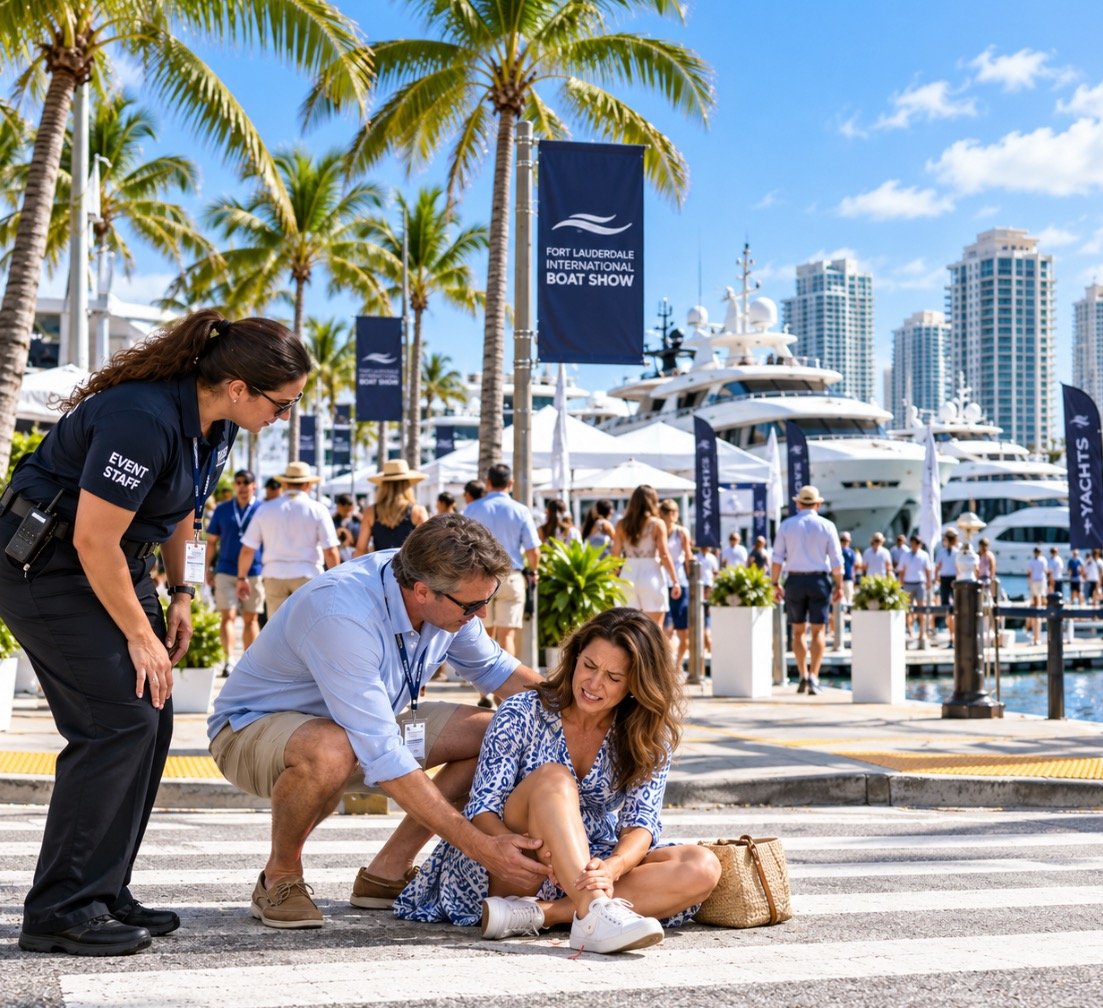
Injured at the Fort Lauderdale International Boat Show? Know Your Legal Rights
FLIBS brings more than 100,000 visitors to Fort Lauderdale every fall across six venues. Were you hurt on a dock, on a boat, or on a water taxi? Florida’s 2-year deadline and 51% fault bar can quickly wreck a claim. Our Fort Lauderdale personal injury lawyers move quickly to protect you.
The Fort Lauderdale International Boat Show (FLIBS) is one of the world’s largest in-water boat shows. Each fall, it draws more than 100,000 attendees to venues around Broward County, including Bahia Mar Yachting Center, Hall of Fame Marina, Las Olas Marina, Pier Sixty-Six Marina, the Broward County Convention Center, and the Superyacht Village. Water taxis shuttle guests between venues across the Intracoastal Waterway. That much foot traffic, equipment, and open water in one place creates real injury risks that most visitors never think about until something goes wrong.
If you were hurt at FLIBS, Florida law (and, in some cases, federal maritime law) may let you seek money damages for medical bills, lost wages, and pain and suffering. But that right has strict limits. HB 837, which took effect March 24, 2023, cut the deadline to file most lawsuits from four years to two years. The law also set a 51% comparative fault bar, meaning if a jury finds you more than half at fault, you get nothing. Some FLIBS injuries that happen on open water during sea trials or water-taxi transport may be subject to federal maritime law, which can shorten key deadlines even further.
This guide explains what a FLIBS injury case looks like, what to do right after an injury, and when to call a lawyer. For a free, 24/7 case review, call our Fort Lauderdale office at 954-525-0050 or our main line at 1-800-747-3733.
How We Can Help With Your Fort Lauderdale International Boat Show (FLIBS) Injury Claim


When you hire our firm after a Fort Lauderdale International Boat Show (FLIBS) injury, you don’t have to navigate the legal maze on your own. Our team handles everything, from the first phone call with an insurance adjuster to the final settlement check. We know how Broward County premises liability cases work. We know when a case may cross into federal maritime law. We also know how quickly evidence disappears at a large event, so we act the same day.
Our attorneys investigate the incident thoroughly. We request surveillance footage from the venues (Bahia Mar, the Convention Center, Pier Sixty-Six, Las Olas Marina, and Hall of Fame Marina all run camera systems). We pull incident reports, exhibitor records, water-taxi passenger lists, and emergency medical records. We interview witnesses, who often live in other states, and must reach them quickly. We send formal preservation (spoliation) letters to the show operator, the venue, the exhibitor whose booth or boat was involved, any water-taxi operator, and any security contractor on duty.
We also work on a contingency fee basis. You pay nothing upfront and nothing out of pocket. We only get paid when we win your case through a settlement or verdict. If you want to talk with our team about your FLIBS injury, you can also contact us online any time.
Understanding Fort Lauderdale International Boat Show (FLIBS) Injury Cases


FLIBS covers several venues at once. The main in-water displays stretch across Bahia Mar Yachting Center, Hall of Fame Marina, Las Olas Marina, Pier Sixty-Six Marina, and the Superyacht Village. Indoor exhibits fill the Broward County Convention Center. Water taxis shuttle guests between venues across the Intracoastal Waterway. Each venue has its own owner, its own operator, its own security contractor, and sometimes its own insurer, which is why FLIBS claims often involve more than one defendant.
A typical land-side case runs on Florida premises liability law. The injured person must show that the property owner or business operator knew or should have known about a dangerous condition (a wet dock, a loose cord, a damaged gangway) and failed to fix it or warn visitors. A typical waterside case turns on federal maritime law or a mix of state and federal rules, which is more complex and requires a lawyer who understands both frameworks.
All FLIBS cases run on a tight clock. Florida’s HB 837 reform caps the land-side deadline at 2 years. Maritime claims can have 3-year outer deadlines, but tickets, waivers, and contracts often include much shorter notice periods. Physical evidence like surveillance video, incident reports, and witness memory can fade within 24 to 72 hours. Fast legal action is the single most important thing an injured visitor can do.
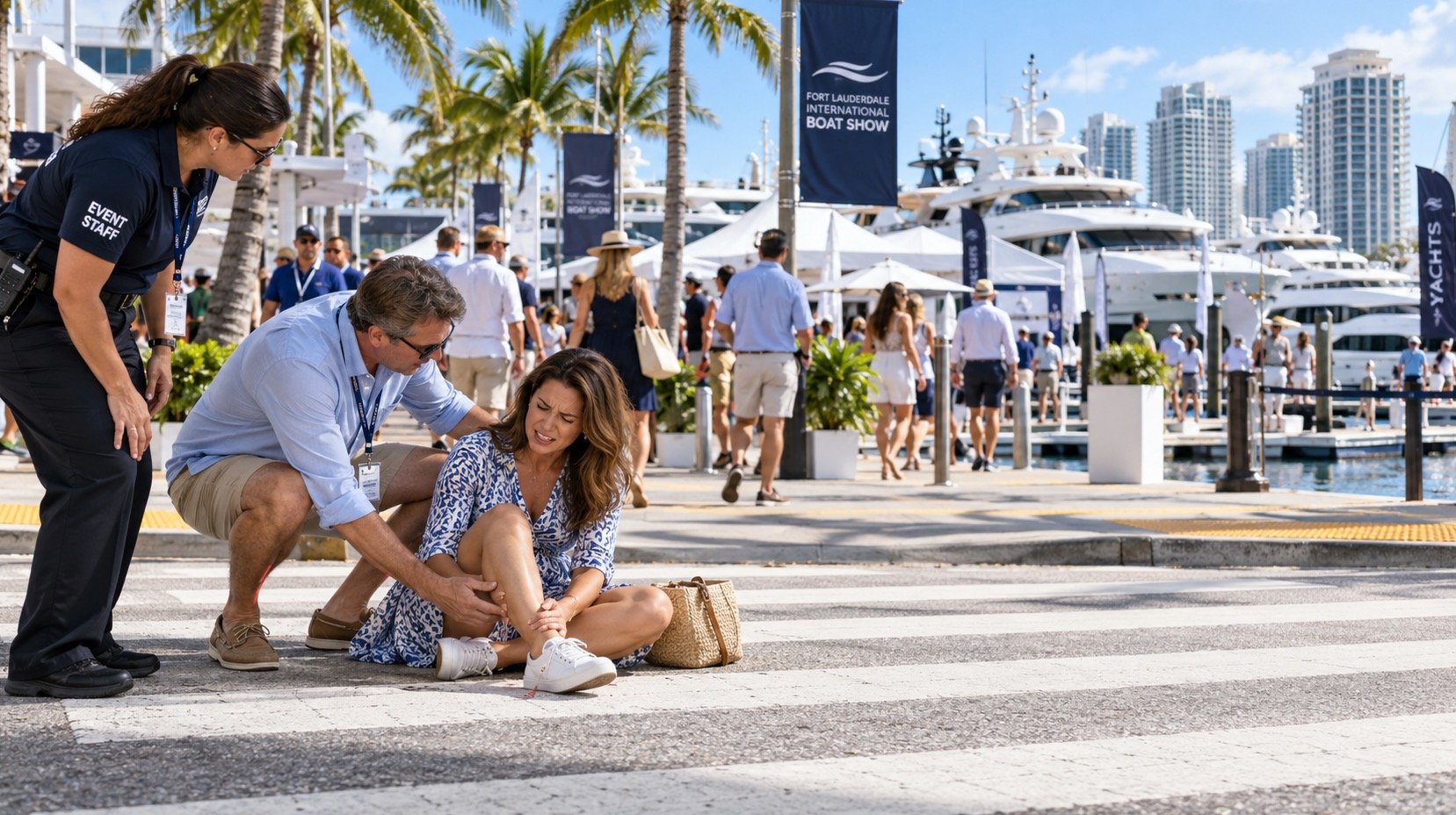
What Should You Do if You’re Injured in a Pedestrian Crosswalk at the Fort Lauderdale International Boat Show?
The Fort Lauderdale International Boat Show attracts thousands of visitors to the city’s waterfront, creating heavy pedestrian traffic around popular venues such as Bahia Mar Yachting Center, Las Olas Marina, and the Broward County Convention Center. With vehicles, rideshare drivers, shuttle buses, and pedestrians sharing busy streets, accidents can happen even when visitors use designated crosswalks.
If a vehicle strikes you or you are otherwise injured while crossing the street near the Fort Lauderdale International Boat Show, you may have grounds to pursue compensation. Taking the right steps immediately after the accident can protect your health and strengthen a potential personal injury claim.
Steps to Take After a Pedestrian Crosswalk Accident while attending the Fort Lauderdale International Boat Show (FLIBS)
- Call 911 and seek immediate medical attention. Pedestrian accidents can cause broken bones, traumatic brain injuries, spinal injuries, and internal injuries. Even if you feel relatively unharmed, some injuries may not become apparent until hours later.
- Report the accident to law enforcement. Ask the responding officer to prepare an official crash report. If the accident occurred near a boat show entrance or designated event crossing, notify event security as well.
- Document the crosswalk and surrounding conditions. Take photographs of the pedestrian crossing, traffic signals, vehicle positions, road markings, lighting, nearby signs, and any visible injuries. These details can help establish how the accident happened.
- Collect witness information. Boat show attendees may be visiting from other cities or states. Obtain names, telephone numbers, and email addresses from anyone who witnessed the collision.
- Preserve available evidence. Nearby businesses, traffic cameras, parking facilities, and event security systems may have recorded the accident. An attorney can help request that relevant footage be preserved before it is deleted.
- Speak with a Fort Lauderdale pedestrian accident lawyer. Before accepting an insurance settlement or providing a recorded statement to the other driver’s insurance company, consider discussing your legal options with an attorney.
Common Causes of Fort Lauderdale International Boat Show (FLIBS) Injuries
Slip, trip, and fall incidents are the most common ort Lauderdale International Boat Show injuries. Rain, splashing water, and spilled drinks can make dock surfaces slippery. Rubber mats, gangways, and finger piers can shift under foot traffic. Convention center aisles get cluttered with cords, display items, and promotional materials. According to CDC falls data, falls are the leading cause of injury-related ER visits nationally, and FLIBS’s crowd density, water-adjacent surfaces, and mixed indoor/outdoor layout drive a steady stream of fall claims each year.
Falls from boats on display are a second major category. Many of the vessels shown at FLIBS are large yachts and superyachts that visitors can board. Steep boarding ladders, slippery decks, unlit cabins, and open hatches all create fall risks. Dropped equipment and crush injuries from moving boats, trailers, or cranes during setup and takedown are another serious concern, especially for workers and vendors who arrive early or stay late.
On-water injuries happen during sea trials, demo rides, water-taxi transport, and shuttle service. Documented injury categories include collisions with other vessels, falls on wet decks, hard contact with equipment during rough-water maneuvers, propeller strikes, and burns from engine components. The U.S. Coast Guard’s annual Recreational Boating Statistics show hundreds of injuries and deaths every year in Florida waters, with contact with watercraft and falls overboard among the leading injury types.
Legal Rights of Fort Lauderdale International Boat Show (FLIBS) Injury Victims
If you were hurt at FLIBS because of someone else’s carelessness, Florida law (and in some cases federal maritime law) gives you the right to seek money damages. Those damages can cover past and future medical bills, lost wages, loss of future earning capacity, pain and suffering, mental anguish, scarring, and property damage.
You have the right to file a claim with the responsible party’s insurance company. If that claim does not resolve the case fairly, you have the right to file a lawsuit and take your case to a Broward County jury (or, in a federal maritime case, to the appropriate federal court). You have the right to hire an attorney. The attorney works for you, not for the insurance company.
You also have the right to refuse to give a recorded statement to the other side’s insurance adjuster, refuse to sign a blanket medical release, and say no to any lowball settlement offer. If a loved one died at FLIBS because of another party’s negligence, close family members may have a Fort Lauderdale wrongful death claim under the Florida Wrongful Death Act, or in some cases a claim under the federal Death on the High Seas Act.
Why Do Fort Lauderdale International Boat Show (FLIBS) Injuries Happen?
FLIBS injuries usually come down to one of three failures. The first is crowd and venue management. More than 100,000 attendees cycle through six separate venues across five days. When walkways get blocked, when wet decks are not mopped, when gangways are not maintained, and when crowd flow is not controlled across the floating docks, slip and fall injuries follow. The venue and the show operator share the duty to keep the premises reasonably safe.
The second is exhibitor and vendor negligence. Individual exhibitors are responsible for their booths and their boats. If a vendor leaves cables across a walkway, fails to secure a display, props a boarding ladder improperly, or allows visitors onto a boat without proper safety equipment, that vendor can be liable for any resulting injury. Boat manufacturers and sellers at FLIBS often carry commercial general liability policies that cover these risks.
The third is operator negligence on the water. Sea trials, demo rides, and the water taxis that shuttle attendees between Bahia Mar, Las Olas, Hall of Fame, and Pier Sixty-Six put visitors in open-water conditions. Negligent captains, overloaded vessels, poorly maintained equipment, and unsafe maneuvers all contribute to on-water injuries. These are the cases most likely to cross into federal maritime jurisdiction, with its own distinct rules and deadlines.
What Should You Do After a Fort Lauderdale International Boat Show (FLIBS) Injury?
First, get medical care right away. On-site paramedics are usually available at ort Lauderdale International Boat Show, and Broward Health Medical Center, Holy Cross Health, and Memorial Regional Hospital are all a short drive from the main venues. Even if you feel okay at the scene, injuries like concussions, internal bleeding, and spinal strain often do not show symptoms for hours. A same-day medical record also strengthens your legal case by linking the injury to the FLIBS incident.
The second step is to report the incident and document the scene. Find a show staff member or security officer and ask them to write an incident report. Request the officer’s name and badge number and ask for a copy of the report. Photograph the exact spot where the injury happened, including any hazards, warning signs (or missing signs), lighting conditions, surface conditions, and the surrounding area. Capture your injuries, your clothing, and any damaged personal belongings.
The third step is to get witness information. FLIBS attendees come from across Florida, around the country, and from overseas, and most go home within days. If you don’t get phone numbers and email addresses at the scene, you may not be able to find the witnesses later. Ask witnesses to send you a quick text describing what they saw. Save every receipt, badge, and ticket. Do not post about the incident on social media. Then contact an experienced attorney as soon as possible to protect your rights.
Critical Evidence in a Fort Lauderdale International Boat Show (FLIBS) Injury Case
FLIBS injury cases hinge on documentary evidence, most of which the show operator, venue, or exhibitors control. Surveillance video is the single most powerful source. Bahia Mar, the Broward County Convention Center, Pier Sixty-Six, Hall of Fame Marina, and surrounding businesses all run camera systems that typically overwrite footage on a 24- to 72-hour cycle. Once that video is gone, it is gone forever. Our firm sends preservation letters within hours of being retained.
Written records matter too. Show operators and exhibitors keep incident reports, maintenance and cleaning logs, booth-setup records, and employee statements. For sea trial injuries, boat operators keep logs of pre-trip safety checks, passenger lists, and vessel maintenance. For water-taxi incidents, operators maintain their own passenger manifests and vessel inspection records. These documents can prove the operator knew about a hazard or failed to follow basic safety protocols.
Physical evidence is often time-sensitive. Hazards get cleaned up. Damaged equipment gets replaced. Set pieces get struck once the show ends. Our attorneys work with investigators to document the scene before it is restored, and we often retain accident reconstruction experts to recreate the incident step by step. For on-water cases, we may hire marine engineers and maritime safety experts to analyze vessel operation and compliance with U.S. Coast Guard rules.
Were You Hurt at Fort Lauderdale International Boat Show? Connect With Our Fort Lauderdale Personal Injury Lawyers
If you were hurt at Fort Lauderdale International Boat Show (FLIBS), time is the most important factor. Surveillance footage from the venues can be overwritten within days. Witnesses from out of state can be impossible to find after they fly home. Show operators and exhibitors can begin building a defense before you even leave the hospital. The sooner you connect with an attorney, the stronger your case becomes.
Our Fort Lauderdale office at 300 SE 17th Street is a short drive from Bahia Mar and the main FLIBS venues. That proximity means our team can be on the ground within hours, meet with you at the hospital, coordinate with your doctors, and send preservation letters the same day. Our consultations are free, 24/7, and without obligation.
If we are a good fit, we take the case on contingency. You pay nothing upfront, nothing out of pocket, and nothing if we don’t win. Call 954-525-0050 any time to speak with a member of our team about your Fort Lauderdale Boat Show injury.
Fort Lauderdale International Boat Show (FLIBS) Injury Claims — Key Data at a Glance
The scale of the Fort Lauderdale International Boat Show creates both large injury risk and large claim potential. Each year, the show draws more than 100,000 attendees across six Broward County venues over five days. Those attendees cycle through indoor exhibits, outdoor water displays, water-taxi transport, and sea trial launches, exposing them to the full range of premises liability and maritime injury risks.
Beyond the show itself, Florida leads the nation in recreational boating activity, and Broward County sits at the heart of the state’s boating economy. The U.S. Coast Guard’s annual Recreational Boating Statistics show Florida reporting hundreds of boating injuries and dozens of fatalities each year, with Broward and Miami-Dade consistently among the top counties. Add in Fort Lauderdale’s huge premises-liability footprint from hotels, convention venues, and tourist attractions, and the legal environment for a FLIBS case becomes highly specialized.
Florida’s HB 837 reform, effective March 24, 2023, reshaped every FLIBS land-side claim. The 2-year statute of limitations and 51% zero-recovery fault bar stack on top of the state’s premises liability knowledge requirement. Maritime claims add a separate 3-year outer deadline under general maritime law. The infographic below sums up the key numbers.
Legal Term Defined
Land Premises Liability vs. Maritime Jurisdiction at the Fort Lauderdale International Boat Show (FLIBS)
Where the injury happens controls which law applies. Falls, trips, dropped equipment, and other injuries that happen on land at Bahia Mar, the Broward County Convention Center, or on fixed docks are governed by Florida premises liability law, including Fla. Stat. §768.0755 for business-establishment slip and fall claims. Those cases follow Florida’s HB 837 rules: a 2-year statute of limitations, modified comparative fault with a 51% bar, and the Florida visitor-status duty-of-care framework.
But if an injury happens on a boat on navigable water — during a sea trial, a demonstration ride, or on one of the water taxis shuttling between FLIBS venues on the Intracoastal — it may fall under federal maritime (admiralty) jurisdiction. Maritime claims can have shorter deadlines (a 3-year statute of limitations for most personal-injury claims under general maritime law, but sometimes much shorter contractual notice periods on tickets, waivers, and charter agreements). Which track your case runs on is a legal question that an experienced attorney can sort out quickly.
Proving Liability in Fort Lauderdale International Boat Show (FLIBS) Injury Cases
Liability means legal fault. To prove liability under Florida premises liability law for a land-side FLIBS injury, your attorney must show four things. First, the show operator or venue owed you a duty of care, which they almost always do for a paying attendee. Second, they breached that duty by failing to maintain safe conditions. Third, that breach caused the injury. Fourth, you suffered real damages.
For claims against business establishments under Fla. Stat. §768.0755, Florida adds an extra requirement: the injured person must prove the business had actual or constructive knowledge of the hazard. Actual knowledge means someone at the show knew about the problem. Constructive knowledge means the problem existed long enough, or happened often enough, that the show operator should have known. Surveillance video, maintenance logs, and prior-incident records are the usual way to prove constructive knowledge.
For on-water injuries, liability may run on federal maritime negligence rules instead. The duty-of-care, breach, causation, and damages framework is similar, but the comparative fault rule, available damages, and deadlines differ. An attorney who regularly handles both Florida premises liability and maritime injury cases can quickly tell you which track applies to your facts.
Dealing With Insurance Companies After a Fort Lauderdale International Boat Show Injury
FLIBS cases often involve multiple insurance companies. The show operator carries event liability insurance. Each venue (Bahia Mar, the Broward County Convention Center, Pier Sixty-Six, and so on) has its own commercial general liability policy. Each exhibitor usually carries a separate policy covering their booth, products, and vessels. If the injury happened on a boat, the boat owner may have a specific marine insurance policy. For water-taxi incidents, the taxi operator carries its own commercial maritime coverage.
Every one of these insurance companies has one goal: pay as little as possible. Adjusters are trained, experienced, and well-resourced. The injured attendee is often in pain, dealing with medical bills, and (if from out of state) worrying about getting home. That is an unfair fight, and the insurance company counts on it. Our firm handles all contact with the insurance company so you can focus on healing.
Three key mistakes to avoid: do not give a recorded statement before talking with a lawyer, do not sign a blanket medical release, and do not accept the first settlement offer. First offers are almost always a fraction of the real case value. Once you are represented, the adjuster cannot call you directly, which immediately takes huge pressure off your recovery.
What to Expect During a Fort Lauderdale International Boat Show (FLIBS) Injury Claim Process
A FLIBS injury claim moves through several stages. The first is the investigation phase, where your attorney gathers evidence, interviews witnesses, pulls records, and sends preservation letters. During this time, you continue medical treatment and keep every bill, prescription, and discharge instruction. This phase usually lasts from the day of the injury until your doctor says you have reached maximum medical improvement (MMI).
Next comes the demand and negotiation phase. Once your treatment is far enough along, your lawyer sends every involved insurance company a detailed demand letter laying out the facts, the law, your injuries, and the damages. The carriers respond with counter-offers, and negotiations often take weeks or months. Many FLIBS cases settle in this phase without a lawsuit.
If negotiations fail, your lawyer files a lawsuit. Land-side cases go to the 17th Judicial Circuit in Broward County. Maritime cases may be filed in the U.S. District Court for the Southern District of Florida. From there, the case moves through discovery, depositions, mediation, and, if needed, trial. Our firm prepares every case as if it will go to trial, which often convinces the insurance company to settle at full value.
Compensation for Fort Lauderdale International Boat Show (FLIBS) Injury Damages
Florida law allows injured FLIBS attendees to recover several types of damages. These fall into two main groups: economic damages (real dollars you can add up) and non-economic damages (harm not tied to a receipt but still very real). Economic damages include past and future medical bills, lost wages, loss of future earning capacity, out-of-pocket expenses, and property damage.
Non-economic damages cover pain and suffering, mental anguish, loss of enjoyment of life, scarring and disfigurement, and loss of consortium. Because FLIBS land-side cases are not motor vehicle cases, the PIP serious-injury threshold does not apply. Injured attendees can pursue the full range of damages from the outset. Maritime cases have slightly different damages rules under general maritime law, and an experienced attorney can walk you through them.
In rare cases involving gross negligence or intentional misconduct (for example, a vendor knowingly operating unsafe equipment), Florida law also allows punitive damages. These are extra damages meant to punish reckless behavior. Punitive damages are capped under Florida law, but they can add significant value in cases involving egregious conduct.
Economic vs. Non-Economic Damages in Fort Lauderdale International Boat Show (FLIBS) Cases
Economic damages are easier to prove because they come with paperwork. Every ambulance ride, emergency room visit, surgery, physical therapy session, and lost workday generates a bill or record. Your lawyer gathers those documents and adds them up. Experts project future medical costs and lost wages based on your injuries, age, and career path.
Non-economic damages are harder to quantify, but they are not harder to prove. They just require different evidence. Photos of your injuries over time, a journal describing the daily impact of the injury, statements from friends and family, and testimony from mental health providers all build the non-economic damages picture. Insurance companies try to minimize these damages because they are harder to put a number on, but a good lawyer knows how to present them clearly to a jury.
In most serious FLIBS cases, non-economic damages make up a large share of the total recovery. A visitor who misses six months of work and faces lifelong chronic pain might have $150,000 in economic damages and $400,000 or more in non-economic damages, depending on the specific facts of the case.
When a Fort Lauderdale International Boat Show (FLIBS) Injury Case Goes to Trial vs. Settlement
Most Fort Lauderdale International Boat Show injury cases settle before trial. Trial is expensive, slow, and uncertain for both sides. The show operator, the venue, and the exhibitors don’t want a Broward County jury to decide how much your case is worth, especially when liability is clear and your injuries are serious. Your lawyer uses that pressure to negotiate a fair settlement without going all the way to court.
But some cases do go to trial. Cases where the insurance company refuses to make a reasonable offer, where liability is sharply disputed, or where damages are so large that the carrier wants to minimize payment are more likely to go before a jury. Our firm prepares every case as if it will go to trial. That preparation often convinces the insurance company to settle at full value, and when it does not, we are ready.
If your case does go to trial, the process can take several days to several weeks. In state court, a jury of six Broward County residents hears the evidence from both sides. In federal maritime court, the process is similar but may involve a judge-only bench trial depending on the case type. Trial is a serious step, but when the insurance company refuses to pay fairly, it is sometimes the only path to full recovery.
Long-Term Effects of Fort Lauderdale International Boat Show (FLIBS) Injuries
Serious FLIBS injuries can affect a person for years, or for the rest of their life. Falls from boats or docks can cause traumatic brain injuries (TBIs) that lead to changes in memory, mood, and personality. Spinal cord injuries can lead to permanent weakness, chronic pain, or paralysis. Crush injuries from boats, trailers, or heavy equipment can require multiple surgeries and leave lifelong mobility problems. Burns and lacerations from engine components can cause permanent scarring.
Beyond physical injuries, Fort Lauderdale International Boat Show survivors often struggle with mental health effects. Post-traumatic stress disorder, anxiety, depression, sleep problems, and fear of returning to similar events are all common. These effects are real injuries under Florida law, and they are compensable. Documentation from a licensed mental health provider is critical to building a non-economic damages claim.
Economic effects can be just as serious. A permanent injury that forces a visitor to leave their career or take a lower-paying job can cost hundreds of thousands or even millions of dollars in lost earning capacity. Your lawyer works with vocational experts and economists to project those future losses so the settlement or verdict fully covers them.
Florida Laws That May Affect Your Fort Lauderdale International Boat Show Case
Several Florida laws can apply to a Fort Lauderdale International Boat Show (FLIBS) injury case. Fla. Stat. §768.0755 governs slip and fall claims against business establishments, requiring proof of actual or constructive knowledge of the hazard. Fla. Stat. §768.075 covers duty of care to visitors and invitees generally. Fla. Stat. Chapter 327 (the Florida Vessel Safety Law) applies to boat operation and could support negligence claims against boat owners or captains on the water, including water-taxi operators.
HB 837, Florida’s 2023 tort reform, builds on all of this. It cut the statute of limitations to 2 years, moved the state from pure to modified comparative fault, raised the comparative-fault bar to 51%, and changed several evidence rules at trial. Every land-side FLIBS case is now shaped by HB 837.
If your case crosses into federal maritime jurisdiction, additional laws apply. General maritime law, the Jones Act (for seamen injured in the course of employment), the Longshore and Harbor Workers’ Compensation Act (for dock workers), and the Death on the High Seas Act all have their own rules. The Florida boat accident framework governs many of these claims.
The Statute of Limitations for Fort Lauderdale International Boat Show Injury Cases
Florida’s HB 837 cut the statute of limitations for most negligence claims from four years to two years, effective March 24, 2023. That applies to the majority of FLIBS injury claims (slip and fall, trip and fall, premises liability, and most other land-side cases). Missing this deadline permanently bars recovery, no matter how strong the facts.
Maritime claims follow different rules. Under 46 U.S.C. §30106, most personal-injury claims arising on navigable water carry a 3-year statute of limitations under general maritime law. That outer deadline sounds longer than Florida’s 2-year rule, but it is often shortened dramatically by contract. FLIBS tickets, sea trial waivers, water-taxi fares, and charter agreements frequently include notice provisions that require written notice of a claim within 6 months (or even 60 days) and lawsuit filing within 1 year.
Wrongful death cases have their own clocks. Under Florida’s Wrongful Death Act, families generally have 2 years from the date of death. Under the federal Death on the High Seas Act, the deadline is also 3 years. With all these moving parts, the most important step after a Fort Lauderdale International Boat Show injury or death is to contact an experienced attorney as soon as possible.
How a Fort Lauderdale Boat Show Injury Lawyer Can Help You
A Fort Lauderdale Boat Show injury lawyer handles the entire legal process so you can focus on healing. The attorney investigates the incident, pulls records, interviews witnesses, and sends formal preservation letters to the show operator, each venue, every involved exhibitor, any water-taxi operator, and any boat owner or captain. In serious cases, the lawyer may hire accident reconstruction experts, marine engineers, premises safety experts, and medical experts to build a complete picture of liability and damages.
The attorney also sorts out the critical land-versus-water jurisdictional question. If your case is pure Florida premises liability, it stays in state court on the 2-year clock. If your case involves a sea trial, a demo ride, or a water-taxi incident, your attorney will evaluate whether maritime law applies and plan the litigation accordingly. Getting this question right early protects your rights and avoids the painful outcome of filing in the wrong court.
Finally, the attorney negotiates with every insurance company involved. For a complex FLIBS case, that often means three, four, or more carriers. Coordinating all of them, pursuing coverage disputes, and pushing each one toward a fair contribution is specialized work. An attorney who handles both Fort Lauderdale slip and fall and Florida boat accident cases regularly brings exactly this experience to your file.
When to Contact a Fort Lauderdale Boat Show Injury Lawyer
Call a lawyer the same day as the injury or the day after. Quick action lets your attorney send preservation letters before surveillance footage is overwritten, interview witnesses while their memories are fresh, and protect you from aggressive insurance adjusters. The sooner you have a lawyer, the stronger your case becomes.
You should also call if the insurance company has already contacted you, asked for a recorded statement, offered a quick settlement, or sent a release to sign. Those are all signs the carrier is moving faster than you. If a show operator or exhibitor has asked you to sign anything, do not sign until you have talked to counsel.
Finally, call a lawyer if you were injured on a boat during a sea trial, demo ride, or water-taxi transfer. Maritime deadlines can be much shorter than Florida’s general 2-year rule, especially when ticket or waiver language is involved. Our consultations are free, 24/7, and without obligation. If we are a good fit, we take the case on contingency, meaning you pay nothing unless we win. Call 954-525-0050 any time.
Why You Need an Experienced Fort Lauderdale Boat Show Injury Lawyer
FLIBS cases are not routine. They sit at the intersection of Florida premises liability, event liability, and maritime law. Many lawyers have never handled a maritime case. Even fewer handle them alongside Florida premises claims. Our firm has handled both for years, so we can assess your case correctly from the first phone call and pull the right levers in the right order.
Experience also means knowing the local players: the Bahia Mar operations team, the Broward County Convention Center’s facilities team, the Boat Show operator’s risk management department, the exhibitor insurance market, the Broward County adjuster pool, and the local marine industry. Those relationships speed up document requests, witness interviews, and preservation efforts, and they translate directly into stronger settlement positions.
Beyond skill, you want a lawyer who treats you like a person, not a file number. Our team keeps clients informed at every step, returns calls promptly, and explains options clearly, in English or Spanish. Our goal is to help clients feel heard, respected, and well represented through a difficult process.
How to Choose the Right Fort Lauderdale Boat Show Injury Lawyer for Your Case
Start with experience. Ask how many Florida premises liability cases the firm has handled and whether the firm has experience with maritime personal injury. Ask about results. Ask about Broward County experience specifically. A firm that works across Florida and has an actual Fort Lauderdale office (not just a virtual address) will know the local courts, convention venues, and marine community far better than a firm based elsewhere.
Then look at credentials. Board Certification in Civil Trial Law by The Florida Bar is a serious credential held by fewer than 3% of Florida attorneys. An AV Preeminent rating from Martindale-Hubbell is the top peer-reviewed recognition for professional excellence and ethics. Both are independent and cannot be bought. Ask which attorneys at the firm hold them.
Finally, pay attention to communication and fee structure. Your attorney should return calls quickly, explain things clearly, and update you regularly. Most personal injury firms, including Anidjar & Levine, work on a contingency fee basis. You pay nothing unless we win. Get the fee agreement in writing before you sign and make sure you understand the percentage, the costs, and how expenses are handled.
About The Law Offices of Anidjar & Levine
Founded in 2005 by Marc Anidjar and Glen Levine, The Law Offices of Anidjar & Levine began as a two-person operation working out of a construction office conference room. Over the past 20 years, that modest start has grown into one of Florida’s most recognized personal injury practices, with more than $1 billion recovered in settlements on behalf of injury clients across the state. We bring that same determination and depth of experience to every FLIBS injury case we handle.
Our Fort Lauderdale office sits at 300 SE 17th Street, in the heart of the city’s marine and hospitality district and just a short drive from Bahia Mar, Pier Sixty-Six, the Broward County Convention Center, and every major hospital treating Fort Lauderdale International Boat Show (FLIBS) injuries in Broward County. We serve clients across the county, from Fort Lauderdale and Hollywood to Pompano Beach, Davie, Weston, and Coral Springs, and across Florida through offices in Miami, Jacksonville, Orlando, Tampa, Fort Myers, West Palm Beach, Daytona Beach, and Naples.
Marc Anidjar, Co-Founder & Personal Injury Attorney
Marc Anidjar co-founded the firm in 2005 and has spent two decades representing seriously injured people throughout Florida. He is Board Certified in Civil Trial Law by The Florida Bar, a distinction held by fewer than 3 percent of Florida attorneys. He also holds an AV Preeminent rating from Martindale-Hubbell, the legal industry’s highest peer-review recognition for professional excellence and ethical standards.
Glen Levine, Co-Founder & Personal Injury Attorney
Glen Levine co-founded the firm alongside Marc Anidjar and has represented injury clients across Florida for more than 20 years. He also holds an AV Preeminent rating from Martindale-Hubbell. He is committed to clear communication, thorough case preparation, and protecting each client’s right to full and fair compensation after a serious injury.
Frequently Asked Questions
What is the statute of limitations for a Fort Lauderdale Boat Show injury case?
Under Florida HB 837, effective March 24, 2023, most land-side negligence claims must be filed within 2 years. Maritime claims arising on the water carry a 3-year outer deadline under general maritime law, but ticket and waiver language can shorten that significantly. Missing the deadline permanently bars recovery.
Does Florida premises liability or federal maritime law govern my FLIBS case?
It depends on where the injury happened. Injuries on fixed land (the Convention Center, Bahia Mar’s terrace, fixed docks) are generally governed by Florida premises liability law. Injuries on a boat on navigable water during a sea trial, demo ride, or water-taxi ride may fall under federal maritime law. An experienced attorney can quickly determine which track your case runs on.
Can I still recover if I was partially at fault for my FLIBS injury?
For Florida land-side cases, yes, as long as you were less than 51% at fault. Under modified comparative fault, your damages are reduced by your percentage of fault. For maritime cases, pure comparative fault applies, which means you can recover even if you were more than 50% at fault, with your damages reduced proportionally.
What are the most common injuries at the Fort Lauderdale International Boat Show?
Slip, trip, and fall injuries on docks, gangways, and convention floors are the most common. Falls from boats on display, dropped equipment, crush injuries from moving vessels or trailers, lacerations and burns from engine components, and on-water injuries during sea trials or water-taxi rides are also frequent. Serious injuries can include traumatic brain injury, spinal cord injury, broken bones, and drowning in extreme cases.
What should I do immediately after a FLIBS injury?
Get medical care right away, even if your injuries seem minor. Report the incident to show staff or security and request a written incident report. Photograph the scene, the hazard, your injuries, and any damaged belongings. Get contact information from every witness (many attendees travel home within days). Do not give a recorded statement to any insurance company before speaking with a lawyer.
Can a signed ticket waiver stop me from suing after a FLIBS injury?
Not always. Florida courts enforce clearly written waivers in some circumstances, but courts also refuse to enforce them for gross negligence, intentional misconduct, or violations of public policy. Maritime waivers face additional federal law scrutiny. Even if you signed a waiver when you bought your ticket or boarded a boat, you may still have a viable claim. An attorney can review the exact language.
Can I file a Fort Lauderdale International Boat Show injury claim if I live out of state?
Yes. The injury happened in Florida, so Florida law and Florida courts generally apply. You do not need to live in Florida to hire a Florida attorney or file a Florida claim. Retaining Florida-based counsel is usually the most effective way for an out-of-state attendee to handle a FLIBS injury case.
Fort Lauderdale and Broward County Local Resources
The following local resources may help injured people and their families in the days and weeks after a serious FLIBS injury. If you are experiencing an emergency, call 911 first.
Hospitals and Emergency Care
• Broward Health Medical Center — Level I Trauma Center · 1600 S Andrews Ave, Fort Lauderdale, FL 33316 · 954-355-4400
• Holy Cross Health — 4725 N Federal Hwy, Fort Lauderdale, FL 33308 · 954-771-8000
• Memorial Regional Hospital — Level I Trauma Center · 3501 Johnson St, Hollywood, FL 33021 · 954-987-2000
• Broward Health Imperial Point — 6401 N Federal Hwy, Fort Lauderdale, FL 33308 · 954-776-8500
Police and Marine Patrol
• Fort Lauderdale Police Department — 1300 W Broward Blvd, Fort Lauderdale, FL 33312 · Non-emergency: 954-764-4357
• Broward Sheriff’s Office — 2601 W Broward Blvd, Fort Lauderdale, FL 33312 · Non-emergency: 954-321-4400
• Florida Fish and Wildlife Conservation Commission — Boating Accident Investigations · 1-888-404-FWCC (3922)
• U.S. Coast Guard Sector Miami (covering Broward) · Search and rescue: 305-535-4314
Courts
• Seventeenth Judicial Circuit Court of Florida — Broward County Courthouse, 201 SE 6th St, Fort Lauderdale, FL 33301 · 954-831-6565
• U.S. District Court for the Southern District of Florida — Federal court for maritime cases · 954-769-5400
Mental Health and Crisis Support
• 988 Suicide & Crisis Lifeline — 24/7 free confidential support · 988
• 211 Broward — 24/7 helpline · 211
• Henderson Behavioral Health · Crisis line: 954-463-0911
Victim Services and Additional Support
• Broward County Victim Services · 954-357-5775
• Florida Department of Health in Broward County · 954-467-4700
• Florida Department of Financial Services — Consumer Insurance Help · 877-693-5236
Injury claims arising from the Fort Lauderdale International Boat Show often involve serious injuries, Florida’s complex premises liability rules, HB 837’s compressed deadlines, federal maritime law for on-water incidents, and multiple insurance carriers. A Fort Lauderdale personal injury lawyer from The Law Offices of Anidjar & Levine can identify every responsible party, coordinate every available coverage source, preserve surveillance and incident-report evidence, and pursue compensation for medical expenses, lost wages, and pain and suffering. Prompt legal guidance can help protect an injured person’s rights and strengthen the claim. Those hurt at the Fort Lauderdale International Boat Show (FLIBS) — whether they live in Florida or traveled from out of state — should contact an experienced attorney for a confidential case review. Our team is available 24/7 at 954-525-0050 or toll-free at 1-800-747-3733.
Real Reviews From Our Clients!
“I slipped on a wet gangway at Bahia Mar and tore my rotator cuff. The show operator said it was just a ‘wet dock, use caution’ situation. Anidjar & Levine got the venue surveillance footage before it was overwritten, showed the gangway had been flagged for repair, and secured a settlement that covered my surgery and lost wages.”
— Michael B., FLIBS Attendee
“A FLIBS water taxi hit a wake at full speed on the Intracoastal, and I was thrown across the deck. I broke two ribs and fractured my wrist. Anidjar & Levine knew exactly how to handle the maritime side of my case and got me a full recovery from the taxi operator’s insurance.”
— Rachel K., Out-of-State Attendee
“I was climbing a boarding ladder on a yacht on display when a rung gave way. I fell about six feet and ended up with a concussion and a broken ankle. Anidjar & Levine coordinated between the exhibitor’s insurer, the show’s event policy, and my own health insurance. Professional and truly on my side.”
— Daniel R., Fort Lauderdale

