

The Law Offices of Anidjar and Levine, a Pensacola personal injury law firm, evaluates vessel damage, injuries, liability, and insurance coverage after collisions, docking incidents, storms, or marina-related accidents. This work often includes preserving photographs, repair estimates, maintenance records, medical documentation, and witness statements to support compensation for property loss, treatment costs, and lost income. Legal counsel may also address insurer disputes, policy exclusions, and negligence defenses. Learn more from a Pensacola Personal Injury Lawyer about how these claims are assessed and pursued.
Main Takeaways
- A Pensacola boat and marine property claim lawyer evaluates vessel damage, injuries, liability, and all available insurance coverage sources after marine incidents.
- Legal help is valuable for storm, hurricane, docking, collision, and marina damage disputes involving undervalued repairs or denied coverage.
- Strong claims rely on preserved evidence, including photographs, repair estimates, maintenance records, witness statements, and medical documentation.
- An attorney reviews policy exclusions, coverage limits, prior vessel issues, and insurer communications to challenge unfair denials or low settlements.
- Lawyers also assess negligence involving unsafe operation, poor maintenance, defective equipment, hazardous docks, or inadequate crew safety training.


How We Can Help With Your Pensacola Boat & Marine Property Injury Claim
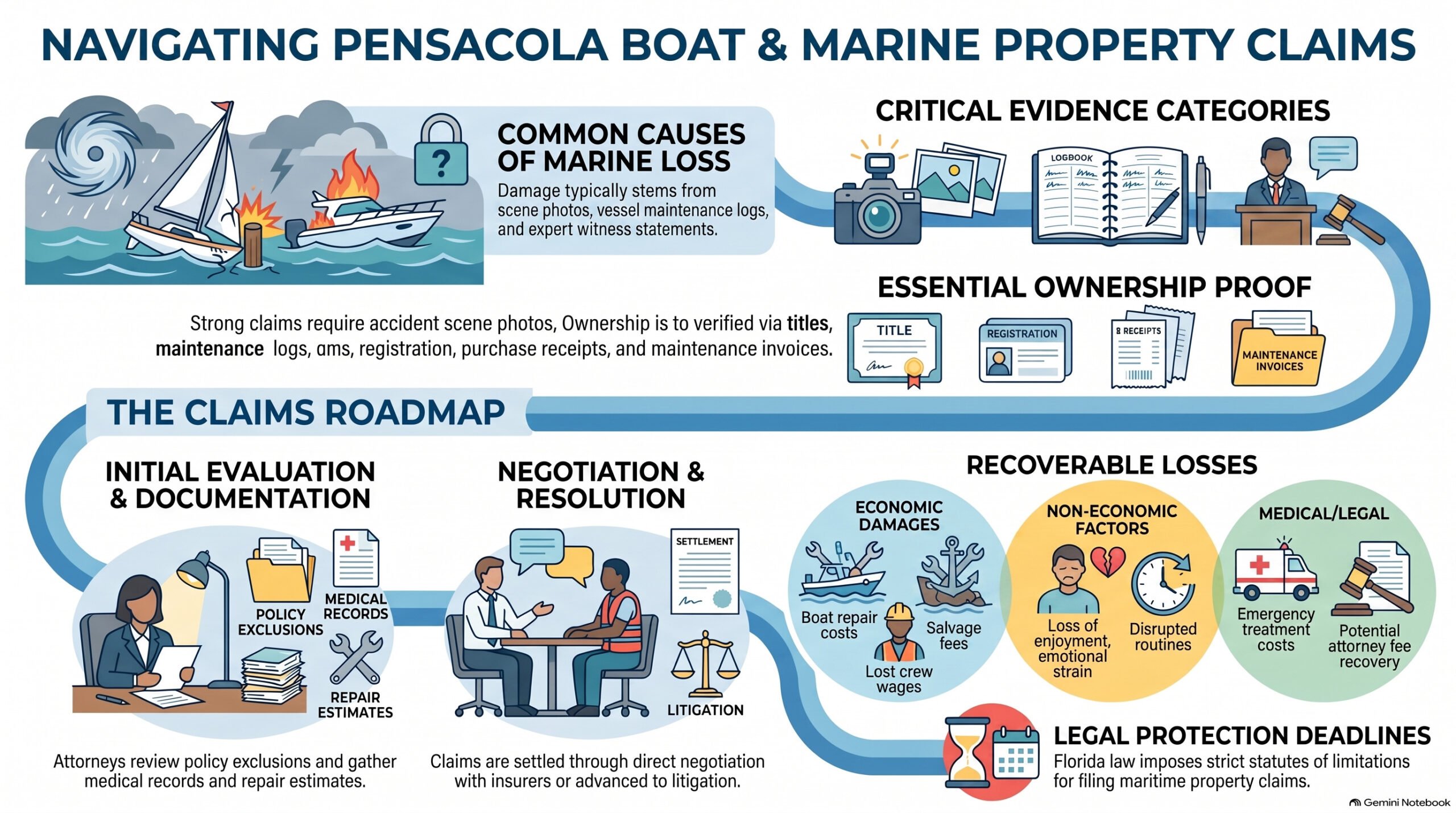
When a boat or marine property loss results in physical injury, a Pensacola boat and marine property claim lawyer can assist by evaluating the incident, identifying all available sources of compensation, and managing the claim from its earliest stages. Counsel provides organized support to injured individuals and families seeking fair outcomes while continuing to care for others.
This assistance often includes gathering maintenance records, repair estimates, witness statements, photographs, and medical documentation. An attorney may review boat insurance coverage, analyze policy exclusions, and communicate with insurers to reduce delay or misunderstanding. Counsel also prepares responses to marine negligence defenses that may be raised to limit responsibility. By coordinating experts, preserving evidence, and presenting a clear demand, legal counsel helps protect the value of the claim. Throughout the process, representation allows clients to focus on recovery, family responsibilities, and practical service to their community, while the legal issues are handled with diligence, structure, and professional care.
OUR CONSULTATIONSARE FREE
START YOUR FREE CASE REVIEW

Understanding Pensacola Boat & Marine Property Claim Injury Cases
A clear understanding of Pensacola boat and marine property claim injury cases helps explain how these matters are evaluated and why outcomes often depend on both factual detail and insurance analysis. These cases generally involve review of vessel conditions, reported injuries, policy terms, repair estimates, witness statements, and timelines surrounding the incident.
From a service-minded perspective, careful evaluation promotes accountability and supports those affected by maritime losses. Investigators and counsel often assess whether Maintenance negligence contributed to unsafe conditions or whether crew safety training was adequate for the vessel’s operations. Medical records, photographs, inspection findings, and communication logs may all influence how responsibility and compensation are considered. Insurance carriers also examine exclusions, coverage limits, ownership interests, and documentation of prior vessel issues. Because marine claims can involve overlapping legal and factual questions, organized evidence and timely reporting are often critical to protecting rights, clarifying obligations, and encouraging fair resolution for injured parties and their families.
Common Causes of Pensacola Boat & Marine Property Claims
Pensacola boat and marine property claims often arise from several recurring events that can produce substantial losses. Common causes include storm and hurricane damage, docking and collision incidents, theft and vandalism losses, and fire or mechanical failures. Each of these circumstances may affect the scope of property damage, the available insurance coverage, and the process for pursuing compensation.
Storm And Hurricane Damage
Because Gulf Coast weather can intensify with little warning, storm and hurricane damage remains one of the most common causes of boat and marine property insurance claims in the Pensacola area. High winds, storm surge, heavy rain, and flying debris can damage hulls, electronics, engines, docks, lifts, and stored equipment within hours. Even well-maintained vessels may suffer major losses when owners have limited time to respond.
Careful storm preparedness and thoughtful evacuation planning often reduce harm, protect neighboring property, and support safer outcomes for families and marina staff. After a severe weather event, policyholders may face disputes involving covered losses, preexisting condition allegations, depreciation, or undervaluation of repairs. Detailed documentation, prompt notice, and organized records frequently help support a fair claim evaluation and timely recovery after widespread coastal storm damage.
Docking And Collision Incidents
Docking and collision incidents also account for a significant share of boat and marine property claims in the Pensacola area, often arising during routine operations rather than major weather events. These losses may involve impact with pilings, seawalls, neighboring vessels, or marina structures, and they frequently raise questions about adherence to Boating Safety Standards and Navigational Rules. In many cases, careful review of maintenance records, operator conduct, and marina procedures helps determine responsibility and protect those seeking fair recovery. Claims can become more intricate when Liability Waivers are asserted or when Third Party Contractors contributed to faulty docking equipment, unsafe fueling areas, or negligent vessel handling. A thorough evaluation of the surrounding circumstances supports informed decision-making and helps individuals, families, and marine businesses pursue appropriate compensation for property damage.
Theft And Vandalism Losses
While severe storms often receive the most attention, theft and vandalism losses remain a persistent source of boat and marine property claims in the Pensacola area. Vessels, motors, electronics, trailers, and navigation equipment may be targeted at marinas, boatyards, and private docks, especially when they appear unattended or lightly protected. Property owners who value stewardship often emphasize preventive security, including locked storage, surveillance cameras, alarm systems, and dock access control. These measures may reduce risk and also support later claims.
When losses occur, careful insurance documentation becomes critical. Photographs, serial numbers, maintenance records, receipts, and incident reports can help establish ownership, condition, and value. Prompt notice to law enforcement and the insurer may strengthen the claim process, while organized records can assist those working to restore affected families and maritime operations.
Fire And Mechanical Failures
Although coastal weather often drives marine losses, fire and mechanical failures also produce serious boat and marine property claims in the Pensacola area. Engine overheating, fuel leaks, corroded wiring, and neglected maintenance can quickly damage vessels, docks, and stored equipment. Electrical hazards often worsen these incidents, especially when shore power systems, batteries, or navigation components malfunction without warning.
When losses occur, careful documentation helps owners, marinas, and families protect their interests and continue serving others responsibly. Investigations may address repair histories, manufacturer defects, operator conduct, and potential arson liability when suspicious fire patterns are observed. Insurance disputes can arise over causation, policy exclusions, depreciation, and the scope of covered property. A thorough legal review often helps clarify responsibility, preserve evidence, and support fair recovery after a destructive marine fire or mechanical breakdown.
Don’t Wait. Call Our Florida Personal Injury Lawyers Now!


Legal Rights of Pensacola Boat & Marine Property Claim Injury Victims
A person injured in a Pensacola boat or marine property incident may have important legal rights under Florida law, including the right to pursue compensation for medical expenses, lost income, property damage, and other related losses. These rights often depend on timely action, careful documentation, and the preservation of maritime evidence after the event. Prompt attention may also help reduce harm caused by insurance claim delays and disputed facts.
Key protections may include the ability to seek:
- Payment for emergency care, treatment, and rehabilitation costs.
- Recovery of wages lost during medical leave or reduced work capacity.
- Compensation for repair or replacement of damaged marine property.
- Accountability when another party’s negligence contributed to the incident.
In many cases, injured individuals also have the right to receive clear policy information, present supporting records, and challenge unfair denials. By understanding these protections, those who serve and support others can make informed decisions while protecting their household’s financial stability and future well-being.
Why Do Pensacola Boat & Marine Property Claim Injuries Happen?
Why do injuries arise so often in Pensacola boat and marine property claim matters? They frequently stem from preventable hazards on vessels, docks, marinas, and launch areas, where routine activity can quickly become dangerous. Slippery surfaces, corroded equipment, poor vessel maintenance, electrical faults, fuel leaks, and unsecured cargo often create conditions for falls, burns, collisions, and crushing injuries.
Weather and water conditions also play a significant role. Sudden storms, rough wakes, strong currents, and limited visibility increase the likelihood of operator error and equipment failure. In many cases, inadequate training, fatigue, distraction, or alcohol use contribute to poor judgment during navigation or loading operations. Safety gear awareness remains important, yet some incidents involve missing life jackets, defective fire extinguishers, or inaccessible emergency tools. Likewise, updates to docking protocols matter because outdated procedures can expose workers, passengers, and visitors to avoidable harm. Careful prevention serves both individual well-being and the broader marine community.
What Should You Do After a Pensacola Boat & Marine Property Claim Injury?
After a Pensacola boat or marine property claim injury, prompt action is often necessary to protect both health and legal interests. Immediate medical care should be obtained, and the incident should be thoroughly documented through photographs, reports, and witness information. It is also often advisable for the injured party to contact a marine lawyer who can assess the claim and explain the next appropriate steps.
Seek Immediate Medical Care
Seek prompt medical attention, even when injuries seem minor, because a timely evaluation supports both health and the integrity of a future boat or marine property claim. After a boating incident, qualified providers can provide initial medical care, identify hidden trauma, and recommend appropriate pain management based on observed conditions.
Prompt care also helps document symptoms as they develop, which may reveal complications not obvious at the scene. An emergency evaluation may be necessary for head injuries, drowning exposure, spinal pain, fractures, or internal harm. Individuals who serve others often minimize their own discomfort, yet responsible action requires preserving personal well-being so continued support remains possible. Following discharge instructions, attending follow-up appointments, and reporting new limitations to medical professionals can strengthen recovery and provide a clear foundation for any later claim review.
Document The Incident
Because conditions at a boating accident scene can change quickly, careful documentation should begin as soon as safety and medical needs are addressed. Clear records may preserve facts that help insurers, investigators, and families understand what occurred and what losses followed.
Helpful documentation often includes a Photo timeline showing vessel positions, weather, water conditions, visible injuries, and damaged equipment. A thorough damage assessment should identify harm to the boat, motor, trailer, electronics, and personal property. Names, contact details, and brief statements should be gathered in witness logs while memories remain fresh. If law enforcement or marina personnel respond, request a copy of any incident report. Receipts, repair estimates, medical discharge papers, and communications with insurers should also be organized and saved carefully for future reference.
Contact A Marine Lawyer
When a boating injury or marine property loss raises questions about fault, insurance obligations, or the value of damages, early legal guidance can help protect a claimant’s position. A marine lawyer can explain reporting duties, preserve evidence, and prevent statements that may weaken a claim.
Counsel may also conduct a Vessel insurance policy review to identify coverage limits, exclusions, deadlines, and duties tied to damage mitigation. This assistance is often valuable after storms, collisions, fires, sinkings, or theft, especially when hurricane preparedness measures become relevant to insurer evaluations. By organizing records, communicating with adjusters, and evaluating repair estimates, an attorney helps claimants pursue fair outcomes while remaining focused on recovery and responsible stewardship. Prompt consultation can also support families, marinas, and crews seeking practical guidance after serious marine losses.
Don’t Wait. Call Our Florida Personal Injury Lawyers Now!
Critical Evidence in a Pensacola Boat & Marine Property Claim Injury Case
In a Pensacola boat and marine property claim injury case, the strength of the claim often depends on the quality and preservation of essential evidence.
Commonly important categories include:
1. Accident scene documentation 2. Vessel damage records 3. Medical treatment evidence 4. Witness and expert statements. When these materials are gathered promptly and maintained carefully, they can help establish liability, confirm the extent of losses, and support a more accurate valuation of the claim.
Accident Scene Documentation
Although the immediate aftermath of a boating accident is often chaotic, careful accident scene documentation can provide some of the strongest evidence in a Pensacola boat and marine property claim injury case. Prompt photographs of water conditions, weather, navigational markers, visible injuries, and the positions of people involved may help preserve facts before they change. Written notes identifying the time, location, witness names, and responding agencies also support the reconstruction of the incident timeline. Records of radio calls, emergency responses, and Safety equipment checks can further clarify whether proper precautions were in place. When thoughtfully gathered, this information may assist attorneys, insurers, and investigators seeking fair outcomes for injured individuals and families. Thorough documentation often strengthens credibility, reduces disputes about causation, and helps those serving others present a clear, reliable account of events.
Vessel Damage Records
Because physical damage to a vessel often reflects the force, direction, and sequence of a collision, vessel damage records can become critical evidence in a Pensacola boat and marine property claim injury case. Photographs, repair estimates, haul-out reports, maintenance logs, and survey findings may help establish impact points, preexisting conditions, and post-accident deterioration. Proper Evidence preservation supports accurate evaluation and may prevent a liability defense from relying on missing or altered records.
Detailed vessel damage records also strengthen Insurance documentation by linking observable damage to the reported event. When organized carefully, these materials can assist attorneys, adjusters, and marine experts in determining causation, valuation, and responsibility. Clear records often improve claim negotiation by reducing factual disputes and providing a reliable foundation for decisions that protect injured individuals and the broader community.
Medical Treatment Evidence
After a boating incident, medical treatment evidence often provides the clearest record of the nature, timing, and severity of an injured person’s condition. Emergency room notes, diagnostic imaging, surgical records, prescriptions, and rehabilitation charts can connect symptoms to the event and document how injuries affect daily function, work capacity, and long-term recovery. Consistent treatment may also strengthen credibility by showing that the injured person sought prompt care and followed medical advice.
In service-minded claims, complete medical documentation helps decision-makers evaluate needs fairly and responsibly. Bills and treatment plans may support compensation for past and future care, while Video surveillance preservation can protect context when injuries are disputed. Although Appraisal damage valuation addresses property loss, medical records remain vital when bodily harm and marine damage arise together in one claim for relief.
Witness And Expert Statements
Medical records often establish the physical effects of a boating incident, while witness and expert statements help explain how the event occurred, why the damage or injury developed, and whether the losses claimed are consistent with the facts.
In a Pensacola boat and marine property claim, neutral witness accounts may clarify vessel speed, weather, navigation conduct, and crew negligence. The value of those accounts often depends on eyewitness credibility, including vantage point, consistency, and any relationship to the parties involved. Expert statements can further assist by interpreting collision patterns, mechanical failures, safety practices, and marine conditions that ordinary observers cannot fully assess. When carefully gathered and compared with photographs, repair records, and medical evidence, these statements can strengthen a claim and support a fair outcome for injured individuals and affected families.
Long-Term Effects of Pensacola Boat & Marine Property Claim Injuries
Boat and marine property claim injuries may produce lasting consequences that extend well beyond the initial incident and recovery period. Many individuals face chronic pain and reduced mobility, while emotional trauma may continue to affect daily functioning and overall well-being. Over time, these conditions often create substantial financial strain through ongoing medical care, lost income, and related long-term expenses.
Chronic Pain And Mobility
A marine-related injury can leave more than immediate physical damage, as chronic pain and reduced mobility often become lasting consequences that disrupt daily life and long-term independence. Individuals may struggle with walking, lifting, climbing, or standing for extended periods, limiting employment, household responsibilities, and community service.
These conditions frequently require ongoing medical treatment, physical therapy, assistive devices, and workplace accommodations. When injuries stem from preventable hazards, such as failures in docking safety or neglected routine inspections, the long-term burden may affect both financial stability and quality of life. Care providers and advocates often recognize that persistent pain can alter a person’s ability to meet obligations and care for others. A careful legal review can help document these losses, support recovery needs, and promote accountability for unsafe marine conditions and practices.
Emotional Trauma After Injury
Persistent physical limitations are often accompanied by emotional trauma that can continue long after visible injuries have begun to recover. Individuals affected by boat or marine property incidents may experience stress and anxiety, sleep disruption, irritability, and a reduced sense of safety during daily activities. These responses can alter relationships, diminish confidence, and complicate participation in work, caregiving, or community service.
A careful understanding of trauma recovery is essential. Emotional harm may surface immediately, or it may emerge gradually as injured persons confront ongoing limitations and reminders of the event. Supportive counseling, consistent medical guidance, and patient-centered rehabilitation often help restore stability. For families and advocates committed to serving others, recognizing these psychological effects can encourage compassionate responses and more complete care for those facing long-term recovery after serious marine injuries.
Financial Strain Over Time
Often, the financial consequences of a Pensacola boat or marine property injury continue well beyond the initial emergency response and early treatment period. Lost income, ongoing rehabilitation, vessel repairs, and replacement of damaged equipment can steadily erode household stability and limit a family’s ability to support others in need.
These burdens may deepen when insurance claim delays interrupt access to promised benefits or reimbursement. In many cases, long-term valuation disputes arise over the condition of the boat, marine equipment, or related property, leaving injured individuals responsible for mounting costs while negotiations continue. A careful legal review may help clarify available coverage, document future losses, and protect financial resources. This support can strengthen recovery efforts and promote responsible planning for dependents, caregivers, and the broader community they continue serving.
Proving Liability in Pensacola Boat & Marine Property Claim Injury Cases
Establishing liability in Pensacola boat and marine property claim injury cases requires a careful showing that a party failed to use reasonable care and that this failure directly caused the injury or damage at issue. This often involves gathering maintenance records, navigation data, witness statements, photographs, and expert analysis to explain how the event occurred and why it could have been prevented.
A thorough review may examine operator inattention, unsafe speeds, defective equipment, poor vessel upkeep, or hazardous dock conditions. Local waterway rules, federal maritime standards, and ordinary negligence principles may all guide the analysis. Comparative fault defenses can also affect recovery when multiple parties share responsibility, making factual detail especially important. In some matters, maritime insurance disputes intersect with liability questions, particularly when the vessel’s condition or policy obligations are contested. A careful presentation of evidence helps clarify responsibility, supports injured individuals and families, and promotes accountability that can strengthen safety practices throughout the Pensacola boating community.
Dealing With Insurance Companies After a Pensacola Boat & Marine Property Claim Injury
After a Pensacola boat or marine property claim injury, insurance communications can quickly become a central part of the matter, even when liability may appear straightforward. Insurers often request recorded statements, medical authorizations, repair estimates, and other documentation that may shape how losses are evaluated. Careful, accurate responses help protect the integrity of the claim and support fair treatment for injured individuals and affected families.
Those assisting claimants should recognize common Policy denial strategies, including narrow policy interpretations, selective use of exclusions, and efforts to minimize the extent of damage or injury. A thorough review of correspondence, policy language, and supporting records can reduce misunderstandings and discourage unfair claim handling. In many matters, coverage dispute negotiation becomes necessary when the insurer contests fault, valuation, or the availability of benefits. A disciplined approach, centered on facts and respectful communication, often serves the broader goal of securing resources needed for recovery, repairs, and continued care for others who depend on the injured person.
What to Expect During a Pensacola Boat & Marine Property Injury Claim Process
The claim process in a Pensacola boat and marine property injury matter typically begins with an initial evaluation of the loss, the parties involved, and the available insurance coverage. It then proceeds through the collection of evidence and damage documentation, followed by negotiations with insurers regarding liability, valuation, and the scope of compensation. If a fair resolution cannot be reached, the matter may conclude through settlement or advance into litigation.
Initial Claim Evaluation
When a Pensacola boat or marine property claim begins, the initial evaluation typically focuses on the facts of the loss, the available insurance coverage, and the extent of the resulting damage or injury. During this stage, counsel or claims professionals review policies, identify liable parties, and assess whether immediate legal or practical action is needed to protect all involved.
This early review often includes basic timelines, witness identification, and a preliminary understanding of medical concerns or property conditions. Evidence preservation tips may be introduced to help prevent avoidable disputes, while Safety inspection steps may be considered to support continued public protection. The purpose is to create an informed starting point for a claim handled with diligence, accountability, and respect for those affected, especially when community well-being and responsible service remain central concerns throughout.
Evidence And Damage Documentation
During a Pensacola boat or marine property injury claim, evidence and damage documentation often shape both liability analysis and the valuation of losses. Photographs of the vessel, dock, equipment, weather conditions, and visible injuries can preserve facts that may quickly change after an incident. Medical records, repair estimates, maintenance logs, and incident reports also help establish what occurred and how the harm affected those involved.
A careful file may include witness statements, captain logs, electronic navigation data, and Surveillance footage review from marinas or nearby businesses. Loss prevention records can show prior inspections, safety procedures, or known hazards that bear on responsibility. Organized documentation allows advocates to present a clear account, support those seeking recovery, and protect the integrity of the claims process for all parties involved.
Negotiation With Insurers
Because marine insurance carriers often begin their review soon after notice of loss, negotiation typically develops alongside the investigation rather than after every fact has been resolved. During this stage, representatives may request recorded statements, repair estimates, maintenance records, and photographs as they evaluate coverage positions and valuation methods.
A careful review of policy language helps identify duties after loss, exclusions, deductibles, and appraisal provisions that may influence discussions. Claim timeline planning also matters, since inspections, expert opinions, and document production can affect leverage and responsiveness. In a service-minded context, effective negotiation often emphasizes accuracy, professionalism, and respect for everyone affected by the damage, including families, crew members, and business partners. Consistent communication, organized submissions, and prompt clarification of disputed issues can reduce delay and support a fair, informed adjustment process for all parties involved.
Settlement Or Litigation
If negotiations do not produce an acceptable resolution, a Pensacola boat or marine property claim may proceed toward settlement on formal terms or into litigation. At this stage, counsel typically reviews losses, policy language, and evidence to measure the value of the claim and assess risk. Careful attention is given to Insurance settlement tactics that may undervalue repairs, delay payment, or unfairly shift responsibility.
When settlement remains possible, formal demands, mediation, or structured discussions may resolve the dispute efficiently and preserve resources for those affected. If litigation becomes necessary, pleadings, discovery, expert evaluations, and motion practice begin. Effective trial preparation strategies help organize documents, testimony, and damage calculations so the matter can be presented clearly. Throughout either path, informed guidance supports fair outcomes and responsible service to others.
Compensation for Pensacola Boat & Marine Property Claim Injury Damages
When a boat or marine property incident causes physical harm, the injured party may be entitled to recover compensation for medical expenses, lost income, pain and suffering, and other related damages. In Pensacola claims, this process often requires careful documentation, prompt treatment, and a clear connection between the incident and the injuries sustained.
A thorough claim presentation may include hospital bills, rehabilitation records, wage verification, and evidence showing how the injury affected daily responsibilities and service to family or community. If an insurer delays, undervalues, or wrongfully denies a valid claim, concerns about Insurance bad faith may arise and require close legal review. In some cases, attorney fee recovery may also become available under applicable law or policy terms. An experienced marine property claim lawyer can help organize evidence, communicate with insurers, and pursue fair compensation so the injured person can focus on recovery, stability, and continued care for others after a serious loss.
Economic vs Non-Economic Damages in Pensacola Boat & Marine Property Claim Cases
In Pensacola boat and marine property claim cases, damages are generally divided into economic losses, such as repair costs, lost income, and medical expenses, and non-economic losses, including pain, suffering, and diminished quality of life. The evaluation of these categories often depends on the nature of the harm, the duration of its effects, and the strength of the supporting records and testimony. A clear understanding of economic damage categories, non-economic loss factors, and the methods used for proving damage value is critical to evaluating the full scope of a claim.
Economic Damage Categories
Although every marine property loss presents unique facts, economic damages in Pensacola boat and marine property claim cases generally refer to the measurable financial losses caused by the incident. These categories commonly include Boat Repair Costs needed to restore hulls, motors, electronics, docks, or onboard equipment to proper condition after collisions, storms, fires, or sinkings.
Additional economic losses may include Salvage Valuation when a damaged vessel must be recovered or sold, Rental Boat Expenses incurred to continue work or community service activities, and Crew Wage Losses tied to canceled trips or interrupted operations. Documentation often comes from invoices, repair estimates, payroll records, marina statements, and marine survey reports. Careful presentation of these figures can help decision-makers evaluate the claim fairly, support responsible recovery efforts, and protect resources relied upon by families, workers, and the public.
Non-Economic Loss Factors
Financial records and repair invoices address only part of a Pensacola boat or marine property claim, because some losses are not reflected in receipts or market valuations. Non-economic loss factors may include disruption of family routines, loss of enjoyment of time on the water, and stress from sudden property damage. These effects can matter deeply to owners who use vessels to support loved ones, volunteer efforts, or community service.
Although boat salvage valuation and liability disputes in arbitration often focus on measurable issues, a full claim review also considers human impact. Courts and insurers may examine inconvenience, emotional strain, and diminished personal use when evaluating overall harm. In marine matters, these concerns help present a more complete picture of loss, especially when service, stewardship, and daily responsibilities are interrupted for extended periods.
Proving Damage Value
When a Pensacola boat or marine property claim moves from loss reporting to valuation, proving the value of the damage requires clear evidence of both economic and non-economic harm. Economic losses are often shown through repair estimates, invoices, replacement costs, and a qualified damage appraisal. Non-economic harm may include loss of use, disruption, and other documented consequences that affect daily responsibilities or charitable service. Strong insurance documentation helps connect the event to the claimed losses, while incident timelines organize facts in a reliable sequence. Witness credibility can strengthen disputed points, especially when observations confirm the condition of the vessel or property before and after the event. In many cases, careful presentation of these materials supports fair settlement negotiations and helps decision-makers measure the full scope of loss with greater confidence and accuracy in their valuation decisions.
Don’t Wait. Call Our Florida Personal Injury Lawyers Now!
When a Pensacola Boat & Marine Property Claim Injury Case Goes to Trial vs Settlement
Because the path of a Pensacola boat and marine property claim injury case depends on disputed facts, available evidence, and the parties’ willingness to negotiate, resolution may occur through settlement or proceed to trial. Early evaluation often centers on liability, repair estimates, medical records, and witness accounts. Comparative fault may influence exposure assessments, while strong documentation can improve settlement leverage during negotiations.
Settlement is often favored when damages are reasonably clear and both sides seek a timely, service-oriented outcome that limits costs, uncertainty, and disruption. Trial becomes more likely when insurers contest causation, minimize losses, or disagree over responsibility for vessel damage and related injuries. In those circumstances, counsel may prepare exhibits, expert opinions, and testimony to present a structured account of what occurred and why compensation is justified. Whether resolved privately or decided in court, the process should remain focused on accountability, fair recovery, and protecting the injured party’s ability to move forward constructively.
Florida Laws That May Affect Your Pensacola Boat & Marine Property Claim Case
In Florida, a Pensacola boat and marine property claim may be shaped by a combination of maritime principles, state negligence rules, insurance policy terms, and statutory deadlines that govern how losses are evaluated and pursued. State and federal law can both influence fault, coverage, and recoverable damages after a vessel collision, dock accident, or storm-related marine loss.
Several legal factors often merit close attention:
- Comparative negligence rules may reduce recovery when an owner’s conduct contributed to the damage.
- Florida boating safety requirements may affect whether an operator acted reasonably under the circumstances.
- Insurance policy language may limit payment based on exclusions, valuation methods, maintenance duties, or navigation restrictions.
- Federal maritime principles may control certain incidents on navigable waters, even when Florida law also applies.
Careful review of these overlapping rules can help families, boat owners, and those assisting others pursue claims in a thoughtful, informed, and service-minded manner.
The Statute of Limitations for Pensacola Boat & Marine Property Claim Injury Cases
Under Florida and federal law, strict filing deadlines can play a central role in a Pensacola boat or marine property personal injury claim. These time limits may vary depending on whether the matter arises under state negligence principles, maritime law, or a claim against a governmental entity. Missing the applicable statute of limitations can prevent an injured person from seeking recovery, even when liability appears clear and damages are significant.
Because marine incidents often involve multiple parties, vessel records, and changing physical conditions, prompt action is important. Careful Injury Documentation helps preserve medical facts, repair information, and witness observations that may later support a claim. Attention to Evidence Deadlines is also necessary, since maintenance logs, photographs, electronic navigation data, and insurance communications may become harder to obtain over time. Individuals who hope to protect others and act responsibly often benefit from understanding these legal deadlines early, before rights are unintentionally lost after an accident on navigable waters.
How a Pensacola Boat & Marine Property Claim Lawyer Can Help You
Filing a boat or marine property claim often requires more than reporting the loss and making certain for an insurer’s response. A Pensacola boat and marine property claim lawyer assists by examining policy language, documenting losses, and presenting evidence in a clear, organized manner. This support can help protect resources that families, businesses, and community-serving organizations depend upon.
Key ways counsel may provide value include:
- Reviewing policies to identify coverage obligations and exclusions.
- Addressing Insurance coverage disputes with targeted legal analysis and supporting documentation.
- Evaluating maritime repair estimates, salvage invoices, and related records for accuracy.
- Negotiating with insurers to pursue fair payment for vessel damage and associated property losses.
Throughout the process, legal counsel may coordinate with surveyors, repair professionals, and financial experts. That coordinated approach can reduce confusion, strengthen the presentation of the claim, and help ensure that the final resolution reflects the actual scope of the marine property damage sustained.
When to Contact a Pensacola Boat & Marine Property Claim Lawyer
Prompt legal attention is often warranted when a boat or marine property loss involves significant damage, disputed causation, delayed insurer responses, or questions about the scope of available coverage. Early consultation may also be appropriate after storm losses, marina fires, sinking events, theft, collision damage, or equipment failure that affects a vessel’s operation or community service mission.
A Pensacola boat and marine property claim lawyer may be contacted once photographs, repair estimates, witness information, and policy documents begin to reveal uncertainty or resistance from the insurer. Timely guidance can help preserve records, meet notice deadlines, and support responsible decision-making for families, charitable groups, and others seeking to restore important marine assets. Knowledge of maritime insurance basics can help identify exclusions, valuation issues, and documentation needs. While immediate safety matters should come first, including attention to first-aid basics, a legal review is often prudent before accepting a low settlement, signing releases, or abandoning a disputed claim.
Why You Need an Experienced Pensacola Boat & Marine Property Claim Lawyer
Because marine property claims often involve layered policy terms, disputed damage assessments, and strict procedural requirements, an experienced Pensacola boat and marine property claim lawyer can provide important guidance from the outset. Counsel helps claimants understand coverage, meet deadlines, and respond effectively when insurers question causation, valuation, or repair costs.
Experience also matters when losses affect families, livelihoods, or community service efforts tied to a vessel or waterfront property. A seasoned lawyer can help reduce insurance claim delays by organizing records, coordinating expert opinions, and presenting facts clearly and persuasively. Careful preservation of evidence is equally important after storms, collisions, fires, theft, or sinking, since missing documentation can weaken a valid claim. Legal guidance supports fair treatment during inspections, negotiations, and supplemental claim submissions. By managing these issues with discipline and accuracy, an experienced advocate helps protect financial recovery and allows injured parties to focus on restoration, responsibilities, and serving others with confidence.
How to Choose the Right Pensacola Boat & Marine Property Claim Lawyer for Your Case
When selecting a Pensacola boat and marine property claim lawyer, claimants should focus on whether counsel has substantial experience with marine insurance disputes, vessel damage valuations, and coastal property losses. A careful review of prior case handling, licensing, and familiarity with regional weather-related claims can help determine whether representation is equipped to protect community-minded clients and their families.
Claimants should also assess responsiveness, professionalism, and clear expectations for client communication from the outset. An effective lawyer should explain timelines, documentation requirements, and likely obstacles without overstating the likelihood of success. Attention to evidence-preservation planning is equally important, especially when repairs, salvage, or storm conditions may alter critical evidence. Reviews, peer recognition, and a willingness to coordinate with surveyors, adjusters, and restoration professionals may further indicate reliable advocacy. By comparing these factors, claimants can choose counsel capable of advancing a claim with diligence, integrity, and respect for the broader impact of financial recovery.
About The Law Offices of Anidjar & Levine
Serving clients throughout Florida, The Law Offices of Anidjar & Levine represents policyholders in complex boat and marine property claim matters involving vessel damage, storm losses, and disputed insurance coverage.
The firm approaches each claim with disciplined preparation, careful investigation, and a service-minded commitment to protecting families, boat owners, and communities affected by serious marine property losses.
Its attorneys evaluate policy language, document damages, and address issues that often delay recovery, including common insurance denials based on causation, valuation, or exclusions.
They also work to preserve records, inspections, and physical proof to reduce the risk of Evidence Spoliation, which can undermine a valid claim.
By coordinating experts and maintaining clear communication, the firm helps clients understand options and pursue fair outcomes.
This measured approach reflects a broader mission of advocacy through service, where legal representation supports stability, accountability, and recovery for those seeking to restore property and continue serving others after unexpected marine losses.
Frequently Asked Questions
Can I File a Claim for Hurricane Damage to My Docked Boat?
Yes, a claim may often be filed for hurricane damage to a docked boat, depending on the policy’s Windstorm Coverage and exclusions. The owner should review Filing Deadlines carefully and provide prompt Policy Notice to the insurer. Photographs, repair estimates, and maintenance records may strengthen the claim. Timely, organized action helps protect available benefits and supports fair recovery, which can assist the owner in restoring property and continuing to serve others.
Does Homeowners Insurance Cover Marine Property Kept at a Private Residence?
Homeowners insurance may cover some marine property kept at a private residence, but coverage is often limited and depends on the policy’s terms. Insurers commonly restrict private coverage for boats, motors, trailers, and related equipment, especially for theft, storm damage, or liability. Policy limits may be low, and exclusions may apply. A careful review of the declarations, endorsements, and exclusions helps families protect their property and plan responsibly for uncovered losses.
What Documents Help Prove Ownership of Damaged Boating Equipment?
Ownership of damaged boating equipment is commonly proven through registration papers, purchase receipts, titles, bills of sale, financing records, warranty documents, and maintenance invoices. Photographs showing the equipment before loss, serial numbers, and manufacturer information also strengthen verification. If available, insurance schedules and prior appraisals provide added support. Careful recordkeeping helps insurers and affected parties efficiently confirm rightful ownership, supporting the broader goal of resolving claims fairly and responsibly.
Can I Recover Losses for Damaged Fishing Gear and Onboard Electronics?
Yes, losses for damaged fishing gear and onboard electronics may be recoverable when evidence shows the items were covered and the damage resulted from a compensable event. Marine claims often include tackle, navigation units, and docked equipment, provided ownership, value, and condition are documented. Repair estimates, electronics repair invoices, photographs, purchase records, and witness statements can strengthen the claim. Careful documentation helps insurers evaluate losses and support fair compensation.
Are Salvage and Towing Costs Covered in a Marine Property Claim?
Yes, salvage and towing costs are often covered in a marine property claim, but coverage depends on the policy terms and the circumstances of the loss. Salvage coverage may apply when expenses protect the vessel from greater harm, while towing reimbursement may be available for necessary transport after a covered incident. Careful policy review helps ensure proper recovery, supports responsible stewardship, and enables affected parties to pursue the full benefits available to them.
—————————
Boat and marine property claims in Pensacola may involve complex facts, insurance disputes, and substantial financial losses.
An experienced Pensacola Personal Injury Lawyer can assess the damage, identify potentially liable parties, protect your legal rights, and pursue appropriate compensation through negotiation or litigation.
The Law Offices of Anidjar and Levine offer knowledgeable guidance tailored to these matters.
Prompt legal assistance can help preserve critical evidence, strengthen your claim, and provide individuals and businesses with greater confidence throughout the process.

