

The Law Offices of Anidjar and Levine help injured people after a commercial vehicle collision by preserving crash evidence, organizing medical and employment records, and managing insurer communications. A Tallahassee Personal Injury Lawyer can also evaluate present and future damages, address comparative negligence arguments, and seek trucking records such as logs, maintenance files, and electronic data. Because these crashes often involve severe injuries, strict deadlines, and complex liability issues, informed legal guidance can help protect the claim and clarify the next steps.
Main Takeaways
- A Tallahassee truck accident lawyer organizes claims, protects evidence, and handles insurer communications so you can focus on treatment and family.
- Strong truck injury cases rely on fast preservation of logs, ELD data, dashcam footage, maintenance records, and witness statements.
- Lawyers evaluate medical treatment, lost income, future care needs, and diminished earning capacity to accurately measure damages.
- Truck crashes often involve fatigue, speeding, poor maintenance, construction zones, and hazardous road conditions, all of which require focused investigation.
- Prompt medical care, police reporting, photographs, and consistent follow-up help connect injuries to the crash and strengthen your claim.


How We Can Help With Your Tallahassee Truck Road & Highways Accident Injury Claim
When a truck collision occurs on Tallahassee roads or highways, the injured party often faces immediate medical, financial, and essential pressures that can be difficult to manage alone. A dedicated legal team can serve by organizing the claim, preserving critical records, and communicating with insurers so the injured person can focus on recovery and family responsibilities.
Counsel can gather Independent medical proof, employment documentation, repair estimates, and witness accounts to present a clear picture of harm and loss. They can also identify gaps in the insurer’s evaluation and respond to Comparative negligence defenses that attempt to unfairly shift blame. Through careful review of policies, deadlines, and settlement proposals, legal advocates help protect the claim’s value and reduce avoidable mistakes. If negotiations do not produce a fair result, they can prepare the matter for litigation with disciplined strategy and reliable evidence. This support promotes accountability and helps injured people achieve the stability they need.
OUR CONSULTATIONSARE FREE
START YOUR FREE CASE REVIEW

Understanding Tallahassee Truck Road & Highways Accident Injury Cases
Beyond the practical support a legal team provides, a clear understanding of Tallahassee truck road and highway accident injury cases helps explain why these claims are often more demanding than ordinary vehicle collisions. They often involve severe injuries, multiple insurance policies, commercial regulations, and parties whose responsibilities must be carefully distinguished.
A disciplined review of Florida injury eligibility is usually crucial at the outset. Counsel commonly evaluates treatment history, employment impacts, insurance coverage, and projected care needs to accurately measure truck crash damages. Attention to documentation deadlines matters because delayed reports, missing records, or inconsistent statements can weaken an otherwise worthy claim. A sound medical record strategy also supports continuity of care and helps present the full human impact of an injury in a clear, respectful manner.
For families focused on protecting others and restoring stability, understanding these legal and evidentiary requirements can help prompt timely action and more informed decisions after a devastating roadway incident.
Common Causes of Tallahassee Truck Road & Highways Accident
Several recurring factors contribute to truck accidents on Tallahassee roads and highways, often creating serious risks for motorists and pedestrians alike. Common causes include driver fatigue, speeding and aggressive driving, poor vehicle maintenance, and hazardous road conditions that reduce visibility, traction, or control. A clear understanding of these causes helps frame how liability and prevention are often evaluated in truck accident cases.
Driver Fatigue Risks
Although federal hours-of-service rules are intended to reduce risk, driver fatigue remains a leading factor in truck accidents in Tallahassee on major roads and highways. Long shifts, irregular sleep, overnight routes, and demanding delivery schedules can impair judgment, slow reaction time, and reduce awareness, placing nearby motorists at serious risk.
Fatigue-related cases often require careful review of logbooks, electronic data, dispatch records, and witness accounts. Post-accident documentation may help identify missed rest breaks, altered entries, or warning signs of exhaustion before impact. In some matters, dashcam footage retrieval can provide useful insight into lane drifting, delayed braking, or other conduct consistent with fatigue. A thorough investigation serves injured people and their families by preserving facts, clarifying responsibility, and supporting accountability when preventable harm occurs on Tallahassee roads.
Speeding And Aggression
When truck drivers exceed safe speeds or respond aggressively to traffic conditions, the risk of a serious crash on Tallahassee roads and highways increases substantially. Excessive speed reduces stopping distance, increases the risk of rollover, and leaves less time to react to merging vehicles, congestion, or sudden hazards. Aggressive driving, including tailgating, unsafe lane changes, and retaliatory behavior, can turn ordinary traffic pressure into preventable harm.
For families, motorists, and public servants committed to community safety, these behaviors merit careful attention. Speeding enforcement plays an important role in discouraging dangerous conduct and promoting accountability among commercial drivers and carriers. A thorough legal review often examines whether delivery demands, unrealistic schedules, or poor supervision contributed to aggressive driving or speeding, helping injured people pursue answers and support for recovery.
Poor Vehicle Maintenance
Because commercial trucks place exceptional demands on brakes, tires, suspension components, and lighting systems, poor vehicle maintenance can create serious hazards on Tallahassee roads and highways. When inspections are delayed, or repairs are ignored, worn parts may fail without warning, placing motorists, passengers, and roadside workers at unnecessary risk. Responsible carriers and drivers help protect the public by following service schedules, documenting repairs, and addressing defects before each trip. Brake failure prevention depends on careful monitoring of pads, air lines, drums, and warning indicators, especially on heavily traveled routes. Tire care, handling checks, and secure cargo equipment are equally important for safe operation. Weather condition planning also supports maintenance decisions, since changing temperatures and rain can intensify existing mechanical weaknesses and reduce a truck’s margin for safe response.
Hazardous Road Conditions
Even where a truck is properly maintained, hazardous road conditions can still create sudden and serious dangers on Tallahassee roads and highways. Uneven pavement, standing water, poor drainage, and limited visibility may reduce traction and extend stopping distances for heavy commercial vehicles. A winter-weather road event, though less common in Florida, can still create slick bridges and an unexpected loss of control.
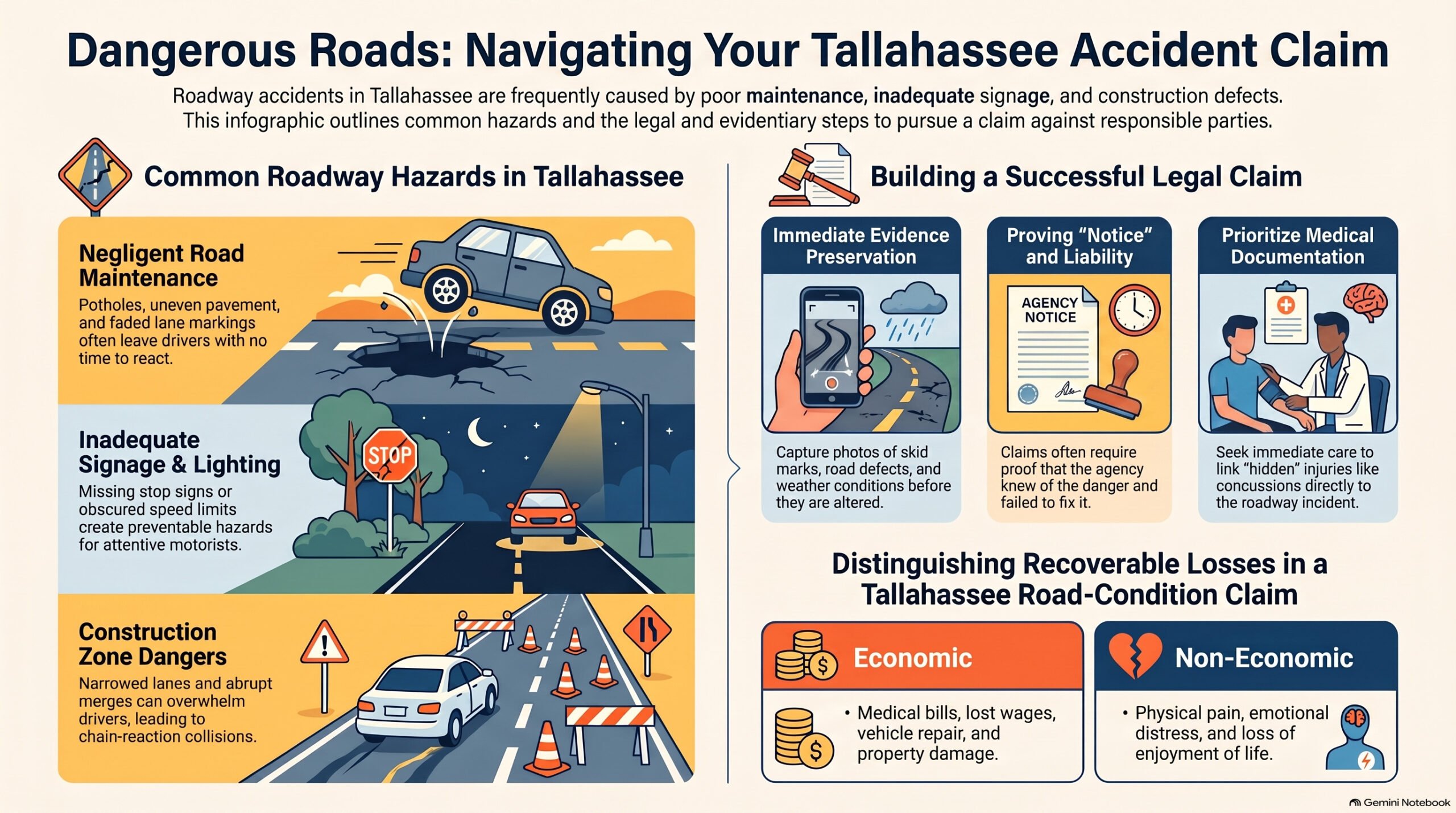
Hazards also increase in lane construction zones, where narrowed lanes, shifting traffic patterns, debris, and unclear signage leave little margin for error. Large trucks require greater space and time to respond safely, especially when road conditions change abruptly. When a crash occurs under these circumstances, careful investigation may determine whether negligent roadway maintenance, inadequate warnings, or unsafe work zone practices contributed to preventable harm for others.
Don’t Wait. Call Our Florida Personal Injury Lawyers Now!


Legal Rights of Tallahassee Truck Road & Highways Accident Injury Victims
Although truck collisions on Tallahassee roads and highways often involve complex liability issues, injured victims retain important legal rights under Florida law to seek compensation for medical expenses, lost income, pain and suffering, and other related damages. These protections also promote pedestrian safety and may apply in matters involving a Local bus crash where overlapping claims exist.
Florida law protects truck accident victims’ rights to pursue compensation, even when complex liability or overlapping bus crash claims are involved.
- Victims may pursue insurance claims against negligent drivers, trucking companies, or other liable parties.
- They may recover damages for present treatment, future care, rehabilitation costs, and diminished earning capacity.
- They have the right to preserve evidence, request crash reports, and seek legal guidance during negotiations.
- They may file a lawsuit within Florida’s statutory deadlines if fair settlement efforts fail.
Why Do Tallahassee Truck Road & Highways Accident Injuries Happen?
Truck accident injuries on Tallahassee roads and highways often result from a combination of driver error, regulatory violations, vehicle defects, and hazardous traffic conditions. Fatigue, distraction, speeding, and impaired judgment can reduce a truck driver’s ability to stop, navigate, or respond safely in heavy traffic. When carriers neglect maintenance or overload trailers, brake failures, tire blowouts, and cargo shifts become more likely.
Road design, severe weather, poor visibility, and congested interchanges also increase crash severity, especially because commercial trucks require greater stopping distance and create wider blind spots. These collisions frequently produce serious harm, including head trauma, fractures, and injuries that complicate Spinal injury recovery for individuals committed to caring for their families and communities. In many situations, pressure within the freight industry, unrealistic delivery schedules, and weak safety oversight contribute to preventable risks. Understanding these causes also helps explain why Insurance claim timelines may become more intricate after catastrophic trucking collisions.
What Should You Do After a Tallahassee Truck Road & Highways Accident Injury?
After a Tallahassee truck accident injury, prompt medical evaluation is crucial to identify injuries, protect health, and create an initial record of harm. The incident should also be reported to law enforcement and other appropriate parties, as an official report can support later insurance or legal claims. In addition, evidence and records, including photographs, witness statements, medical documents, and repair estimates, should be carefully preserved to strengthen the factual foundation of the case.
Seek Immediate Medical Care
Because injuries from a highway truck collision may not be immediately apparent, prompt medical evaluation is essential even when symptoms seem minor at the scene. Early assessment helps identify internal bleeding, concussions, spinal trauma, and soft tissue damage before complications worsen and burden loved ones who may be providing care.
Emergency responders or physicians can document symptoms, order imaging, and recommend treatment tailored to the person’s condition. Clear follow-up instructions should be observed carefully, including activity limits, Hydration needs, wound care, and a medication review to prevent harmful interactions or overlooked side effects. Immediate care also creates a reliable medical record that links the injury to the collision and can later support recovery planning. By seeking treatment without delay, injured individuals protect their health and preserve their ability to continue serving their families and communities.
Report The Truck Accident
When a collision occurs on a Tallahassee road or highway, the incident should be reported to law enforcement as soon as feasible. Prompt reporting helps emergency responders reach the scene, supports public safety, and creates an official police report describing the basic facts.
Those involved should provide accurate information to officers, answer questions carefully, and request instructions before leaving. If roadway conditions pose hazards to others, concerns should be communicated so that additional assistance can be arranged. A calm report can also help protect other drivers from further harm. If available, dashcam footage may be mentioned to officers so they know relevant material exists. Clear communication with law enforcement reflects responsible conduct and helps ensure the event receives appropriate attention, professionalism, and community care.
Preserve Evidence And Records
Once law enforcement has been notified and immediate safety concerns have been addressed, attention should turn to preserving evidence and records connected to the Tallahassee truck accident. Helpful actions may include photographing vehicle damage, roadway debris, skid marks, cargo conditions, visible injuries, and weather or lighting factors before conditions change. Witness names, contact information, medical evaluations, repair estimates, and towing or storage receipts should also be organized carefully for future reference.
Because commercial carriers control important materials, injured parties often need prompt legal assistance to request spoliation letters and preserve trucking company data. These records can include driver logs, electronic logging device downloads, maintenance files, inspection reports, dash camera footage, dispatch communications, and black box information. Preserving this evidence may strengthen accountability and support fair recovery for everyone affected.
Critical Evidence in a Tallahassee Truck Road & Highways Accident Injury Case
In a Tallahassee truck road and highways accident injury case, the strength of a claim often depends on whether essential evidence is identified, preserved, and interpreted promptly.
Important sources commonly include:
- Crash scene documentation
- Electronic logging data
- Driver qualification records
- Witness and camera evidence
Each category may help clarify how the collision occurred, whether safety rules were followed, and which party may bear legal responsibility.
Crash Scene Documentation
A carefully documented crash scene often provides the foundation for proving how a Tallahassee truck accident occurred and who bears legal responsibility. Photographs, measurements, debris patterns, gouge marks, vehicle positions, and road conditions can help investigators reconstruct events accurately and carefully. Such documentation may also clarify the truck’s pre-crash route and the weather impact at the time of collision.
Witness names, surveillance footage sources, damaged guardrails, skid marks, cargo spills, and nearby traffic controls can all preserve facts that later disappear. Prompt scene documentation serves injured people, their families, and the broader community by preserving the truth and supporting accountability. In serious truck cases, these details may reveal speeding, improper lane changes, unsafe following distance, visibility problems, or roadway hazards that contributed to preventable harm and losses.
Electronic Logging Data
Beyond physical marks left at the scene, electronic logging data can provide a precise record of a commercial truck’s movement, operating hours, and driver activity before a Tallahassee road or highway collision. These records may show speed patterns, rest breaks, route deviations, and possible hours-of-service violations that help clarify how the event developed. When preserved promptly, the information can support a careful effort to protect injured people and promote accountability for everyone sharing the road. Review of electronic logs often involves comparing onboard entries with dispatch records, fuel receipts, GPS history, and recent FMCSA compliance updates. Proper handling also requires attention to Data privacy policies, chain of custody, and accurate interpretation. In many cases, this digital evidence helps establish a reliable timeline when witness memories are limited or disputed later.
Driver Qualification Records
When a commercial truck collision occurs on a Tallahassee road or highway, driver qualification records often become a central source of evidence for evaluating whether the driver and motor carrier met federal safety standards before the crash. These files may include license status, medical certification, training records, prior crashes, drug and alcohol testing history, and Truck employment history. Careful review can reveal whether the carrier hired, retained, or supervised the driver with reasonable care and a genuine regard for public safety. Investigators may compare qualification materials with dispatch practices, personnel files, and maintenance violation records to identify larger safety failures within the company. In cases involving severe injury, these records help clarify whether preventable risks were ignored, and whether stronger hiring and oversight practices could have protected others sharing the roadway.
Witness And Camera Evidence
Independent witness accounts and camera footage often provide a direct factual record of how a Tallahassee truck collision unfolded on a road or highway, complementing the driver qualification evidence that addresses what the carrier knew before the event. These sources may confirm vehicle position, lane changes, speed, traffic signals, braking, and the sequence of impact. Nearby businesses, dash cameras, traffic systems, and bystanders can preserve important details that fade quickly from memory. Prompt collection matters because recordings are often deleted and witness recollections can change over time. Digital forensics may recover metadata, timestamps, and file histories that help verify authenticity. When reviewed alongside police reports, vehicle data, and insurance communications, this evidence can clarify disputed facts and support a fair evaluation of responsibility, damages, and the needs of those harmed.
Long-Term Effects of Tallahassee Truck Road & Highways Accident Injuries
Truck, road, and highway accidents in Tallahassee can have lasting consequences that extend well beyond the initial emergency response and medical treatment. These injuries often involve chronic pain challenges, reduced mobility, and permanent disability, all of which may alter a person’s ability to work and manage daily life. In many cases, the long-term impact also includes emotional trauma effects, which can influence mental health, personal relationships, and overall restoration.
Chronic Pain Challenges
A persistent pain condition can become one of the most disruptive long-term consequences of a Tallahassee truck accident, affecting far more than the initial physical injury. Lingering pain may interfere with concentration, sleep, relationships, and the ability to participate consistently in family, community, and service-oriented responsibilities.
Ongoing treatment often requires repeated appointments, therapy, and careful medication management. Medication side effects can create additional burdens, including fatigue, nausea, or impaired focus, which may complicate recovery and daily obligations. Chronic pain may also affect employment stability, making workplace accommodation an important consideration for those attempting to remain productive while rehabilitating. In many cases, the condition also carries emotional strain, as unrelenting discomfort can gradually erode resilience, patience, and a person’s capacity to serve others consistently and confidently.
Mobility And Disability
When a collision causes lasting damage to the spine, joints, nerves, or limbs, reduced mobility can become one of the most significant long-term effects of a Tallahassee truck accident. Survivors may face difficulty walking, standing, lifting, driving, or completing routine household tasks without assistance. In many cases, ongoing medical care includes physical rehabilitation, assistive devices, and coordinated support from family members or community providers. Practical adjustments may also be necessary to preserve independence and safety at home and in transit. These measures can include Accessible vehicle adaptations, wheelchair ramp planning, widened doorways, and modified bathing areas. For those committed to caring for others, understanding these limitations helps them provide respectful support, promote dignity, and recognize how mobility loss can affect employment, daily responsibilities, and long-term quality of life.
Emotional Trauma Effects
Beyond the visible physical harm, serious roadway collisions in Tallahassee can leave lasting emotional trauma that disrupts daily life long after initial treatment ends. Survivors may experience anxiety, depression, sleep disturbance, flashbacks, and fear of travel, all of which can strain family roles, work performance, and community involvement.
These effects may be intensified when injuries include a traumatic brain injury, because cognitive changes often deepen frustration, isolation, and loss of confidence. Caregivers and advocates who seek to support injured individuals should recognize that emotional recovery frequently requires counseling, structured treatment, and patient encouragement over time. In legal matters, documentation of psychological harm can also influence post-trauma compensation, helping secure resources for therapy, rehabilitation, and other services that restore stability, dignity, and long-term well-being for survivors.
Proving Liability in Tallahassee Truck Road & Highways Accident Injury Cases
Because liability in Tallahassee truck road and highway accident injury cases often turns on a detailed factual record, the analysis typically focuses on whether a driver, trucking company, maintenance provider, cargo loader, or another party failed to meet a legal duty of care. Evidence may include crash reports, driver logs, electronic data, inspection records, witness statements, and scene reconstruction.
A careful review often examines speeding, fatigue, distracted driving, improper loading, poor maintenance, and violations of safety rules. In cases involving truck company negligence, investigators may assess hiring practices, supervision, training, and compliance with state and federal regulations. Comparative fault assessment can also matter when several parties contributed to the collision or when the injured person’s conduct is disputed. For those committed to protecting others and strengthening community safety, proving liability serves a larger purpose. It helps identify preventable failures, promotes accountability, and supports fair legal outcomes grounded in reliable facts and responsible conduct for everyone involved.
Don’t Wait. Call Our Florida Personal Injury Lawyers Now!
Dealing With Insurance Companies After a Tallahassee Truck Road & Highways Accident Injury
After a Tallahassee truck road or highway accident injury, dealings with insurance companies often shape the progress and value of a claim. Insurers commonly request recorded statements, medical authorizations, and repair estimates soon after a collision. A careful, service-minded approach helps ensure accurate information and supports fair treatment for all parties involved.
Clear communication and organized records are crucial. Claim documentation tips include preserving photographs, invoices, medical reports, wage records, and correspondence with adjusters. Each contact should be dated and summarized to reduce confusion and prevent avoidable disputes. Injured individuals are often encouraged to avoid speculation about fault, injuries, or future recovery when speaking with insurers. Negotiating settlements generally requires a measured review of medical needs, lost income, and non-economic harm, rather than quick acceptance of an early offer. Thoughtful preparation promotes integrity, strengthens credibility, and helps ensure that insurance discussions reflect the full impact of the Tallahassee truck accident injury.
What to Expect During a Tallahassee Truck Road & Highways Accident Injury Claim Process
A Tallahassee truck road and highways accident injury claim typically begins with an initial examination of the facts, the damages involved, and the parties that may be responsible. From there, the process often centers on gathering evidence, determining liability, and maintaining clear medical treatment documentation to support the claimed injuries and losses. Many claims conclude through settlement negotiations, although some proceed to litigation when fault, damages, or insurance coverage remain contested.
Initial Claim Evaluation
When a Tallahassee truck accident injury claim begins, the initial evaluation typically focuses on whether the available facts support liability, causation, and measurable damages. During this stage, legal counsel generally reviews the incident timeline, medical treatment history, insurance information, and immediate financial effects on the injured person and household. Effective client communication is important because it helps clarify concerns, goals, and practical needs and promotes informed decision-making.
Careful document organization also plays a central role in this early assessment. Records such as medical bills, wage information, photographs, correspondence, and repair estimates are commonly gathered and arranged for efficient review. This process helps determine claim readiness, identify missing information, and establish a disciplined foundation for serving the injured individual with diligence, respect, and responsible guidance throughout.
Evidence And Liability
From that initial assessment, the claim process generally moves to evidence development and liability analysis, where the available proof is examined to determine how the truck collision occurred and who may be legally responsible.
This stage often includes reviewing police reports, witness statements, photographs, roadway conditions, electronic logging data, maintenance records, and post-accident documentation. Attorneys may evaluate whether the truck driver, motor carrier, cargo loader, maintenance provider, or another party failed to meet a duty of care. They may also compare statements against physical evidence to identify inconsistencies before they affect credibility. A careful liability review can strengthen negotiations and reduce the risk of insurance claim denial. For those committed to helping others recover fairly, this phase supports accountability, informed advocacy, and a more complete understanding of the collision’s underlying causes.
Medical Treatment Documentation
Because injury claims often turn on the connection between the collision and the reported harm, medical treatment documentation becomes a central part of the Tallahassee truck accident claim process. Emergency room notes, diagnostic imaging, physician referrals, and follow-up records help show when symptoms began and how care progressed.
Consistent treatment also supports credibility. Missed appointments, long gaps in care, or incomplete Pain medication logs may create questions about severity, need, or daily limitations. Organized records can also reduce Insurance claim delays by giving adjusters a clearer view of injury-related expenses and recovery needs. In some cases, Evidence photo timelines of bruising, swelling, mobility aids, and home modifications further support written charts. Thorough documentation enables advocates and caregivers to present accurate information while keeping the injured person’s service to family and community in view.
Settlement And Litigation
Although many Tallahassee truck accident injury claims resolve through settlement, the process often involves extended investigation, insurer review, and negotiation before compensation is offered. Evidence is gathered, damages are calculated, and parties assess medical records, wage loss, and future care needs.
When settlement efforts stall, litigation may become necessary to protect the injured person’s interests and encourage fair accountability. During suit, each side exchanges documents, takes depositions, and evaluates expert opinions about causation, safety practices, and long-term effects. Insurers commonly raise Negligence defenses and comparative fault arguments to reduce exposure. A structured legal approach helps clarify disputed facts, accurately measure losses, and support a resolution that serves the injured person, family stability, and broader community responsibility. Court schedules can also affect timing and expenses.
Compensation for Tallahassee Truck Road & Highways Accident Injury Damages
When a truck collision on Tallahassee roads or highways causes serious injury, the injured party may be entitled to pursue compensation for both immediate losses and long-term harm. In many cases, recovery depends on prompt medical evaluation, careful Insurance documentation, and a clear record of how the crash affected daily responsibilities, family support, and future care needs.
Compensation may be sought through negotiations with insurers or, when necessary, through formal legal action. A cash settlement may resolve a claim if it reasonably reflects the full extent of the injury and related burdens. However, evaluating any offer requires attention to medical recommendations, rehabilitation demands, and the likely duration of recovery. A thorough investigation can also identify all responsible parties, including drivers, trucking companies, maintenance providers, and others whose conduct contributed to the event. By approaching the claim with discipline and accuracy, injured individuals are better positioned to secure resources that support stability, treatment, and continued service to their households and communities.
Economic vs Non-Economic Damages in Tallahassee Truck Road & Highways Accident Cases
In Tallahassee truck road and highway accident cases, damages are generally divided into economic and non-economic categories, each addressing a different type of loss. Economic damages typically include measurable financial harm, such as medical expenses, lost income, and future care costs, while non-economic losses often relate to pain, suffering, and diminished quality of life. Establishing the value of either category requires clear evidence, credible documentation, and, in many cases, professional testimony to support the claimed amount.
Economic Damages Explained
Because truck crashes on Tallahassee roads and highways often create substantial financial strain, economic damages focus on the measurable monetary losses tied to the injury. These damages commonly include hospital bills, rehabilitation costs, medication expenses, lost wages, reduced earning capacity, property damage, and other out-of-pocket losses directly caused by the collision.
To establish these amounts, claimants typically rely on Medical proof, accident documentation, billing records, employment files, repair estimates, and expert evaluations. Careful records help demonstrate what has already been paid and what future care or income loss may reasonably require. In service-oriented communities, understanding economic damages can help families pursue resources needed for recovery while maintaining stability. A thorough presentation of documented losses also supports fair negotiations with insurers and strengthens the overall claim after a serious truck accident.
Non-Economic Losses Overview
Although economic damages cover bills and lost income, non-economic damages address the human consequences of a truck collision that do not have a fixed price tag. These losses may include pain, suffering, loss of enjoyment of life, mental anguish, and the strain serious injuries place on family relationships and daily service to others.
In Tallahassee truck road and highway accident cases, non-economic harm often reflects how deeply a person’s life has been altered after workplace negligence or other careless conduct. Emotional distress recovery may involve anxiety, sleep disruption, grief, embarrassment, or trauma associated with the crash and its aftermath. While these damages are less tangible than medical expenses, they remain important because they recognize dignity, personal well-being, and the broader impact an injury can have on meaningful participation in home, work, and community life.
Proving Damage Value
When a claim involves both measurable expenses and deeply personal harm, proving the value of damages requires credible evidence that connects the truck collision to the full scope of the injured person’s losses. Economic damages are commonly supported by bills, wage records, repair estimates, and expert testimony addressing future damages calculation. Non-economic damages, while less concrete, may be shown through treatment history, testimony from family members, and documentation describing pain, limitations, and changes in daily life. Medical causation proof is critical in both categories, because insurers often dispute whether the crash actually caused the claimed condition. In service-oriented representation, careful preparation helps present losses with honesty and dignity. A thorough damages presentation can strengthen settlement discussions and provide a clearer basis for fair compensation after a serious roadway collision.
When a Tallahassee Truck Road & Highways Accident Injury Case Goes to Trial vs Settlement
While many Tallahassee truck road and highway accident injury claims resolve through negotiated settlement, some proceed to trial when liability is disputed, damages are contested, or an insurer refuses to offer fair compensation. In these matters, counsel evaluates evidence, witness credibility, medical records, and future losses to determine whether settlement serves the injured person’s best interests and broader need for accountability.
A sound Negotiation strategy often seeks prompt recovery while reducing uncertainty, expense, and delay. Settlement may be appropriate when fault is clear, and the insurer meaningfully recognizes the full extent of harm. Trial preparation becomes necessary when crucial facts are denied, expert opinions conflict, or settlement offers remain inadequate. Preparing for court can strengthen bargaining positions because insurers may respond differently when a case is ready for verdict. Whether resolved privately or presented before a jury, the process should remain focused on truthful proof, fair compensation, and responsible outcomes that support restoration, stability, and community well-being.
Florida Laws That May Affect Your Tallahassee Truck Road & Highways Accident Case
Because truck accident claims are shaped by more than the facts of the collision itself, several Florida laws may materially influence how a Tallahassee road or highway injury case is investigated, valued, and resolved.
- Federal trucking rules may help determine whether a carrier or driver violated safety duties related to hours, inspections, loading, or maintenance.
- Evidence preservation obligations can affect access to black box data, driver logs, dash camera footage, and maintenance records before they are lost or overwritten.
- Florida’s comparative negligence may reduce compensation if an injured person is found partly at fault, making careful fact development especially important.
- Insurance claim deadlines and policy notice requirements may affect available coverage, settlement leverage, and a family’s ability to secure support for medical care and daily needs.
Applied together, these laws often shape liability arguments, damage calculations, and negotiations in ways that reward prompt, service-minded advocacy and careful documentation after a serious commercial truck collision.
Don’t Wait. Call Our Florida Personal Injury Lawyers Now!
The Statute of Limitations for Tallahassee Truck Road & Highways Accident Injury Cases
In Tallahassee truck road and highway accident injury cases, the statute of limitations sets a firm legal deadline for filing a lawsuit, and missing that deadline can bar recovery regardless of the claim’s underlying strength. Florida law generally allows only a limited period to commence a personal injury action, so timely attention helps preserve the ability to pursue accountability and meaningful relief.
Because truck crashes often involve multiple parties, records should be preserved early and reviewed carefully. Proof of negligence may depend on driver logs, maintenance files, electronic data, witness statements, and roadway reports. Evidence of damages, including medical records, lost income documentation, and rehabilitation costs, also becomes harder to collect as time passes. Certain circumstances may affect the filing deadline, but exceptions are narrow and fact-specific. For individuals focused on serving loved ones and their communities after a serious collision, respecting the statute of limitations helps preserve legal options and supports an orderly path toward recovery and responsibility.
How a Tallahassee Truck Road & Highways Accident Lawyer Can Help You
Once the filing deadline has been identified and protected, a Tallahassee truck road and highways accident lawyer can help by investigating the collision, preserving essential evidence, and building a claim that reflects the full scope of the harm suffered.
Counsel often organizes facts methodically, aligns losses with supporting records, and maintains a clear filing-claim timeline for every required step.
- Reviews crash reports, witness accounts, driver logs, and electronic data.
- Creates an Evidence preservation checklist to secure photos, maintenance files, and cargo records.
- Calculates medical costs, lost income, future care needs, and other damages.
- Negotiates with insurers and opposing parties, and prepares for litigation if needed.
This support can reduce confusion for families focused on mending and serving others. A lawyer may also coordinate with experts, identify liable parties, and present a thorough demand that reflects accountability, community safety, and the injured person’s long-term recovery and financial stability after a serious highway collision.
When to Contact a Tallahassee Truck Road & Highways Accident Lawyer
When a truck crash causes serious injury, disputed fault, or uncertainty about insurance coverage, prompt contact with a Tallahassee truck road and highways accident lawyer is often advisable. Early action can help protect the interests of injured people, families, and others affected by the collision. It may also support orderly communication with insurers, medical providers, and investigating agencies.
Contact is especially important when commercial vehicles, multiple parties, or significant property damage are involved. In such situations, Evidence preservation may become urgent because vehicle data, maintenance records, roadway conditions, and electronic logs can change or disappear. Prompt outreach may also help locate witness statements while memories are fresh and before witnesses become difficult to reach. A timely consultation can help a person understand filing deadlines, reporting obligations, and practical next steps after a disruptive event. Acting without unnecessary delay may better position those seeking accountability and recovery to make informed decisions that serve both immediate and long-term needs.
Why You Need an Experienced Tallahassee Truck Road & Highways Accident Lawyer
Because truck accidents on Tallahassee roads and highways often involve severe injuries, complex liability questions, and aggressive insurance responses, representation by an experienced lawyer can be pivotal to a well-supported claim. Such counsel helps preserve evidence, identify every potentially responsible party, and protect injured people from statements that may weaken recovery efforts.
An experienced attorney also develops an effective Insurance claim strategy based on medical records, crash reports, witness accounts, electronic logging data, and applicable trucking regulations. This approach supports fair valuation of losses, including treatment costs, lost income, future care, and diminished quality of life. In addition, legal guidance can reduce confusion around accident settlement timelines by managing communications, meeting deadlines, and responding to insurer tactics designed to limit payment. For families seeking stability after a devastating collision, experienced representation provides structure, accountability, and an informed path toward compensation that can support recovery, financial security, and continued service to others in need.
How to Choose the Right Tallahassee Truck Road & Highways Accident Lawyer for Your Case
In selecting the right Tallahassee truck road and highways accident lawyer, attention should center on experience with commercial truck litigation, familiarity with state and federal trucking regulations, and a record of handling claims involving serious injuries and disputed liability.
A careful review of credentials should include courtroom readiness, negotiation strength, and the ability to coordinate evidence from police reports, driver logs, black box data, and medical records. A practical Client consultation checklist may help families compare communication practices, case strategy, responsiveness, and the lawyer’s approach to protecting injured people and the wider community. Fee structure transparency is also crucial, since clear terms promote trust and allow clients to focus on recovery and service to loved ones. It is also wise to assess whether the lawyer can explain legal options plainly, meet deadlines consistently, and pursue fair compensation without unnecessary conflict. Thoughtful selection supports accountability, safety, and meaningful advocacy following a truck-highway collision.
About The Law Offices of Anidjar & Levine
Although every accident claim presents different facts, The Law Offices of Anidjar & Levine is recognized for representing injured people in Tallahassee with a focus on responsive client service and thorough case preparation.
The firm approaches truck, road and highway collision matters with careful investigation, clear communication, and disciplined advocacy intended to protect clients and their families.
Its attorneys and support staff work to identify liable parties, document losses, and pursue fair compensation through settlement or, when necessary, litigation.
Their practice emphasizes Evidence Preservation, a pivotal step in truck accident cases involving driver logs, black box data, inspection records, and roadway conditions.
The firm also applies this methodical approach to other injury matters, including Building Accident Claims, when dangerous property conditions cause harm.
By maintaining regular contact and offering practical guidance, The Law Offices of Anidjar & Levine seeks to ease administrative burdens so injured individuals can focus on recovery and continued service to others.
Frequently Asked Questions
Can I Recover Damages if I Was Partially at Fault?
Yes, damages may still be recoverable when a person was partially at fault. Under comparative negligence, liability is apportioned according to each party’s share of responsibility, which can allow partial recovery. For example, if losses total $100,000 and fault is assigned at 20 percent, recovery may be reduced to $80,000. A careful legal evaluation helps clarify fault allocation and supports fair compensation for all affected parties involved.
Are Commercial Trucking Companies Regulated Differently Than Private Truck Owners?
Yes. Commercial trucking companies are subject to broader regulation than private truck owners, because they must meet Federal compliance requirements, industry safety standards, and detailed state licensing rules. They are also expected to review driver background information, maintain records, inspect vehicles, and monitor hours of service. Private owners usually face fewer obligations. This distinction matters when determining responsibility, especially for those seeking to protect injured people and promote safer roads.
Can Black Box Data Be Recovered After a Truck Accident?
Yes, black box evidence can often be recovered after a truck accident, including GPS data, speed, braking, and engine activity. Recovery depends on the device’s condition, the truck model, and how promptly the data is preserved. Those assisting injured parties generally act promptly to prevent loss or overwriting. Professional retrieval and careful legal preservation help ensure the information remains available to support accountability, clarify events, and guide service to those affected.
Do Truck Accident Claims Involve Different Experts Than Car Accident Cases?
Yes, truck accident claims often require different experts than car accident cases. They may involve Crash Reconstruction experts, Vehicle Maintenance analysts, and professionals addressing Negligent Hiring and Expert Liability issues. Because commercial trucking is heavily regulated, these claims often demand broader technical review. A careful expert team helps clarify fault, protect injured parties, and support fair outcomes for those seeking to serve others through responsible legal action and public safety.
Can Weather Conditions Affect Liability in a Truck Highway Accident?
Yes, weather conditions can affect liability in a truck accident on a highway. Rain, fog, wind, or ice may alter road conditions and reduce visibility, but they do not automatically excuse negligent conduct. Liability issues often turn on whether the truck driver, carrier, or another party adjusted speed, maintenance, routing, and safety practices to protect others. A careful investigation helps determine whether reasonable precautions were taken under the circumstances present.
—————————
Truck road and highway accidents in Tallahassee can result in serious injuries, complex liability questions, and substantial financial consequences.
A thorough legal evaluation may help injured parties understand their rights, preserve critical evidence, and pursue appropriate compensation.
The Law Offices of Anidjar and Levine offer focused representation tailored to the circumstances of each claim.
With experienced legal guidance from a Tallahassee Personal Injury Lawyer, accident victims may be better prepared to address medical expenses, lost income, and the long-term effects of a collision.

