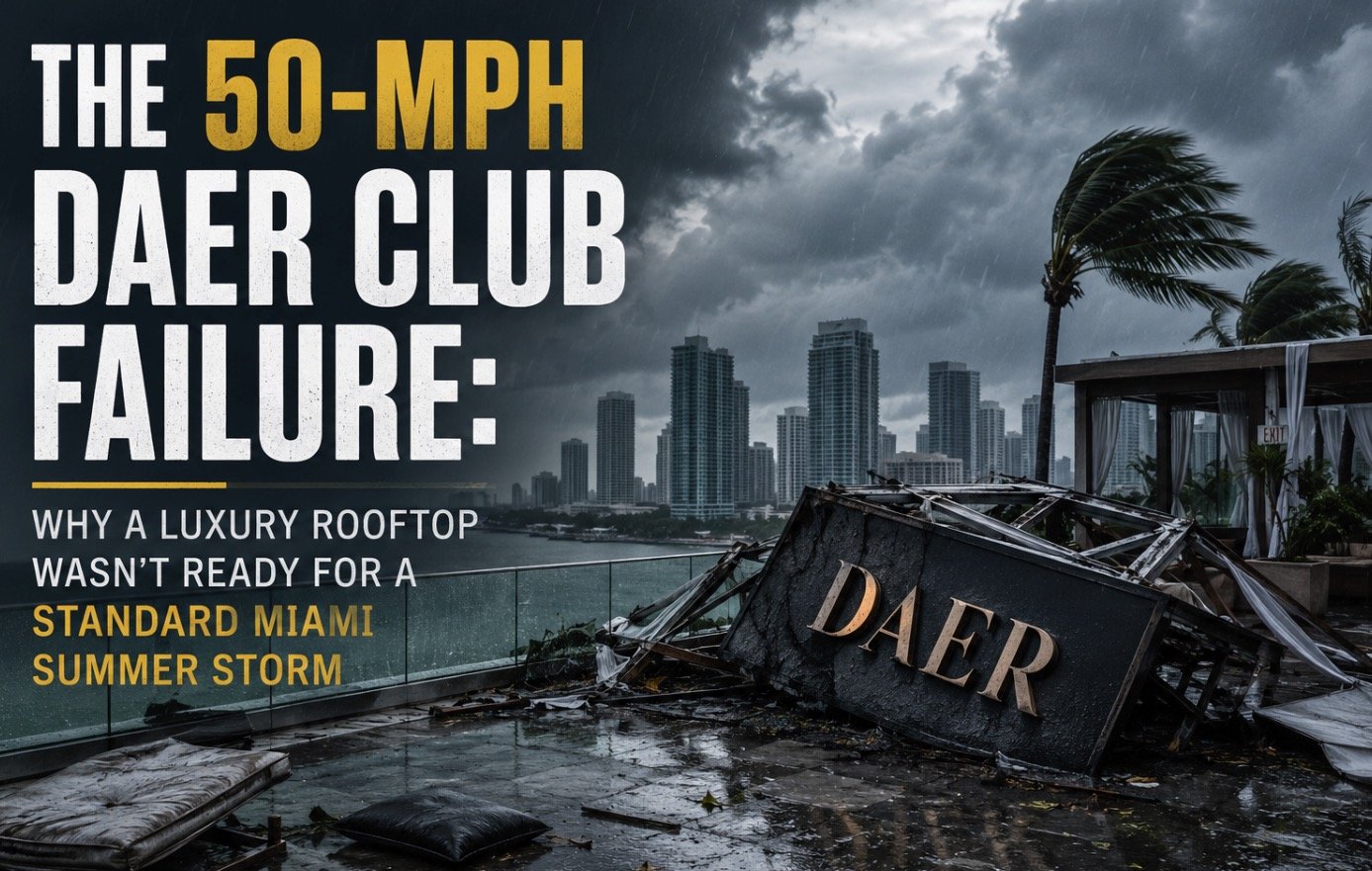
This is a structural safety analysis of the DAER Club collapse at Seminole Hard Rock Hotel & Casino
A high-energy Saturday evening at the Seminole Hard Rock Hotel & Casino’s DAER Club is typically the pinnacle of South Florida’s “high vibes.” In a venue that cost $1.5 billion to realize, guests expect a meticulously curated experience where the only thing more striking than the architecture is the sense of exclusive security. But as we saw this past weekend, even the most premium leisure environments can be humbled by complacency when the elements intervene.
Just after 7:00 p.m., the transition from sunset cocktails to chaos was instantaneous. What has since been labeled a “freak accident” was actually something far more sobering: a stark reminder of how quickly routine South Florida weather can turn a high-end sanctuary into a scene of structural failure. When a metal cabana frame is uprooted from a rooftop and sent plunging into a crowded pool area below, the thin line between luxury aesthetic and engineered safety becomes a matter of life and death.
Takeaway 1: The “Freak Accident” Threshold — Why 50 MPH Should Alarm You
The most unsettling revelation from this incident isn’t the storm itself. It’s the relatively low threshold at which the structure failed.
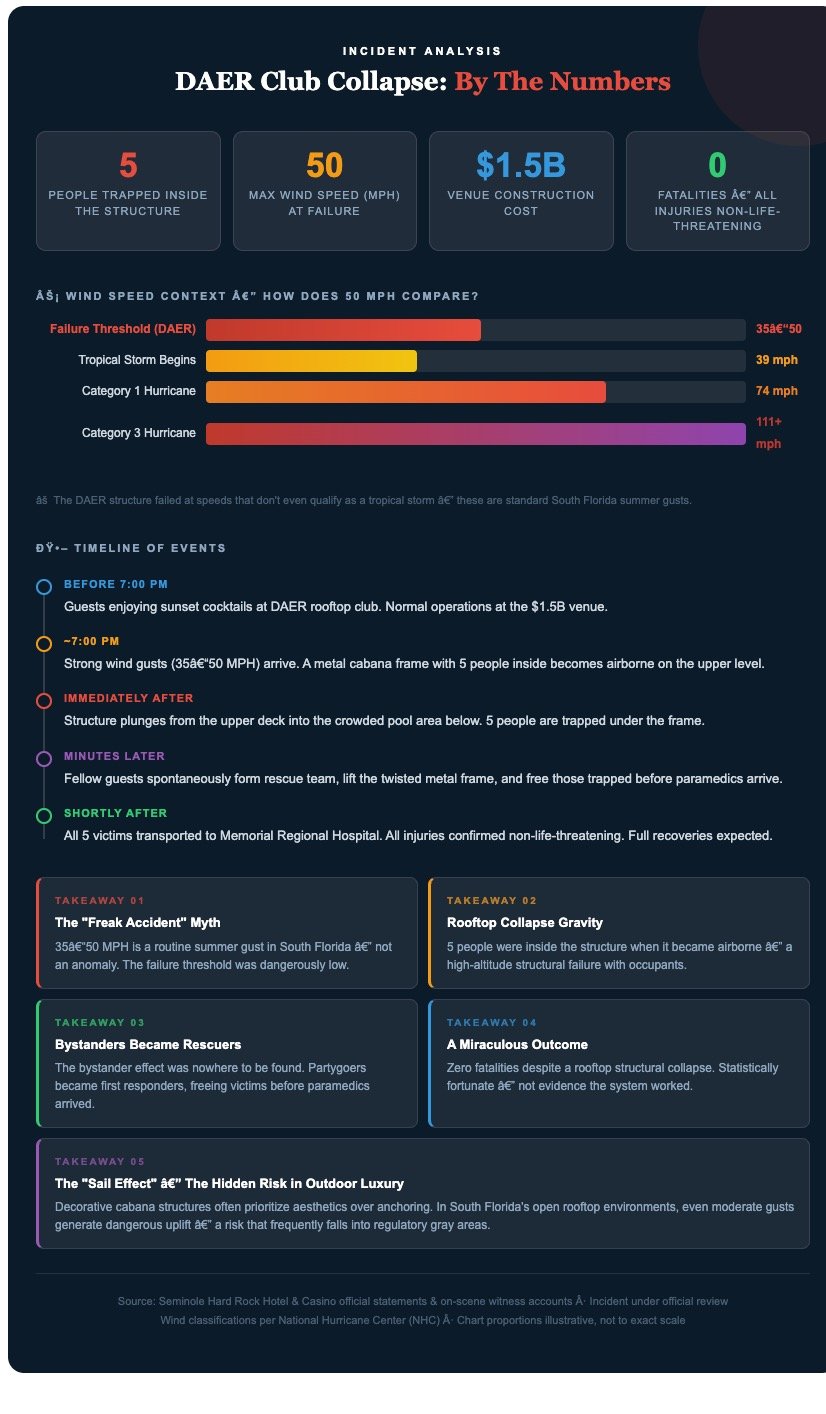
Officials estimated wind gusts between 35 and 50 miles per hour — speeds that don’t even reach the sustained strength of a tropical storm (which begins at 39 mph). In the context of South Florida, these are not hurricane-force winds. They are standard summer gusts. The kind of gusts locals barely flinch at.
“Wind gusts from the storm were estimated at 35 to 50 miles per hour.”
For a premier global destination like the Hard Rock, the fact that a routine thunderstorm could dislodge heavy metal frames from a rooftop venue suggests a serious failure in structural engineering or maintenance — or both. When a structure behaves more like a sail than a permanent fixture in ordinary weather, it raises an urgent question: Were these semi-permanent outdoor features ever truly engineered for the environments they inhabit?
The hospitality industry’s tendency to frame such events as “freak” or “wicked” weather is worth scrutinizing. It risks deflecting accountability onto nature rather than directing it where it belongs — toward the human decisions made in design, installation, inspection, and oversight.


Takeaway 2: The Gravity of a Rooftop Collapse
This was not a simple case of a poolside gazebo tipping over on a lawn. The mechanics of this failure were significantly more terrifying.
A metal cabana frame was caught by a gust of wind on an upper level of the outdoor club and sent plunging into the crowded pool area below. But the detail that elevates this from a property damage incident to a near-tragedy is this: five people were inside the structure when it became airborne.
“Hard Rock officials and witnesses tell us a series of strong wind gusts caused that structure to come down from an upper level above the pool area of the outdoor club. Five people were injured when that gazebo fell.”
This was a high-altitude structural failure with occupants. A leisure accessory became a falling cage. The physics of a weighted metal frame dropping from an upper rooftop level into a public gathering space represents precisely the worst-case safety scenario that venue risk managers are supposed to prevent.
The rooftop setting compounded every aspect of the danger — limited escape routes, elevated fall distance, and a densely populated landing zone. The fact that this happened in a venue regularly packed with hundreds of guests on a busy Saturday evening makes the outcome, by any statistical measure, extraordinarily lucky.
Takeaway 3: The “Bystander Effect” Inverted
In the immediate aftermath of the collapse, the atmosphere at DAER shifted from nightclub to rescue site — and something remarkable happened.
The so-called “bystander effect,” that well-documented psychological phenomenon where individuals in crowds fail to act during emergencies, was nowhere to be found. Instead, partygoers bypassed their own shock and panic to form an ad hoc rescue team within seconds.
Cell phone footage and eyewitness accounts captured the moment: guests rushing toward the wreckage, not away from it. People who had moments earlier been dancing or sipping cocktails dropped into action, working together to lift and shift the twisted metal frame to free those trapped beneath it.
These ordinary guests became the primary first responders. Before paramedics could reach the rooftop, fellow patrons had already begun triage. It also underscores a training gap worth addressing: most guests at a luxury rooftop club have no emergency preparedness training whatsoever. The fact that spontaneous coordination still saved lives is remarkable. Imagine the outcome with even a basic bystander response framework in place.
Takeaway 4: The Miraculous Scope of the Injuries
Given the physics involved — a metal structure falling from elevation with five people trapped inside — the medical outcome can only be described as fortunate.
All five victims were transported to Memorial Regional Hospital. Officials confirmed their injuries were non-life threatening, and all five are expected to recover fully.
This outcome deserves honest reflection. A rooftop collapse involving heavy metal components in a densely packed venue typically results in far greater damage. The “scary moments” described by witnesses aren’t hyperbole — they reflect the reality that the gap between what happened and what could have happened was closed almost entirely by luck and the rapid response of fellow guests.
From a liability and risk management perspective, that should offer no comfort to venue operators. A near-miss of this magnitude — one that required luck rather than system performance to avoid mass casualties — is not a success story. It is a warning. The five individuals who walked away from Memorial Regional Hospital are a testament to fortunate circumstances. They are not evidence that the system worked.


Takeaway 5: “Under Review” — The Hidden Risks of Outdoor Structures
The incident remains officially under review, with preliminary findings pointing to weather as the cause. But the “weather-related” designation, while factually accurate, risks becoming a conversational off-ramp, diverting attention from a deeper industry-wide problem.
In high-wind regions like South Florida, aesthetic outdoor structures — the open-air cabanas, shade frames, and decorative canopies that define the rooftop club aesthetic — often prioritize visual appeal over heavy-duty, engineered anchoring systems. They are designed to look effortlessly luxurious. They are not always designed to stay put in 50-mph gusts.
The technical mechanism at work is what structural engineers call the sail effect: when the combined surface area of fabric and framing catches wind like a sail, the uplift and lateral forces generated can exceed what standard anchoring can resist — especially if that anchoring has shifted, loosened, or degraded over time. In a rooftop environment with no surrounding windbreak, even moderate gusts pose a high risk.
The broader question for the hospitality industry: are these semi-permanent fixtures subject to the same rigorous inspection and load-rating standards as permanent structures? In many jurisdictions, the answer is no. Temporary and semi-permanent outdoor installations often fall into regulatory gray areas, leaving safety standards to the discretion of venue operators — a discretion not always exercised with the rigor that densely occupied public spaces demand.
Were You Injured at DAER Club? The Law Offices of Anidjar & Levine Can Help
The DAER Club incident is a sobering lesson for both high-end travelers and venue operators. In the subtropics, “wicked weather” isn’t an anomaly. It’s the baseline. Any venue built to serve guests in South Florida — especially an outdoor rooftop club — operates in a climatological environment where fast-moving thunderstorms, sudden wind shear, and rapid intensification of localized gusts are simply part of the seasonal landscape.
This event should prompt a meaningful shift in how we evaluate outdoor luxury. The velvet rope, the perfectly curated cabana, the rooftop vista — these are the products a guest purchases. But beneath the aesthetic, there is an implicit contract: this space has been engineered to keep you safe. When that contract goes unexamined, the result is a structure that appears to be a feature but functions as a hazard.
As storm season approaches and rooftop venues fill back up across South Florida, one question lingers: in our collective pursuit of the perfect open-air experience, have we grown too comfortable ignoring the raw, indifferent power of the very elements we’ve gathered to enjoy? The 50-mph gust doesn’t care about the aesthetics. It never did.
If you or someone you love was injured in the DAER Club cabana collapse or in any incident caused by a property owner’s failure to maintain a safe environment, you may be entitled to significant compensation. Incidents like this fall squarely under Florida’s premises liability laws, which hold venue operators accountable when their negligence results in guest injuries.
For over 20 years, The Law Offices of Anidjar & Levine have been Florida’s trusted voice for personal injury victims. Founded by Marc Anidjar and Glen Levine and headquartered in Fort Lauderdale, the firm has grown into one of the state’s most recognized personal injury practices.
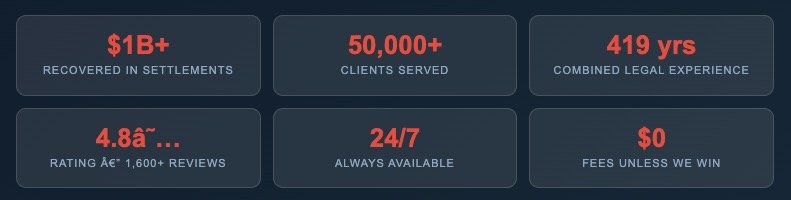
Their attorneys have secured over $20 million for a single family in Jacksonville and obtained one of the top ten settlements of the year in Florida for a Broward County family. With two board-certified civil trial lawyers on staff, insurance companies know from day one that Anidjar & Levine will take a case all the way to court if necessary.
Every client receives the personal cell phone numbers of founders Marc Anidjar and Glen Levine directly — because if you have a concern, they want to hear it firsthand. Offices span Florida from Fort Lauderdale, Miami, and West Palm Beach to Tampa, Orlando, Jacksonville, Fort Myers, and more. If you can’t come to them, they’ll come to you.
Consultations are always free, confidential, and available around the clock. You pay nothing unless we win your case.