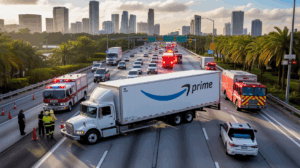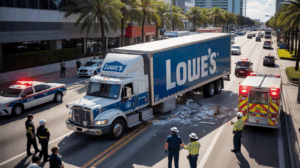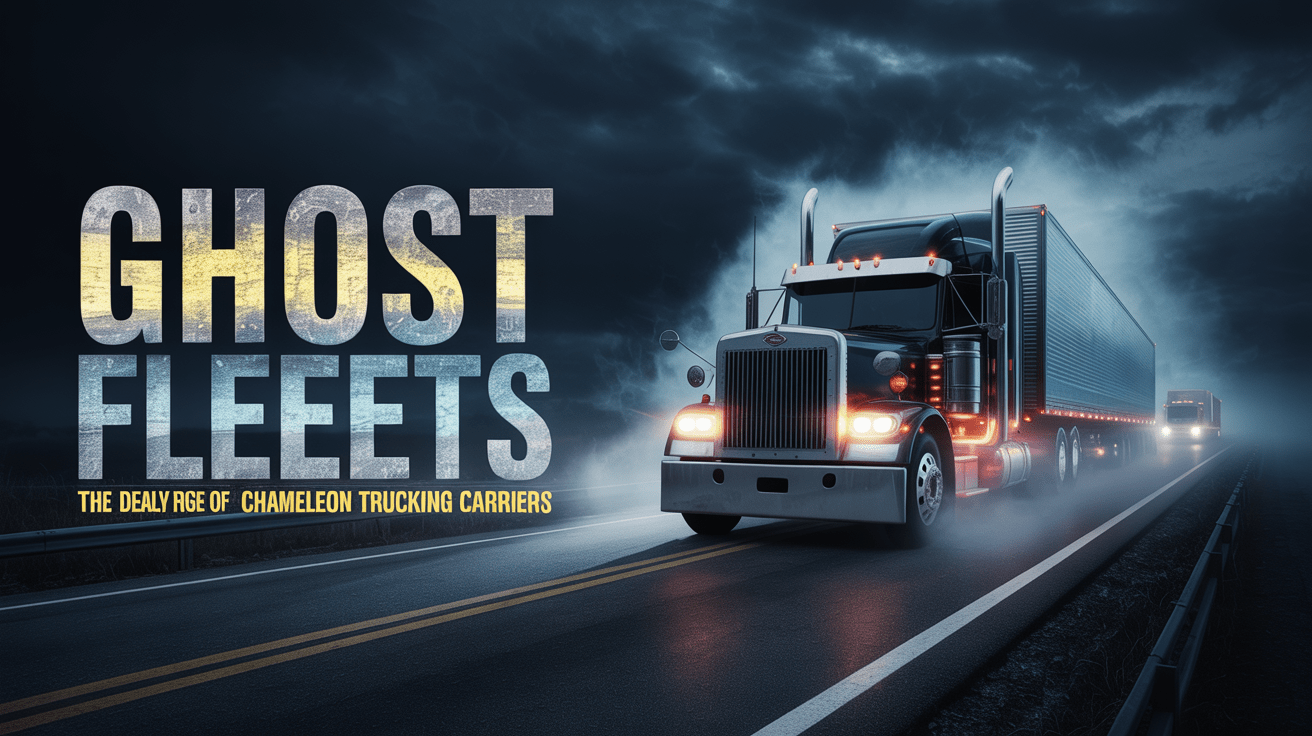
The trucking industry keeps America moving, but a growing body of reporting suggests that some carriers have learned to exploit the system meant to keep the public safe. They change names. They switch registration numbers. They reorganize on paper after serious crashes, safety violations, or out-of-service actions. Then they go right back to hauling freight. Investigators, regulators, and safety advocates call these operators chameleon carriers—and for families sharing the road with them, the consequences can be catastrophic.
Recent reporting by CBS News and 60 Minutes has brought unusual public attention to the issue. Their investigations depict a freight ecosystem in which certain carriers allegedly erase their histories by reincarnating under new identities, while some brokers continue to funnel loads to them. The picture that emerges is not merely one of reckless driving, but of a larger safety failure involving registration loopholes, weak vetting, thin oversight, and relentless commercial pressure. For injured victims, that matters. It means a devastating truck crash may involve far more than a single negligent driver.
For The Law Offices of Anidjar and Levine, this is exactly the kind of issue that deserves serious legal scrutiny. Chameleon trucking cases are not ordinary vehicle-collision claims. They can involve layered corporate structures, leased equipment, broker relationships, disputed authority records, manipulated logs, and attempts to obscure who really controlled the load, the truck, and the driver. When a victim is left with life-changing injuries, the central question is no longer just what happened on the highway. It becomes who put that danger there in the first place.
If you need help after a crash involving a ghost fleet, the Florida Truck Accident Lawyer at Law Offices of Anidjar and Levine may be able to assist.
Main Takeaways
- Ghost fleets are unsafe trucking companies that shut down and reappear under new names, USDOT numbers, or shell companies to escape scrutiny.
- These carriers often keep the same owners, drivers, trucks, phone numbers, and customers while presenting a falsely clean safety profile.
- Identity resets exploit FMCSA data gaps, delayed records, and weak matching systems that fail to connect new entities to past violations.
- Hidden histories can mask failed inspections, out-of-service orders, drug violations, falsified logs, poor maintenance, and exhausted drivers.
- The result is higher crash risk, weaker accountability, and preventable injuries or deaths for motorists, families, and communities.
What Is a Chameleon Carrier?
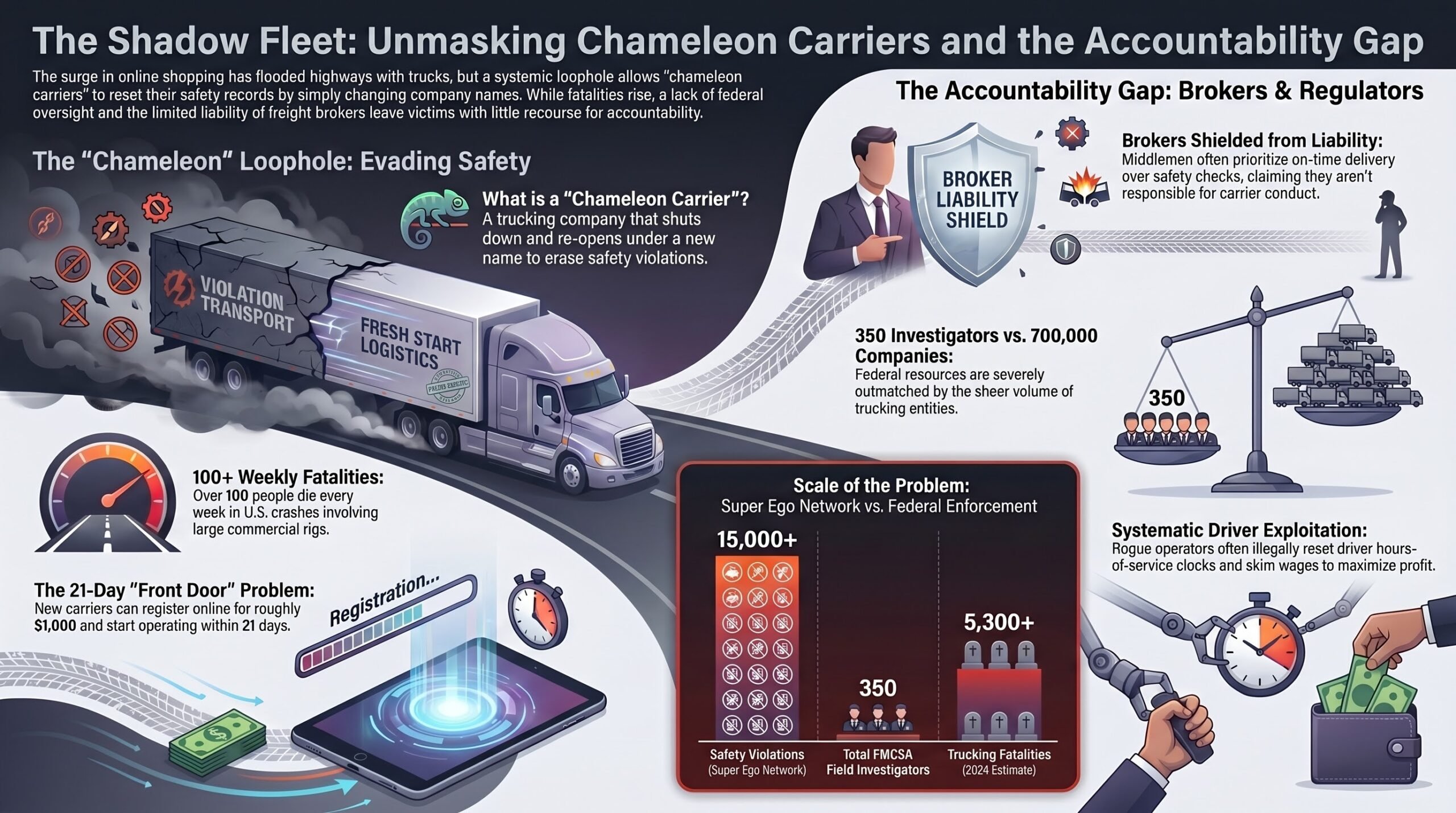
A chameleon carrier is generally understood to be a trucking company that sheds one business identity and adopts another to avoid the consequences of its own safety record. That may mean reappearing under a new company name, a new Department of Transportation number, or a slightly altered ownership structure, while continuing to use the same trucks, facilities, managers, or operating methods.
The concept is not just a media label. The Federal Motor Carrier Safety Administration has officially recognized the problem for years and has published a congressional report on risk-based vetting methods designed to identify chameleon carriers seeking operating authority. That matters because it confirms a crucial point: this is not an isolated loophole discovered yesterday. It is a long-running enforcement problem that federal regulators have understood for more than a decade.
The concern is obvious. Safety oversight depends on accurate identity. If a carrier can bury a trail of crashes, suspensions, unsafe maintenance records, or failed inspections simply by resurfacing under a new banner, then the regulatory system loses one of its most important tools: memory. And when the system forgets, the public pays the price.
60 Minutes and CBS News Stories
You can see the two videos we reference throughout this post here:
What Are “Ghost Fleets” in the Trucking Industry?
In trucking, “ghost fleets” are carrier networks that seem to disappear and reappear under new names, new USDOT numbers, or new corporate filings when regulators close in. When you hear that term, think of connected businesses masking the same people, trucks, and risks. These chameleon trucking companies don’t always appear linked on paper, yet they often operate like a single family of carriers.
That matters because you share the road with them, and your community bears the cost. Hidden trucking company ownership can make dangerous patterns harder to spot after inspections, lawsuits, or ghost fleet trucking accidents. A fleet may vanish, then return with a cleaner profile while the underlying safety culture stays the same.
For families, drivers, and advocates seeking accountability, that feels isolating, but you’re not alone in naming the problem. Ghost fleets are, at their core, unsafe trucking carriers using fresh identities to keep hauling freight while old warning signs fade from public view.


How Chameleon Carriers Evade Federal Safety Regulations
You can see how chameleon carriers rebrand to dodge oversight, swap registration numbers, and keep operating under a fresh identity. You’re often looking at the same risks behind a new company name, even after crashes, violations, or failed drug tests. Those loopholes in federal screening let unsafe operators stay on the road when they shouldn’t.
Rebranding To Dodge Oversight
Although federal regulators track carriers through registration numbers and safety scores, chameleon trucking companies keep slipping through by shutting down after crashes or violations, then reopening under new names and fresh USDOT numbers. You see how chameleon carriers exploit gaps, bury FMCSA safety violations, and sidestep truck safety regulation violations tied to high-risk motor carriers.
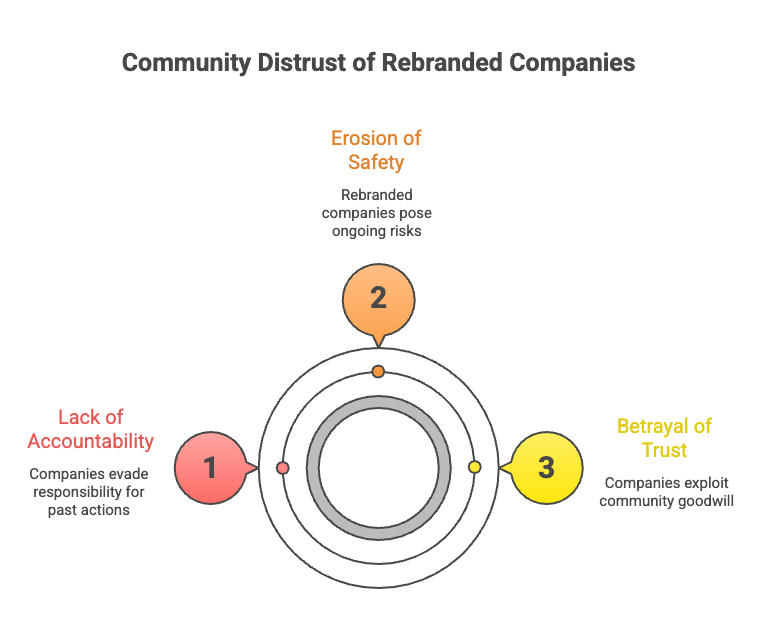
- You feel betrayed when a company with a deadly record simply changes its sign and asks your community to trust it again.
- You worry because families like yours share the road with firms that erase blame faster than regulators can connect the dots.
- You want accountability, yet these rebranded fleets keep blending back into the industry, stealing the sense of safety and belonging that every driver, shipper, and neighbor merits on America’s highways today.
New Numbers, Same Risks
When a trucking company racks up crashes, failed inspections, or drug violations, it can dodge scrutiny by applying for a new USDOT number and reappearing as a supposedly different carrier.
That reset doesn’t erase the danger you and your community face. These trucking company rebranding tactics let negligent trucking companies appear clean on paper while the same unsafe leaders, equipment, and practices remain in place. You earn roads where safety records mean something, not a shell game that rewards repeat offenders. By cycling through fresh identifiers, chameleon carriers weaken accountability and complicate liability for commercial truck accidents after a wreck.
Families, drivers, and honest carriers all lose when risky operators blend back into the industry crowd. Recognizing the pattern helps you stand with others demanding real transparency, so bad actors can’t keep changing names while the hazards remain exactly the same.
Loopholes In Federal Screening
That paper reset works because gaps in federal screening let chameleon carriers slip through with surprising ease. When a carrier changes its name, address, or ownership on paper, you’d expect alarms to sound. Too often, they don’t. Federal databases still struggle to connect old crash records, failed inspections, and drug violations to the new identity.
That leaves you, your family, and everyone sharing the highway exposed.
- You trust that someone checked the truck beside you.
- You assume a deadly safety history can’t just vanish.
- You want a system that protects your community, not paperwork tricks.
Chameleon carriers exploit delayed data, weak identity matching, and limited cross-checks between brokers and regulators. Until screening closes those loopholes, dangerous fleets can keep reentering the industry and threatening the people who belong on these roads.
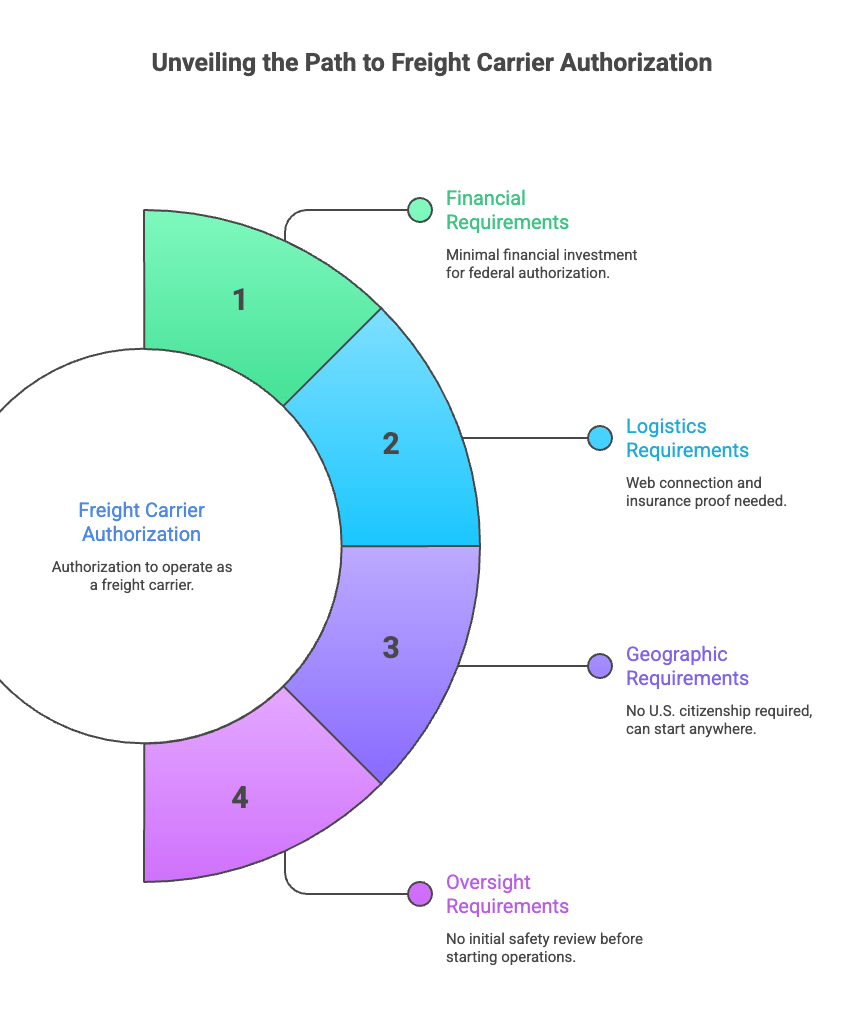
- Financial: As little as $300 to $1,000 for federal authorization.
- Logistics: A web connection and proof of minimal insurance.
- Geography: Can be started from anywhere in the world; no U.S. citizenship required.
- Oversight: Zero initial safety review is required before a company starts moving freight.
Why These Carriers Are So Dangerous
The danger of chameleon trucking is not abstract. It shows up in hard crash data and in horrifying real-world stories. According to the Insurance Institute for Highway Safety, 4,354 people died in large-truck crashes in 2023, and the majority of those killed were not inside the truck at all. Sixty-five percent were occupants of passenger vehicles, while another 17 percent were pedestrians, bicyclists, or motorcyclists.[5] In other words, when trucking safety fails, ordinary families in smaller vehicles often suffer the most severe harm.
The broader roadway environment is already dangerous enough. NHTSA reported that 39,254 people died in traffic crashes in 2024 across all vehicle categories.[6] Against that national backdrop, the rise of carriers allegedly gaming their identities should alarm anyone who drives on Florida highways, interstates, or local roads near freight corridors.
CBS News reported that the federal government approved more than 10,000 new trucking companies in the last five years that were run by the same officers or relatives, operated from the same facilities, or used the same trucks as defunct companies with serious safety histories. According to that investigation, those reconstituted carriers were four times more likely to be involved in severe crashes than companies that were not reincarnated. The same investigation said crashes involving such carriers killed at least 141 people and injured another 1,800 over that period.
Those numbers help explain why the phrase “ghost fleets” feels so accurate. On paper, one company disappears. In reality, the risk remains. The truck is still out there. The business model is still out there. The danger is still out there.
The Human Cost Behind the Headlines
The videos you asked us to analyze are powerful because they refuse to treat this issue as a technical compliance story. They put grieving families and injured survivors at the center.
In one CBS News report, journalists examine a Christmas Eve 2022 crash on I-75 near Cincinnati in which a tractor-trailer crossed the median and struck two vehicles, killing multiple members of the same family, including a pregnant woman. The report says the truck used a stolen federal registration number and that toxicology testing showed elevated cocaine and methamphetamine levels in the driver’s system. It also reports that the carrier involved in that crash had changed its identity multiple times following safety issues.
In another case highlighted in the reporting, a truck carrying freight for a major retailer struck a vehicle carrying Delilah Colman, leaving the child catastrophically injured. Her family’s story underscores a point truck-crash victims know too well: the emotional trauma does not end when the wreckage is cleared. It continues through surgeries, rehabilitation, financial strain, family disruption, and the painful realization that the crash may have been preventable.
The 60 Minutes investigation adds another layer by focusing on Super Ego Holding, a Serbia-linked network that the program described as part of a larger chameleon-carrier scheme under federal investigation. The report cites data indicating that Super Ego-connected carriers logged nearly 15,000 safety violations and 500 accidents over a two-year period. It also features drivers and a whistleblower who allege that company-affiliated managers pushed unsafe schedules, manipulated electronic logging systems, and participated in wage and contract abuses.
When people hear about trucking litigation, they sometimes imagine a simple negligence case against one driver who made one bad decision. These reports suggest the reality can be far more disturbing. Sometimes the danger appears systemic. Sometimes the crash is the visible endpoint of a business structure that rewarded speed, opacity, and plausible deniability long before impact.
The Alarming Rise of Unsafe Trucking Companies on U.S. Roads
As freight demand keeps rising, unsafe trucking companies are slipping onto U.S. roads by changing names, reopening under new registration numbers, and hiding records of crashes, violations, and failed drug tests. You might assume regulators or brokers would catch them, but many don’t. Instead, these carriers blend into the system, moving freight beside reputable fleets and making it harder for your community to know who’s operating responsibly.
You can see the pattern in how quickly some companies disappear, then return under fresh identities with the same people, same equipment, and same risky habits. That cycle lets troubled operators stay in business while honest carriers compete against rule breakers who cut costs through deception. When oversight can’t keep pace, unsafe companies gain ground across major routes, local roads, and delivery networks. That growth affects everyone connected to the supply chain, from drivers and warehouse teams to families who trust that the trucks around them meet basic standards and merit public confidence.
How the System Lets Chameleon Carriers Survive
One reason chameleon carriers persist is that it appears remarkably easy to form or reform a motor-carrier entity. The second video describes how networks can create U.S. trucking companies with relatively limited barriers, obtain the required paperwork, and emerge as ostensibly clean carriers even if the same people and equipment were associated with a troubled predecessor. CBS’s broader written investigation similarly found that regulators have often missed warning signs in their own data and that suspicious applicants sometimes reused identifying information so blatantly that the failures bordered on absurdity.
The problem is both scale and structure. The 60 Minutes report noted that the FMCSA had only about 350 investigators overseeing roughly 700,000 trucking companies at the time of the interview. Even as the agency moves to modernize its registration system, the imbalance is hard to ignore. A thinly staffed regulator cannot catch every bad actor, especially when they deliberately manipulate names, ownership records, or corporate affiliations.
That does not excuse the conduct. It simply explains why accountability often must come from multiple directions at once: regulatory enforcement, civil litigation, public exposure, and aggressive post-crash investigation by counsel who know what warning signs to look for.
Common Tactics Used by Chameleon Trucking Companies
To stay on the road after crashes, failed inspections, or drug violations, chameleon trucking companies often dissolve on paper and quickly reopen under a new name, new USDOT number, and sometimes a different listed owner. They use confusion as cover. When you look closer, you see the same trucks, the same managers, the same phone numbers, and sometimes the same unsafe habits moving freight through your community.
- They shuffle ownership among relatives, partners, or shell companies, making accountability feel just out of reach when families need answers most.
- They change addresses, emails, and dispatch contacts, so you can’t easily trace patterns or connect one troubled carrier to its old identity.
- They keep equipment, drivers, and customers in place, creating the illusion of a fresh start while the underlying risks stay beside you on the highway.
That betrayal cuts deep because your roads should unite communities, not expose neighbors, children, and workers to hidden danger every single day.
The Freight Broker Question: Who Helped Put the Truck on the Road?
One of the most consequential issues raised by the CBS reporting is whether freight brokers should be held liable when they allegedly hire or retain unsafe carriers. This matters because brokers occupy a powerful position in the supply chain. They often do not own the trucks, but they help decide which carriers haul the freight.[1] If they route loads to companies with glaring safety red flags—or if they fail to investigate suspicious carrier histories—their role may become central in a serious injury case.
That debate has now reached the U.S. Supreme Court. As summarized by Oyez, the pending case Montgomery v. Caribe Transport II, LLC asks whether federal law preempts a state common-law claim against a broker for negligently selecting a motor carrier or driver. The case involves C.H. Robinson Worldwide, Inc., which allegedly arranged the shipment in question. Whatever the Court ultimately decides, the very existence of the case confirms how significant this issue has become nationally.
For victims, the legal importance is enormous. In catastrophic truck crashes, the driver may have limited insurance, few assets, or an intentionally thin corporate employer. If the evidence shows a broker ignored serious safety indicators or helped keep a reincarnated carrier in business, that may reshape the scope of the case. A lawyer who stops at the driver’s may miss the deeper story. A lawyer who understands chameleon-carrier dynamics will ask whether other parties created, enabled, or profited from the danger.
Why Chameleon Trucking Cases Require a Different Kind of Investigation
A true chameleon-carrier case is rarely solved by a routine police report alone. The public narrative might identify one company name on the side of the trailer, but that name may not tell the whole truth. The real investigation often begins after the crash, when attorneys and experts start tracing the corporate web.
That means examining registration histories, prior operating authorities, inspection records, insurance filings, lease agreements, dispatch communications, maintenance records, ELD data, subcontracting chains, and broker-carrier contracts. It can mean comparing old and new DOT numbers, matching physical addresses, identifying common owners or relatives, and analyzing whether the same trucks or drivers were recycled into a supposedly new carrier. It can also require reviewing whether electronic logs were altered or whether loads were unlawfully reassigned to entities the broker did not properly vet.
The 60 Minutes reporting makes clear why this work matters. Drivers alleged that managers reset electronic driving-hour clocks and even instructed them to physically change names and DOT numbers on trucks using printed labels and duct tape. If those allegations are true, then critical evidence can disappear quickly unless counsel acts fast to preserve it. In a case like that, delay does not just weaken the claim. It may allow the truth to be buried under yet another corporate identity.
Why Ghost Fleets Pose a Serious Threat to Motorists
When you share the road with a ghost fleet, you can’t see the crashes, violations, and failed inspections hidden behind a new company name. That creates deadly oversight gaps, because unsafe carriers can keep hauling freight before regulators, brokers, and motorists catch up. As a result, you’re exposed to serious risks from trucks that look compliant on paper but carry a dangerous past.
Hidden Safety Histories
Although most drivers assume a truck’s federal registration reflects its true safety record, chameleon carriers exploit gaps in that system by shutting down, renaming themselves, and reappearing under new numbers that erase a trail of crashes, failed inspections, and drug violations from easy view.
That means you can share the road with a truck that looks legitimate while its most alarming history stays buried. Your family, neighbors, and fellow commuters merit better than a paperwork disguise.
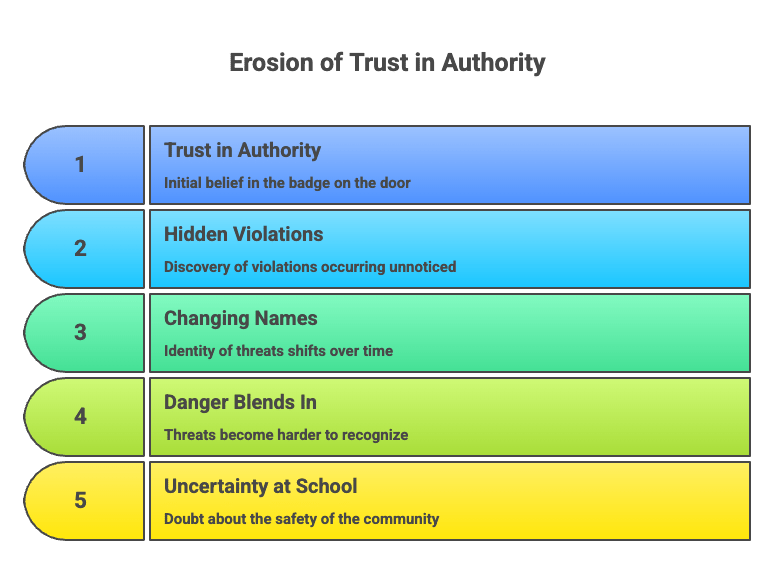
- You trust the badge on the door, but hidden violations can follow beside you at highway speed.
- You expect warnings to protect your community, yet names change, and danger blends in.
- You shouldn’t have to guess whether the truck near your child’s school has already left devastation behind elsewhere before.
Deadly Oversight Gaps
Because regulators and freight brokers still rely on fragmented records and inconsistent screening, ghost fleets can slip onto the road before anyone connects the dots between a “new” carrier and an old pattern of crashes, failed inspections, or falsified logs. That leaves you sharing highways with trucks that haven’t truly earned your trust.
| Oversight gap | Risk to you |
|---|---|
| New registration | Old dangers reappear |
| Weak broker vetting | Unsafe loads move fast |
| Missing data links | Crash patterns stay hidden |
| Log fraud | Exhausted drivers keep rolling |
When agencies miss aliases and brokers chase speed over scrutiny, ghost fleets keep operating. You merit a system that recognizes repeat offenders before another family joins this grief. Stronger screening, shared databases, and real accountability help protect everyone, so your community doesn’t face preventable loss on tomorrow’s roads alone.
Why Victims Should Not Wait to Get Legal Help if Involved in a Ghost Fleet Truck Accident
Truck-crash victims often assume the facts will sort themselves out. Unfortunately, the opposite is usually true. Companies begin protecting themselves immediately. Records can be moved, overwritten, or reframed. Insurers start evaluating exposure. Corporate defendants start defining the narrative before the injured person has even left the hospital.
That is why it is so important for injured victims and grieving families to speak with counsel that recognizes the warning signs of chameleon trucking from the outset. In a serious commercial-vehicle case, speed matters not just for filing deadlines, but for evidence preservation. Skid marks fade. Dash-cam footage disappears. Log data changes. Equipment gets repaired or redeployed. Corporate relationships get denied.
For a firm like The Law Offices of Anidjar and Levine, the value is not merely in filing a lawsuit. It is in asking smarter questions earlier.
- Was the carrier truly independent, or part of a broader network?
- Had the company recently changed names?
- Did the truck, trailer, or driver have a history tied to a prior entity?
- Did a broker ignore available safety red flags?
- Did multiple companies share the same address, ownership circle, or equipment?
- Did anyone benefit financially from keeping an unsafe operation on the road?
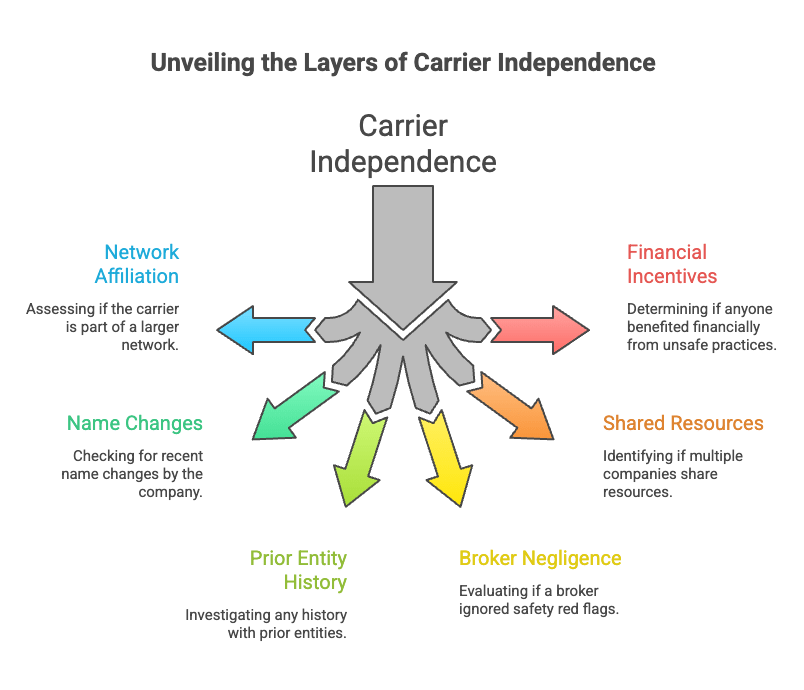
Those are the kinds of questions that can transform a case from a narrow collision claim into a full accountability case.
Who Can Be Held Liable in a Ghost Fleet Truck Accident Case?
If you’re hurt in a ghost fleet truck crash, you may have claims against more than just the driver. You can look at the carrier and broker, the shipper if it ignored clear safety risks, and the truck’s owner when their actions helped cause the wreck. You may also need to trace aliases and related companies to pierce the corporate veil and identify who’s really responsible.
Carrier And Broker Liability
Although a ghost fleet crash may appear to be the fault of a single truck driver, liability often extends far beyond the person behind the wheel. You may have claims against the carrier that hired, trained, supervised, or kept an unsafe driver on the road. You may also pursue the broker if it ignored warning signs, skipped safety checks, or continued giving loads to a company with a hidden record.
- You are owed answers when a carrier treats your family like collateral damage.
- You are owed accountability when a broker profits while unsafe trucks threaten your community.
- You are owed justice when companies hide behind new names to escape blame.
When you stand up, you join others demanding safer roads, honest screening, and responsibility from every company that helped cause the wreck.
Shipper Negligence Claims
Even though shippers often try to stay in the background, they can face liability if they helped put a dangerous ghost fleet truck on the road. If you were hurt, you may have a claim when a shipper ignored clear warning signs, hired an obviously unsafe carrier, or pushed impossible deadlines that encouraged corner-cutting.
You should look at what the shipper knew, what it should’ve checked, and whether its choices increased the risk to everyone sharing the road. A shipper may be negligent if it failed to review safety records, overlooked suspicious registration changes, or kept using a carrier with a pattern of violations.
That matters because accountability shouldn’t stop with the company whose name was on the trailer. When shippers help create the danger, you merit answers, support, and a path toward justice too.
Driver And Owner Responsibility
When a ghost fleet truck causes a crash, the driver and the truck’s owner often sit at the center of the case. You can hold the driver responsible for speeding, fatigue, distraction, impairment, or ignoring safety rules. You can also pursue the owner when poor maintenance, unsafe hiring, or knowingly allowing a dangerous truck on the road helped cause your injuries. In many cases, both share responsibility, and that matters because you merit answers, accountability, and a path forward.
- You shouldn’t carry the weight of someone else’s reckless choices alone.
- You merit to know who put that truck beside your family on the highway.
- You belong among people who demand safer roads and real consequences.
Together, these claims can help you seek justice and protect others in your community.
Corporate Veil And Aliases
Because ghost fleet companies often hide behind new names and fresh registration numbers, you may need to look past the logo on the truck to find everyone who shares legal responsibility. When one carrier dissolves and reappears, you can still trace owners, managers, insurers, brokers, and affiliated companies that kept the operation moving.
| Party | Why it matters |
|---|---|
| Owners/managers | They may control unsafe practices through aliases |
| Brokers/affiliates | They may ignore warning signs and keep loads flowing |
You don’t have to accept a paper maze as the final answer. Courts can pierce the corporate veil when shell companies exist to dodge safety rules, debts, or crash claims. That means your case may reach the people and businesses behind the badge swap. When you uncover the real network, you stand stronger—and you won’t be standing alone.
What Victims Should Do After a Crash Involving a Ghost Fleet
After a crash involving a ghost fleet, you should act fast to preserve photos, witness details, police reports, and other crash scene evidence. You’ll also need to identify hidden carrier links and request broker records before pivotal documents disappear or get buried behind new company names. Taking these steps early helps protect your legal rights and strengthens your claim.
Preserve Crash Scene Evidence
Start by locking down as much evidence as you can at the crash scene, since ghost fleets and chameleon carriers often change names, numbers, and records fast. Use your phone to photograph the truck, trailer, license plates, USDOT numbers, damage, skid marks, cargo, road conditions, and every angle of the scene. Record video if you can, and save the time and location.
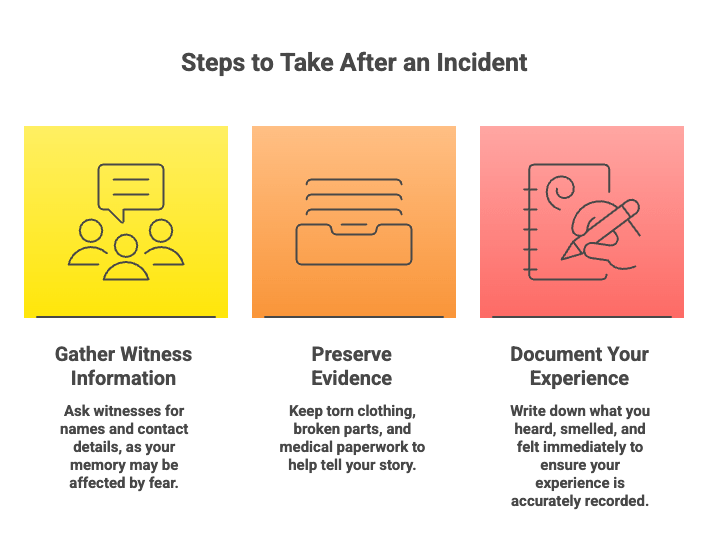
- Ask witnesses for names and contact details, because your memory may blur while the fear still shakes you.
- Keep torn clothing, broken parts, and medical paperwork, because those painful details help tell your story.
- Write down what you heard, smelled, and felt right away, because your experience matters and your community needs the truth.
You aren’t overreacting. You’re protecting yourself and standing with others who have been harmed by these dangerous carriers.
Identify Hidden Carrier Links
Once you’ve secured the scene, look past the logo on the truck and identify every company tied to that load, because ghost fleets often hide behind leased trailers, shell carriers, and changing USDOT or MC numbers.
You can photograph the cab, trailer, license plate, door markings, shipping labels, and any paperwork visible after the crash. Ask responding officers to note all business names, permit numbers, and ownership details in their report. If the driver speaks with you, listen for who employs them, who owns the trailer, and whose name appears on insurance cards or fuel receipts. Save screenshots of the carrier’s online profile before it changes. Compare names across FMCSA records, inspection histories, and public filings. When you map those links early, you strengthen your claim and help your community expose repeat offenders before they hurt someone else.
Request Broker Records
Demand the broker’s records quickly, because those files can reveal who actually arranged the load, what safety checks were done, and whether warning signs were ignored. When a ghost fleet is involved, those details help you connect the truck, the broker, and the people behind the paperwork.
You merit the full story, not a sanitized version.
- Ask for rate confirmations, carrier packets, emails, and dispatch notes, because they can expose rushed decisions and overlooked red flags.
- Request onboarding records and insurance documents, so you can see whether the broker trusted a carrier with a hidden past.
- Seek communication logs after the crash, since they may show blame shifting, quiet panic, or attempts to rewrite events.
You’re not alone in this process. Every record you request helps your community see how these dangerous networks operate.
Protect Your Legal Rights
Records can show how a ghost fleet got on the road, but protecting your legal rights also means acting quickly after the crash. Call 911, get medical care, photograph the truck, trailer, logos, plates, and paperwork, and gather witness names. Don’t trust quick calls from insurers or brokers. You merit support, answers, and a team that sees the whole picture.
| Moment | What you do | Why it matters |
|---|---|---|
| Roadside | Save photos, names, reports | Fleeting details can vanish |
| Hospital | Follow treatment, keep records | Injuries need proof |
| Afterward | Speak with a lawyer fast | Evidence can be hidden |
Ask for crash reports, dispatch records, electronic logs, and broker communications. When you act early, you help protect your claim and everyone else sharing the road with you.
What Accountability Should Look Like
Real accountability in chameleon trucking cases should operate on two levels. The first is compensation for the people whose lives were shattered. A family dealing with traumatic brain injury, spinal damage, wrongful death, or permanent disability should not bear the cost of a freight system that rewards risky conduct. Medical expenses, future care, lost income, diminished earning capacity, pain and suffering, and wrongful-death damages are not abstractions. They are the legal language for losses that are painfully real.
The second level is deterrence. Civil litigation cannot fix every weakness in the regulatory system, but it can expose patterns, compel production of documents, test corporate denials, and impose financial consequences when unsafe practices contribute to tragedy. In that sense, holding all responsible parties accountable does more than help one family. It pressures the industry to stop treating safety as a paperwork problem.
That is one reason this topic matters so much in Florida. The state’s highways carry enormous commercial traffic, from consumer goods to e-commerce freight to port-related shipments. Corridors such as I-95, I-75, the Florida Turnpike, and roads serving major ports and distribution hubs create constant interaction between passenger vehicles and heavy commercial rigs. The combination of dense traffic, heavy truck volume, and vulnerable passenger vehicles creates exactly the environment in which a hidden bad actor can do the most damage.
When a carrier becomes a ghost on paper but stays alive on the road, every family sedan beside it becomes part of the risk.
The Bottom Line for Injured Victims
The rise of chameleon carriers should change how people think about truck accidents. Some crashes are not just the result of one driver’s negligence in one terrible moment. Some are the foreseeable outcomes of a system that allowed unsafe carriers to keep resurfacing, keep hauling, and keep generating profit after clear warning signs.
That is why victims need more than sympathy. They need a law firm prepared to investigate the full chain of responsibility. The Law Offices of Anidjar and Levine can position itself as a serious advocate in this space because the firm’s role is not to repeat the headlines. It is to act on what the headlines reveal: that trucking cases may involve hidden corporate actors, disputed safety histories, and multiple layers of negligence.
If you or someone you love was injured in a truck accident, especially one involving questions about carrier identity, subcontracting, broker selection, or a company that seems to have appeared out of nowhere, do not assume the company on the door is the whole story. Get experienced legal help quickly. In a chameleon-trucking case, the truth may already be trying to disappear.
Ghost fleets put you and your family at risk by hiding dangerous safety histories behind new names and numbers. When a chameleon carrier causes a crash, you shouldn’t have to untangle that deception alone. With help from the Law Offices of Anidjar and Levine, you can hold negligent trucking companies, brokers, and other responsible parties accountable through the right legal support.
If you need a Florida Truck Accident Lawyer, acting quickly, preserving evidence, and knowing your rights gives you the best chance to recover compensation and help push unsafe carriers off the road for everyone’s protection.