

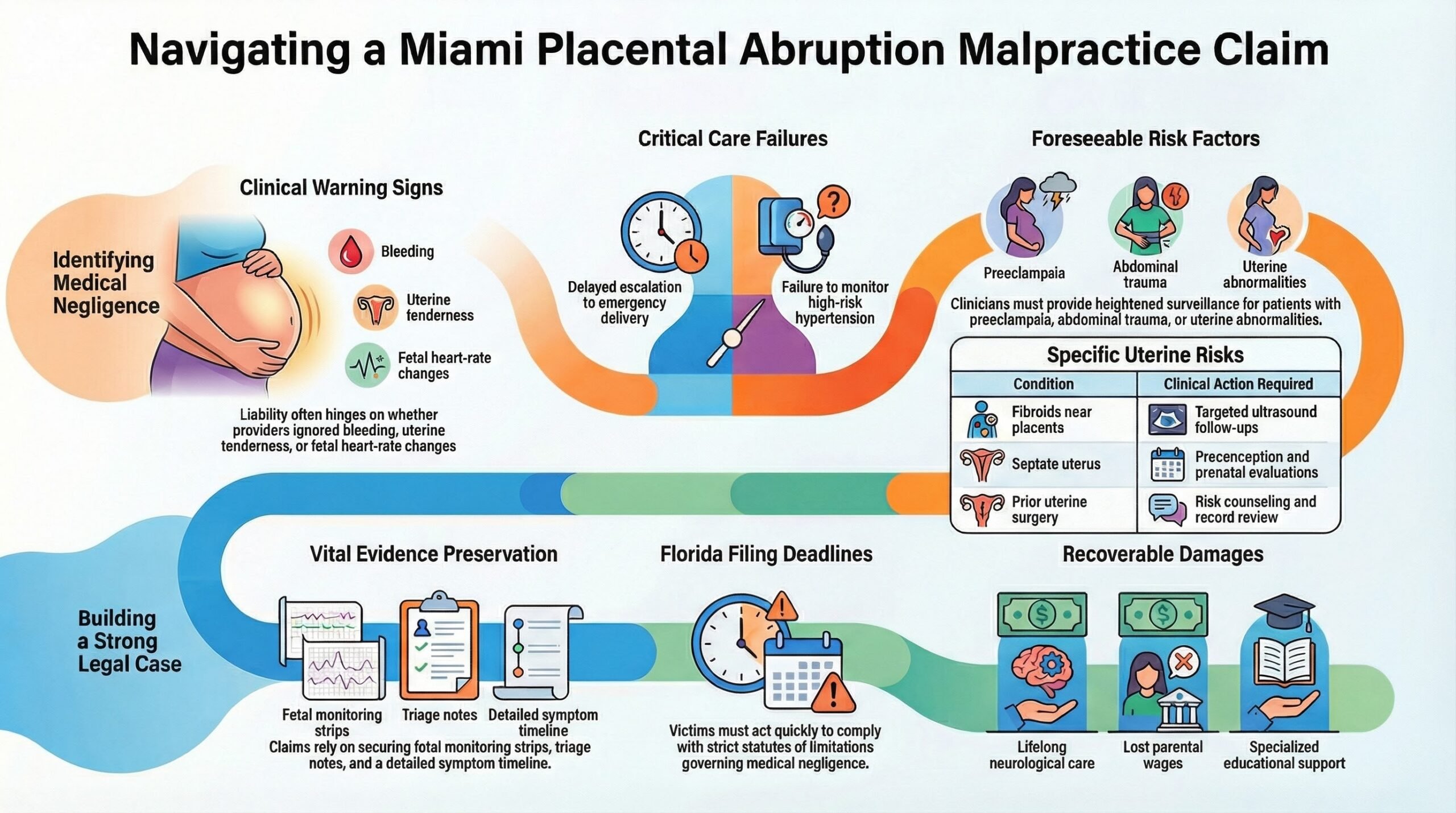
If you suspect a placental abruption injury in Miami, you need a lawyer who can move fast to secure prenatal records, triage notes, fetal monitoring strips, imaging, and operative reports before critical evidence disappears.
Law Offices of Anidjar and Levine can help build a clear timeline showing whether clinicians missed warning signs like bleeding, severe pain, uterine tenderness, or fetal heart changes, and whether they delayed escalation to emergency delivery.
You’ll also learn how Florida deadlines and damages may affect your options, including by speaking with a Miami Medical Malpractice Lawyer.
Main Takeaways
- Placental abruption cases hinge on whether clinicians promptly recognized bleeding, pain, uterine tenderness, and fetal heart-rate changes.
- Strong claims rely on a minute-by-minute timeline from triage notes, fetal monitoring strips, imaging, labs, nursing notes, and operative reports.
- Lawyers review protocol adherence: continuous monitoring, escalation to emergency delivery, anesthesia coordination, and readiness for transfusion and neonatal support.
- Risk factors like hypertension/preeclampsia, trauma, substance use, and uterine abnormalities help evaluate foreseeability and required preventive monitoring.
- Preserve evidence by saving discharge papers, imaging summaries, medication lists, and a symptom timeline, and request complete medical records quickly.


How We Can Help With Your Miami Placental Abruption Injury Claim
Although a placental abruption can unfold without warning, you still have options for holding negligent providers accountable and securing the resources your family needs.
Even when placental abruption strikes without warning, you may still pursue accountability and secure the resources your family needs.
You can rely on our team to investigate promptly, preserve records, and build a claim that reflects the full scope of harm.
You’ll receive clear guidance as you gather prenatal files, fetal monitoring strips, lab results, and hospital policies, while we identify where care deviated from accepted standards.
You can expect disciplined communication with insurers and defense counsel, and you’ll stay informed before any settlement decision.
When travel or recovery limits your availability, we’ll support Telehealth coordination so you can participate without added strain.
You’ll also receive help connecting to Financial counseling, so medical bills, wage loss, and future care planning remain organized.
You can focus on serving your family, while we pursue accountable outcomes.
OUR CONSULTATIONSARE FREE
START YOUR FREE CASE REVIEW

Understanding Miami Placental Abruption Injury Cases
When placental abruption occurs during pregnancy or labor, the outcome often turns on how quickly clinicians recognize the warning signs and act on them.
In Miami injury cases, you’ll usually examine whether the care team assessed symptoms promptly, monitored maternal and fetal status appropriately, and escalated to emergency delivery when risk became clear.
You’ll also look at how they documented bleeding, pain, uterine tenderness, and fetal heart changes, since gaps in records can signal delayed response.
To understand liability, you focus on whether providers followed accepted hospital protocols, used diagnostic imaging when clinically indicated, and coordinated timely consultation with obstetrics and anesthesia.
You may also evaluate whether staff communicated risks clearly, obtained informed consent, and implemented preventive measures such as appropriate triage, continuous monitoring, and readiness for transfusion or neonatal support.
Common Causes of Miami Placental Abruption Injuries
When you assess common causes of Miami placental abruption injuries, you’ll often see maternal hypertension and preeclampsia as leading risk factors that can strain placental attachment.
You also need to take into account abdominal trauma or falls, as well as substance use during pregnancy, because each can trigger sudden separation and rapid complications.
In addition, you can’t overlook uterine abnormalities and fibroids, which may disrupt normal implantation and increase the likelihood of abruption.
Maternal Hypertension And Preeclampsia
Because high blood pressure changes how blood flows through the uterus and placenta, maternal hypertension and preeclampsia remain leading contributors to placental abruption.
When your vessels constrict and the placenta receives less steady perfusion, small areas can separate, triggering bleeding and reduced oxygen for your baby.
You serve your family best by treating elevated pressure early and taking symptoms seriously, including severe headaches, visual changes, swelling, or upper abdominal pain.
Your clinician may monitor urine protein, platelet levels, and liver enzymes, and may use diagnostic biomarkers to assess worsening disease and fetal risk.
If you have a genetic predisposition or prior hypertensive pregnancy, you’ll likely need closer surveillance, medication adjustments, and a clear delivery plan that prioritizes safety for both patients you protect and love.
Abdominal Trauma Or Falls
Although many abruptions develop from medical conditions, direct abdominal trauma and falls remain common and preventable triggers in Miami placental abruption injury cases.
When you experience a vehicle collision, a workplace impact, or a slip on a wet surface, the uterus can shift suddenly, and the placenta may shear from the uterine wall.
These outcomes often reflect biomechanical impacts, including rapid deceleration, compression from an incorrectly worn seat belt, or blunt force to the abdomen.
You can reduce risk by practicing careful movement on stairs, requesting timely repairs for hazards, and using Protective gear where appropriate, such as properly positioned seat belts and job-specific supports.
If an incident occurs, you should seek immediate evaluation, document symptoms, and report unsafe conditions to protect others.
Substance Use During Pregnancy
Physical impacts like crashes and falls can trigger an abruption in an instant, yet substance use during pregnancy can raise the risk over time by stressing the placenta and constricting blood flow.
If you use tobacco, cocaine, methamphetamine, or misuse prescription drugs, you can intensify hypertension and inflammation, which may weaken placental attachment and increase bleeding.
Alcohol exposure can contribute to fetal alcohol complications, and drug exposure can lead to neonatal withdrawal, both of which may require urgent newborn care after delivery.
If you’re supporting a loved one, you can encourage early prenatal visits, honest screening, and evidence-based treatment, including medication-assisted care when appropriate.
You can also document counseling, referrals, and follow-up, helping clinicians intervene before warning signs escalate.
Uterine Abnormalities And Fibroids
When the uterus has structural differences, such as fibroids, a septum, or scarring from prior procedures, it can disrupt how the placenta implants and stays anchored as pregnancy progresses.
You may face a higher abruption risk when blood flow is uneven or the uterine wall can’t expand uniformly.
Your care team can assess Fertility Impact, then plan safer prenatal monitoring that supports both mother and baby.
| Concern | What you can do |
|---|---|
| Fibroids near the placenta | Request targeted ultrasound follow-ups |
| Septate uterus | Discuss preconception evaluation options |
| Prior uterine surgery | Share records, ask about risk counseling |
| Unclear symptoms | Ask about Imaging Techniques, including Doppler |


Legal Rights of Miami Placental Abruption Injury Victims
Because a placental abruption can escalate quickly and leave lasting harm, you still have legal rights in Miami if negligent prenatal care, delayed diagnosis, or mismanaged delivery contributed to the injury.
You can pursue accountability while honoring your commitment to protect your child and support others facing similar harm.
Florida law may allow recovery for medical costs, future care, lost income, and pain and suffering, and it also recognizes wrongful death damages when a preventable loss occurs.
Strong Privacy Protections can limit unnecessary disclosure of sensitive health information while your claim proceeds, and you can challenge unfair denials through an established Appeals Process.
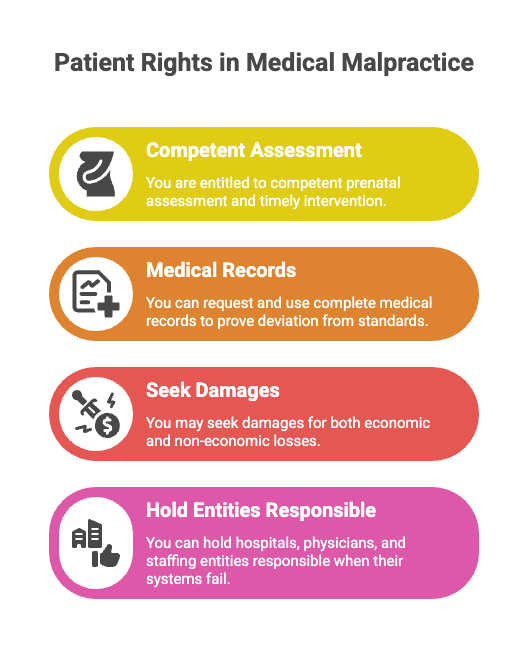
- You’re entitled to competent prenatal assessment and timely intervention.
- You can request and use complete medical records to prove deviation from standards.
- You may seek damages for both economic and non-economic losses.
- You can hold hospitals, physicians, and staffing entities responsible when their systems fail.
Steps to Take After a Miami Placental Abruption Injury
After a placental abruption injury in Miami, you must seek emergency medical care immediately, since prompt treatment can protect both your health and your baby’s outcome.
You should document your symptoms and all treatment, including discharge papers, test results, medications, and follow-up instructions, so you can establish a clear timeline of what occurred.
As soon as your condition is stable, you should contact a Miami lawyer, because early legal guidance helps preserve evidence and protect your rights.
Seek Emergency Medical Care
Although placental abruption can escalate rapidly, treat any warning signs as a medical emergency and seek immediate care.
Call 911 or go to the nearest emergency department if you have bleeding, severe abdominal pain, contractions, dizziness, or reduced fetal movement.
You serve your family best by acting decisively, not waiting for symptoms to pass.
When help arrives, communicate clearly so responders can set appropriate Triage Priorities, including maternal stability and fetal monitoring.
Follow medical direction and avoid driving yourself if you feel weak, lightheaded, or in pain.
Review Transport Options with dispatch or your provider, such as ambulance transport versus direct hospital arrival, and choose the safest, fastest route.
If you can, bring a support person to assist with childcare and coordination.
Document Symptoms And Treatment
Prompt medical care protects your health and your baby’s safety, but you should also start preserving a clear record of what happened while details remain fresh.
As soon as you’re able, write a Symptom timeline that notes when bleeding, abdominal pain, contractions, dizziness, or reduced fetal movement began, and how symptoms changed over hours.
Include times, severity, and any triggers such as lifting, trauma, or sudden stress.
Request and save copies of discharge papers, imaging summaries, fetal monitoring strips if provided, and lab results.
Keep Medication records that list drug names, doses, start and stop times, and any side effects you reported.
Document follow-up appointments, activity restrictions, and warning signs you were instructed to watch for.
This careful documentation helps you support safe, consistent care for your family.
Contact A Miami Lawyer
When should you contact a Miami lawyer following a placental abruption?
You should reach out as soon as your family’s immediate medical needs are stabilized, especially if you suspect delayed diagnosis, inadequate monitoring, or improper emergency response.
Early legal guidance helps you preserve records, identify critical timelines, and protect your ability to pursue accountability that can improve safety for other families.
You can call during Office Hours to discuss what happened, what documentation you’ve gathered, and what questions to ask your medical providers next.
If travel or recovery makes an in-person meeting difficult, request Virtual Consultations so you can act promptly without added strain.
You’ll also learn how notice requirements, insurance communications, and evidence preservation may affect your next steps.
How a Miami Placental Abruption Injury Lawyer Can Help You
If you suspect a placental abruption resulted from medical negligence, a Miami placental abruption injury lawyer can step in quickly to protect your rights and position your claim for success.
You’ll receive a focused case evaluation that clarifies what happened, what records matter, and which deadlines control your options, so you can act responsibly for your family and community.
Your lawyer can also promote fee transparency, explaining costs, contingency terms, and what you’ll owe only if the case resolves.
- Gather prenatal, labor, and delivery records, then identify missing documentation.
- Consult qualified experts, and connect findings to accepted standards of care.
- Communicate with insurers and providers to reduce pressure on you and your loved ones.
- Build a damage analysis and negotiate firmly, preparing for litigation when necessary.
With steady guidance, you can pursue accountability while keeping your attention on service and recovery.
Long-Term Effects of Miami Placental Abruption Injuries
When a placental abruption leads to oxygen loss, you may face lifelong neurological impairments that affect mobility, learning, and behavior.
You may also see chronic developmental delays emerge over time, requiring consistent monitoring and tailored educational support.
As these challenges persist, you’ll likely need ongoing medical care, including therapies, follow-up evaluations, and coordinated treatment plans to manage long-term outcomes.
Lifelong Neurological Impairments
Although placental abruption often presents as an acute obstetric emergency, it can also set in motion lifelong neurological impairments for a child, particularly after oxygen deprivation or significant blood loss in utero.
If your family serves a child with a brain injury, you may face ongoing motor dysfunction, impaired coordination, and persistent difficulties with Sensory Processing that affect daily care routines.
You’ll often coordinate neurologic evaluations, medication oversight, and therapy plans, while monitoring for complications that can intensify without consistent follow-through.
Seizure disorders may emerge or worsen, so Seizure Management becomes a central responsibility, requiring careful documentation of triggers, response times, and treatment effects.
As you advocate for stability and safety, you can also preserve records and timelines that clarify causation and support accountability when preventable lapses contributed to harm.
Chronic Developmental Delays
Because placental abruption can disrupt oxygen delivery during critical stages of fetal brain development, some children experience chronic developmental delays that persist long after the delivery crisis ends.
You may notice slower speech, attention, or motor progress, and you’ll likely need to advocate early, consistently, and with compassion for your child’s potential.
In school settings, you can request evaluations, secure educational accommodations, and coordinate goals that preserve dignity while building independence.
As your child grows, you can also plan transitional services that support vocational readiness, daily living skills, and community participation, so your family can serve others by modeling steady, informed perseverance.
| Moment | What you may see | What you can do |
|---|---|---|
| Preschool | missed milestones | document patterns |
| Elementary | learning gaps | request accommodations |
| Teens | future anxiety | plan transitional services |
Ongoing Medical Care Needs
Managing long-term medical care after a Miami placental abruption injury often means coordinating multiple care providers, monitoring for evolving symptoms, and budgeting for services that don’t end after discharge.
You may need regular pediatric, neurological, and therapy visits, and you’ll track progress to confirm each intervention still fits your child’s needs.
You can best serve your family by keeping records, requesting clear care plans, and requesting timely referrals.
Rehabilitation Planning helps you align occupational, physical, and speech therapies with measurable goals, while also preparing for equipment, home modifications, and respite support.
Medication Management requires consistent dosing, refill oversight, and careful observation for side effects, especially as your child grows.
If challenges arise, you should advocate for care coordination meetings to prevent gaps and reduce crises.
Proving Liability in Miami Placental Abruption Medical Malpractice Injury Cases
When a placental abruption leads to injury, proving liability in a Miami medical malpractice case hinges on showing that the care you received fell below the accepted standard and directly caused harm to you or your baby.
You do this by identifying what a careful obstetric team should’ve recognized, monitored, and treated, then comparing it to what actually occurred during prenatal care, labor, and delivery.
You’ll typically rely on Expert Testimony from qualified physicians who can explain warning signs, appropriate fetal surveillance, timely escalation, and when an emergency delivery is required.
A careful Timeline Reconstruction also matters, because minutes can change outcomes.
You can gather prenatal records, triage notes, fetal monitoring strips, imaging, nursing documentation, and operative reports to map symptoms, responses, and delays.
When you present a clear sequence of events, you help the court see how preventable choices or missed interventions contributed to injury, and you honor your family’s commitment to protecting others through accountability.
Compensation for Miami Placental Abruption Damages
Accountability often starts with a clear, well-documented damages claim. You’ll want to gather records that show how a placental abruption changed your family’s health, finances, and daily stability.
Compensation may include past and future medical costs for emergency care, NICU stays, medications, therapy, and long-term support services.
You can also pursue recovery for pain and suffering, loss of enjoyment of life, and the added burdens of caregiving when complications are severe.
You should document lost earnings with pay stubs, tax returns, employer statements, and proof of reduced hours or job changes.
When applicable, you can seek damages for diminished earning capacity and the value of necessary household assistance.
Your attorney can evaluate available insurance coverage, identify all responsible parties, and present a demand supported by expert reports.
By treating damage documentation as a service to your child’s future, you strengthen your case and protect vital resources.
The Statute of Limitations for Miami Placental Abruption Injury Cases
A well-supported damages package only protects your family if you can still bring the claim, and Florida’s filing deadlines can close that window sooner than you expect.
In Miami, the statute of limitations sets the time limit for filing, and missing it can end the case regardless of its validity.
You should identify the correct deadline early, because the timeframe may depend on whether the claim sounds in medical negligence, wrongful death, or another theory tied to prenatal and delivery care.
You also need to track notice requirements and related Filing Deadlines that can apply before a lawsuit begins.
Florida may allow limited extensions under the Discovery Rule, but courts apply it narrowly, and it rarely excuses delay when records, symptoms, or complications should’ve alerted you sooner.
To serve your child’s future and protect your household, preserve records, document timelines, and act promptly so procedural bars don’t erase accountability.
Why You Need an Experienced Miami Placental Abruption Injury Lawyer
Because placental abruption can progress quickly and leave limited time to interpret what went wrong, you need an experienced Miami placental abruption injury lawyer who can move fast, secure critical evidence, and frame the claim correctly from the start.
Placental abruption escalates fast—an experienced Miami lawyer must move quickly, preserve evidence, and frame the claim correctly from day one.
You’re not only seeking accountability for your own family, but you’re also helping protect future patients by insisting on safe obstetric care.
You’ll rely on counsel who understands how hospitals document fetal monitoring, triage decisions, and emergency interventions, then compares those records to accepted standards.
With Local knowledge, your lawyer can act promptly with Miami providers, obtain complete charts, and identify missing data before it disappears.
You also need Trial experience, because insurers often resist fair outcomes unless they face a credible courtroom threat.
Your lawyer should build damages carefully, coordinate qualified medical reviewers, and present a clear narrative that connects delays, omissions, or miscommunication to preventable harm.
How to Choose the Right Miami Placental Abruption Injury Lawyer for Your Case
When you’re evaluating attorneys after a suspected placental abruption injury, you should look past advertising and focus on credentials that predict results.
Confirm the lawyer regularly handles birth injury and obstetric negligence cases, and ask for examples of outcomes that reflect careful case development, not just quick settlements.
You’ll serve your family best by choosing counsel who respects the stakes, communicates clearly, and treats your child’s future as the priority.
Prepare targeted Interview Questions about medical record review, use of qualified experts, and how the firm proves causation and damages.
Ask who’ll manage day-to-day work, how often you’ll receive updates, and what decisions require your approval.
Demand Fee Transparency, including contingency percentages, litigation costs, and what happens if recovery isn’t obtained.
Finally, assess responsiveness and integrity during the consultation, because you’ll need steady guidance through demanding months, and focused advocacy in negotiations or trial.
About the Law Offices of Anidjar and Levine
Client-first advocacy defines the Law Offices of Anidjar and Levine, a Florida personal injury firm that represents families facing the aftermath of suspected placental abruption and other birth-related injuries.
You receive direct access to a team that prioritizes clear communication, careful case planning, and steady guidance through each stage of a claim.
You can expect prompt updates, practical timelines, and a focus on protecting your child’s future needs while respecting your family’s values.
The Firm’s history reflects a commitment to standing up for people who must manage intricate insurance and liability issues while caring for others.
You’ll see that approach in how the firm gathers records, consults qualified professionals, and presents evidence with discipline and precision.
Community outreach further reinforces this service mindset, as the firm supports local initiatives and treats every client relationship as a responsibility to the broader community you serve.
Frequently Asked Questions
What Does It Cost to Hire a Miami Placental Abruption Injury Lawyer?
You’ll often pay nothing upfront, because many attorneys use contingency fees, collecting only if you recover compensation.
You may still cover case costs, such as records, experts, and filing fees, and the firm should explain whether it advances them.
Some lawyers offer retainer agreements for limited services or unusual fee structures, so you’ll want a written breakdown.
Ask for the percentage, cost of handling, and appeal fees.
Will My Medical Records Stay Confidential During the Legal Process?
Yes, your medical records typically stay confidential, and you control when they’re shared.
Your attorney requests only relevant documents, applies patient privacy safeguards, and seeks protective orders when needed.
Courts and opposing parties must follow confidentiality rules, and they can’t access records without authorization or proper legal process.
You can also request record redaction to remove sensitive, unrelated details, supporting your case while respecting your duty to serve others.
How Long Does a Placental Abruption Lawsuit Usually Take to Resolve?
You can expect a placental abruption lawsuit to resolve in about 12–24 months, though more complex cases may take longer.
You’ll move faster when records and experts align, and when settlement timelines stay realistic during negotiations or mediation.
If the case goes to trial, scheduling and motions often add months.
When a verdict is challenged, the appeal timeframe may extend resolution by 6–18 months, depending on the court’s docket.
Can I Pursue a Claim if I Signed Hospital Consent Forms?
Yes, you can still pursue a claim even if you signed hospital consent forms.
Those forms don’t excuse negligent care, and they don’t replace true informed consent about material risks and alternatives.
If staff withheld crucial information, rushed your decision, or failed to honor consent revocation, you may have grounds.
You’ll serve others best by preserving records, noting timelines, and obtaining an independent medical review to assess preventable harm.
Do I Need to Attend Court, or Can My Lawyer Appear for Me?
You often don’t need to attend court, and your lawyer can appear for you at many hearings.
You’ll still need to participate when the judge requires your presence, such as for crucial testimony or settlement approval.
Your attorney may request Appearance waivers for routine proceedings, and courts sometimes allow Remote testimony when travel or health issues interfere.
You serve others best by staying available, promptly providing documents, and preparing carefully with counsel.
—————————
When placental abruption results from medical negligence, you don’t have to manage the aftermath alone.
You can protect your rights by preserving records, following medical guidance, and acting within Florida’s strict filing deadlines.
Law Offices of Anidjar and Levine can evaluate the incident, identify liable parties, and pursue compensation for medical costs, lost income, and long-term care needs.
If you’re ready to move forward, you can request a focused case review today with a Miami Medical Malpractice Lawyer.

