Were you hurt in a crash, fall, or someone else’s negligence anywhere in Miami-Dade? Florida’s 2-year deadline, the 51% fault bar, and the 14-day PIP window can quickly gut a case. Our Miami personal injury lawyers move quickly to protect you.
Main Takeaways From This Guide
Miami is one of Florida’s most densely populated and heavily visited cities. Between daily commutes on I-95 and the Palmetto, year-round tourism, a huge rideshare and delivery workforce, and a mix of permanent residents and short-term renters, Miami-Dade sees an enormous share of Florida’s personal injury claims each year. If you or a loved one was hurt because of someone else’s carelessness, Florida law gives you the right to seek money damages for your medical bills, lost wages, and pain and suffering.
That right has strict limits. Florida’s 2023 tort reform, HB 837, cut the deadline to file most negligence lawsuits from four years to two years, raised the comparative fault bar to 51%, and tightened several other rules that favor insurance companies. For motor vehicle claims, Florida’s Personal Injury Protection (PIP) system also demands that you start medical treatment within 14 days of the crash or lose no-fault benefits entirely.
This guide walks you through what a Miami personal injury case looks like, what to do and what to avoid, and how our firm handles everything from the first phone call with an adjuster to the final settlement check. For a free, confidential case review, call our Miami office at 305-384-6882 or our main line at 1-800-747-3733, 24 hours a day.
Legal Term Defined
What Is a Florida Negligence Claim?
A Florida personal injury claim is built on four parts, called the elements of negligence. First, the person who hurt you (the defendant) owed you a duty of care — the duty to act like a reasonable person would in the same situation. Second, the defendant breached that duty by acting carelessly, like running a red light, failing to clean up a spill, or not fixing a known hazard. Third, that breach caused the harm. Fourth, you suffered real damages, measured in medical bills, lost income, pain, and other losses.
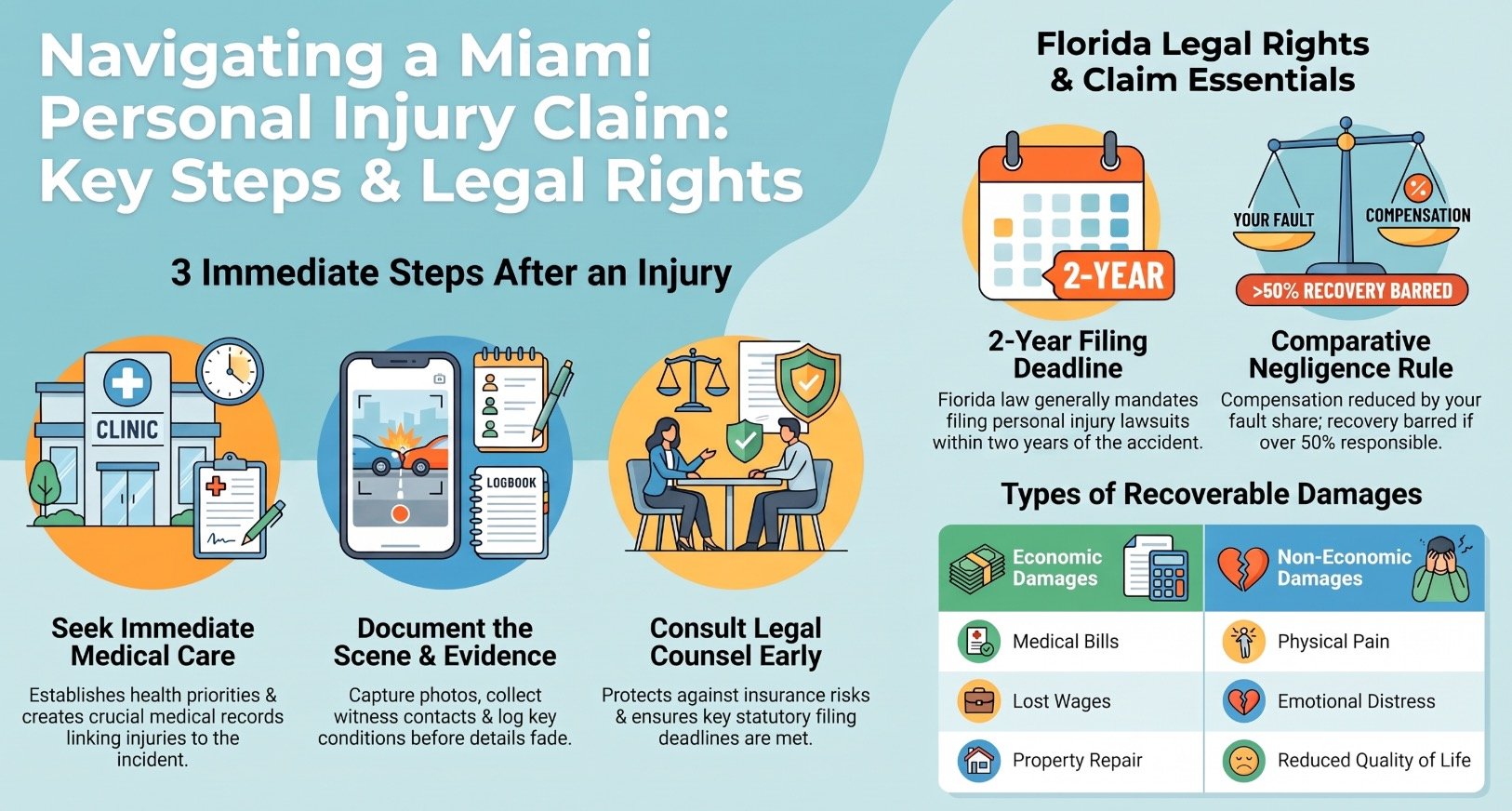
Under HB 837 (March 24, 2023), Florida uses modified comparative fault with a 51% bar. If a jury finds you 51% or more at fault, you recover nothing. If a jury finds you less than 51% at fault, your damages are reduced by your fault percentage. And you have only 2 years from the date of injury to file suit for most claims.
How We Can Help With Your Miami Personal Injury Claim
When you hire our firm, you do not have to deal with the insurance company alone. Our team handles every call, every letter, and every form. We know how Miami-Dade insurers operate; we know how fast they move to lock in low offers, and we know what evidence to gather before it disappears. From day one, our job is to level the playing field so you can focus on healing.
Our attorneys investigate the incident thoroughly. For motor vehicle crashes, that means pulling the Florida Traffic Crash Report, interviewing witnesses, and requesting Event Data Recorder (EDR) data from the vehicles. For Miami slip and fall cases, it means securing surveillance footage, incident reports, and maintenance records. For Miami medical malpractice cases, it means working with medical experts to review records and build the standard-of-care story.
We also work on a contingency fee basis. You pay nothing upfront and nothing out of pocket. We only get paid when we win your case through a settlement or verdict. If you want to talk with our team about your Miami injury, you can also contact us online at any time.
Understanding Miami Personal Injury Cases
A Miami personal injury case covers any claim where someone was hurt because of another person’s or company’s carelessness in Miami-Dade County. That includes car accidents, motorcycle crashes, commercial truck crashes, pedestrian hit-and-runs, bus accidents, slip and falls at hotels and restaurants, nursing home neglect, defective product injuries, and wrongful death.
Each category has its own rules and its own evidence timeline. A car crash case runs on Florida’s PIP system and the 14-day treatment deadline. A slip and fall case runs on Fla. Stat. §768.0755, which forces the injured person to prove the business knew about the hazard. A nursing home case runs on Chapter 400’s mandatory 75-day pre-suit period. Knowing which rules apply to your case is the first step toward a strong claim.
All of them share one thing: a tight clock. HB 837’s 2-year deadline applies across the board, and physical evidence like surveillance video, EDR data, and crash-scene debris can disappear within 24 to 72 hours. Fast legal action is the single most important thing an injured person can do.
Common Causes of Miami Personal Injury Claims
Motor vehicle crashes are the most common source of Miami personal injury claims. I-95, the Palmetto Expressway, SR-826, the Dolphin Expressway, and surface streets like Biscayne Boulevard, Brickell Avenue, and Flagler Street all see heavy daily crash volumes. The usual causes include distracted driving (texting, phone use, in-car screens), speeding, running red lights, impaired driving, and following too closely in stop-and-go traffic.
Slip, trip, and fall incidents are the next most common. Miami’s heavy retail, restaurant, hotel, and tourism footprint means lots of commercial premises where wet floors, uneven surfaces, poor lighting, and tracked-in rain water can cause serious falls. Hotel pool decks, grocery store aisles, mall food courts, and apartment stairwells all generate regular injury claims.
Rounding out the top causes are workplace injuries (especially in construction, hospitality, and transportation), medical malpractice from Miami-Dade’s large hospital network, defective product injuries, dog bites, and nursing home neglect. Each one has its own legal framework, and our firm handles all of them.
Legal Rights of Miami Personal Injury Victims
If you were hurt in Miami because of someone else’s carelessness, Florida law gives you several important rights. You have the right to seek money damages for your medical bills, lost wages, loss of future earning capacity, pain and suffering, mental anguish, scarring, and property damage. You have the right to file a claim with the responsible party’s insurance company. If that claim does not resolve the case fairly, you have the right to file a lawsuit and take your case to a Miami-Dade jury.
You have the right to hire an attorney. The attorney works for you, not for the insurance company. You have the right to refuse to give a recorded statement to the other side’s insurance adjuster. You have the right to refuse to sign a blanket medical release that gives the insurance company access to your entire medical history, including records unrelated to the incident.
You have the right to say no to any lowball settlement offer. Insurance companies count on injured people not knowing these rights. If a loved one died because of someone else’s negligence, close family members may have a Miami wrongful death claim for their own losses, including loss of support, loss of companionship, and funeral expenses.
Steps to Take After a Miami Personal Injury
The first step is to get medical care right away. For a car crash, that means seeing a doctor within the 14-day PIP window, or you lose Florida’s no-fault benefits entirely. For a slip and fall, nursing home injury, or any other type of personal injury, prompt medical care creates the paper trail that ties the injury to the incident. Follow every discharge instruction and go to every follow-up visit. Missed appointments are the easiest way for an adjuster to shrink your claim.
The second step is to document what happened. For a motor vehicle crash, that means calling 911, taking photos of both vehicles and the scene, and getting contact information from witnesses. For a slip and fall, report the incident to the manager, request a written incident report, and photograph the hazard, the surrounding area, and any warning signs (or the lack of them). For any injury, save your shoes, your clothing, and any physical evidence that could tell the story later.
The third step is to protect your rights. Do not give a recorded statement to any insurance company before talking with a lawyer. Do not sign a release, a waiver, or any settlement offer. Do not post about the incident on social media. Insurance companies search Facebook, Instagram, and other platforms looking for pictures and posts they can use to argue you are not really hurt. Keep your accounts private and let your attorney handle all communication.
How a Miami Personal Injury Lawyer Can Help You
A Miami personal injury lawyer handles every part of the legal process so you can focus on healing. The attorney investigates the incident, gathers records, interviews witnesses, and sends formal preservation letters (called spoliation letters) to protect physical and electronic evidence before it is lost. For serious cases, the lawyer may hire accident reconstructionists, medical experts, vocational experts, and economists to build the full picture of your injuries and losses.
The attorney also negotiates with every insurance company involved. For a car crash, that often means your own PIP carrier, the at-fault driver’s liability carrier, your health insurance company, and sometimes your own uninsured/underinsured motorist coverage. For a slip and fall, it means the premises owner’s commercial general liability carrier. Each policy has its own rules, limits, and procedures, and a lawyer who knows how to coordinate them often triples or quadruples what an injured person could recover on their own.
If the insurance company will not pay fairly, your lawyer files a lawsuit in the Miami-Dade County 11th Judicial Circuit. From there, the case moves through discovery, depositions, mediation, and if needed, trial. Our firm prepares every case as if it will go to trial, because that preparation often convinces the insurance company to settle at full value.
Event Data Recorder, Surveillance, and Medical Record Preservation in Miami Cases
In a Miami motor vehicle case, the Event Data Recorder (EDR) inside the other vehicle is often the single most powerful piece of evidence. Most cars and trucks built after 2012 have an EDR that records what the vehicle was doing in the seconds before, during, and after a crash. The data includes speed, braking, throttle position, steering input, and seat belt status. According to the National Highway Traffic Safety Administration (NHTSA), EDR data is admissible in court when a qualified specialist properly preserves and downloads it.
For slip and fall and premises liability cases, the key evidence is surveillance video and the business’s own records. Miami’s hotels, retail stores, restaurants, and office buildings run private camera systems that typically overwrite footage on a 24 to 72 hour cycle. Once that video is gone, it is gone forever. Written incident reports, maintenance logs, cleaning schedules, and employee statements all need to be preserved through formal spoliation letters.
For nursing home and medical malpractice cases, the critical evidence is in the medical records themselves. Facilities can amend charts after a serious injury or death, so preservation letters must reach the facility, its corporate parent, and any staffing agency immediately. Our firm sends those letters within hours of being retained, and we work with independent experts to review every record before the defense can clean it up.
Miami Personal Injury Claims — Key Data at a Glance
Miami-Dade County generates one of the largest shares of Florida’s personal injury claims each year. According to FLHSMV 2022 Florida Traffic Crash Facts, Florida reported 401,523 crashes, 3,535 deaths, and more than 253,888 injuries in a single year, with Miami-Dade accounting for roughly 60,000 of those crashes. Beyond motor vehicle crashes, CDC falls data show that falls are the leading cause of injury-related emergency department visits nationally, and Miami’s heavy retail and hospitality footprint generates thousands of fall claims every year.
Florida’s HB 837 reform, effective March 24, 2023, reshaped every Miami personal injury claim. The 2-year statute of limitations, the 51% zero-recovery fault bar, and Florida’s existing 14-day PIP treatment window stack on top of one another to create a tight legal timeline. Insurance companies know this and move fast. Physical evidence like EDR data, surveillance video, and incident reports can degrade within 24 to 72 hours.
The infographic below sums up the key data points every Miami injury victim should know, along with the most common insurer tactics used to deny or reduce legitimate claims.
Proving Liability in Miami Personal Injury Cases
Liability means legal fault. To prove liability under Florida law, your attorney must show the four elements of negligence: duty, breach, causation, and damages. In a car accident case, the duty of care comes from the rules of the road and the general obligation to drive carefully. In a slip and fall case, the duty flows from Fla. Stat. §768.0755 and traditional premises liability rules. In a medical malpractice case, the duty is defined by the professional standard of care in the relevant specialty.
Evidence of liability can come from many sources. For a crash, that includes the police report, witness statements, dash-cam footage, surveillance video, EDR data, and sometimes expert accident reconstruction. For a slip and fall, it includes incident reports, maintenance and cleaning logs, prior-incident records, surveillance video, and testimony from employees or witnesses. For a nursing home case, it includes medical records, staffing schedules, state inspection reports, and expert testimony from nursing and medical experts.
Insurance adjusters push back hard on liability. They argue that the injured person was partly at fault, that the hazard was “open and obvious,” or that the injury would have happened anyway. Under HB 837, if the jury puts more than half the fault on the injured person, the case ends with zero recovery. Building a clean liability story early is essential.
Dealing With Insurance Companies After a Miami Personal Injury
Insurance companies are not on your side. Even your own insurance company has one goal: pay as little as possible on every claim. Adjusters are trained, experienced, and well-resourced. The injured person is often in pain, stressed about bills, and unfamiliar with Florida’s complicated rules. That is an unfair fight, and the insurance company counts on it.
Here are three key mistakes to avoid. First, do not give a recorded statement to the other side’s insurance company before you talk with a lawyer. Adjusters ask questions in a specific order designed to lock in answers they can later use against you. Second, do not sign a blanket medical release. That form gives the insurance company access to your entire medical history, including records unrelated to the incident. Third, do not accept the first settlement offer. First offers are almost always a fraction of the real case value.
Your lawyer handles all contact with the insurance company. That means every phone call, every letter, and every request goes through counsel. The adjuster cannot call you directly once you are represented. This simple shift takes huge pressure off the injured person and almost always leads to a better outcome.
What to Expect During a Miami Personal Injury Claim Process
A Miami personal injury claim moves through several stages. The first is the investigation phase, where your attorney gathers evidence, interviews witnesses, pulls records, and preserves physical and electronic evidence. During this time, you continue medical treatment and keep every bill, prescription, and discharge instruction. This phase usually lasts from the day of the incident until your doctor says you have reached maximum medical improvement (MMI).
Next comes the demand and negotiation phase. Once your treatment is far enough along, your lawyer sends the insurance company a detailed demand letter laying out the facts, the law, your injuries, and the damages. The insurance company responds with a counter-offer, and negotiations often take weeks or months. Many cases settle in this phase without a lawsuit.
If negotiations fail, your lawyer files a lawsuit in Miami-Dade’s 11th Judicial Circuit. That begins the litigation phase: discovery, depositions, motions, mediation, and if needed, trial. Most personal injury cases settle before trial, but some do go to a jury. From start to finish, a Miami personal injury case can take anywhere from several months (for simple cases that settle quickly) to two or three years (for serious cases that go to trial).
Compensation for Miami Personal Injury Damages
Florida law allows injured people to recover several types of damages. These fall into two main groups: economic damages (real dollars you can add up) and non-economic damages (harm that is not tied to a receipt but is still very real). Economic damages include past and future medical bills, lost wages, loss of future earning capacity, out-of-pocket expenses, and property damage.
Non-economic damages cover pain and suffering, mental anguish, loss of enjoyment of life, scarring and disfigurement, and loss of consortium (the harm to a spouse’s relationship with the injured person). In Florida motor vehicle claims, non-economic damages for pain and suffering are only available if you meet the serious injury threshold, which generally requires a permanent injury, significant and permanent scarring, or death. That threshold does not apply to premises liability, nursing home, and medical malpractice claims.
In rare cases involving drunk driving, intentional misconduct, gross negligence, or elder abuse, Florida law also allows punitive damages. These are extra damages meant to punish reckless behavior and discourage others from doing the same. Punitive damages are capped under Florida law, but they can add significant value to a case involving egregious conduct.
Economic vs. Non-Economic Damages in Miami Personal Injury Cases
Economic damages are easier to prove because they come with paperwork. Every emergency room visit, surgery, physical therapy session, lost workday, and repair estimate generates a bill or record. Your lawyer gathers those documents and adds them up. Experts project future medical costs and lost wages based on your injuries, your age, and your career path.
Non-economic damages are harder to quantify, but they are not harder to prove. They just require different evidence. Photos of your injuries over time, a journal describing the daily impact of the incident, statements from friends and family, and testimony from mental health providers all build the non-economic damages picture. Insurance companies try to minimize these damages because they are harder to pin to a number, but a good lawyer knows how to present them clearly to a jury.
In most serious Miami cases, non-economic damages make up a large share of the total recovery. A victim who misses six months of work and faces lifelong chronic pain might have $200,000 in economic damages and $500,000 or more in non-economic damages, depending on the specific facts of the case.
When a Miami Personal Injury Case Goes to Trial vs. Settlement
Most Florida personal injury cases settle before trial. Trial is expensive, slow, and uncertain for both sides. The insurance company does not want a Miami-Dade jury to decide how much your case is worth, especially if liability is clear and your injuries are serious. Your lawyer uses that pressure to negotiate a fair settlement without going all the way to court.
But some cases do go to trial. Cases where the insurance company refuses to make a reasonable offer, where liability is sharply disputed, or where the damages are so large that the carrier wants to minimize payment all have a higher chance of going before a jury. Our firm prepares every case as if it will go to trial. That preparation often convinces the insurance company to settle at full value, and when it does not, we are ready.
If your case does go to trial, the process can take several days to several weeks. A jury of six Miami-Dade residents hears the evidence from both sides and decides fault and damages. The judge then enters judgment based on the verdict. Trial is a serious step, but when the insurance company refuses to pay fairly, it is sometimes the only path to full recovery.
Long-Term Effects of Miami Personal Injuries
Serious personal injuries can affect a person for years, or for the rest of their life. Traumatic brain injuries (TBIs) can cause changes in memory, mood, and personality that may never fully go away. Spinal cord injuries can lead to permanent weakness, chronic pain, or paralysis. Multiple fractures, especially crush fractures, can leave a victim with lifelong mobility problems and recurring surgeries. Pressure ulcers from nursing home neglect can cause infections, hospitalizations, and even death.
Beyond the physical injuries, survivors of serious incidents often struggle with mental health effects. Post-traumatic stress disorder, anxiety, depression, sleep problems, and fear of returning to the location of the injury are all common. Florida law recognizes these effects as real injuries, and they are compensable. Documentation from a licensed mental health provider is critical to building a non-economic damages claim.
Economic effects can be just as serious. A permanent injury that forces a victim to leave their career or take a lower-paying job can cost hundreds of thousands or even millions of dollars in lost earning capacity. Your lawyer works with vocational experts and economists to project those future losses so the settlement or verdict covers them.
Florida PIP and the Serious Injury Threshold
Florida’s Personal Injury Protection (PIP) law applies to every motor vehicle accident in Miami. Under Fla. Stat. §627.736, most drivers must carry at least $10,000 in PIP coverage. PIP pays 80% of medical bills and 60% of lost wages regardless of who caused the crash. But PIP only applies if you receive initial medical treatment within 14 days. Miss that deadline and PIP benefits are lost entirely.
To sue the at-fault driver for pain and suffering (not just economic losses), Florida requires you to cross the serious injury threshold. That means proving at least one of the following: significant and permanent loss of an important bodily function, permanent injury within a reasonable degree of medical probability, significant and permanent scarring or disfigurement, or death. Soft-tissue injuries sometimes qualify, but it takes careful medical documentation.
Not every Miami personal injury case runs through PIP. Slip-and-fall, nursing home, medical malpractice, and premises liability cases are not governed by the no-fault system. In those cases, the injured person pursues the at-fault party’s commercial general liability or professional liability policy directly, and the serious injury threshold does not apply.
The Statute of Limitations for Miami Personal Injury Cases
Florida’s 2023 tort reform law, HB 837, cut the statute of limitations for most negligence claims from four years to two years. That change took effect on March 24, 2023, and it applies to every Miami personal injury claim arising from an incident on or after that date. Two years sounds like plenty of time, but it goes fast when you are dealing with surgeries, physical therapy, insurance disputes, and the daily effects of a serious injury.
If a loved one died because of someone else’s negligence, the family generally has two years from the date of death to file a wrongful death claim under Florida’s Wrongful Death Act. Some case types have different rules. Medical malpractice claims generally run on a 2-year deadline from discovery (with an outer limit of 4 years in most cases). Nursing home claims under Chapter 400 add a mandatory 75-day presuit investigation period. Claims against government defendants have short notice requirements that must be met well before the lawsuit deadline.
Missing the statute of limitations ends the case, no matter how strong the facts are. The courts have no power to extend the deadline for most negligence claims. That is why the single most important step after a Miami injury is to contact an experienced attorney as soon as possible.
When to Contact a Miami Personal Injury Lawyer
The best time to call a lawyer is the same day as the incident or the day after. Fast legal action lets your attorney send preservation letters before evidence is lost, interview witnesses while their memories are fresh, and shield you from aggressive insurance adjusters. The sooner you have a lawyer, the stronger your case becomes.
You should also call if the insurance company has already contacted you, asked for a recorded statement, offered a quick settlement, or sent a release to sign. Those are all signs that the insurance company is moving faster than you are. A lawyer can slow that process down and make sure nothing gets signed before you know the full picture of your injuries.
Finally, call a lawyer anytime you are confused about what to do next, worried about mounting medical bills, or struggling to deal with an insurance company. Our consultations are free, 24/7, and without obligation. If we are a good fit, we take the case on contingency, meaning you pay nothing unless we win. Call 305-384-6882 any time.
Why You Need an Experienced Miami Personal Injury Lawyer
Not every lawyer handles Florida personal injury cases, and not every lawyer who does has deep experience in Miami-Dade County. Our firm has been representing injured Floridians since 2005, and we have recovered more than $1 billion in settlements for injury clients across the state. We know the Miami courts, the local insurance adjusters, the hospitals and treating physicians, and the way Miami-Dade juries evaluate cases.
Experience matters at every step. An experienced lawyer knows which experts to hire, which arguments the insurance company will make, and how to counter them. An experienced lawyer knows the typical settlement range for your type of injury, so you do not accept a lowball offer. An experienced lawyer also knows when to go to trial and when to accept a strong offer.
Beyond skill, you want a lawyer who treats you like a person, not a file number. Our team keeps clients informed at every step, returns calls promptly, and explains options clearly. The goal is for clients to feel heard, respected, and well-represented through a difficult process.
How to Choose the Right Miami Personal Injury Lawyer for Your Case
Start with experience. Ask how many Florida personal injury cases the firm has handled and how long the firm has been in business. Ask about results. Ask about Miami-Dade County experience specifically. A firm that works across Florida and has an actual Miami office (not just a virtual address) knows the local courts and insurance landscape far better than a firm based elsewhere.
Then look at credentials. Board Certification in Civil Trial Law by The Florida Bar is a serious credential held by fewer than 3% of Florida attorneys. An AV Preeminent rating from Martindale-Hubbell is the top peer-reviewed recognition for professional excellence and ethics. Both credentials are independent and cannot be bought. Ask which attorneys at the firm hold them.
Finally, pay attention to communication and fee structure. Your attorney should return calls quickly, explain things clearly, and update you regularly on your case. Most personal injury firms, including Anidjar & Levine, work on a contingency fee basis. You pay nothing unless we win. Get the fee agreement in writing before you sign and make sure you understand the percentage, the costs, and how expenses are handled.
About The Law Offices of Anidjar & Levine
Founded in 2005 by Marc Anidjar and Glen Levine, The Law Offices of Anidjar & Levine began as a two-person operation working out of a construction office conference room. Over the past 20 years, that modest start has grown into one of Florida’s most recognized personal injury practices, with more than $1 billion recovered in settlements on behalf of injury clients across the state. We bring that same determination and depth of experience to every Miami personal injury case we handle.
Our Miami office sits at 75 Valencia Avenue, Suite 100, in Coral Gables, a short drive from downtown Miami, Brickell, the airport, and every major hospital treating injury victims in Miami-Dade. We serve clients across the county, from Miami Beach and Aventura to Kendall, Doral, and Homestead. We also serve clients across Florida through offices in Fort Lauderdale, Jacksonville, Orlando, Tampa, Fort Myers, West Palm Beach, Daytona Beach, and Naples.
Marc Anidjar, Co-Founder & Personal Injury Attorney
Marc Anidjar co-founded the firm in 2005 and has spent two decades representing seriously injured people throughout Florida. He is Board Certified in Civil Trial Law by The Florida Bar, a distinction held by fewer than 3 percent of Florida attorneys. He also holds an AV Preeminent rating from Martindale-Hubbell, the legal industry’s highest peer-review recognition for professional excellence and ethical standards.
Glen Levine, Co-Founder & Personal Injury Attorney
Glen Levine co-founded the firm alongside Marc Anidjar and has represented injury clients across Florida for more than 20 years. He also holds an AV Preeminent rating from Martindale-Hubbell. He is committed to clear communication, thorough case preparation, and protecting each client’s right to full and fair compensation after a serious injury.


Frequently Asked Questions
What is the statute of limitations for a Miami personal injury case?
Under Florida HB 837, effective March 24, 2023, most negligence-based personal injury claims must be filed within 2 years from the date of the incident. Missing this deadline permanently bars recovery. Some case types, like medical malpractice and claims against government defendants, have different or additional notice deadlines.
Does Florida PIP apply to all Miami personal injury cases?
No. PIP only applies to motor vehicle crashes. In car and truck crash cases, Florida requires most drivers to carry at least $10,000 in PIP coverage, and the injured person must receive medical treatment within 14 days to activate PIP. Slip and fall, nursing home, medical malpractice, and other non-motor-vehicle cases are not governed by PIP.
How does Florida HB 837 affect Miami personal injury cases?
Florida HB 837 (March 24, 2023) replaced pure comparative fault with modified comparative fault (51% bar) and reduced the statute of limitations from 4 years to 2 years. Insurers now argue aggressively that the injured person shares blame to clear the 51% threshold, which would end the case with zero recovery.
Can I still recover if I was partially at fault for my Miami injury?
Yes, as long as you were less than 51% at fault. Under Florida’s modified comparative fault system, your damages are reduced by your percentage of fault. If a jury finds you 20% at fault, your damages are reduced by 20%. If a jury finds you 51% or more at fault, you recover nothing.
What types of cases does a Miami personal injury lawyer handle?
A Miami personal injury lawyer handles any claim where someone was hurt because of another person’s or company’s carelessness. That includes car, truck, motorcycle, bicycle, and pedestrian crashes, rideshare crashes, slip and fall and premises liability, nursing home neglect and abuse, medical malpractice, defective products, dog bites, construction accidents, boating accidents, and wrongful death.
How much does a Miami personal injury lawyer cost?
Our firm works on a contingency fee basis. You pay nothing upfront and nothing out of pocket. The firm’s fee is a percentage of the recovery and is only paid if we win your case through a settlement or verdict. We cover case expenses along the way and recover them from the settlement at the end. You pay nothing if we do not win.
What should I do immediately after a Miami injury?
Get medical care right away, even if your injuries seem minor. For a motor vehicle crash, that means seeing a doctor within the 14-day PIP window. Report the incident to the proper authorities (911 for a crash, the manager for a slip and fall, state agencies for nursing home concerns). Document the scene with photos, get contact information from witnesses, and avoid giving recorded statements to any insurance company until you have spoken with an attorney.
Miami and Miami-Dade County Local Resources
The following local resources may help injured people and their families in the days and weeks after a serious Miami injury. If you are experiencing an emergency, call 911 first.
Hospitals and Emergency Care
• Jackson Memorial Hospital — Level I Trauma Center · 1611 NW 12th Ave, Miami, FL 33136 · 305-585-1111
• Mount Sinai Medical Center — 4300 Alton Rd, Miami Beach, FL 33140 · 305-674-2121
• Baptist Hospital of Miami — 8900 N Kendall Dr, Miami, FL 33176 · 786-596-1960
• Mercy Hospital Miami — 3663 S Miami Ave, Miami, FL 33133 · 305-854-4400
Police and Highway Patrol
• City of Miami Police Department — 400 NW 2nd Ave, Miami, FL 33128 · Non-emergency: 305-579-6111
• Miami-Dade Police Department · Non-emergency: 305-476-5423
• Florida Highway Patrol — Troop E (Miami) · 305-470-2500
• Request a Florida Crash Report (FLHSMV)
Courts
• Eleventh Judicial Circuit Court of Florida — Miami-Dade County Courthouse, 73 W Flagler St, Miami, FL 33130 · 305-275-1155
• Miami-Dade County Clerk of the Courts · 305-275-1155
Mental Health and Crisis Support
• 988 Suicide & Crisis Lifeline — 24/7 free confidential support · 988
• Switchboard of Miami (211) — 24/7 helpline · 211
• Citrus Health Network — Behavioral Health Services · 305-825-0300
Elder Abuse Reporting (For Nursing Home or Elder Injury Concerns)
• Florida Abuse Hotline (DCF) — 24/7 elder abuse and neglect reporting · 1-800-96-ABUSE (1-800-962-2873)
• Florida Long-Term Care Ombudsman Program · 1-888-831-0404
Victim Services and Additional Support
• Miami-Dade County Victim Services · 305-547-7430
• Florida Department of Health in Miami-Dade County · 305-575-5000
• Florida Department of Financial Services — Consumer Insurance Help · 877-693-5236
Personal injury claims in Miami often involve serious injuries, Florida’s complex PIP and premises liability rules, HB 837’s compressed deadlines, and aggressive insurance company defenses aimed at blaming the injured person. A Miami Personal Injury Lawyer from The Law Offices of Anidjar & Levine can identify every responsible party, coordinate every available coverage source, preserve EDR and surveillance evidence, and pursue compensation for medical expenses, lost wages, and pain and suffering. Prompt legal guidance can help protect an injured person’s rights and strengthen the claim. Those hurt in a Miami-Dade incident should consider contacting an experienced attorney for a confidential case review. Our team is available 24/7 at 305-384-6882 or toll-free at 1-800-747-3733.
Real Reviews From Our Clients!
“I slipped on a wet floor at a Miami hotel and broke my wrist. The hotel kept telling me it was my fault for not watching where I was walking. Anidjar & Levine got the surveillance footage before it was overwritten, proved the staff knew about the spill, and secured a settlement that covered every medical bill and my lost income.”
— Elena V., Miami Beach
“After a drunk driver T-boned my car on US-1, I had serious back and neck injuries. Anidjar & Levine handled every call with the insurance company, coordinated my PIP and health insurance, and got me a settlement that reflected the full value of my case, including the pain I still deal with every day.”
— Luis T., Coral Gables
“When my mother developed bedsores at a Miami nursing home, the facility kept blaming it on her age. Anidjar & Levine pulled the wound-care records, showed the sores were preventable, and held the facility accountable for the care she deserved. Professional, compassionate, and truly on our side.”
— Monica L., Kendall