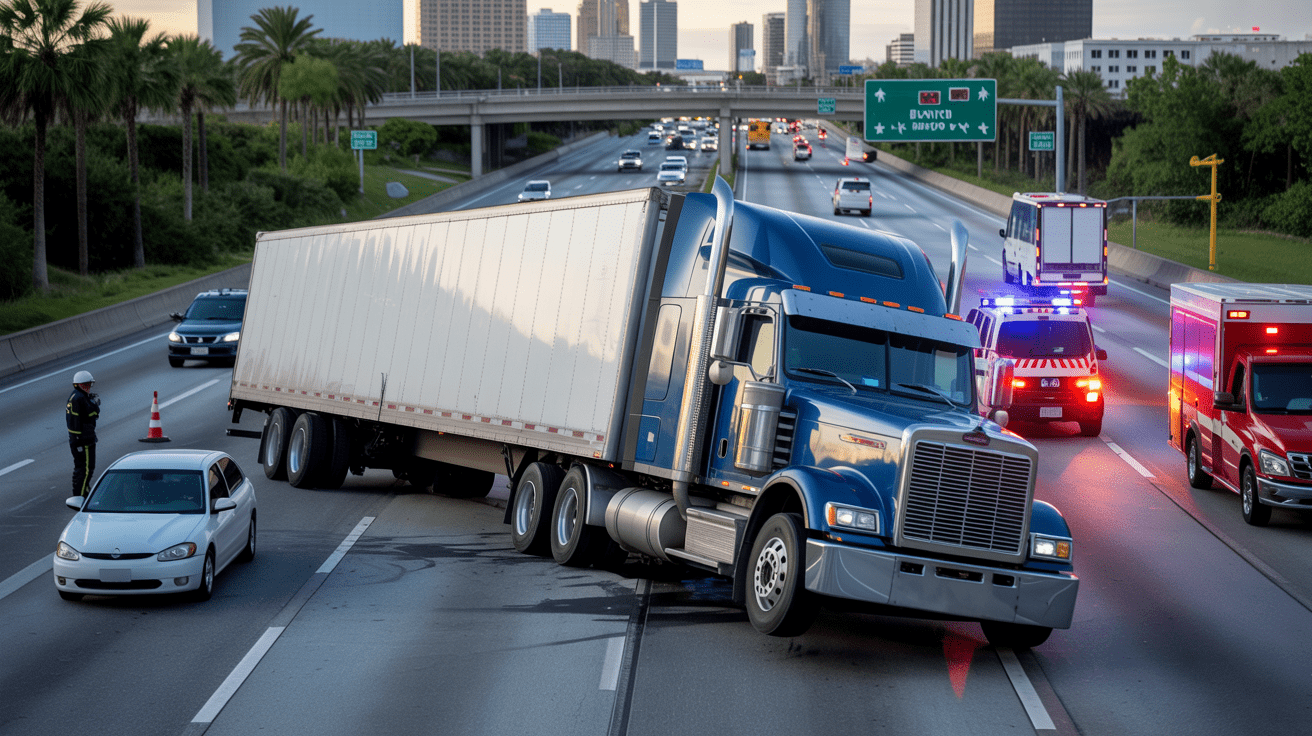
You’ve probably seen it on the news, or even worse, in your rearview mirror. A massive truck folded in on itself, blocking the entire highway. It’s a scene of pure chaos. But what happens after the sirens fade away?
Learn More: Tampa Jackknife Truck Accident Lawyer
Well, that’s what we’re here for. We’re gonna break down the entire anatomy of a jackknife truck accident, from that violent crash on the road all the way to the complex knockdown drag out fight in the courtroom. So first things first, what is a jackknife accident? Just picture a folding pocket knife snapping shut.
That is exactly what happens on the road when a truck’s trailer suddenly swings out to a sharp ninety degree angle from the cab. In that one split second, the driver loses all control, And that multi ton vehicle, it becomes a completely unpredictable force of destruction. And the human cost of that sudden loss of control is just immense. We are not talking about simple fender benders here.
The people caught in these collisions often face injuries that will change their lives forever. I’m talking about severe spinal trauma that can lead to paralysis, permanent nerve damage, and deep, deep emotional wounds like PTSD that stick around long after the physical scars have healed.
Okay, so to really understand the aftermath we have to go right back to the beginning. We have to uncover the cause and that means the investigation starts by following a trail of evidence all to answer one single critical question. So who is to blame? It seems like a simple question, right?
But this is THE question that drives every single thing that happens next. And trust me, the answer is almost never as simple as you’d think. Just look at this web of potential responsibility. I mean, sure, the fault could lie with the truck driver for speeding or driving while exhausted.
But what if the trucking company he works for has been skipping crucial maintenance? Or what if the manufacturer made defective brakes? It could even be the fault of the crew that loaded the cargo or a government agency that failed to fix a dangerous road. It gets complicated fast.
And when we look at the actual data, you can see that while driver error, you know, things like slamming on the brakes too hard, is often the number one cause, it’s not the whole story. Look at that chart. Mechanical failures, like old worn out brakes, are a huge piece of the pie. And sometimes, it’s just improperly loaded cargo or some really bad weather that provides that final push.
So how do you go from just thinking you know the cause to actually proving it in a court of law? Well, that brings us to our next step: building the case piece by piece, fact by fact. You know, proving fault isn’t just about pointing a finger and saying it was them. It’s a very methodical legal process, an attorney has to prove four key things: one) Someone had a duty to be safe two) They failed to meet that duty three) That specific failure is what directly caused the crash and four) the victim suffered real measurable harm because of it.
You have to prove all four. So how do you prove it? With cold, hard evidence. And the first, most critical piece is the truck’s black box.
This thing is basically the digital truth teller. It records objective unbiased data, speed, braking, steering, right up to the moment of impact. There’s no arguing with the data. Next up, you have the driver’s logbooks.
These are absolutely crucial.
They show investigators exactly how many hours that driver was on the road. And they can reveal if the driver was pushing past federal safety limits. The very rules designed to stop tired drivers from causing these exact kinds of crashes.
Maintenance records can tell such a powerful story. You open them up and what do you find? Do they show a history of diligent repairs and regular safety checks? Or do they reveal a dangerous pattern of neglect and cutting corners?
This is often the piece of evidence that shifts the blame from the driver to the company itself. And finally, you can never ever underestimate the power of the human eye. Witness statements give you that invaluable outside perspective. They help investigators reconstruct those critical moments right before the crash from people who are actually there to see it happen.
Now gathering all this evidence takes time, right? But here’s the thing: time is a luxury that victims just don’t have. In Florida, for instance, you have a strict two year time limit to file a lawsuit. That’s it.
If you wait too long, evidence disappears, people’s memories fade, and that window for justice? It can slam shut for good. So you’ve done it. You’ve gathered the evidence.
You’ve built a strong case. The fight should be over, right? Nope. Not even close. Because now you have to face the primary obstacle in any victim’s journey, the insurance company and its playbook.
This quote from our source material really gets right to the heart of it. The injuries are catastrophic, which means the potential payouts are huge. So, to protect their bottom line, insurance companies get aggressive. They have a whole set of tactics designed to limit how much they have to pay out.
And you can see the conflict right here. It’s a total clash of goals. The victim needs money to cover medical bills, lost wages, maybe even long term care. But the insurer’s goal: to delay, to dispute, and to deny the true value of that claim.
It’s their job.
And here are the specific plays they’ll run. They’ll question if your medical care was really necessary. They’ll argue your injuries were from a pre existing condition. And they’ll almost always make a quick, lowball offer that might seem like a lot of money at first, but it almost never covers the long term costs.
The single biggest takeaway here, an insurer’s first offer is never their best offer. It’s all just part of the strategy. So after all that, after navigating this whole maze, what does a victory actually look like? Well, brings us to the final part of our journey, the path to compensation, and what justice really means for a victim in financial terms.
See, fair compensation isn’t just a single check. It’s a comprehensive recovery that’s designed to try and make a victim whole again. It covers all the medical bills, not just from today but for the future too. It covers lost income, the physical pain and emotional suffering, and in the most severe cases, the permanent loss of enjoyment of life.
But there is a catch, and in a state like Florida it is a huge one. It’s called the comparative negligence rule. Look at this chart. If a jury decides you were, say, twenty percent at fault for the accident, your compensation gets reduced by twenty percent.
Makes sense. But here’s the crazy part. If they decide you were fifty one percent at fault, just one percent over half, you get zero. Nothing.
That one single percentage point is the difference between a fair recovery and walking away with absolutely nothing. Which brings us to our final thought. We’ve gone from the crash site through the evidence and into the courtroom. But after all of it, after assigning a percentage of blame and putting a dollar value on a lifetime of suffering, Can a system built on assigning fault ever truly, fully account for the human cost of a life that was changed in a single, violent instance?