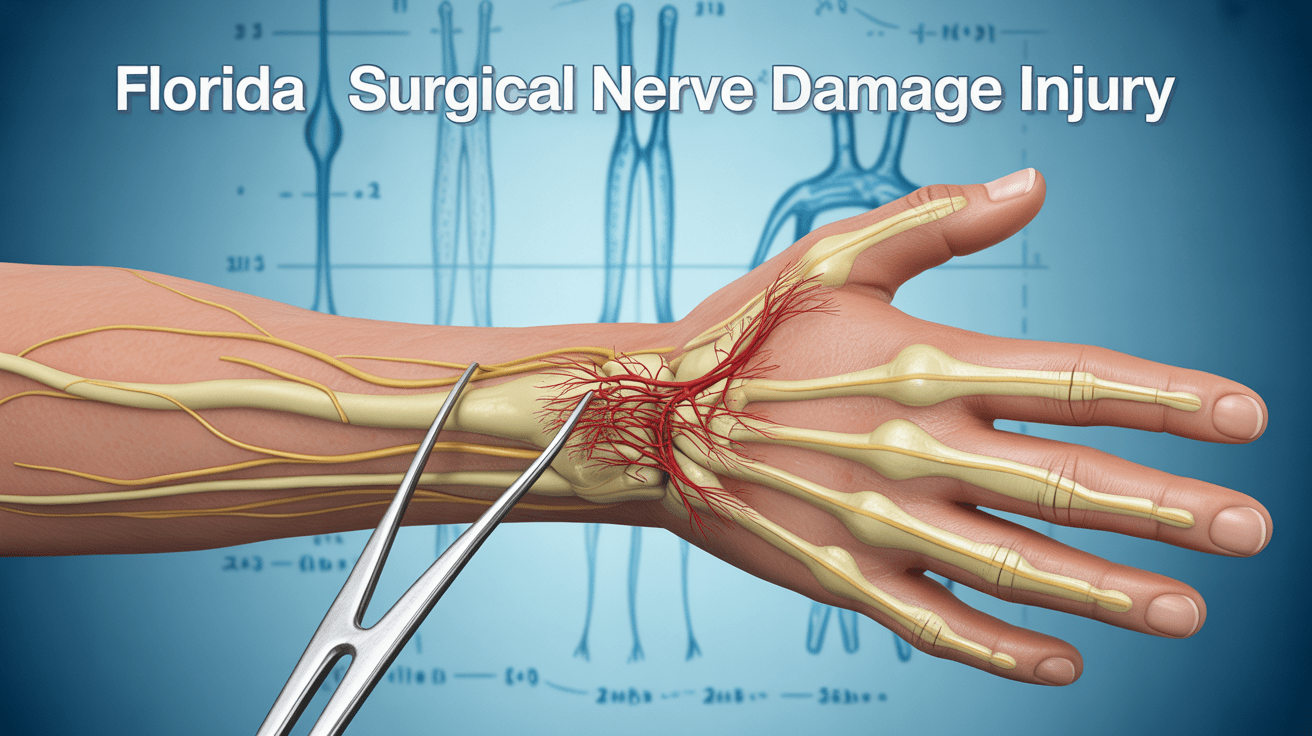
Alright let’s talk about something really tough, what happens when the very surgery that was supposed to fix you ends up causing a whole new problem, like nerve damage. If this has happened to you here in Florida, you need to know your rights and that’s exactly what we’re gonna break down today.
Learn More: Florida Surgical Nerve Damage Injury Lawyer
So you went in for a procedure, right? You were looking for a fix, an end to the pain, but you came out with something different, something new and maybe even worse. It’s confusing, it’s frustrating, and honestly it’s pretty scary.
We’re gonna cut through that confusion and talk about what might be going on and more importantly what you can actually do about it. Let’s dive in. Okay, so first things first. What do we even mean when we talk about surgical nerve damage? Let’s get a clearer picture of this unexpected injury.
Maybe after your surgery you started feeling things that just weren’t there before. You know, like a constant tingling in your hands or a weird burning feeling in your feet. Maybe a part of your body feels numb and it’s making simple things like buttoning a shirt almost impossible.
Look, you are not imagining it. These are the classic telltale signs of nerve damage, and it’s a really serious complication that can pop up right away or even show up weeks later.
And the thing is, this goes so much deeper than just physical pain, right? We’re talking about a ripple effect that touches every single part of your life. It can mess with your ability to work, your ability to just get around, it takes a huge toll on your mental health, I mean dealing with chronic pain can lead to serious anxiety and depression.
And then there’s the financial hit, all those medical bills piling up while you’re maybe losing wages. Each one of these things is a massive disruption.
So, if any of this is hitting home for you, if it sounds familiar, you’re probably asking, okay, what do I do right now? And that’s the right question, because what you do next is absolutely critical. Okay, here’s your game plan. Three crucial first steps: Number one: Go get a proper medical evaluation and do it now.
You need a diagnosis and you need to see if anything can be done to stop things from getting worse.
Step two is huge. Document everything. I mean it. Your pain levels, what you can and can’t do, every single conversation you have with a doctor.
You’re building a record. And third, you need to talk to an experienced attorney. You’ve got to understand your rights and protect your options before some really important deadlines just fly by. This leads to the big question, right?
How does something like this even happen in a sterile operating room? Well, it usually boils down to a handful of specific causes, and a lot of the time, they’re things that could have and should have been prevented. Okay, cause number one: a problem with the tools.
Think about it: a surgeon is only as good as their instruments. If a tool is dull, or it’s not working right, or it’s just used carelessly around a nerve that’s as delicate as a thread, well the damage can be devastating. It’s a simple mistake with catastrophic results. All right, next up is the anesthesia itself.
You know those regional nerve blocks? They’re super common but they also require an incredible amount of precision. If the anesthesiologist isn’t using something like an ultrasound to guide that needle in exactly the right spot, they can literally hit the nerve. Or they might inject the anesthetic in a way that chemically burns it.
It’s a high stakes procedure.
Now here’s one you probably haven’t thought about: positioning. When you’re out cold on that operating table for hours, you’re not moving. It’s up to the surgical team to make sure you’re positioned and padded correctly. If they don’t, your own body weight can stretch or compress vulnerable nerves.
We’re talking about the one in your elbow, you know your funny bone, or the one by your knee. It’s not so funny when it gets damaged. And listen, the danger doesn’t just end when the surgery’s over. An infection can set in at the surgical site afterwards.
That infection causes swelling and inflammation, and all that pressure can start squeezing nearby nerves, causing damage days or even weeks later. It just goes to show how critical proper wound care really is.
Okay, so we’ve seen how it can happen. But how do you actually prove it from a legal standpoint? This is where we get into the nuts and bolts of what’s called medical negligence.
The whole idea of a medical malpractice case is built on this one core concept: the standard of care. Now, this isn’t about demanding perfection from doctors. Nobody’s perfect. Instead, it’s a legal benchmark.
The big question is simple: Did your doctor and their team provide the same level of care that any other reasonable, competent doctor would have in that exact same situation? So to build a solid claim, you have to prove these three things. Think of them like the three legs of a stool. First, there was a duty.
Easy enough. You were their patient.
Second, there was a breach of that duty. This means the care you got fell below that standard we just talked about. And third, causation. You have to connect the dots and show that this failure is what directly caused your injury.
You need all three. If one is missing, the whole thing falls apart. Okay, but wait a minute, I know what you’re thinking. I signed a whole bunch of papers before surgery, didn’t I sign my rights away on some consent form?
This is a huge question and it stops a lot of people in their tracks. Let’s be crystal clear about this: Signing an informed consent form does not give a doctor permission to be negligent. What you’re signing is an acknowledgment of the known risks of a surgery the things that can happen even when everyone does everything right. A preventable mistake, an error.
That is not a known risk, that’s negligence. Okay, I want you to really focus on this number on the screen. It is incredibly important.
That number, two years. In Florida that is generally your deadline. It’s called the statute of limitations for filing a medical malpractice claim, and the clock starts ticking from the moment the injury happened or importantly when you discovered it. This is why time is absolutely of the essence. If you wait too long, you could lose your right to do anything about it. Period.
So, let’s say you move forward and have a successful claim. What’s the actual point? What’s the goal? Well, it’s all about getting the resources you need to recover, to adapt, and to move on with your life. In legal terms, these resources are called damages.
And damages usually fall into two big buckets. On one side you have economic damages. These are the things you can put a price tag on, right? The medical bills, the income you’ve lost, the cost of therapy you’re going need down the road.
Then on the other side, you have noneconomic damages. These are for the losses that don’t come with a receipt. The daily pain, the emotional suffering, the fact that you can’t enjoy life the way you used to. And make no mistake, both of these are very, very real.
When you look at this list, you really start to see the whole picture. A claim isn’t just about covering yesterday’s bills. It’s about looking at the future. Are you going to need physical therapy for years?
Do you need special devices to get around your own home now? How is this going to affect your career and your ability to earn a living five, ten years from now? All of that has to be factored in. And really, this is what it all boils down to.
This is not about hitting some kind of jackpot. It’s about accountability. It’s about making sure you have what you need to handle your recovery, to adjust to what might be a new normal, and to do it all with your dignity intact.
So we want to leave you with one final question to think about. If your surgery didn’t go as planned, if you’re now living with an outcome that has completely changed your life, what’s the one question you need to ask next? It’s this, Was what happened to me just a known risk of surgery, or was it a preventable mistake? Finding the answer to that question, that is your first step toward getting the answers and the help you deserve.