

The Law Offices of Anidjar and Levine, an Orlando Personal Injury Lawyer firm, investigates hazardous conditions in big-box and discount stores, including spills, cluttered aisles, uneven surfaces, and inadequate warnings. The legal team gathers surveillance footage, incident reports, inspection records, witness accounts, and medical documentation to evaluate notice, causation, comparative fault, and damages. Legal assistance may also help preserve evidence, manage insurer communications, coordinate medical records, and pursue compensation for treatment, lost income, pain, and ongoing effects. The following information explains available legal support and important claim considerations.
Main Takeaways
- An Orlando slip-and-fall lawyer evaluates whether store hazards, inadequate maintenance, or missing warnings caused your injury.
- Attorneys investigate spills, cluttered aisles, uneven surfaces, lighting, inspection practices, and employee responses.
- Important evidence includes photographs, surveillance footage, incident reports, inspection records, witness accounts, and medical documentation.
- A lawyer can communicate with insurers, coordinate claim documentation, and pursue compensation for treatment, lost income, and pain.
- Legal counsel addresses comparative fault and seeks to establish the store’s knowledge, the unreasonable danger, and its failure to respond.


How We Can Help With Your Orlando Slip & Fall Big-Box & Discount Injury Claim
When a customer suffers an injury in an Orlando big-box or discount store, legal counsel can help determine whether hazardous conditions, inadequate maintenance, or insufficient warnings contributed to the incident. An attorney can listen to the customer’s account, review available records, and identify practical steps for protecting the claim. This may include requesting surveillance footage, preserving photographs, locating incident reports, and communicating with insurers on the customer’s behalf.
Counsel can also examine whether store policies were followed and whether staffing decisions affected customer safety. Issues such as Negligent hiring, inadequate supervision, or insufficient employee training may require careful review of employment practices and operational procedures. The legal team can coordinate with medical providers, document treatment, and evaluate the claim’s financial effects without placing unnecessary burdens on the injured person.
Through organized investigation and clear communication, legal counsel can help a customer make informed decisions while seeking accountability. The representation remains focused on service, dignity, and a fair resolution.
OUR CONSULTATIONSARE FREE
START YOUR FREE CASE REVIEW

Understanding Orlando Slip & Fall Big-Box & Discount Injury Cases
Orlando slip-and-fall cases involving big-box and discount stores generally turn on whether the business knew, or reasonably should have known, about a dangerous condition and failed to address it or provide an adequate warning. Florida premises liability law may require proof of the store’s actual or constructive knowledge, the condition’s unreasonable danger, and the resulting injury. Evidence can include incident reports, inspection records, surveillance footage, employee testimony, medical documentation, and witness accounts. Premises liability signage may support a store’s position, but a warning does not automatically eliminate responsibility if it was unclear, obstructed, or inadequate under the circumstances. Stores may also raise Comparative fault defenses, asserting that the injured person failed to exercise reasonable care. The court may assign percentages of responsibility, potentially reducing damages accordingly. Each claim requires careful evaluation of notice, warnings, injuries, and causation. Attorneys serving injured community members can help preserve evidence, communicate with insurers, and explain available legal options while pursuing fair accountability.
Common Causes of Orlando Slip & Fall Big-Box & Discount
Common causes of slip-and-fall incidents in Orlando big-box and discount stores include wet floors, cluttered aisles, uneven parking lots, and inadequate lighting. These conditions can create hazards that customers may not reasonably anticipate while shopping or entering the premises. Identifying the source of a dangerous condition is often crucial when evaluating potential liability.
Wet Store Floors
Wet store floors are a frequent hazard in big-box and discount retailers, where spills, cleaning activities, leaking equipment, and tracked-in rainwater can create dangerous walking conditions. Each Floor hazard requires prompt attention because customers may not see moisture, especially under dim lighting or near refrigerated displays. Employees can support slip prevention by inspecting vulnerable areas, placing visible warning signs, restricting access when appropriate, and drying surfaces without delay. Effective compliance training should explain inspection schedules, cleaning procedures, footwear expectations, and escalation requirements. Retailers should also preserve accurate records, including inspection times, photographs, witness information, and the substance involved. These incident reporting ideas can help identify recurring conditions and demonstrate whether reasonable safety measures were taken. Prompt documentation may assist injured customers, employees, and those evaluating responsibility after a fall.
Cluttered Shopping Aisles
When merchandise, stocking carts, boxes, or promotional displays obstruct a shopping aisle, customers may be forced to traverse around unexpected hazards or walk through narrowed passageways. These conditions can create trip-and-stumble hazards, particularly for older adults, children, and customers carrying items or assisting companions. Shopping cart obstructions may also restrict visibility, making it difficult to recognize objects placed near the floor. Retailers generally have a responsibility to organize merchandise, maintain reasonable aisle clearance, and monitor conditions during stocking and promotional changes. Employees who identify blocked pathways should promptly remove or reposition the obstruction and provide suitable warnings when immediate correction is not possible. Documentation of aisle conditions, witness observations, and store responses may help clarify whether inadequate inspection or housekeeping contributed to an incident.
Uneven Parking Lots
Uneven parking lots can create slip, trip, and fall hazards for customers entering or leaving big-box and discount stores. Cracked pavement, potholes, raised asphalt, and abrupt changes in elevation may destabilize a person carrying purchases, assisting a child, or using a mobility aid. Poor drainage can worsen these conditions by leaving loose gravel, mud, or standing water near damaged surfaces. Driver distractions, including mobile device use or congested traffic, may prevent motorists from recognizing pedestrians who must walk around defects. Parking attendants and store personnel may help direct traffic, identify dangerous areas, and report maintenance concerns, but property owners generally remain responsible for reasonable inspection and repair practices. Incident reports, photographs, witness information, and medical records can help document how an uneven surface contributed to an injury.
Poor Store Lighting
Poor store lighting can conceal spills, obstacles, damaged flooring, and changes in elevation that create slip, trip, and fall hazards for customers in big-box and discount stores. Inadequate illumination may result from burned-out bulbs, obstructed fixtures, poor maintenance, or deliberate efforts to reduce operating costs. Store operators generally have a responsibility to inspect customer areas, correct lighting deficiencies, and provide reasonable warnings when hazards cannot be promptly addressed. Liability standards may depend on whether management knew, or reasonably should have known, that insufficient lighting created an unsafe condition. Customers and witnesses can support an investigation by documenting the location, preserving photographs, identifying nearby employees, and recording the time and circumstances of the incident. Prompt evidence preservation may help clarify visibility, store practices, and whether reasonable safety measures were followed.
Don’t Wait. Call Our Florida Personal Injury Lawyers Now!


Legal Rights of Orlando Slip & Fall Big-Box & Discount Injury Victims
Orlando slip and fall victims injured in big-box and discount stores may have legal rights when a dangerous condition caused the accident, and the store failed to address it reasonably. Florida liability standards generally require examining notice, reasonable inspection practices, and whether the condition created an unreasonable risk. A legal claim may seek compensation for medical treatment, lost income, pain, and related losses.
Orlando store injury claims may depend on proving a dangerous condition, reasonable notice, and the store’s failure to respond appropriately.
- Photograph the aisle, floor, footwear, warning signs, and surrounding displays.
- Record the time, location, symptoms, witnesses, and employee statements.
- Request incident-report information without making speculative admissions.
- Preserve shoes, clothing, medical records, receipts, and communications.
Evidence preservation can influence whether the condition and store response are later established. Victims should obtain prompt medical evaluation and avoid altering relevant materials. Consulting a qualified Orlando premises-liability attorney can help identify responsible parties, evaluate deadlines, communicate with insurers, and protect the claimant’s interests. Serving injured people requires careful listening, accurate documentation, and informed guidance throughout the process.
Why Do Orlando Slip-and-Fall Big-Box & Discount Injuries Happen?
Several conditions can cause slip-and-fall injuries in Orlando big-box and discount stores, including spilled liquids, leaking refrigeration units, damaged flooring, cluttered aisles, and merchandise left in walkways. High customer traffic can worsen these dangers by spreading moisture, displacing products, and obscuring unsafe areas from view. Inadequate lighting, uneven entry surfaces, loose mats, and weather-related water tracked indoors may also create dangerous surface hazards.
Store operators generally establish Safety protocols to identify, correct, and document hazardous conditions. Injuries can occur when inspections are inconsistent, warning signs are absent, or employees fail to respond promptly after learning about a danger. Effective employee training should address spill response, aisle maintenance, floor inspections, and procedures for securing merchandise. Staffing shortages, poor communication, and pressure to maintain rapid operations may undermine these practices. When reasonable safeguards are neglected, customers, including those shopping to support their households and communities, may face preventable injuries caused by unsafe premises.
Don’t Wait. Call Our Florida Personal Injury Lawyers Now!
What Should You Do After an Orlando Slip & Fall Big-Box & Discount Injury?
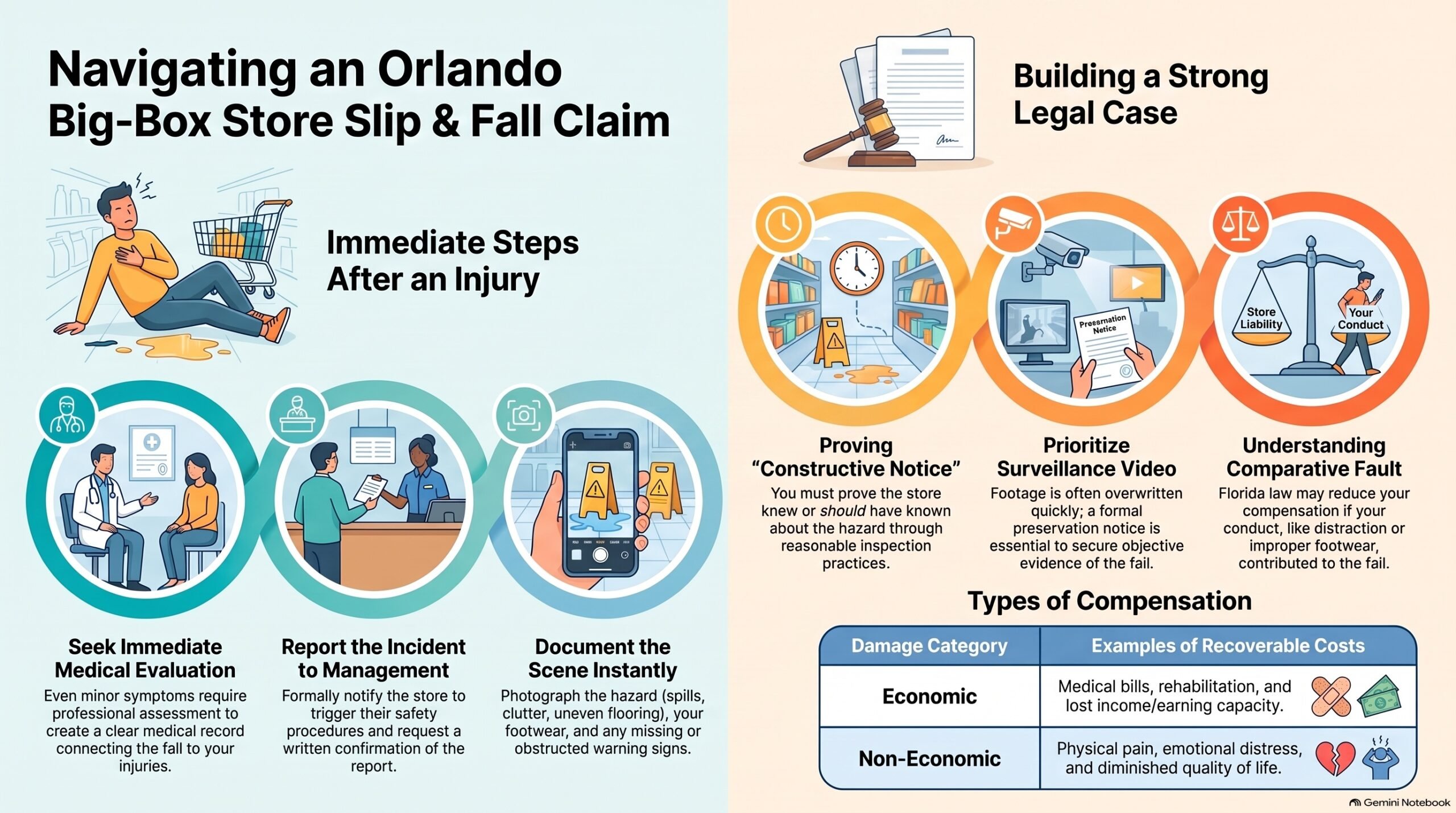
After a slip-and-fall injury in Orlando, the injured person should seek immediate medical care, even if symptoms initially appear minor. The incident should be reported promptly to store management, with a request for a written report or confirmation of the complaint. Photographs, surveillance details, receipts, clothing, and witness contact information should also be preserved to document the conditions and circumstances.
Seek Immediate Medical Care
Prompt medical evaluation is a crucial first step after a slip-and-fall in an Orlando big-box or discount store, even when the injury initially appears minor. A qualified healthcare professional can identify fractures, sprains, head trauma, or internal injuries that may not produce immediate symptoms. Timely treatment also creates a clear medical record describing the condition and its connection to the fall. Individuals should follow discharge instructions, attend recommended appointments, and monitor changes such as increasing pain, swelling, dizziness, numbness, or limited movement. Immediate first aid may include controlling bleeding, applying a cold pack, and keeping an injured limb still when appropriate. Wounds should receive proper cleaning and dressing to prevent complications from infection. Prompt care supports recovery and helps preserve crucial evidence concerning the injury’s seriousness and treatment needs.
Report the Store Incident
Store management should be notified as soon as practicable following an Orlando slip-and-fall, regardless of whether the injury initially seems serious. A prompt report allows the business to activate its safety procedures, arrange appropriate assistance, and create an official record of the occurrence. The injured person should calmly explain where and how the event happened, identify any immediate symptoms, and request that the report accurately reflect the circumstances. If a manager is unavailable, customer service personnel or another authorized employee may receive the notice. The person should obtain the report’s reference information and retain it with medical records. Timely reporting can help preserve evidence by prompting the store to secure relevant materials before conditions change. A written incident timeline should then be maintained, including notification details and subsequent medical attention.
Document Evidence and Witnesses
When possible, the injured person should photograph the location, floor or ground conditions, warning signs, footwear, visible injuries, and any property involved in the Orlando slip-and-fall. Images should include wide views showing the surrounding area and close views showing specific hazards. The person should preserve receipts, clothing, medical records, and other materials supporting Damages Proof. Witnesses should be identified by name and contact information, and their observations should be recorded promptly while memories remain accurate. Store employees’ statements should be noted, including comments about prior complaints, inspections, or cleanup. The injured person should avoid altering the scene or posting details online. Careful documentation may address Comparative Negligence allegations concerning attention, footwear, or conduct. A legal professional can help preserve evidence and pursue appropriate claims.
Critical Evidence in an Orlando Slip & Fall Big-Box & Discount Injury Case
Critical evidence can establish how the incident occurred, whether the store had notice of the hazard, and the extent of the resulting injuries.
Key materials may include:
- Surveillance video showing the area before and after the fall
- Store incident reports documenting the event and reported conditions
- Witness statements describing the hazard and available warnings
- Medical treatment records connecting the fall to the claimed injuries
Together, these records can help clarify liability and support an injury claim.
Surveillance Video Evidence
Surveillance video can provide objective evidence in an Orlando slip-and-fall injury case by showing the condition of the floor, the surrounding area, and the events immediately before and after the incident. Footage may reveal whether a spill, obstruction, or hazardous surface existed, how long it remained, and whether employees or customers noticed it. In a premises liability claim, these details can help clarify whether the store had actual or constructive notice of the danger and failed to respond reasonably. Video may also document footwear, warning signs, lighting, and the person’s movements, which can address allegations of comparative negligence. Prompt preservation is important because systems may automatically overwrite recordings. A legal representative can request relevant footage, identify camera locations, and evaluate whether the images fairly portray the incident without altering or omitting context.
Store Incident Reports
Store incident reports can supplement surveillance footage by documenting how a big-box or discount retailer recorded an Orlando slip-and-fall after it occurred. These reports may identify the date, time, location, floor condition, employee response, and immediate steps taken after notification. A completed Slip notice can help establish when the store learned of the hazard and whether personnel inspected or corrected the area. The report may also reveal inconsistencies between internal records and later descriptions of the incident. Prompt evidence preservation requests can help prevent the loss, alteration, or routine destruction of related documents, photographs, inspection logs, and electronic entries. An Orlando slip-and-fall lawyer may evaluate the report’s completeness, authorship, and timing, and seek records that clarify the retailer’s response and safety procedures.
Witness Statements
When available, witness statements can provide independent accounts of the conditions surrounding an Orlando slip-and-fall at a big-box or discount retailer. Customers, employees, delivery personnel, or other visitors may describe the substance, obstruction, lighting, warning signs, and store response observed before or after the incident. Their accounts can help establish how long a hazardous condition existed and whether reasonable inspection or cleanup procedures were in place. Investigators may seek contact information, written statements, photographs, or recorded interviews while memories remain reliable. Consistency, opportunity to observe, and potential bias are important factors in a credibility assessment. Witnesses may later assist with deposition preparation by reviewing only their own recollections and identifying what they personally saw. Accurate, neutral testimony can clarify disputed facts and support a fair evaluation of responsibility.
Medical Treatment Records
Medical treatment records provide objective evidence of the injuries attributed to an Orlando slip and fall at a big-box or discount retailer. Emergency evaluations, physician notes, imaging reports, and therapy records can document symptoms, diagnoses, treatment plans, and restrictions. Consistent records may link the incident to conditions such as fractures, sprains, or head injuries and establish the severity of the resulting limitations.
Gaps in treatment records may raise questions about delayed care, changing symptoms, or alternative causes. Accordingly, an injured person should preserve appointment confirmations, discharge instructions, diagnostic reports, and pharmacy receipts. Records from primary care providers and experts can further clarify pre-existing conditions and distinguish them from injuries sustained during the fall. Careful collection and organization of this evidence allows legal representatives to evaluate causation, damages, and the services needed to support recovery.
Long-Term Effects of Orlando Slip & Fall Big-Box & Discount Injuries
Long-term injuries from Orlando big-box and discount store slip-and-fall incidents may cause chronic pain, reduced mobility, and lasting disability. Victims may also face ongoing medical expenses for treatment, rehabilitation, medication, and assistive services. These physical consequences can create substantial emotional and financial strain, particularly when they limit employment and daily activities.
Chronic Pain and Disability
Persistent pain after a slip-and-fall in an Orlando big-box or discount store can interfere with mobility, employment, sleep, and everyday activities. A Shoe Slip may cause lasting damage to the back, joints, nerves, or soft tissue, even when initial symptoms appear manageable. When discomfort continues, the condition may develop into a Chronic Injury that limits walking, standing, lifting, driving, or performing household responsibilities. Some individuals may require workplace accommodations, reduced hours, or a change in occupation because pain and restricted movement affect reliability and endurance. Disability can also influence personal independence, family participation, and emotional well-being. A careful medical evaluation can document functional limitations and identify whether symptoms are temporary, recurring, or permanent. Accurate records help clarify how the incident affects long-term quality of life and daily functioning.
Ongoing Medical Expenses
Over time, injuries from an Orlando slip-and-fall in a big-box or discount store may require ongoing medical care and create expenses that extend well beyond the initial treatment. Follow-up visits, diagnostic imaging, prescription medications, physical therapy, and mobility equipment may remain necessary as recovery progresses. Some individuals may need expert evaluations or revisions to an ongoing treatment plan when symptoms persist or worsen. Pain management options can include medication, therapeutic procedures, rehabilitation, and other clinically appropriate services, each carrying potential costs. Documentation of appointments, recommendations, invoices, and related supplies can help establish the scope of care. Medical professionals may also assess whether future treatment is reasonably likely. When injuries affect work capacity, lost earning ability may accompany continuing care, making accurate records important when evaluating the full consequences of the condition.
Emotional and Financial Strain
A serious slip and fall injury in an Orlando big-box or discount store can create emotional and financial strain that continues after initial medical treatment ends. Persistent pain, reduced mobility, and uncertainty about future abilities may contribute to emotional distress, including anxiety, depression, or withdrawal from ordinary activities. A long term recovery can also require therapy, transportation, medication, household assistance, and repeated medical evaluations. If the injured person cannot work, lost wages may compound existing bills and affect dependents who rely on that income. Family members may assume caregiving responsibilities, creating additional pressure and disrupting established routines. Careful documentation of symptoms, expenses, missed work, and functional limitations can help clarify the injury’s broader effects. Legal guidance may assist families in evaluating available compensation and pursuing accountability while preserving dignity throughout the recovery process.
Proving Liability in Orlando Slip & Fall Big-Box & Discount Injury Cases
When a customer suffers injuries in an Orlando big-box or discount store, proving liability generally requires showing that the business created a dangerous condition, knew about it, or should have discovered it through reasonable inspection. Premises liability claims may involve spilled liquids, uneven flooring, obstructed aisles, inadequate lighting, or merchandise placed unsafely. Evidence should connect the hazard to the fall and establish how long it existed or why employees should have addressed it. Hazard identification procedures, warning signs, employee reports, surveillance footage, photographs, incident records, and witness statements can help clarify what occurred. A store inspection policy may demonstrate the expected safety standard, while inspection logs can reveal whether staff followed it consistently. Medical records and testimony can document the resulting injuries, but negligence proof must also address the store’s conduct. Careful investigation allows advocates to present an accurate account, preserve relevant evidence, and support an injured customer’s pursuit of accountability under Florida law.
Dealing With Insurance Companies After an Orlando Slip & Fall Big-Box & Discount Injury
Because insurance companies protect their financial interests, an Orlando slip-and-fall victim should approach communications with caution and avoid providing a recorded statement or signing documents before fully understanding the potential claim. Insurers may request medical records, incident details, employment information, or authorization forms. Each response should remain accurate, consistent, and limited to relevant facts, without speculation about fault or recovery.
A victim should preserve photographs, receipts, witness contact information, and medical documentation. Information about security cameras should be requested promptly because recordings may be overwritten under routine retention policies. Store policy adherence may also affect how the insurer evaluates notice, inspections, hazard correction, and employee training. A lawyer can help identify damaging assumptions, communicate with adjusters, and protect confidential information while reviewing available evidence.
The injured person should follow medical recommendations and report symptoms honestly. Settlement offers should not be accepted merely because they arrive quickly, particularly when treatment remains incomplete or future expenses are uncertain. Careful communication helps preserve options and supports a fair resolution.
What to Expect During an Orlando Slip & Fall Big-Box & Discount Injury Claim Process
The claim process typically begins with an initial case evaluation, followed by systematic evidence collection concerning the incident, injuries, and property conditions. Insurance claim negotiations then address liability, damages, and potential compensation based on the available documentation. If settlement efforts fail, the matter may proceed to trial, where the evidence and legal arguments are presented for resolution.
Initial Case Evaluation
During an initial case evaluation, an Orlando slip-and-fall lawyer examines the circumstances of the incident, the property owner’s potential liability, and the extent of the reported injuries. The discussion generally addresses the basics of negligence, including whether a hazardous condition existed, whether responsible parties knew or should have known about it, and whether reasonable precautions were taken. The lawyer may ask about medical treatment, ongoing limitations, employment effects, and the client’s immediate concerns. This consultation also provides an overview of the claim timeline, explaining potential stages such as legal assessment, communication with insurers, negotiation, and, if necessary, litigation. The lawyer evaluates whether the matter appears legally supportable and identifies factors that could affect recovery. Clients can expect candid guidance, respectful communication, and an explanation of available options before deciding how to proceed.
Evidence Collection Process
Prompt evidence collection helps establish how a hazardous condition developed, whether store personnel knew or should have known about it, and what steps were taken before the incident. A legal representative may inspect the location, photograph floor conditions, preserve surveillance footage, and identify witnesses who observed the area or reported prior problems. Receipts, incident reports, maintenance records, inspection logs, and employee statements can clarify store practices and support findings concerning store liability. Medical records and photographs of injuries may connect the event to documented harm without overstating the claim. The injured person should preserve clothing, footwear, and communications related to the occurrence. Statute timelines can limit available legal remedies, making prompt documentation and witness outreach important. Counsel may also issue preservation requests to prevent relevant evidence from being altered or destroyed.
Insurance Claim Negotiations
Once evidence has been preserved, insurance claim negotiations typically begin with notice to the store’s insurer and an evaluation of liability, medical records, lost income, and other documented damages. The injured customer may provide a recorded statement, authorize the release of relevant medical documentation, and respond to reasonable requests for information. Customer duties include preserving receipts, following prescribed treatment, attending appointments, and avoiding statements that speculate about fault or recovery. The insurer may review surveillance footage, employee reports, store policies, and alleged warning practices before posing questions or presenting a proposed valuation. Settlement timelines vary according to injury severity, treatment progress, documentation, and insurer responsiveness. A representative can organize communications, identify gaps in the evidence, and explain how comparative negligence or policy limits may affect the evaluation. Careful negotiation protects accuracy and promotes fair consideration of the customer’s documented losses.
Settlement Or Trial
Settlement or trial is generally determined by the strength of the liability evidence, the extent of the injuries, the completeness of documented damages, and the parties’ willingness to resolve the dispute. After medical records, incident reports, photographs, witness accounts, and financial losses are evaluated, the parties may pursue Pretrial negotiations. These discussions can involve demand letters, insurer responses, mediation, and revised offers. The settlement timeline varies according to injury progression, medical treatment, investigative needs, and court deadlines. A settlement may provide a predictable resolution without trial, although its terms should be reviewed carefully before acceptance. If negotiations fail, the case may proceed to trial, where each side presents evidence concerning negligence and damages. Throughout the process, counsel generally explains available options and helps protect the injured person’s interests.
Compensation for Orlando Slip & Fall Big-Box & Discount Injury Damages
Compensation in an Orlando slip-and-fall at a big-box or discount store may cover medical expenses, lost income, reduced earning capacity, pain and suffering, and other legally recognized damages. The recoverable amount depends on the injury’s severity, required treatment, prognosis, and evidence establishing fault. Store operators may be held responsible when employees knew or reasonably should have known about a spill, obstruction, inadequate lighting, or unsafe flooring and failed to correct the issue or warn customers. Claims involving parking lots or walkways may also require examination of pavement damage, drainage conditions, maintenance records, and lighting. Landlord liability can arise when a property owner retained responsibility for structural conditions or common-area maintenance under a lease or applicable law. Documentation strengthens the evaluation and includes photographs, incident reports, witness information, medical records, wage evidence, and communications with the store. A legal professional can help preserve evidence, identify responsible parties, assess applicable insurance, and pursue a resolution that addresses the injured person’s practical needs.
Economic vs Non-Economic Damages in Orlando Slip & Fall Big-Box & Discount Cases
Economic damages may include medical expenses, lost income, rehabilitation costs, and other measurable financial losses resulting from a slip-and-fall. Non-economic damages address less tangible harm, such as pain, emotional distress, inconvenience, and diminished quality of life. Calculating total compensation requires evaluating both categories in light of the injury’s severity, duration, and effect on the individual’s daily life.
Economic Damages
When a shopper is injured in an Orlando big-box or discount store, a damages claim generally distinguishes between measurable financial losses and non-economic harm. Economic damages may include reasonable medical expenses arising from emergency treatment, physician visits, diagnostic testing, prescriptions, rehabilitation, and necessary future care. Medical bills documentation helps connect each charge to the reported injury and supports a reliable calculation of recoverable costs. If the injury prevents work, wage-loss records, employer statements, tax information, and disability documentation may establish income lost during recovery. A claim may also address reduced future earning capacity when medical evidence shows lasting work limitations. Receipts for transportation, medical equipment, and other necessary out-of-pocket expenses can further support the calculation. Careful organization helps attorneys present a complete, verifiable financial claim.
Non-Economic Damages
Beyond documented financial losses, a slip-and-fall claim may also include non-economic damages that reflect the injury’s personal impact. These damages can include physical pain, emotional distress, inconvenience, disfigurement, and diminished enjoyment of daily activities. In Orlando big-box and discount-store cases, the severity and duration of symptoms may influence how these effects are evaluated. A person who cannot participate in family responsibilities, community service, recreation, or ordinary routines may experience losses that receipts cannot fully demonstrate. Proving damages often requires consistent testimony, medical observations, and accounts from people who have witnessed changes in behavior or ability. Documenting injuries through treatment records and personal observations can help establish the connection between the fall and ongoing limitations. Each claim remains dependent on its specific facts, evidence, and legal circumstances.
Calculating Total Compensation
Total compensation in an Orlando slip-and-fall case generally combines economic damages, such as medical expenses, lost wages, and reduced earning capacity, with non-economic damages for pain, emotional distress, disability, and diminished enjoyment of life. Economic losses should be supported by invoices, employment records, physician opinions, and projections of future treatment or diminished income. Non-economic damages require a careful assessment of injury severity, recovery duration, permanent limitations, and effects on daily activities and relationships. Comparative fault may reduce an award if the injured person’s conduct contributed to the incident, making accurate factual development vital. Evidence preservation, including photographs, surveillance requests, witness information, and incident reports, can strengthen valuation and liability arguments. A thorough assessment helps counsel pursue compensation that addresses both measurable losses and lasting personal consequences.
Don’t Wait. Call Our Florida Personal Injury Lawyers Now!
When an Orlando Slip & Fall Big-Box & Discount Injury Case Goes to Trial vs. Settlement
An Orlando slip-and-fall injury case may resolve through settlement or proceed to trial, depending on the strength of the evidence, the parties’ willingness to negotiate, and the extent of the claimant’s damages. Settlement can provide a faster, more predictable resolution while reducing litigation costs and the uncertainty of a jury’s decision. Negotiations may become more productive after medical records, incident reports, witness accounts, photographs, and store communications clarify the disputed issues.
If negotiations stall, the Trial discovery process allows each side to obtain relevant information, question witnesses, consult qualified experts, and evaluate the evidence before presenting it in court. Counsel may use settlement leverage strategies based on documented injuries, persuasive liability evidence, and the projected costs of continued litigation. Trial requires preparation for opening statements, testimony, exhibits, cross-examination, and closing arguments. The appropriate path depends on the claimant’s objectives, risk tolerance, recovery needs, and willingness to pursue accountability through a formal judicial process.
Florida Laws That May Affect Your Orlando Slip & Fall Big-Box & Discount Case
Florida law may affect an Orlando slip-and-fall case through rules governing premises liability, notice of dangerous conditions, comparative negligence, and available damages.
These rules help determine whether a store acted reasonably and how responsibility should be evaluated.
- Premises Liability: A business may owe lawful visitors a duty of reasonable care, including inspection, maintenance, and warnings about hazards.
- Notice: Evidence may show whether employees knew, or reasonably should have known, about liquid, debris, uneven flooring, or other dangerous conditions.
- Comparative Negligence: A claimant’s recovery may be reduced if personal conduct, such as distraction or unsuitable footwear, contributed to the incident.
- Damages: Florida law may permit compensation for medical treatment, lost income, reduced earning capacity, and pain-related losses when supported by evidence.
A careful legal review can help clarify disputed facts, preserve meaningful evidence, and promote fair treatment for injured individuals and responsible businesses. Counsel serving the community may also explain how surveillance footage, incident reports, witnesses, and medical records affect the claim.
The Statute of Limitations for Orlando Slip & Fall Big-Box & Discount Injury Cases
Because Florida law imposes strict deadlines, an injured person may lose the right to pursue an Orlando slip-and-fall claim if a lawsuit is not filed within the applicable statute of limitations. In many Florida negligence cases, the general deadline is two years from the date of the injury, although particular facts, defendants, or legal claims may create different rules. A claim involving a government entity can require earlier notice and additional procedural compliance. Determining the correct deadline promptly helps protect injured individuals and preserves access to meaningful legal remedies.
Early evidence preservation is equally important. Store receipts, photographs, medical records, witness information, incident reports, and communications with the store. Surveillance footage may be overwritten quickly, making prompt requests especially valuable. Comparative negligence can reduce compensation if an injured person is found partly responsible, but it does not necessarily eliminate the claim. Accurate records and timely action support fair evaluation while allowing responsible parties to be held accountable under Florida law.
How an Orlando Slip & Fall Big-Box & Discount Lawyer Can Help You
When a shopper suffers an injury in a big-box or discount store, an Orlando slip-and-fall lawyer can investigate the incident, identify potentially responsible parties, and assess whether negligence contributed to the dangerous condition.
The lawyer may preserve evidence, communicate with insurers, and coordinate information from medical providers and witnesses.
- Store records, surveillance footage, photographs, and inspection logs can help illustrate how long a spill or obstruction existed.
- Medical documentation can connect the incident to treatment needs, lost income, and continuing limitations.
- Damages Calculation may account for medical expenses, rehabilitation, diminished earning capacity, and pain-related losses.
- A comparative negligence analysis can evaluate whether the shopper’s conduct affects potential recovery under Florida law.
A lawyer can also explain legal options, organize documentation, and advocate for a fair resolution while treating the injured person and family with respect. This assistance allows community-minded advocates to support accountability and informed decision-making without making unsupported promises about an outcome.
When to Contact an Orlando Slip & Fall Big-Box & Discount Lawyer
Prompt legal guidance may be appropriate soon after a shopper sustains an injury in a big-box or discount store, particularly if the injury resulted from a spill, uneven flooring, falling merchandise, or another hazardous condition. Early contact allows an Orlando slip-and-fall lawyer to help identify practical next steps while details are still available.
A consultation can be especially important when medical treatment is ongoing, the store has requested statements, or responsibility is disputed. Counsel may explain statute deadlines that could affect the ability to pursue a claim and identify documents or notices that require prompt attention. Evidence preservation is also time-sensitive. Photographs, surveillance recordings, incident reports, witness information, receipts, and clothing may help clarify what occurred. Store conditions can change quickly, and surveillance systems may automatically overwrite recordings. Individuals serving injured shoppers should thus encourage prompt documentation, appropriate medical care, and careful communication with insurers or store representatives. Seeking advice does not require a decision to file suit; it provides information for informed, responsible choices.
Why You Need an Experienced Orlando Slip & Fall Big-Box & Discount Lawyer
An experienced Orlando slip-and-fall lawyer can evaluate how store policies, employee conduct, surveillance evidence, and the hazardous condition may affect a claim. That assessment is important because premises liability cases often depend on proving what the store knew, should have known, and failed to correct or warn about. Big-box and discount retailers may have intricate procedures for inspections, incident reporting, maintenance, and employee training. An attorney can identify gaps in those procedures, preserve relevant evidence, and address disputes regarding the cause of the fall, injuries, and damages.
Experienced representation also supports a focused attorney strategy when communicating with insurers, requesting records, interviewing witnesses, and presenting medical documentation. Counsel can help protect an injured person from premature statements or settlement decisions that may undervalue legitimate losses. By examining liability and damages jointly, a qualified lawyer can pursue accountability while helping the injured individual obtain resources for treatment, recovery, and daily needs. This guidance can also reduce unnecessary burdens during an already difficult period.
How to Choose the Right Orlando Slip & Fall Big-Box & Discount Lawyer for Your Case
Selecting the right Orlando slip-and-fall lawyer requires careful consideration of the attorney’s experience with premises liability claims involving big-box and discount retailers. A suitable attorney should understand how store inspections, cleaning schedules, incident reports, surveillance footage, and employee testimony may establish whether a dangerous condition existed and whether management had notice.
Potential clients may evaluate the lawyer’s record with comparable cases, communication practices, resources, and approach to client service. The attorney should clearly explain legal options, identify realistic challenges, and establish who will handle important communications. A thoughtful Case strategy should address liability, medical documentation, lost income, future needs, and any defenses the retailer may raise.
Early evidence preservation is also critical because video recordings, electronic records, and physical conditions may change or disappear. The lawyer should promptly identify relevant evidence and take appropriate steps to protect it. A careful consultation can help an injured person select representation that can advance the claim responsibly and support a fair resolution.
About The Law Offices of Anidjar & Levine
The Law Offices of Anidjar & Levine represents individuals injured in slip-and-fall incidents involving big-box and discount retailers throughout Orlando.
The firm assesses potential premises liability claims involving hazardous conditions, inadequate maintenance, negligent inspections, or insufficient warnings.
Its attorneys review incident reports, medical records, photographs, surveillance footage, and witness accounts to clarify how an injury occurred and whether a retailer may be legally responsible.
The firm’s approach centers on informed guidance and responsive communication.
An attorney may explain applicable deadlines, identify available sources of compensation, and help protect a client’s interests during discussions with insurers or opposing counsel.
Each matter receives consideration based on its facts, the extent of the injuries, and the evidence supporting liability.
Individuals considering representation may examine the firm’s lawyer background, experience with injury litigation, and record of serving injured community members.
Although results vary by case, professional preparation can help clients pursue their claims with greater clarity and confidence.
Frequently Asked Questions
Can I Pursue a Claim if I Slipped in a Store but Was Not Seriously Injured?
Yes, a person may pursue a claim after slipping in a store without serious injury, particularly if unsafe conditions caused the incident. Prompt medical treatment can document symptoms and connect them to the fall, even when injuries initially appear minor. Liability may depend on whether the store knew or reasonably should have known about the hazard. Available compensation amounts vary according to medical expenses, lost income, pain, and other provable damages.
What Happens if a Store Blames Another Customer for Creating the Hazard?
A store may argue that another customer created the hazard, but that does not automatically absolve the store of responsibility. The core issue is whether employees knew, or reasonably should have known, about the condition and failed to respond appropriately. Evidence may include surveillance footage, inspection records, incident reports, photographs, and witness identification. Comparative negligence could reduce recovery if the injured person contributed to the fall. A legal evaluation can clarify available remedies.
Can Surveillance Footage Be Requested From the Store After My Accident?
Yes, surveillance footage can often be requested after an accident, but the store may not voluntarily provide it. A claimant or attorney can send a written preservation notice demanding that relevant recordings be protected from deletion under the store’s video retention practices. Formal evidence requests, such as subpoenas or discovery, may later compel production. Prompt action is important because footage can be overwritten, and preserving it may clarify how the hazard arose and who knew about it.
Are Store Employees Required to Complete an Incident Report After a Fall?
Store employees are not universally required to complete an incident report after a fall, although company policies may mandate one. A manager may document the event, collect witness statements, preserve surveillance footage, and record reported pain severity. The injured person should request confirmation that a report exists, provide accurate details, and avoid speculation. If employees refuse, the person should promptly document the incident independently and seek appropriate legal guidance regarding evidence preservation and reporting requirements.
Can I Still Shop at the Store While My Injury Claim Is Pending?
Yes, an injured shopper may generally continue shopping at the store while a claim is pending. However, the shopper should avoid conduct that could appear inconsistent with the claimed limitations and follow medical guidance. Because the Store liability timeline may depend on the preservation of incident evidence, returning to the location could lead to additional observations or statements. The shopper should document symptoms, communicate carefully with personnel, and consult counsel before discussing the injury further.
—————————
Orlando slip and fall accidents in big-box and discount stores can result in serious injuries, medical costs, and lasting disruption.
When unsafe conditions, inadequate inspections, or delayed warnings contribute to an accident, victims may have legal options. Orlando Personal Injury Lawyer:
The Law Offices of Anidjar and Levine can assess the circumstances, identify potentially responsible parties, and pursue appropriate compensation.
Prompt legal guidance may help preserve evidence, manage communications with insurers, and protect a claimant’s rights throughout the personal injury process.

