




1.0 Introduction: The Unique Environment of Hospital Premises Liability
While hospitals are designed as places of healing, they present a unique and heightened risk environment for premises liability claims. The constant activity, the inherent vulnerability of the patient population, and complex operational protocols create a setting in which the potential for slip-and-fall incidents is significantly more pronounced than in standard commercial venues. These factors render hospital-based claims a distinct legal challenge, demanding a specialized strategic approach that accounts for both the clinical realities and the rigorous standards of care owed to patients and visitors.
Learn More: Florida Hospital Slip And Fall Injury Lawyer
This analysis will dissect the foundational legal principles governing these cases under Florida law, deconstruct the most common vectors of hospital negligence, and outline the tactical framework required to build and litigate these complex claims successfully. The objective is to provide legal professionals with a clear understanding of the evidentiary and procedural imperatives for establishing liability and securing full compensation. A successful case begins with a firm understanding of the hospital’s fundamental legal duties under Florida law.
2.0 The Legal Framework: Establishing the Duty of Care in Florida
The strategic imperative of grounding a hospital slip and fall claim in Florida’s premises liability laws cannot be overstated. Proving liability is not merely about demonstrating that an injury occurred on hospital property; it hinges on methodically proving that the hospital breached its legal duty to maintain a reasonably safe environment. This requires a disciplined application of core negligence principles to the specific, and often complex, facts of the case.
To establish liability, a claimant must successfully prove the following essential elements:
- Duty of Reasonable Care: A hospital has a non-delegable legal obligation to its patients and visitors to identify, correct, and communicate potential hazards on its premises. This duty mandates the implementation of robust safety protocols, the execution of timely inspections, and the provision of clear, unambiguous warnings about dangerous conditions.
- Breach of Duty: A breach is established by demonstrating that the hospital knew, or through reasonable diligence should have known, about a dangerous condition and subsequently failed to take appropriate remedial action. Evidence of neglected maintenance, inadequate safety policies, or failure to adhere to established internal protocols serves as definitive proof of a breach.
- Causation: A clear, documented, and defensible link must be forged between the hospital’s breach of duty and the claimant’s injuries. This requires demonstrating that the hazardous condition was the direct and proximate cause of the fall and that the fall, in turn, directly caused the documented medical harm, from acute injuries to long-term sequelae.
While these principles are universal to negligence law, their tactical application becomes clearest when examining the specific, recurring scenarios where hospital safety protocols most often fail.
3.0 Common Negligence Scenarios and Evidentiary Focus
Liability in hospital slip and fall cases is most often established by analyzing specific, recurring failures in safety and maintenance protocols. These scenarios create foreseeable risks that a reasonably prudent facility is legally obligated to mitigate. This section deconstructs the most common causes of such incidents and identifies the critical evidence needed to prove negligence for each.



3.1 Wet or Freshly Mopped Floors
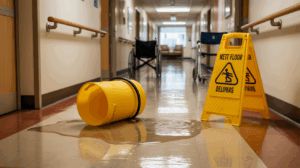
Routine cleaning and maintenance become a significant liability if not managed with disciplined safety protocols. To prove negligence, the evidentiary focus must scrutinize the hospital’s operational procedures through mopping timetables, training records, compliance audits, and photographic evidence of the placement and visibility of warning signage. Strategically, these records are used to dismantle the “reasonable care” defense by demonstrating that cleaning occurred during high-traffic periods or that staff failed to adhere to established safety standards.
3.2 Spilled Liquids and Leaks
The constant presence of fluids from sources like IV bags, ice machines, and HVAC condensate lines creates a persistent risk of transparent and easily missed slip hazards. Establishing the hospital’s actual or constructive notice of the hazard is critical, which can be accomplished by securing incident reports, reviewing maintenance logs, and obtaining surveillance footage. Strategically, surveillance footage is the most powerful of these, as it provides an objective, unassailable timeline that can neutralize defense claims of prompt response or a lack of notice.
3.3 Cluttered or Obstructed Walkways
In a high-traffic hospital environment, corridors can easily become cluttered with medical carts, IV poles, and electrical cords, creating obvious trip hazards. To establish liability, it is necessary to review incident logs for prior complaints, examine staffing patterns to determine if understaffing contributed to neglect, and analyze housekeeping policies and training records. This body of evidence is strategically vital to framing the incident not as an isolated accident, but as the predictable outcome of systemic operational failures.
3.4 Inadequate Lighting and Signage
Poor illumination in corridors, stairwells, and parking areas can conceal hazards and contribute significantly to falls. Proving this form of negligence involves comparing the facility’s lighting levels to accepted industry standards, reviewing maintenance records for bulb replacements, and using surveillance footage to demonstrate how shadows or dim light compromised visibility. This evidence allows counsel to argue that the hospital created a latent hazard by failing to meet objective, non-negotiable safety benchmarks.
With the liability framework firmly established through meticulous evidence gathering, the strategic focus pivots to the equally critical task of constructing a comprehensive and indefensible damages model.
4.0 A Tactical Framework for Case Development and Proving Liability
Developing a successful hospital slip and fall case demands a disciplined and time-sensitive strategy. Evidence in a hospital setting is uniquely ephemeral—surveillance footage is routinely overwritten, and incident details are quickly lost. Therefore, the immediate, methodical actions taken by the victim and their legal counsel are critical to preserving the claim and building an unassailable foundation for proving liability.
Immediate Post-Incident Protocols
A victim can take several critical steps immediately following an incident to protect both their health and their legal claim.
- Seek Immediate Medical Care: This action serves a dual strategic purpose: it prioritizes the client’s well-being while simultaneously creating the foundational medical record that incontrovertibly links the fall to the resultant injuries, preempting defense arguments that the harm originated from a pre-existing condition.
- Report the Incident Promptly: The fall must be reported to hospital administration to create an official record of the event. This action formalizes the time, location, and circumstances of the incident, locking in the hospital’s version of events before a defense narrative can be constructed. Obtaining an incident report number and the names of staff involved is a mandatory step.
- Preserve Evidence and Witnesses: This step secures the objective, contemporaneous proof needed to overcome conflicting testimony. Photographing the scene, the hazard, and injuries captures ephemeral conditions, while securing footwear and collecting witness contact information preserves physical evidence and invaluable third-party accounts of the event.
The Lawyer’s Investigative Role
Once engaged, legal counsel must execute swift, decisive actions to formally build the case and secure evidence that will otherwise be lost.
- Evidence Preservation: Counsel must immediately dispatch formal preservation letters and, if necessary, utilize subpoenas to secure surveillance footage, incident reports, and maintenance logs before they are overwritten or destroyed. This preempts spoliation and establishes a clear, documented timeline of events under the hospital’s control.
- Expert Consultation: A case built solely on lay testimony is vulnerable. Integrating expert analysis is a non-negotiable strategic imperative. Safety experts dismantle the hospital’s “reasonable care” defense by citing industry standards, while vocational and economic experts transform abstract suffering into a quantifiable, defensible damages model.
- Insurer Management: All communications with the hospital’s risk managers and insurance carriers must be exclusively managed by legal counsel. This controls the narrative, prevents the claimant from making damaging admissions, and allows counsel to challenge inadequate settlement offers with a well-substantiated, evidence-driven demand.
5.0 Assessing Damages and Pursuing Full Compensation
Once liability is clearly established, the strategic focus shifts to a comprehensive valuation of the claim. Florida law permits an injured party to recover compensation for a wide range of economic and non-economic damages that directly result from the hospital’s negligence. Constructing a meticulous and indefensible damages model is essential for commanding a full and fair settlement or prevailing at trial.
The following categories outline the primary damages that can be pursued in a hospital slip and fall claim:
- Medical Expenses: This category covers all past, present, and future medical costs related to the injuries.
- Emergency care, surgery, and hospitalization (Documentation: all itemized medical bills, hospital records, and explanation of benefits statements.)
- Rehabilitation and physical therapy (Documentation: therapy notes, billing statements, and physician prescriptions for treatment.)
- Future medical treatment and life-care costs (Documentation: a comprehensive life-care plan and report prepared by a qualified medical expert.)
- Lost Income and Earning Capacity: This compensates for the financial impact on the claimant’s ability to work.
- Wages lost from missed work (Documentation: pay stubs, employment records, and employer verification letters.)
- Diminished future earning potential due to long-term limitations (Documentation: tax returns, performance reviews, and a formal report from a vocational rehabilitation expert.)
- Pain and Suffering (Non-Economic Damages): This category addresses the significant physical and emotional toll of the injury.
- Physical pain and chronic syndromes (Documentation: pain management records, medical expert reports, and personal journals documenting daily impact.)
- Emotional distress, anxiety, and depression (Documentation: mental health treatment records, diagnoses, and expert psychological evaluations.)
- Loss of enjoyment of daily life (Documentation: testimony from the claimant, family, and friends detailing the inability to engage in pre-injury activities.)
- Associated Costs: These are out-of-pocket expenses incurred as a direct result of the injury.
- Assistive devices and home modifications (Documentation: receipts for walkers, ramps, grab bars, and invoices from contractors.)
- Household and caregiving services (Documentation: invoices or cancelled checks for hired help, and expert testimony on the value of replacement services.)
Securing full compensation also requires navigating the common legal defenses and procedural complexities that can limit or bar recovery.
6.0 Navigating Common Defenses and Procedural Hurdles
Hospitals and their insurers will deploy specific legal defenses and procedural challenges to minimize or defeat a claim. Experienced counsel must anticipate and strategically dismantle these hurdles to protect the client’s right to full recovery.
| Challenge | Description | Strategic Mitigation |
| Comparative Negligence | This defense argues that the claimant shares fault, claiming pre-existing mobility issues or failure to observe a warning contributed to the fall. The goal is to reduce the hospital’s liability percentage and the final award. | The counter-strategy involves using expert medical and biomechanical testimony to distinguish a patient’s baseline limitations from the acute, overriding hazard created by the hospital’s negligence, proving the breach was the primary cause. |
| Statute of Limitations | Florida imposes a strict two-year filing deadline for negligence actions. This window can be altered by nuances such as the victim’s age or if the defendant is a government-owned hospital with shorter presuit notice periods. | The only mitigation is immediate legal consultation to identify all responsible parties and track every applicable deadline. Failing to file within the statutory window results in the claim being permanently barred, making timely action non-negotiable. |
| Third-Party Liens | Government benefit programs like Medicare and Medicaid have a statutory right to seek reimbursement from a settlement or verdict for medical care they covered. These liens must be resolved before disbursing funds. | Counsel’s role is to obtain and verify all conditional payments, aggressively negotiate all permissible reductions on the final lien amount, and ensure all legal obligations are resolved to maximize the client’s net recovery. |
Navigating these complexities successfully underscores the critical need for specialized legal expertise in this niche area of premises liability litigation.
7.0 Conclusion: Key Strategic Imperatives for Litigating Florida Hospital Slip and Fall Claims
Florida hospital slip and fall cases are complex, high-stakes matters that demand a sophisticated and proactive legal strategy. The unique intersection of premises liability law, hospital operational standards, and the ephemeral nature of evidence creates a challenging litigation environment. Success depends on a swift, evidence-driven approach that combines deep knowledge of Florida law with meticulous case management from the moment the incident occurs.
For legal professionals, achieving a just outcome mandates adherence to several critical strategic imperatives:
- Master the Initial 48 Hours: The viability of a claim is often won or lost in the first 48 hours post-incident. Immediate, aggressive action to preserve ephemeral evidence like surveillance footage is not merely important; it is the foundational imperative upon which all subsequent strategy rests.
- Integrate a Multi-Disciplinary Expert Team: A claim built on lay testimony alone is inherently vulnerable. Mandate the integration of opinions from medical, safety, vocational, and economic experts to validate negligence, dismantle defenses, and substantiate the full value of long-term damages.
- Dismantle Defenses Proactively: Do not wait for the defense to raise issues of comparative negligence or statutory deadlines. A proactive strategy anticipates these arguments from the outset and builds a factual record designed specifically to neutralize them before they can gain traction.
- Construct an Indefensible Damages Model: Ultimate success is measured by the client’s recovery. This requires constructing a detailed and meticulously documented calculation of all economic and non-economic damages to command full and fair compensation and justify the claim’s value to insurers and juries.


We Can Help.