




If you’ve suffered a spinal cord injury in Miami, you need counsel early to protect your rights, preserve evidence, and meet strict deadlines.
You can rely on Law Offices of Anidjar and Levine to manage insurer communications, prevent harmful statements, and investigate promptly through records requests, scene review, and witness outreach.
Your claim should reflect full losses, including future treatment, rehabilitation, attendant care, and home modifications.
If your injury may involve negligent care, learn more from a Miami Medical Malpractice Lawyer.
Keep going to see how causes, timing, and lawyer selection affect outcomes.



Main Takeaways
- Seek a Miami spinal cord injury lawyer early to protect rights, preserve evidence, and meet Florida’s filing deadlines.
- Counsel manages insurer communications to prevent harmful statements and to demand full value for lifelong medical and home care needs.
- A strong firm conducts a prompt investigation through scene review, witness statements, and complete medical records, imaging, and incident reports.
- Attorneys use medical experts, life-care planners, and vocational analysts to prove causation and quantify future costs and lost earnings.
- Choose counsel with catastrophic-injury experience, clear written contingency fees and costs, and reliable, bilingual communication if needed.
How We Can Help With Your Miami Spinal Cord Injury Claim
Although a spinal cord injury can change nearly every part of your life, you don’t have to manage the legal and financial fallout alone.
You’re entitled to counsel that treats your claim as a responsibility to your family and your future, not merely a file number.
You’ll get clear guidance, steady communication, and a plan shaped around what you can’t afford to lose.
You can rely on us to gather records, coordinate with medical providers, and document the full scope of your losses, including long-term care and reduced earning capacity.
Rely on us to gather records, coordinate medical providers, and document losses like long-term care and reduced earning capacity.
You’ll benefit from Strategic Negotiation that pushes back against low offers, corrects incomplete narratives, and keeps pressure on insurers and opposing counsel.
You’ll also receive Settlement Planning that aligns any resolution with ongoing treatment needs, home adjustments, and financial stability.
When litigation becomes necessary, you’ll have an advocate ready to present your story with discipline and credibility in court.
Understanding Miami Spinal Cord Injury Cases
Once you’ve secured counsel to manage evidence, negotiations, and long-term planning, it helps to understand what makes Miami spinal cord injury cases distinct and why the details matter from day one.
You’ll face a claim that turns on measurable impairment, future medical needs, and how clearly your limitations connect to the incident, treatment timeline, and expert opinions.
Your team must organize records, preserve imaging, and document daily impacts to ensure your story remains consistent and credible.
You also need to anticipate how jurors in Miami will weigh responsibility, personal accountability, and the reliability of medical testimony.
At the same time, insurance complexities can shape every decision, including policy limits, coverage exclusions, liens, and disputes over life-care projections.
When you approach the case with discipline and service-minded purpose, you protect your household’s stability while ensuring the process honors the seriousness of your injury and the community’s standards of fairness.


Common Causes of Miami Spinal Cord Injuries
In Miami, you can suffer a spinal cord injury in a motor vehicle collision, where sudden impact forces can damage the spine and surrounding nerves.
You may also face serious harm after a slip and fall accident or a workplace incident, especially when unsafe property conditions or inadequate safety practices create preventable risks.
You should also consider sports and recreation trauma, since high-speed activities and contact sports can cause catastrophic spinal injuries in a single event.
Motor Vehicle Collisions
When a crash delivers sudden force to the body, a motor vehicle collision can damage the spinal cord in seconds through violent flexion, extension, or compression of the spine.
You may face long-term limitations in mobility and independence, so prompt medical care and careful documentation are essential.
In Miami, rear-end impacts, high-speed lane changes, and side collisions at busy crossings often produce these injuries.
Unsafe Intersection Design, poor lighting, and confusing signals can increase the chance of a catastrophic hit.
You can also serve your community by prioritizing Vehicle Maintenance, because worn tires, faulty brakes, and broken lights raise risk for everyone on the road.
If another driver, a fleet operator, or a roadway authority failed in their duty, you can pursue accountability while supporting safer streets for others.
Slip And Fall Accidents
Although people often associate spinal cord trauma with high-impact crashes, slip and fall accidents can also cause devastating injuries through sudden back-and-neck loading on hard surfaces.
When you lose traction, your body may twist, compress, or hyperextend, and a single impact can damage vertebrae and spinal nerves.
You often see these incidents where Lighting design is poor, shadows hide changes in elevation, or glare obscures wet areas.
Flooring materials also matter because slick tile, worn carpet edges, and uneven thresholds can compromise safe footing, especially in entryways during rain.
If you’re hurt, document the scene promptly, identify witnesses, and seek medical evaluation even if symptoms seem mild. By pursuing accountability, you help protect others from the same hazard.
Workplace Injury Incidents
Because many Miami jobs involve physical labor, tight deadlines, and shared workspaces, workplace incidents remain a leading cause of spinal cord injuries, even outside obvious construction hazards.
You may face falls from ladders, collapsing shelves, or being struck by objects in warehouses, hospitals, and delivery routes, where one misstep can cause permanent harm.
When Safety Protocols aren’t enforced, you’re exposed to unsafe lifting practices, poor traffic control, and inadequate training, all of which increase the risk of spinal trauma.
Equipment Failures also create sudden danger, including malfunctioning forklifts, defective harnesses, and broken handrails that give way without warning.
If you serve others through your work, you merit the same duty of care in return, supported by proper oversight and accountability.
Sports And Recreation Trauma
Work sites aren’t the only places where a single impact can change your life; Miami’s sports and recreation scene also produces spinal cord injuries with alarming speed.
On fields, courts, and water, a hard collision, a fall from a bicycle, or a shallow-water dive can compress the spine and disrupt nerve function in seconds.
You can reduce risk by supporting Helmet Safety policies, insisting on properly fitted gear, and modeling safe technique for younger athletes.
If a head impact occurs, you shouldn’t “play through,” you should request prompt evaluation and follow disciplined Concussion Management to prevent repeat trauma.
When an incident happens despite precautions, you can still serve others by documenting the scene, reporting hazards, and encouraging teammates to seek care, since early treatment often protects long-term mobility.
Legal Rights of Miami Spinal Cord Injury Victims
When a spinal cord injuryupends your life in Miami, you still retain strong legal rights that can help you secure medical care, income support, and long-term assistance.
You can pursue compensation from negligent drivers, property owners, employers, or product manufacturers, and you can demand accountability that helps protect others from similar harm.
Florida law also recognizes the full scope of losses you may face, including future treatment needs, reduced earning capacity, and the cost of ongoing support.
- You can claim economic damages for medical bills, rehabilitation, adaptive equipment, and attendant care.
- You can seek non-economic damages for pain, suffering, and loss of enjoyment of life.
- You may invoke Employment Protections, including reasonable workplace adjustments and safeguards against disability-based discrimination.
- You can request Housing Accommodations that promote accessibility, safety, and independent living, while enforcing fair housing rights under state and federal law.



Steps to Take After a Miami Spinal Cord Injury
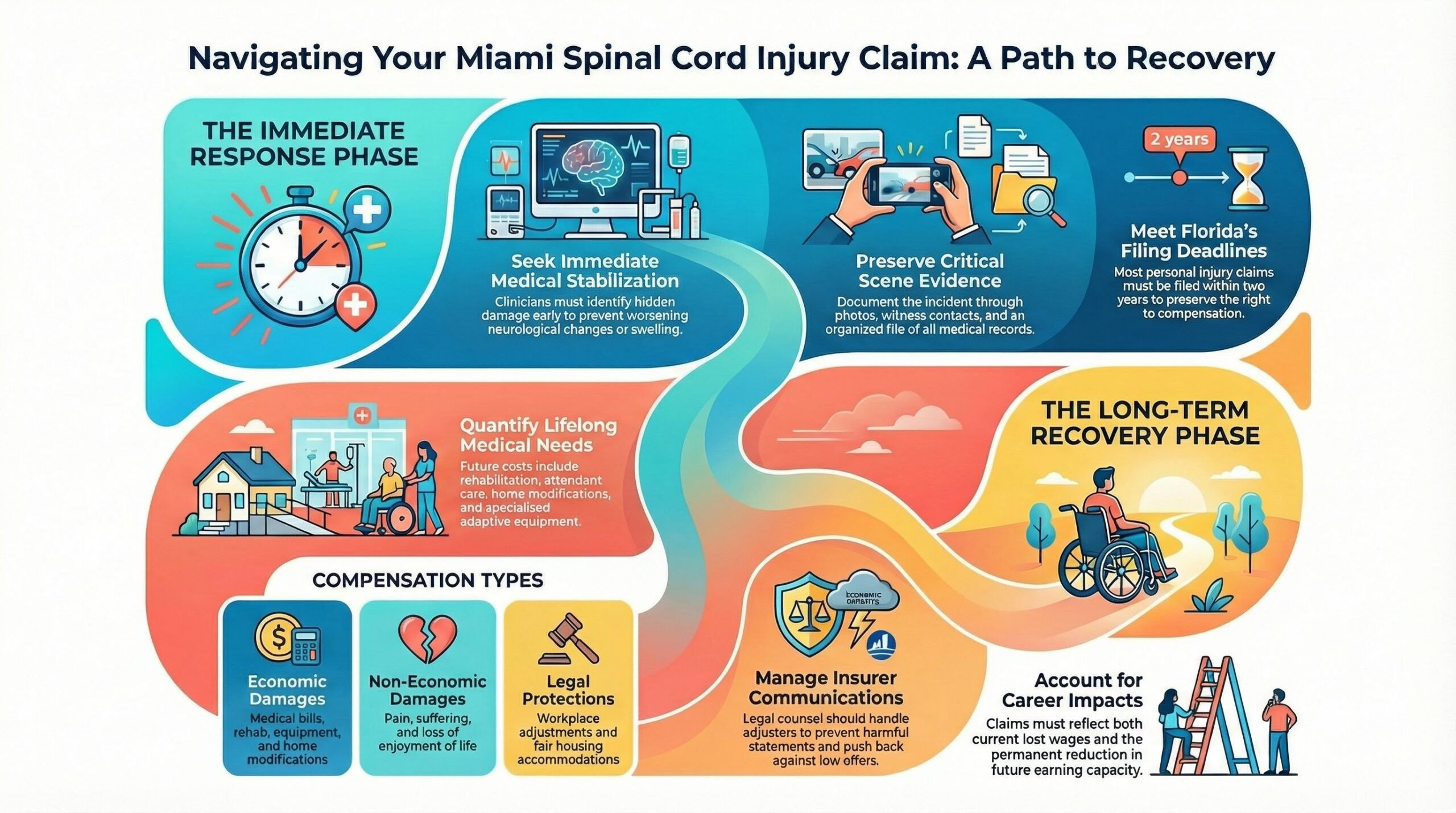
After a Miami spinal cord injury, you must seek immediate medical care, even if symptoms seem unclear, because prompt treatment also creates crucial documentation.
You should preserve evidence and records by photographing the scene, saving communications, and keeping all medical bills and discharge instructions in one organized file.
You’ll also want to consult a Miami attorney as soon as possible, so you can protect your rights, avoid costly missteps, and position your claim for fair compensation.
Seek Immediate Medical Care
Although you may feel stable enough to delay treatment, seeking immediate medical care is the most critical step after a Miami spinal cord injury.
Call 911 or go to an emergency room so you receive an Emergency assessment, where clinicians can identify hidden spinal damage, internal bleeding, or neurological changes that aren’t yet obvious.
Follow instructions closely, keep your neck and back still, and don’t attempt to “walk it off,” because unnecessary movement can worsen the injury.
Rapid stabilization protects your airway, breathing, and circulation, while imaging and neurological checks guide early decisions that may limit swelling and preserve function.
By acting quickly, you also safeguard your ability to continue serving others, since timely care supports a safer recovery and a clearer treatment path.
Attend all recommended follow-up appointments promptly.
Preserve Evidence And Records
Preserving evidence and records starts at the scene and continues through every stage of treatment, and it can substantially strengthen your spinal cord injury claim in Miami.
If you’re able, photograph vehicles, hazards, and visible injuries, then write down names, contact details, and brief witness statements.
Ask someone you trust to help, so you can focus on recovery while still protecting the facts for everyone affected.
Keep every medical record, discharge paper, prescription list, and referral, and request complete billing ledgers from each provider.
Save emails, texts, and portal messages related to appointments, symptoms, and work restrictions.
Create Digital Backups of photos and documents, and avoid editing original files to protect Metadata Retention.
Maintain a dated journal of pain levels, mobility limits, and daily assistance needs, and store it securely.
Consult A Miami Attorney
Reach out to a Miami spinal cord injury attorney as soon as you can, because early legal guidance helps you protect your rights while critical evidence and deadlines remain within your control.
You’ll clarify what to say to insurers, how to document losses, and which communications should go through counsel.
You can also align your case strategy with your commitment to serve others by focusing on long-term care needs, family stability, and fair accountability.
Ask for fee transparency in writing, including costs, medical lien issues, and how a contingency fee works.
If your household members or witnesses speak Spanish or Haitian Creole, request bilingual services to ensure everyone can provide accurate statements without confusion.
Your attorney can coordinate records, consult experts, and prepare a demand that reflects the full scope of harm.
How a Miami Spinal Cord Injury Lawyer Can Help You
When a spinal cord injury disrupts your life, a Miami spinal cord injury lawyer can step in quickly to protect your rights and stabilize your claim.
You shouldn’t have to manage paperwork, deadlines, and insurers while you focus on care and supporting those who depend on you.
Your attorney coordinates evidence, confirms liability, and keeps communications disciplined and respectful.
- Investigate decisively: You’ll get prompt scene review, witness outreach, and records requests to preserve evidence before it disappears.
- Handle insurer pressure: Your lawyer speaks for you, prevents damaging statements, and pushes for fair valuation and timely responses.
- Document losses: You’ll receive organized support for medical bills, missed income, and needed services, with clear, defensible summaries.
- Support your household: Through Family Counseling referrals and Benefit Navigation, you can provide steadier guidance and maintain dignity throughout the process.
Long-Term Effects of Miami Spinal Cord Injuries
After a Miami spinal cord injury, you may face chronic pain and spasticity that persist long after the initial trauma, affecting sleep, concentration, and daily function.
You can also experience a lasting loss of mobility and independence, which affects how you work, travel, and manage personal care.
As treatment continues, you’ll likely confront ongoing medical care costs, including therapy, equipment, medications, and home modifications that add up over time.
Chronic Pain And Spasticity
Although many people expect the most serious challenges to end once the initial trauma stabilizes, chronic pain and spasticity often become lasting complications of a Miami spinal cord injury.
You may feel burning, stabbing, or deep aching pain that persists despite recovery, while involuntary muscle tightness can disrupt sleep and daily routines.
These symptoms can fluctuate, so you’ll need consistent tracking and coordinated care to reduce setbacks.
Your clinical team may recommend medication adjustments, targeted stretching, and Neuromodulation therapies to interrupt pain signaling and calm overactive muscle responses.
Just as important, Psychological coping helps you manage stress, maintain patience with slow progress, and stay present for the people who rely on your steady service.
When symptoms affect your work and finances, document them carefully for accountability and support.
Mobility And Independence Loss
Even if your acute symptoms improve, a Miami spinal cord injury can permanently change how you move through your home, workplace, and community.
You may need a wheelchair, braces, or assisted transfers, and everyday tasks such as bathing, cooking, or driving may require new routines.
If you’re committed to serving others, this shift can be especially difficult because you must balance your desire to help with practical limits on energy and access.
Adaptive Technology can restore meaningful control, such as voice-activated devices, power mobility, and vehicle hand controls, enabling you to participate more fully.
Home Modifications, including ramps, widened doorways, roll-in showers, and lowered counters, can reduce fall risks and preserve privacy.
With planning, you can protect autonomy while staying engaged in family and service roles.
Ongoing Medical Care Costs
Regaining day-to-day independence often requires more than equipment and home changes, because a spinal cord injury also brings ongoing medical needs that don’t end when you leave the hospital.
You may face recurring specialty visits, therapy, medication management, skin and respiratory monitoring, and periodic hospitalizations for complications that arrive without warning.
These services add steady costs, and they often increase as you age.
To protect your family and support others who depend on you, you’ll need clear documentation of every expense.
Request itemized statements, track pharmacy and durable medical supplies, and use Billing Audits to catch duplications or improper coding.
With Cost Forecasting, you can project future care, including attendant services and replacement schedules, so your claim reflects long-term realities rather than short-term invoices.
Proving Liability in Miami Spinal Cord Medical Malpractice Injury Cases
Because a spinal cord injury can permanently change your mobility and independence, proving liability in a Miami medical malpractice case requires a disciplined, evidence-driven approach.
You must show the provider owed you a duty of care, breached the accepted medical standard, and caused harm that wouldn’t have occurred with proper treatment.
Start by securing complete records, imaging, operative notes, and nursing charts, then document the timeline with precision.
You’ll rely on Expert Witnesses in the same specialty to explain what competent clinicians would’ve done and where the care fell short.
A rigorous Causation Analysis connects the negligent act, such as delayed diagnosis, surgical error, or improper post-operative monitoring, to the spinal cord damage.
You should preserve communications, incident reports, and device logs when applicable, and identify every responsible party, including physicians, hospitals, and supervising entities.
Compensation for Miami Spinal Cord Damages
While a spinal cord injury often creates lifelong consequences, your compensation claim in Miami should focus on the full scope of losses the negligence caused, not just the initial hospital bill.
You should document future surgeries, rehabilitation, attendant care, mobility equipment, home and vehicle modifications, and the wages you’ll likely lose over time.
You can also pursue damages for pain, suffering, and diminished enjoyment of life, so your claim reflects what it now takes to serve your family and community with stability and dignity.
You’ll strengthen value by using clear medical projections, vocational analysis, and life-care planning that ties each expense to functional needs.
You should also evaluate Tax Implications, including how interest, punitive awards, or certain allocations may be treated.
In serious cases, Structured Settlements can provide reliable, long-term payments, reduce financial missteps, and support ongoing care without sacrificing accountability for the harm done.
The Statute of Limitations for Miami Spinal Cord Injury Cases
Even if you’re still focused on treatment and adapting to new limitations, Florida’s statute of limitations can quietly control whether you’ll have the right to pursue compensation for a Miami spinal cord injury.
In many personal injury matters, you generally must file within two years of the incident, and missing that deadline can bar recovery no matter how serious your losses are.
Because your ability to provide for family and support others may depend on timely action, you should track crucial dates carefully.
Certain facts can shift when the clock starts.
Under the Discovery Rule, the filing period may begin when you knew, or reasonably should’ve known, that negligence caused the harm, not always the day symptoms appeared.
Florida also recognizes limited Tolling Exceptions, such as when a defendant can’t be located, fraud, concealed wrongdoing, or the injured person is legally incapacitated.
Preserve records and confirm the correct deadline early.
Why You Need an Experienced Miami Spinal Cord Injury Lawyer
Meeting Florida’s filing deadline is only the starting point in a Miami spinal cord injury case, since insurers and defendants often use every available tactic to reduce what they pay or avoid liability altogether.
You need experienced counsel to anticipate those moves, preserve crucial evidence, and present your losses with discipline and credibility.
When your mobility, independence, and ability to serve others are at stake, a lawyer’s Case Strategy can’t be improvised.
You benefit from a plan that aligns medical proof, vocational limits, and life-care needs, while challenging blame-shifting and minimizing arguments.
An experienced attorney also manages communications so you don’t unintentionally harm your claim, and they pursue full compensation for treatment, equipment, home modifications, and long-term support.
Through consistent Client Advocacy, you’re treated with respect, your priorities remain central, and negotiations stay focused on accountability, not convenience.
If trial becomes necessary, you’re prepared, not pressured.
How to Choose the Right Miami Spinal Cord Injury Lawyer for Your Case
Choosing the right Miami spinal cord injury lawyer comes down to three essential elements: focused experience, credible resources, and a communication style that protects your claim.
You should prioritize attorneys who routinely handle catastrophic injury cases, understand long-term medical needs, and can document future care with reputable experts.
Ask how they investigate liability, preserve evidence, and address insurance tactics, because early missteps can reduce the support you can provide your family and community.
Evaluate the lawyer’s Communication Style during your first contact.
You’re entitled to clear timelines, prompt updates, and guidance that keeps you from making statements that weaken your case.
Confirm Fee Transparency in writing, including contingency terms, costs, and how expenses get handled if the case doesn’t succeed.
Finally, choose someone who treats your recovery as a service mission, pursuing full compensation so you can restore stability and continue serving others.
About the Law Offices of Anidjar and Levine
After you’ve identified the qualities that matter in a Miami spinal cord injury lawyer, you should also evaluate the firm’s track record and day-to-day approach to client service.
With the Law Offices of Anidjar and Levine, you can expect a team that treats your case as a responsibility to you and to the wider community, not merely a file number.
You’ll see that the firm’s Firm History reflects sustained focus on serious injury claims, disciplined preparation, and consistent follow-through.
You’re kept informed through clear updates, timely responses, and practical guidance that helps you make decisions with confidence.
The attorneys coordinate medical records, consult appropriate medical experts, and document damages so your claim is supported by reliable evidence.
Stay informed with clear updates, timely responses, and evidence-backed support through coordinated records, expert input, and thorough damage documentation.
If you value service, the firm’s Community Outreach signals a commitment to helping others beyond the courtroom.
You can pursue accountability while supporting safer practices for everyone in Miami.
Frequently Asked Questions
Will My Health Insurance or Medicaid Need Reimbursement From My Settlement?
Yes, you may need to reimburse your health insurer or Medicaid from your settlement.
They often assert subrogation rights and pursue lien enforcement for medical bills they’ve paid related to your injury.
You should request a full lien statement, confirm the charges are injury-related, and challenge errors or non-covered services.
When you negotiate reductions, you protect your recovery and preserve funds to support your ongoing care and service.
How Are Structured Settlements Used for Lifelong Spinal Cord Care Costs?
You use structured settlements to convert part of your recovery into scheduled payments that match lifelong spinal cord care costs, including attendants, equipment, and home modifications.
You’ll select an Annuity Structure that provides monthly income plus periodic lump sums for predictable replacements.
You can add Inflation Protection to ensure payments rise with medical inflation.
You’ll coordinate terms with benefit eligibility and caregiving goals to ensure steady resources for those who serve you.
Can I Recover Damages if I Was Injured While Visiting Miami From Another State?
Yes, you can recover damages for injuries suffered while visiting Miami from another state.
You’ll typically file in Florida, where the incident occurred, and establish personal jurisdiction over the responsible party.
Act promptly, because filing deadlines can bar an otherwise valid claim.
Preserve evidence, obtain medical records, and document how the injury limits your ability to serve others.
You should also carefully coordinate treatment and expenses across state lines.
What Happens if the At-Fault Driver Is Uninsured or Underinsured in Florida?
If the at-fault driver is uninsured or underinsured in Florida, you’ll often rely on your own auto policy for protection.
You can file a claim under Uninsured Motorist coverage to pursue compensation beyond PIP, including pain and suffering.
If you carry multiple vehicles or policies, you may qualify for Stacking Limits, which increase your available coverage.
You should notify your insurer promptly, document losses carefully, and cooperate with required evaluations.
How Are Spinal Cord Injury Settlements Taxed Under Federal and Florida Law?
You’ll typically exclude from federal income tax the settlement amounts tied to physical injury, including medical bills and pain and suffering, and Florida won’t impose state income tax.
However, Taxable components can include punitive damages, pre-judgment interest, and any wages not linked to the injury’s physical harm.
You should document allocations carefully and use proactive Tax planning to preserve funds for ongoing care and meaningful service to others.
—————————
When you suffer a spinal cord injury in Miami, you’re facing medical uncertainty, lost income, and long-term care decisions that can’t wait.
You can protect your rights by documenting the incident, following the treatment plan, and consulting counsel before the deadlines expire.
Law Offices of Anidjar and Levine can investigate liability, calculate damages, negotiate aggressively, or take your case to trial if needed. You don’t have to manage insurers alone.
Act promptly to preserve evidence.
Learn more about your legal options here: Miami Medical Malpractice Lawyer


We Can Help.