



1.0 Introduction: The Strategic Challenge of Impaired Driving Litigation
The convergence of major commercial corridors, intense port activity, and dense urban traffic makes Miami a high-risk environment for catastrophic commercial vehicle accidents. When a Miami truck driver’s impairment from drugs is a factor, the complexity of the subsequent legal claim escalates dramatically. Litigating these high-stakes cases demands a disciplined, evidence-based strategy from the moment of impact. Success is not achieved by chance; it is the direct result of a rapid, methodical process designed to uncover the truth, establish clear lines of accountability, and ensure victims are made whole.
The core objective of this case study is to analyze the integrated legal and evidentiary strategies required to navigate these claims effectively. We will deconstruct the process of proving driver impairment and linking it to the collision, extending liability beyond the driver to the carrier, and meticulously quantifying the full spectrum of a victim’s damages. This analysis demonstrates how a litigation-ready approach, built on a foundation of verifiable facts and expert analysis, creates the leverage necessary to secure full and fair compensation for victims and their families.
The entire strategic framework rests on a single foundational element: a clear and precise understanding of the specific nature of the driver’s impairment.



2.0 The Anatomy of Driver Impairment: Common Causation Factors
Strategically, understanding the root cause of a commercial driver’s impairment is the first critical step in building a successful claim. Identifying the specific substance—or combination of substances—involved directly shapes the evidentiary strategy, dictating the necessary toxicology analysis, expert testimony, and investigation into the carrier’s oversight failures. Each category of impairment introduces distinct challenges and requires a tailored approach to prove causation and liability.
2.1 Prescription Medication Misuse
Prescription medications, even when taken with therapeutic intent, can profoundly undermine a driver’s ability to operate a commercial vehicle safely. Drugs such as sedatives, certain painkillers, and even antihistamines can quietly erode a driver’s alertness, judgment, and reaction time. Impairment often arises from dosing errors or a failure to heed “do not drive” advisories. Evidence of medication diversion within a fleet—where drivers share or acquire prescription drugs without proper oversight—directly supports a claim for negligent supervision and a systemic failure to enforce a clear drug and alcohol policy under FMCSA regulations.
2.2 Illicit Drug Consumption
The consumption of illicit substances like stimulants or opioids introduces a severe and unacceptable risk into the operation of an 80,000-pound commercial truck. These drugs fundamentally distort a driver’s perception and reaction time, turning minor operational lapses into devastating collisions. Litigating these cases requires a rigorous investigation into the operational pressures that allowed an impaired driver onto the road. Exposing logbook patterns that indicate concealment or coercive dispatching is powerful evidence of negligent supervision, transforming a driver’s bad act into a carrier’s actionable, systemic failure.
2.3 Marijuana Impairment
As a distinct category, marijuana impairment degrades the specific cognitive and motor functions essential for safe commercial driving. The primary effects include delayed reaction times, which hamper a driver’s ability to respond to sudden traffic changes, and poor lane control resulting from degraded motor coordination. Cannabis also impairs short-term memory, which can cause a driver to miss critical navigation cues or forget recent instructions. Furthermore, it distorts the perception of time and distance, undermining a driver’s capacity to maintain safe following distances and execute merge decisions properly.
2.4 Polydrug and Alcohol Combination
The simultaneous use of multiple substances, particularly in combination with alcohol, creates a synergistic effect that amplifies impairment in unpredictable ways. This combination significantly increases the risk of critical driving errors such as lane departures and delayed braking. Proving polydrug use is strategically critical because it elevates the driver’s conduct to a level of recklessness that can unlock punitive damages. It demonstrates a conscious disregard for safety that demands a higher degree of accountability from both the driver and the carrier that failed to prevent it.
Understanding these distinct causes of impairment provides the necessary foundation for constructing the legal framework required to prove them in a formal claim.
3.0 The Litigation Framework: From Crash Scene to Courtroom
Building a successful, litigation-ready case in the wake of a drug-impaired truck accident depends on a rapid, methodical, and multi-pronged strategy that begins moments after the collision. Every action taken—from securing the scene to formally demanding carrier records—is a critical step in a disciplined process designed to establish liability and preserve the victim’s rights.
3.1 Phase I: Immediate Response and Evidence Preservation
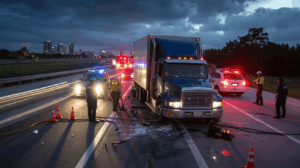
The actions taken in the immediate aftermath of a crash are foundational. The primary goal is to ensure safety while simultaneously initiating the evidence preservation process that will support the future claim.
- Scene Safety and Stabilization: The first priority is assessing for immediate hazards like leaking fuel or unstable cargo and securing the perimeter with reflective triangles or flares to prevent secondary collisions.
- Official Notification: Promptly contacting police and Emergency Medical Services (EMS) is essential. This action initiates an official response, creates a formal crash report, and secures a professional medical evaluation for all involved parties—a critical record for demonstrating injuries.
- On-Scene Information Capture: Before the scene is cleared, it is vital to capture initial evidence. This includes photographing vehicle positions, skid marks, and roadway debris, as well as collecting the names and contact details of any witnesses.
3.2 Phase II: Building the Evidentiary Foundation
With the immediate scene managed, the focus shifts to a coordinated effort to build a comprehensive body of evidence. This phase requires the integration of legal action and expert analysis to formally link the driver’s impairment to the crash. Experts in toxicology, accident reconstruction, and vehicle telematics work in concert to analyze data and form defensible conclusions about causation. Key evidentiary components must be formally preserved through legal demands and, if necessary, subpoenas.
- Electronic Data: This includes “black box” or Electronic Control Module (ECM) data, dashcam footage, GPS records, and electronic driver logs, all of which provide an objective timeline of the truck’s operation.
- Toxicology and Medical Records: Lawful drug and alcohol test results are paramount. It is critical to obtain these records along with documented chain-of-custody reports to ensure their admissibility.
- Carrier and Dispatch Records: Formal preservation demands must be sent to the trucking company to retain all dispatch communications, vehicle maintenance files, and the driver’s complete hiring, training, and qualification files.
3.3 Phase III: Establishing Comprehensive Liability
A key strategic objective is to extend liability beyond the individual driver to the motor carrier. This is accomplished by investigating whether the company engaged in negligent entrustment or supervision by failing to enforce safety policies or ignoring red flags. A thorough carrier investigation scrutinizes several key areas:
- Compliance Audits: The carrier’s adherence to Federal Motor Carrier Safety Administration (FMCSA) regulations is examined, including rules governing hours-of-service, driver qualifications, and vehicle maintenance.
- Policy Enforcement: The investigation audits the carrier’s own policies on substance use, including its protocols for random drug testing and mandatory post-incident screenings. A policy that exists only on paper is evidence of systemic failure.
- Operational Pressures: A review of logbooks and dispatch records can reveal patterns of coercive dispatching or unrealistic schedules that encourage unsafe behaviors, including substance use to combat fatigue.
Once fault has been methodically established through this framework, the focus shifts to the equally critical task of quantifying the full extent of the harm suffered by the victim.


4.0 Quantifying Harm and Securing Full Compensation
Proving liability is the first pillar of a successful claim, but a comprehensive valuation of the victim’s long-term harm is essential to securing a just financial recovery. The consequences of a high-impact collision with a commercial vehicle often extend far beyond the initial injuries, creating a cascade of physical, cognitive, and emotional challenges. Meticulously documenting and quantifying these damages through objective evidence is a strategic imperative.
4.1 Chronic Pain Complications
For many survivors, the most enduring consequence is chronic pain, a condition that can severely limit mobility and undermine the capacity to work. An effective claim requires documentation through pain management logs, pharmacy records, and expert testimony from a physiatrist to establish the need for long-term, evidence-based management, which may include physical rehabilitation, non-opioid pharmacology, and other sustained therapies.
4.2 Cognitive and Memory Deficits
Traumatic brain injuries sustained in these crashes can lead to lasting cognitive and memory deficits, disrupting a victim’s professional life and threatening their independence. These deficits must be objectively documented through neuropsychological evaluations and translated into financial terms by vocational experts to quantify diminished earning capacity and project future care needs.
4.3 Emotional and Psychological Trauma
The “invisible injuries” of emotional and psychological trauma are just as debilitating as physical ones. Conditions such as anxiety, depression, and Post-Traumatic Stress Disorder (PTSD) are predictable responses to a catastrophic accident. For a claim to succeed, it is crucial that they are substantiated through the records of treating psychologists or psychiatrists to form a credible basis for non-economic damages.
Florida Law and Recoverable Damages
Under Florida law, victims of drug-impaired truck driver negligence have the right to seek full compensation for their losses. This compensation is typically categorized as follows:
- Economic Damages: This includes all calculable financial losses, such as past and future medical expenses, lost income, and the loss of future earning capacity.
- Non-Economic Damages: These damages are intended to compensate for the human impact of the injuries, including physical pain, emotional suffering, and the loss of enjoyment of life.
- Punitive Damages: In cases where the driver’s impairment demonstrates a reckless disregard for the safety of others, Florida law may permit an award of punitive damages, which are intended to punish the wrongdoer and deter similar conduct.
Securing this compensation requires not only proving the damages but also navigating the procedural and strategic hurdles inherent in complex litigation.
5.0 Navigating Procedural and Strategic Hurdles
Beyond proving liability and quantifying damages, successful litigation requires navigating a landscape of critical legal deadlines, complex doctrines, and common defense tactics. A failure to manage these procedural elements with precision can jeopardize an otherwise strong case.
5.1 The Florida Statute of Limitations
Time is a critical factor in any negligence claim. In Florida, the statute of limitations for personal injury actions is generally two years from the date of the crash. Missing this deadline can permanently bar a victim’s right to recovery. While certain tolling exceptions may exist—such as a defendant’s active concealment of facts or a victim’s legal incapacity—these exceptions are narrowly applied and should not be relied upon. A disciplined legal strategy involves immediately identifying all potential defendants and calendaring every applicable deadline.
5.2 The Doctrine of Comparative Negligence
Defense counsel will often attempt to shift blame by arguing that the victim was partially at fault for the accident. Under Florida’s comparative negligence doctrine, a victim can still recover damages even if found to be partially responsible, but their financial award will be reduced by their percentage of fault. The primary strategy to counter these claims is to use accident reconstruction analysis, vehicle data, and witness testimony to present a clear, fact-based narrative that accurately apportions fault.
5.3 Ancillary Case Management Issues
Several other practical issues frequently arise during litigation and must be managed proactively to protect the integrity of the claim.
- Social Media Risks: Defense counsel and insurance investigators routinely scrutinize a claimant’s social media profiles, searching for posts that could be used to contradict claims about injuries. Clients should be advised to set all profiles to private and refrain from discussing any aspect of the accident or their recovery online.
- Handling Medical Liens: When medical bills are paid by health insurers or government programs, those entities often place a lien on any future settlement funds. Legal counsel is responsible for verifying the validity of these liens, negotiating reductions where possible, and ensuring all legitimate liens are paid from the settlement proceeds.
5.4 Defeating Bad Faith Insurance Tactics
Beyond procedural rules and defense arguments, litigation involves actively countering insurer tactics designed to delay, deny, or underpay legitimate claims. Under Florida law, insurers have a duty to handle claims in “good faith,” which requires timely and transparent communications. This duty provides a powerful legal tool to compel fair dealing and punish unreasonable delays or lowball settlement offers that are not based on a realistic evaluation of the facts.
Navigating these complexities underscores why specialized legal expertise is not a luxury but an absolute necessity in these cases.
6.0 Conclusion: Strategic Imperatives for Litigating Impairment Cases
Success in drug-impaired commercial vehicle litigation is the product of a highly disciplined and integrated strategy. It demands a combination of rapid evidence preservation at the outset, sophisticated integration of toxicology and reconstruction experts, and a deep understanding of both federal carrier regulations and the profound, long-term impacts of catastrophic injuries on victims. The process requires moving with urgency to secure perishable data while simultaneously building a comprehensive narrative of negligence that extends from the driver’s actions to systemic failures at the carrier level.
For legal counsel, achieving a just outcome for victims in these complex cases hinges on adherence to several core imperatives:
- Commanding FMCSA regulations and toxicology evidence to build an irrefutable case of negligence.
- Adopting a trial-ready approach from day one to create maximum settlement leverage and prepare for court.
- Aggressively tracing liability from the driver to the carrier by exposing systemic safety failures and negligent supervision.
- Executing a disciplined process for documenting and quantifying both economic and non-economic damages through expert testimony.
Ultimately, a diligent, expert-led legal approach is essential to protect the rights of those harmed, hold all responsible parties accountable, and secure the justice and financial recovery that victims deserve.


We Can Help.