




The Law Offices of Anidjar and Levine handles Orlando truck accident claims involving logbook and ELD violations by acting fast to preserve driving-time evidence, including raw ELD exports, dispatch messages, GPS data, fuel and toll receipts, and onboard video before it’s overwritten.
We compare these records against hours-of-service logs to identify edits, gaps, and falsified rest breaks that can demonstrate fatigue and carrier pressure.
We also track deadlines, including Florida’s two-year filing rule.
Learn more from our Orlando Truck Accident Lawyer.
Key Takeaways
- An Orlando truck accident lawyer can investigate logbook and ELD violations to show fatigue, missed breaks, or illegal driving hours.
- Act fast to preserve raw ELD exports, dispatch messages, GPS data, fuel receipts, tolls, and camera footage before they’re overwritten.
- Compare paper logs, ELD timelines, and supporting documents to expose falsified entries, edits, deleted unassigned miles, or time-shifting.
- Send preservation letters to prevent spoliation and stop repairs, towing releases, or vehicle disposal without documented consent.
- Use carrier records, training policies, and prior inspection history to demonstrate that negligent oversight and dispatcher pressure contributed to violations.
How We Can Help With Your Orlando Truck Accident Logbook Violations Claim
Because logbook violations often reveal how a crash happened and who cut corners, we focus early on securing and analyzing the records that can prove driver fatigue or noncompliance with federal hours-of-service rules.
We move fast to secure logbooks and key records that can expose fatigue and hours-of-service violations.
We act quickly to preserve electronic logging data, supporting documents, dispatch messages, fuel receipts, and GPS records, then compare them for inconsistencies that signal improper driving time.
We coordinate with you to gather medical and employment information, so the claim reflects the full scope of your losses and your ongoing needs.
Our Client communication stays consistent and respectful, with clear timelines, prompt updates, and practical guidance at each decision point.
We also manage insurer contacts, reduce avoidable stress, and keep your case moving with purpose.
When it’s time to press for resolution, we apply a disciplined Settlement strategy, grounded in the evidence, your priorities, and fair valuation of harm.
Understanding Orlando Truck Accident Logbook Violations Cases
With preservation efforts underway and the initial evidence in hand, we can evaluate what logbook violations mean in the context of an Orlando truck accident claim and how they shape liability and damages.
We review paper logs, electronic logging device data, dispatch records, fuel receipts, GPS pings, and inspection reports to confirm whether recorded hours match real-world activity. When the records conflict, we can argue the carrier failed to guarantee lawful operations, and we can connect that failure to fatigue risk, reduced reaction time, and preventable decision-making.
We also assess how the trucking company’s compliance program supports public safety. That includes driver training policies, supervision practices, and whether managers addressed prior issues.
We track regulatory updates that affect recordkeeping duties and enforcement expectations, then apply them to your case timeline. If the evidence supports it, we pursue compensation that reflects medical needs, lost income, and the full human impact of harm.
Common Causes of Orlando Truck Accident Logbook Violations
As we evaluate Orlando truck accident logbook violations, we should focus on the most frequent causes that can distort a driver’s true on-duty record.
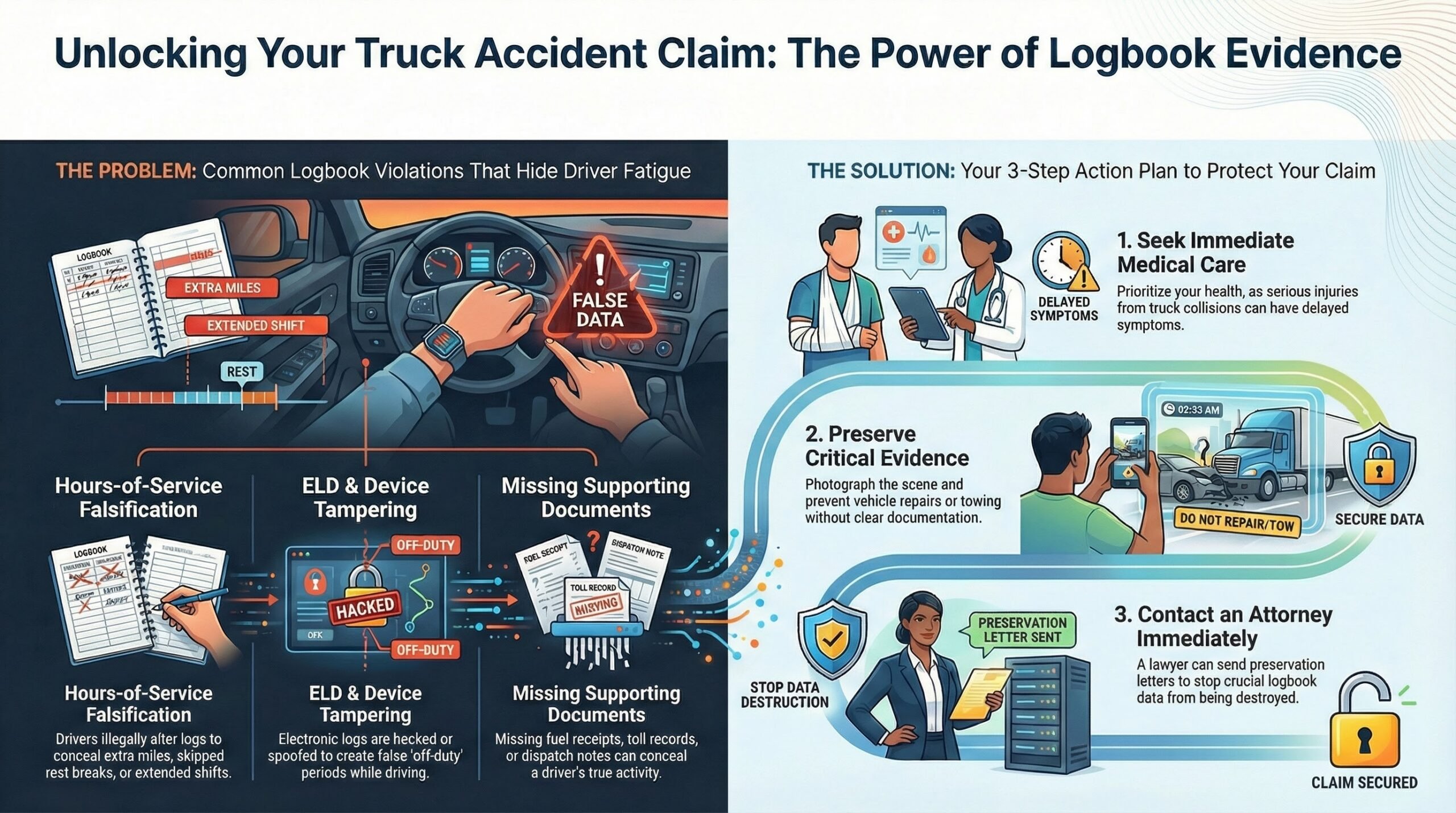
We often see hours-of-service falsification, improper timekeeping entries, and missing supporting documents, each of which can conceal fatigue-related risk and undermine compliance.
We also watch for ELD device tampering, because it can mask driving time, complicate crash investigations, and strengthen a liability case when the evidence supports it.
Hours-Of-Service Falsification



Falsifying hours-of-service records is among the most common causes of truck accident logbook violations in Orlando cases. When a driver exceeds legal limits, fatigue can build quietly, and a single lapse in attention may cause catastrophic harm to others on the road.
We often find falsified logbooks used to conceal extra miles, skipped breaks, or extended shifts, all of which undermine safety and public trust. These duty violations can also reflect broader pressure from carriers or dispatch to meet unrealistic delivery schedules.
If you’ve been injured, we’ll work to identify the full paper trail, compare it to objective data, and hold responsible parties accountable. Our goal is simple, protect the community and pursue fair recovery for you.
Improper Timekeeping Entries
Improper timekeeping entries often trigger serious logbook violations in Orlando truck accident cases because even small recording mistakes can distort a driver’s true level of fatigue and compliance. When start and stop times are rounded, shifted between duty statuses, or entered out of sequence, the log can falsely suggest adequate rest and lawful driving.


We help you evaluate whether these entries reflect careless habits, pressured dispatch practices, or training gaps, and how each issue can endanger the public. During record audits, inconsistencies often appear between log entries and operational timelines, raising questions about credibility and safety culture.
Payroll discrepancies can also reveal that a driver worked, loaded, or waited longer than the log reports, which may support claims of negligence. We use these findings to pursue accountability and safer roads.
Missing Supporting Documents
Logbook entries don’t stand alone, and when the supporting paperwork is missing, even a neatly written record can’t be verified. In Orlando truck crash cases, we often see gaps such as fuel tickets, scale slips, toll records, repair invoices, and dispatch notes, all of which help confirm a driver’s location and time.
Missing receipts can make lawful time appear suspicious, and they may conceal delays, rerouting, or unreported stops that affect fatigue analysis.


We work with you to request records from carriers, brokers, and vendors, then compare them against the log and trip data to identify inconsistencies. When documentation audits reveal repeated omissions, we can argue the carrier failed to maintain required records, weakening defenses and supporting accountability for those harmed.
ELD Device Tampering
Behind many hours-of-service disputes in Orlando truck accident claims, we find ELD device tampering used to make driving time look compliant when it wasn’t. When a carrier or driver alters electronic records, fatigue risks rise, and the public bears the cost.
We often see ELD hacking that edits duty status, deletes unassigned miles, or blocks location data so a route appears shorter. We also investigate Device spoofing, where hardware or apps mimic engine signals, creating false “off-duty” periods while the truck keeps moving.
To serve injured neighbors well, we request raw ELD data, sensor logs, and transfer reports, then compare them to fuel receipts, tolls, dispatch messages, and GPS breadcrumbs. When the timeline doesn’t match, we act quickly to preserve evidence and accountability.
Legal Rights of Orlando Truck Accident Logbook Violations Victims
Even when a crash seems like a routine traffic incident, a truck driver’s hours-of-service paperwork can reveal violations that expand our legal options and strengthen a claim.
When we represent you, we focus on accountability because fatigue-related driving endangers everyone on the road and undermines worker protections meant to keep schedules humane and safe.
Logbook violations can support negligence claims, increase available damages, and expose carrier pressure, unsafe dispatch practices, or poor supervision.
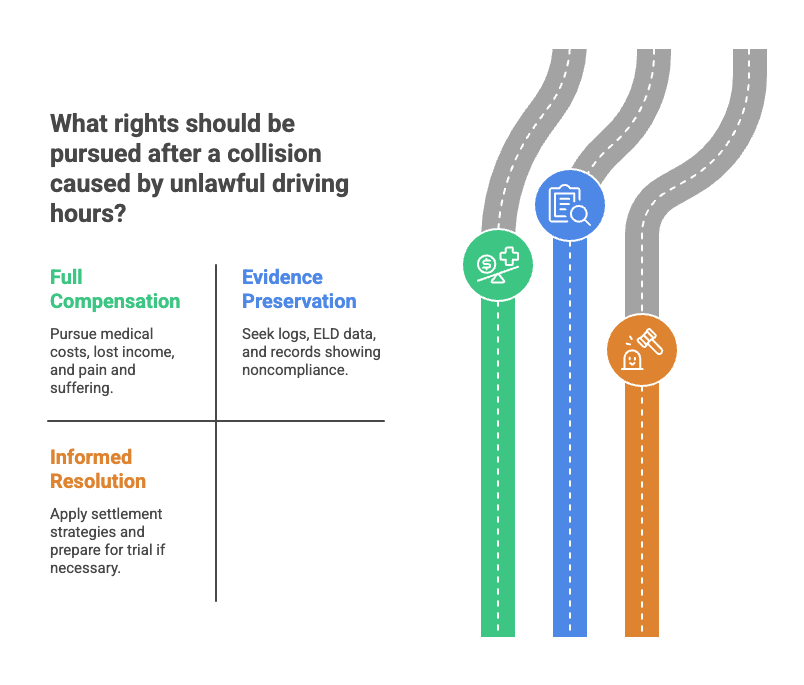
- Right to full compensation: We can pursue medical costs, lost income, and pain and suffering when unlawful driving hours contributed to the collision.
- Right to evidence preservation: We can seek logs, ELD data, dispatch records, and policies that show a pattern of noncompliance.
- Right to informed resolution: We apply disciplined settlement strategies, evaluating liability, causation, and long-term needs, and we prepare every case for trial if required.
Together, we can pursue results that reflect service, safety, and responsibility.
Steps to Take After an Orlando Truck Accident Logbook Violations
After an Orlando truck accident involving logbook violations, we should act quickly to protect your health and your potential claim.
We’ll encourage you to seek medical care right away, then work with you to preserve crucial evidence such as driver logs, electronic data, and photographs before it disappears.
We’ll also guide you in properly reporting and documenting the incident, ensuring the official record accurately reflects what happened and when.
Seek Medical Care
When a truck crash raises concerns about logbook violations, we should prioritize medical care, not postpone it while details are sorted out. We’ll help you focus on safety, starting with calling 911 and accepting an on-site evaluation.
Even if we feel steady, prompt medical attention protects our health and creates a clear baseline for recovery. Truck collisions can cause head, neck, and internal injuries that don’t announce themselves right away.
Delayed symptoms, such as dizziness, numbness, confusion, or worsening pain, may not appear for hours or days, and waiting can complicate treatment.
We should follow discharge instructions, attend follow-up visits, and track changes in function, sleep, and mood. Serving others also means being honest with clinicians, so they can document what happened and provide proper care.
Preserve Critical Evidence
In the hours following a truck crash, we need to lock down vital evidence before it disappears or gets overwritten. We’ll act with a service mindset, because preserving proof protects everyone harmed and supports a fair outcome.
If you’re able, keep vehicles and cargo undisturbed, and don’t allow repairs, towing releases, or disposal without clear documentation and consent. We’ll request immediate retention of electronic logging device data, GPS records, dispatch communications, and onboard camera footage, since many systems recycle files quickly.
We also prioritize chain preservation, so custody remains clear of the scene and in secure storage. Through careful metadata collection, we can verify when files were created, accessed, or altered.
We’ll also seek preservation letters to prevent spoliation and compel retention.
Report And Document Incident
Within minutes of a truck crash, we should report the incident and document it thoroughly, because accurate records often determine whether logbook violations and fatigue-related conduct can be proven.
We should call 911, request medical assistance, and make certain law enforcement creates an official crash report.
If we’re able, we should take photos of vehicle positions, damage, skid marks, road conditions, and any visible hours-of-service materials in the cab.
We should then build an incident timeline, noting the time of impact, weather, traffic, statements made at the scene, and when emergency responders arrived.
We should also gather witness statements, including each person’s name, contact details, and what they observed.
How an Orlando Truck Accident Logbook Violations Lawyer Can Help You
Although truck drivers and carriers may treat logbooks as routine paperwork, those records often reveal the clearest story about fatigue, scheduling pressure, and illegal hours behind the wheel. When you’ve been harmed, we use that story to serve you with diligence and respect, pursuing driver accountability while insisting on regulatory oversight that protects the public.
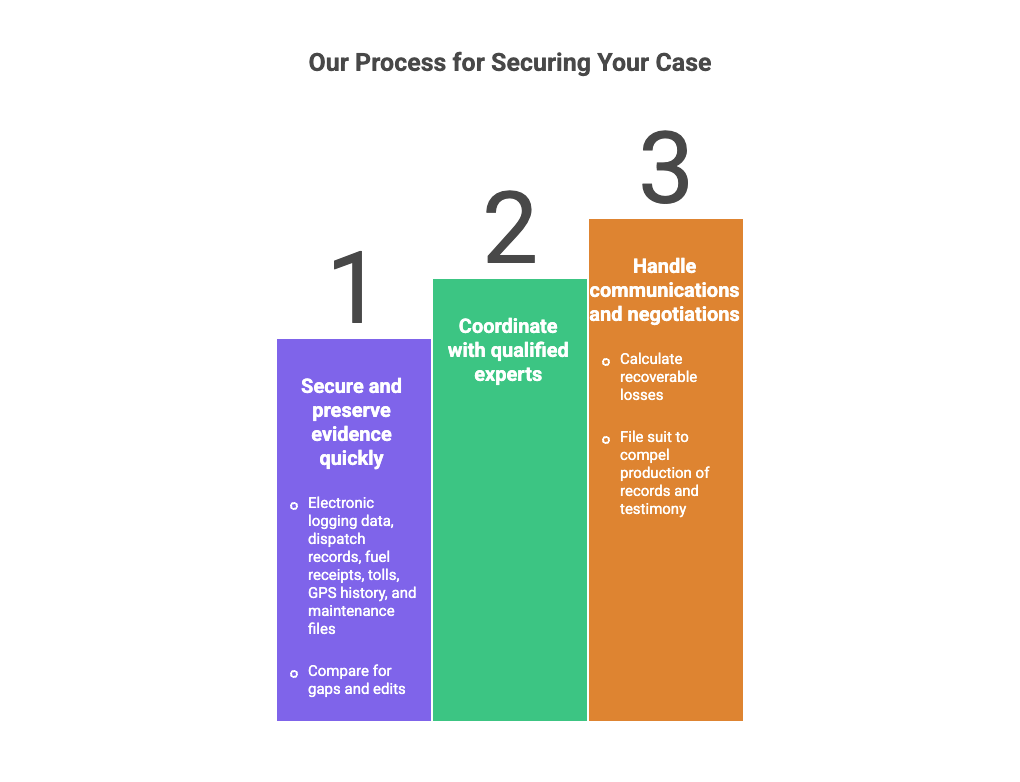
- We secure and preserve evidence quickly, including electronic logging data, dispatch records, fuel receipts, tolls, GPS history, and maintenance files, then compare them for gaps and edits.
- We coordinate with qualified experts to interpret hours-of-service rules, identify patterns of coercion or corner-cutting, and explain violations in plain terms for insurers or a jury.
- We handle communications and negotiations, calculate your recoverable losses, and, when necessary, file suit to compel production of records and testimony.
Throughout, we keep you informed, protect deadlines, and work to obtain a fair resolution without unnecessary delay.
Long Term Effects of Orlando Truck Accident Logbook Violations Injuries
When logbook violations contribute to an Orlando truck crash, we often see injuries that don’t end when the initial treatment does, and you may face consequences that persist for years.
We’ll explain how chronic pain and reduced mobility can limit work and daily function, and how neurological and cognitive impairment may affect memory, concentration, and coordination.
We’ll also address psychological trauma and PTSD, because these conditions can disrupt sleep, relationships, and long-term recovery even when physical injuries appear stable.
Chronic Pain And Mobility
Living with persistent pain after a truck crash linked to logbook violations can reshape nearly every part of daily life. We often see clients face chronic stiffness in the neck, back, hips, or shoulders, which makes routine tasks slower and more exhausting.
As you try to keep serving your family, workplace, and community, pain can limit lifting, standing, driving, and even restful sleep, creating a cycle of fatigue and reduced activity. We encourage careful documentation of flare-ups, therapy visits, and work restrictions because long-term mobility losses are easy for insurers to minimize.
When movement remains limited, Mobility aids such as braces, canes, or walkers may help restore stability and safety while treatment continues. We’ll help you pursue compensation that supports sustained care and daily independence.
Neurological And Cognitive Impairment
Because logbook violations often indicate fatigue and delayed reaction time behind the wheel, truck crashes can produce head trauma and oxygen deprivation that leave lasting neurological and cognitive impairment.
We see survivors struggle with attention, processing speed, memory, and executive function, even when outward injuries appear resolved. These changes can affect medication management, driving safety, and the ability to serve family, coworkers, and the community consistently.
We encourage prompt evaluation, including cognitive screening to document deficits and guide rehabilitation, and brain imaging to identify bleeding, swelling, or diffuse injury that may not be obvious in early exams.
We also help you coordinate records from neurologists, therapists, and vocational consultants, so the full scope of impairment is clearly supported and responsibly presented in your claim.
Psychological Trauma And PTSD
Although a truck crash may leave few visible marks after the initial emergency care, we often see deep psychological trauma develop in the weeks and months that follow, especially in collisions linked to logbook violations and driver fatigue.
You may experience intrusive memories, sleep disruption, irritability, or avoidance of driving routes that feel unsafe. When these symptoms persist, they can meet the criteria for PTSD and interfere with work, relationships, and daily routines.
We encourage early screening and timely trauma counseling because structured support can reduce symptom severity and help restore a sense of control.
We also recognize secondary stress on spouses, children, and caregivers who shoulder new responsibilities and fear recurrence. Collectively, we can document these harms, connect you with qualified care, and pursue accountability that supports long-term recovery.
Proving Liability in Orlando Truck Accident Logbook Violations Cases
When a crash involves a commercial truck, we can often prove liability by showing the driver or carrier violated federal hours-of-service rules and then tried to conceal it through inaccurate logbooks. We work with you to trace the timeline, compare paper logs to ELD downloads, and identify gaps that suggest off-the-record driving or improper edits.
To serve the truth, we pursue objective data. We request fuel receipts, toll records, GPS pings, dispatch messages, and shipping documents, then align them with the stated duty status. We also examine electronic hire verification to confirm who controlled the driver’s work and whether supervision encouraged unsafe schedules.
Where available, we evaluate driver fatigue biometrics, such as sleep and alertness indicators captured by onboard systems, to show that fatigue likely impaired reaction time. Finally, we look for company patterns, including prior violations, training failures, and weak auditing, to demonstrate negligent oversight that contributed to the collision.
Compensation for Orlando Truck Accident Logbook Violations Damages
Strong proof of logbook violations and fatigue-related conduct puts us in a position to pursue full financial recovery for the harm a truck crash causes. With that foundation, we can present a clear demand package that reflects what you and your family have endured, and what it will take to move forward with stability and dignity.
We pursue compensatory damages for medical care, rehabilitation, prescriptions, future treatment, lost income, reduced earning capacity, property damage, and the practical costs of daily assistance. When injuries disrupt relationships and independence, we also document pain, suffering, and loss of enjoyment of life with credible records and witness support.
If a carrier or driver falsified records, ignored hours-of-service rules, or engaged in unsafe driving, we evaluate punitive remedies designed to deter similar misconduct and protect others on Florida roads. Our goal is service through accountability, ensuring the responsible parties fund the recovery you need.
The Statute of Limitations for Orlando Truck Accident Logbook Violations Cases
Because deadlines can control whether your claim ever reaches the negotiating table, we focus on Florida’s statute of limitations early in every Orlando truck accident case involving suspected logbook violations. In most negligence actions, Florida law generally allows two years from the crash date to file suit, so we treat the calendar as evidence and act promptly to protect your rights and your family’s stability.
Still, timing rules aren’t always simple. Certain statute exceptions may apply when a defendant can’t be located, when a death changes the nature of the claim, or when other legally defined circumstances affect the filing window.
In addition, tolling periods can pause the clock in limited situations, such as when a responsible party is absent from the state or when fraud conceals crucial facts tied to logbooks, electronic logging data, or dispatch records. We help you document dates, preserve records, and file before time expires, so you can keep serving others without uncertainty.
Why You Need an Experienced Orlando Truck Accident Logbook Violations Lawyer
Meeting the filing deadline is only one part of building a winning logbook-violation case, and the work gets harder once we move from the calendar to the evidence.
When a crash involves fatigue, skipped breaks, or falsified hours, we must prove what happened behind the wheel and inside the company’s safety culture, not just what appears in a police report. That’s where Experienced representation matters, because we understand how carriers document routes, dispatch decisions, and compliance efforts.
We pursue targeted discovery to secure electronic logging data, driver qualification files, fuel and toll records, GPS history, maintenance logs, and internal messages that may reveal pressure to violate hours-of-service rules.
We also work with qualified experts to interpret patterns, identify inconsistencies across records, and present the timeline clearly. By handling these steps promptly and carefully, we protect your claim, support your recovery, and help hold negligent parties accountable for the harm done to your community.
How to Choose the Right Orlando Truck Accident Logbook Violations Lawyer for Your Case
When a truck crash may involve falsified hours or skipped rest breaks, choosing the right Orlando logbook violations lawyer can determine whether essential proof gets preserved or lost. We should look for counsel who acts quickly to secure electronic logging data, driver qualification files, dispatch records, and maintenance histories before they change or disappear.
We can start with focused Client interviews to learn how the firm investigates hours-of-service violations, works with reconstruction experts, and handles communications with insurers and carriers. We should confirm the lawyer can explain strategy in plain terms, listen carefully, and respect our goal of protecting others from preventable harm.
We also need transparency on Fee structures, including contingency percentages, litigation costs, and how expenses are handled if the case doesn’t recover. Finally, we should review our courtroom experience, prior trucking case results, and a plan for timely updates to stay informed and ready to serve our families and community.
About the Law Offices of Anidjar and Levine
Although every trucking case turns on its own facts, we’ve built the Law Offices of Anidjar and Levine around a disciplined, evidence-first approach that helps injured clients pursue fair compensation with confidence.
We focus on serving people who are hurt and overwhelmed, and we take responsibility for the details that often determine outcomes.
We review logbooks, electronic logging data, dispatch records, and maintenance files, and coordinate with qualified experts as needed.
You’ll work with a team that returns calls, explains each step, and prepares every claim as if it will be challenged.
We don’t measure success only by results; we also measure it by how consistently we protect your time, dignity, and peace of mind.
Our commitment extends beyond casework through community outreach that supports safer roads and stronger local networks.
We value accountability, and client testimonials help reflect the standards we work to meet every day for you.
Frequently Asked Questions
Will My Immigration Status Affect My Ability to File a Claim?
In most cases, your immigration status won’t prevent you from filing a claim. We can pursue compensation based on the facts of the harm, while remaining mindful of potential immigration consequences associated with disclosure and reporting.
We’ll offer documentation assistance, help you gather records safely, and communicate with insurers in a way that protects your interests. If special risks exist, we’ll address them early and clearly.
Can I Recover Damages if I Was Partly at Fault?
Yes, you can often recover damages even if you were partly at fault. Under comparative negligence rules, your compensation may be reduced in proportion to your assigned fault, reflecting apportioned liability among all responsible parties.
We’ll work to document the full scope of harm, present credible evidence, and challenge inflated fault allegations. Even if your share of fault exceeds the legal limits, we can still pursue a fair, service-minded outcome.
How Are Attorney’s Fees and Case Costs Handled?
We typically handle attorneys’ fees through contingency agreements, so you don’t pay fees unless we recover compensation for you.
We’ll explain the percentage, how it changes if litigation advances, and any applicable fee caps under state rules.
Case costs, such as filing fees, records, experts, and depositions, are usually advanced by our firm and reimbursed from the recovery.
We’ll provide a written breakdown, so you can plan responsibly and serve others.
What Happens if the Trucking Company Files for Bankruptcy?
If the trucking company files for bankruptcy, the claim moves into bankruptcy court, and the automatic stay may pause litigation. We’ll file a proof of claim, monitor trustee oversight, and pursue available insurance proceeds that may remain outside the estate.
If recovery depends on company assets, asset liquidation can limit payouts and prioritize secured creditors. We’ll evaluate options, including relief from stay or claims against third parties, while protecting your interests.
Will I Need to Testify in Court or Attend a Deposition?
You might need to testify, but we often resolve cases without court testimony.
We’ll prepare you thoroughly, so you can speak plainly and serve the truth with confidence.
A deposition is more common, and we’ll handle deposition scheduling to reduce disruption to your work and family commitments.
We’ll attend with you, protect your rights, and object when needed.
If a trial becomes necessary, we’ll guide each step and support you.
———————
If you’ve been hurt in an Orlando truck crash involving logbook violations, Law Offices of Anidjar and Levine can help you pursue accountability and fair compensation.
We’ll review driver records, electronic logging data, and company policies to identify hours-of-service breaches and related safety failures.
We’ll handle insurer communications, protect your deadlines, and build a claim grounded in clear evidence.
Learn more about your options by speaking with an Orlando Truck Accident Lawyer who can help you pursue damages and move forward with confidence.


We Can Help.