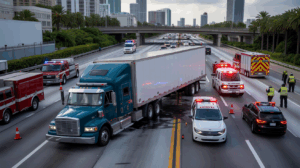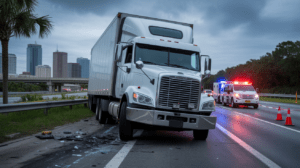




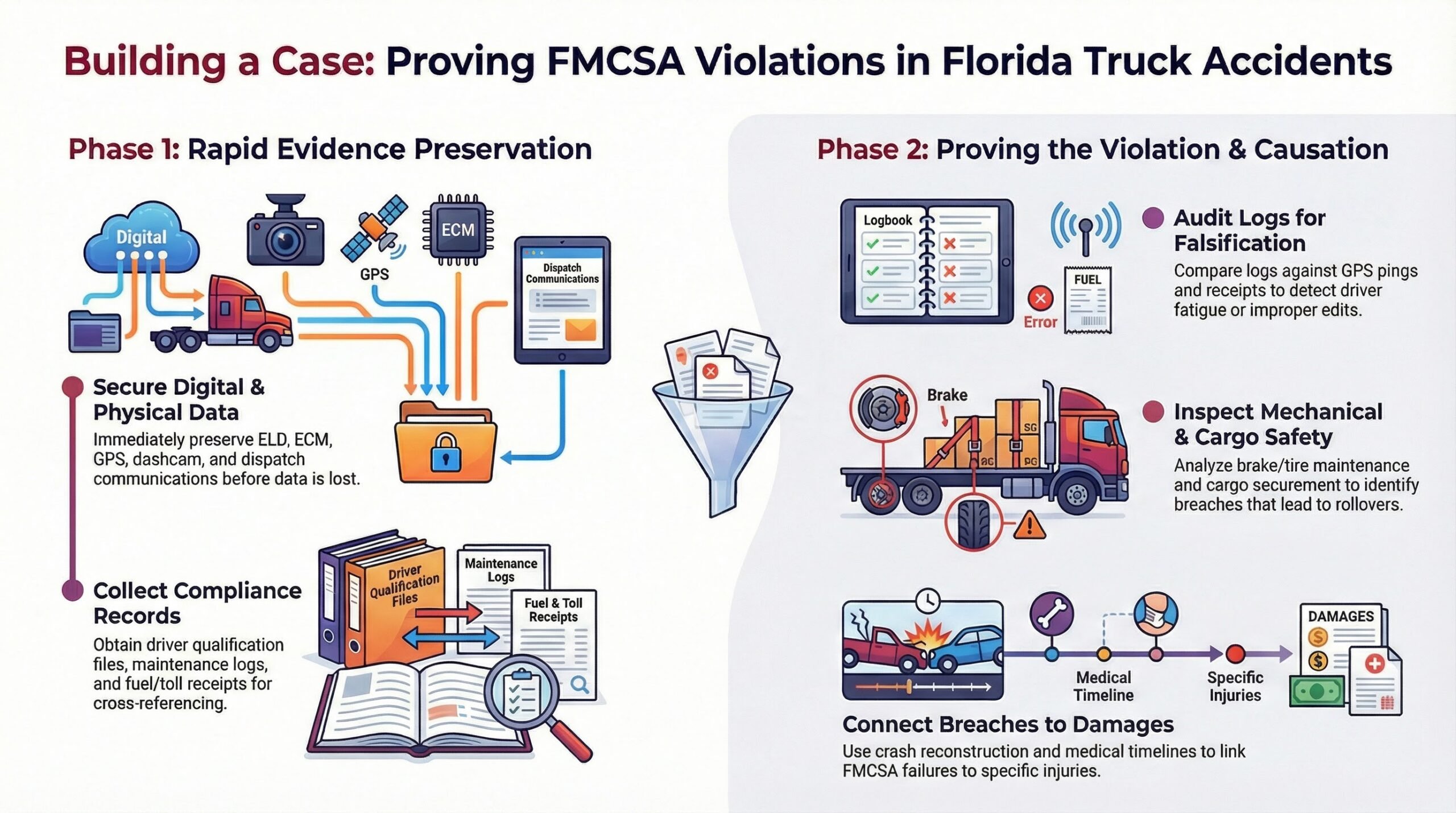
Law Offices of Anidjar and Levine handles Florida truck accident claims built on provable FMCSA violations by moving fast to preserve ELD, ECM, GPS, dashcam, and phone video before it’s lost.
We secure maintenance and inspection files, driver qualification records, dispatch communications, fuel and toll receipts, and police reports, then audit logs for fatigue or improper edits.
We work with qualified experts to connect safety breaches to your injuries and damages.
Learn more from our Florida Truck Accident Lawyer page and keep going to see what steps matter most.



Key Takeaways
- A Florida truck accident lawyer can quickly send preservation letters to secure ELD, ECM, GPS, dashcam, and dispatch data before it disappears.
- FMCSA violations are proven by auditing logs against fuel receipts, tolls, GPS pings, and communications to detect fatigue and falsified records.
- Maintenance and inspection records can reveal FMCSA safety violations, such as brake, tire, lighting, or steering neglect, that increase crash risk.
- Cargo securement and overload evidence—tie-down condition, anchor strength, and load checks—can link FMCSA failures to rollovers and jackknifes.
- Strong cases connect FMCSA breaches to causation and damages using crash reconstruction, medical timelines, functional limits, and documented future care needs.
How We Can Help With Your Florida FMCSA Violations Truck Accident Claim
When a Florida truck crash involves suspected FMCSA violations, we can move quickly to identify what went wrong and build a claim that ties those regulatory failures to your injuries.
We gather time-sensitive records, secure available footage, and coordinate with qualified professionals who can explain how safety breakdowns contributed to the collision.
We also document your medical course and day-to-day limitations so that your damages are presented clearly and credibly.
We keep your needs at the center of our work through consistent client communication, clear timelines, and prompt answers to difficult questions.
At each step, we develop a focused case strategy that supports your goals, whether that means pursuing early resolution or preparing for litigation.
We handle insurer contacts, organize evidence, and present a demand that reflects both financial losses and the long-term impact on your ability to serve your family and community.
Understanding Florida FMCSA Violations Truck Accident Cases
Although many truck accidents look like ordinary roadway collisions at first glance, cases involving potential FMCSA violations require a different level of analysis and proof.
We focus on whether the carrier and driver met federally mandated safety duties, and we help you understand how those duties intersect with Florida liability rules and insurance defenses.
To serve you well, we gather time-sensitive evidence, preserve electronic data, and evaluate patterns that may point to driver fatigue without jumping to conclusions.
We also examine logbook accuracy, comparing paper or electronic entries against fuel receipts, GPS pings, toll records, dispatch communications, and onboard telematics.
When the records don’t align, we can identify who created them, who approved them, and what oversight was in place.
We then connect any proven violations to the crash sequence through qualified analysis, so the legal claim rests on clear, documented facts rather than assumptions.


Common Causes of Florida FMCSA Violations: Truck Accidents
We often see Florida FMCSA violations and truck accidents trace back to preventable choices that prioritize speed and profit over safety.
We’ll explain how hours-of-service violations and improper vehicle maintenance can create fatigue and mechanical failures that leave drivers with no margin for error.
We’ll also address overloaded or unsecured cargo, distracted or impaired driving, and how these factors frequently compound in serious crashes.
Hours-Of-Service Violations
Because delivery schedules and pay structures often reward speed, hours-of-service violations remain a leading cause of FMCSA-related truck accidents in Florida.
When a driver exceeds daily limits or skips required breaks, Driver fatigue builds quietly, then shows up as delayed braking, lane drift, and poor judgment.
We often see carriers pressure drivers to “make up time” or keep rolling despite traffic, weather, or loading delays, and that culture can endanger everyone on the road.
We help you serve your community by pursuing accountability through Logbook audits, electronic data reviews, and dispatch records that reveal how long the driver actually worked.
When violations are identified, we link them to the crash timeline, identify responsible parties, and advocate for safer practices to prevent future tragedies across Florida.
Improper Vehicle Maintenance
Neglecting routine inspections can turn a heavy commercial truck into an avoidable hazard on Florida roads.
When carriers skip required vehicle inspections or rush through maintenance logs, small defects can become catastrophic failures, and the public pays the price.
Worn tires, faulty lights, and steering issues reduce a driver’s ability to respond, especially in rain, traffic, or construction zones.
Brake systems warrant special attention because heat, weight, and repeated stops quickly expose weaknesses.
If pads, lines, or air components aren’t serviced on schedule, stopping distance increases and control can vanish without warning.
We work to show how maintenance lapses violate FMCSA standards, and we help you pursue accountability so safer practices protect everyone we serve.
Proper upkeep is a duty, not an option.
Overloaded Or Unsecured Cargo
Cargo problems can spiral into disaster fast when a trailer rolls out overloaded or the load isn’t properly secured.
When weight limits are ignored, braking distances increase, tires overheat, and guidance becomes unpredictable, placing every nearby driver at risk.
Even within legal limits, a load shift can trigger a rollover or jackknife, especially on Florida ramps, bridges, and sudden stops.
FMCSA rules require proper securement, documented tie downs inspection, and periodic rechecks along the route.
We encourage carriers and drivers to treat cargo control as a public service, not a box to check.
If straps are worn, anchor points are weak, or pallets are stacked improperly, the hazard grows with every mile.
When violations cause harm, we work to show how preventable choices led to loss and injury.
Distracted Or Impaired Driving
Even when a load is secured and weight limits are met, a truck becomes dangerous in seconds when the driver’s attention or judgment slips.
Distraction violates FMCSA safety duties by reducing scanning, delaying braking, and increasing lane drift, placing families and road workers at immediate risk.
We often see crashes linked to phone use, where texting, navigation, or calls impair cellphone use and lead to missed hazards.
Impairment also occurs without alcohol, such as fatigue, over-the-counter drugs, and prescription side effects, which can cause medication impairment, slowed reactions, or poor decision-making.
When a carrier pressures schedules or ignores screening, preventable harm follows.
We help you document log issues, device records, and medical disclosures, then hold drivers and companies accountable for restoring safety and serving the public.
Legal Rights of Florida FMCSA Violations Truck Accident Victims
Accountability can determine whether a Florida truck accident claim ends in a fair recovery or an avoidable shortfall. When FMCSA violations cause harm, we can assert your legal rights through disciplined Victim advocacy and careful Settlement negotiation, while keeping the focus on restoring stability for you and those who depend on you.
Accountability drives fair recovery in Florida truck claims—especially when FMCSA violations demand focused advocacy and disciplined settlement negotiation.
Your rights typically include the right to seek compensation for losses related to the crash and to demand that responsible parties be held accountable for unsafe practices.
We work to identify every liable actor, not just the driver, because a carrier’s compliance failures may be central to fault.
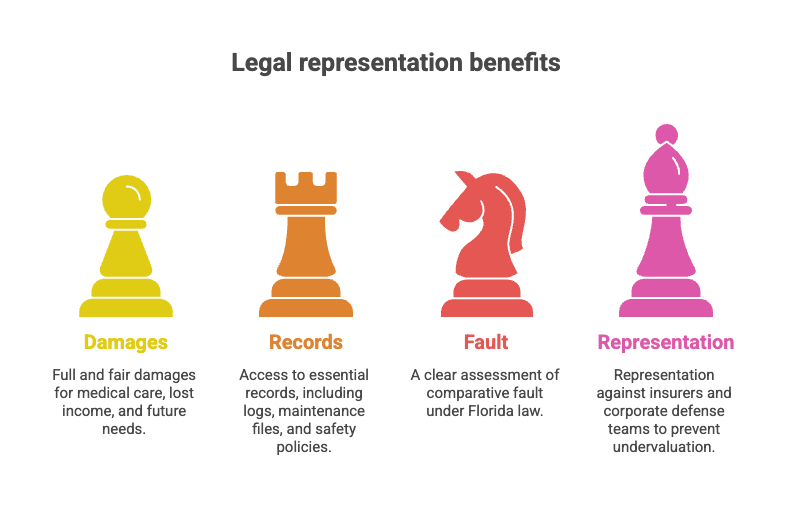
We’ll maintain transparency, protect your voice, and pursue outcomes that support healing and responsibility for the broader community.


Steps to Take After a Florida FMCSA Violations Truck Accident
Following a Florida truck crash with possible FMCSA violations, we should act quickly and methodically. We’ll start by ensuring you seek medical care immediately.
Next, we’ll help you preserve evidence and records, including photos, witness details, medical paperwork, and any communications with the carrier or insurer.
Finally, we’ll make sure the crash is properly reported, and we’ll encourage you to consult counsel promptly so we can protect your rights and position your claim from the outset.
Seek Medical Care Immediately
A prompt medical evaluation should be our first priority following a Florida truck crash involving suspected FMCSA violations, because some injuries don’t present clear symptoms at the scene.
We should seek an immediate assessment at an emergency room, urgent care, or with our primary physician, even if we feel “fine,” since head trauma, internal injuries, and soft-tissue damage can worsen quickly.
We’ll also support those who depend on us by following discharge instructions, attending referrals, and completing follow-up care without delay.
Accurate pain documentation is essential; we should describe the onset, location, intensity, and limitations in daily activities, and report any dizziness, numbness, or sleep disruption.
Prompt care protects our health, reduces complications, and creates a clear clinical timeline that guides treatment decisions and recovery planning.
Preserve Evidence And Records
Next, we’ll lock down the evidence and records that can prove how the crash happened and whether FMCSA safety rules were ignored.
If you’re able, take clear photos of vehicle positions, damage, skid marks, road signs, weather, and any visible cargo issues, then note the time, location, and trucking company identifiers.
We’ll also gather witness names and contact details, and preserve any dashcam or phone video without editing.
Keep every medical, towing, rental, and wage document, plus written notes about symptoms and daily limits, so we can present a complete and service-minded account of your losses.
Request that the truck and trailer remain secured to preserve the chain and enable later digital forensics of the ELD, ECM, GPS, and maintenance logs.
Report And Consult Counsel
Protecting records and physical evidence only works if we also create a clear, timely paper trail with the appropriate authorities and obtain legal counsel before statements or files are used against us.
We should report the crash to local law enforcement, request the report number, and document every contact with the trucking company or insurer.
If injuries exist, we also notify medical providers and keep follow-up notes aligned with the incident timeline.
We’ll help you gather witness statements while memories are fresh and coordinate with investigators to flag potential FMCSA violations for preservation requests.
Before you give a recorded statement or sign releases, we consult counsel to ensure your account remains accurate and complete.
Early legal support also positions you for disciplined settlement negotiation, focused on fair outcomes and responsible accountability.
How a Florida FMCSA Violations Truck Accident Lawyer Can Help You
When a truck crash involves possible FMCSA violations, we can step in immediately to identify the safety rule breaches that may have caused or worsened the collision.
We act quickly to preserve logs, ELD data, maintenance records, and dispatch communications, then compare them to applicable federal and Florida standards.
Through FMCSA outreach, we help you understand how safety rules work in practice and how violations can indicate accountability across the transportation chain.
We also practice Driver advocacy, recognizing that responsible drivers may be pressured by schedules or unsafe policies, and that truth matters for everyone’s safety.
- Secure and analyze crucial evidence before it’s lost
- Identify liable parties, including carriers and contractors
- Coordinate with qualified experts to document violations
- Handle communications and negotiations to protect your interests
Throughout, we keep service and integrity at the center, so your case helps keep roads safer for others.
Long Term Effects of Florida FMCSA Violations: Truck Accident Injuries
When FMCSA violations lead to a serious truck crash in Florida, we often see injuries that don’t end when the initial treatment does.
We’ll explain how chronic pain and disability can restrict work and daily function, how traumatic brain injury sequelae may impair memory, focus, and judgment, and how emotional trauma and PTSD can disrupt sleep, relationships, and stability.
Chronic Pain And Disability
Although many truck crash injuries in Florida appear manageable in the early weeks, FMCSA-related violations can set the stage for chronic pain and lasting disability that disrupts work, mobility, and daily independence.
When a carrier ignores safety rules, the force of impact often leaves soft-tissue, spine, or joint damage that doesn’t resolve with routine care.
You may experience chronic fatigue due to poor sleep, medication side effects, and the constant strain of compensating for injured areas.
Over time, these symptoms can lead to functional limitations, such as reduced lifting tolerance, slower walking, or difficulty driving and performing household tasks.
We work with you to document consistent pain patterns, treatment response, and how daily service to family or community is affected.
With clear medical support, we can pursue compensation for long-term care and lost earning capacity.
Traumatic Brain Injury Sequelae
Because FMCSA violations can lead to high-impact crashes and violent head movement, traumatic brain injuries often leave long-term sequelae that aren’t obvious in the emergency phase but become disruptive over time.
We often see clients struggle with attention, processing speed, and memory, which can signal neurocognitive decline and interfere with work, school, and safe driving.
You may also notice sensory deficits, including vision changes, tinnitus, light sensitivity, or altered balance, which can increase fall risk.
These effects can fluctuate, so we encourage consistent medical follow-up, neuropsychological testing, and documentation of daily limitations.
When we serve you, we connect the clinical record to how the injury changes your functional capacity, so your claim reflects future care needs, adaptive support, and reduced earning ability.
Emotional Trauma And PTSD
After a serious truck crash tied to FMCSA violations, many people don’t just heal from broken bones and bruises; they carry emotional trauma that can evolve into long-term PTSD.
We often see sleep disruption, intrusive memories, and hypervigilance that make daily routines feel unsafe.
Common PTSD triggers include air brakes, highway merges, flashing lights, or even medical appointments, and they can appear months after the collision.
We encourage you to document symptoms, seek trauma-informed counseling, and lean on trusted community support, because early care protects long-term functioning.
Practical Coping strategies may include controlled breathing, grounding exercises, structured exposure guided by a clinician, and consistent sleep habits.
When we build a clear record of these harms, we can advocate for treatment costs and meaningful accountability.
Proving Liability in Florida FMCSA Violations Truck Accident Cases
When a truck crash involves an FMCSA violation in Florida, we must connect that safety lapse to the chain of events that caused the collision and the resulting harm.
We do this by gathering records early, preserving onboard data, and demonstrating how a specific rule breach increased roadway risk.
We review driver qualification files, inspection and maintenance histories, and dispatch communications to identify preventable choices.
Electronic logging can reveal hours-of-service violations, skipped breaks, or edits that suggest fatigue and pressure to drive.
Route-planning evidence may show unrealistic schedules, unsafe detours, or disregard for weather and construction warnings.
We also compare the carrier’s policies to FMCSA standards to demonstrate negligent supervision or training.
Next, we tie the violation to causation through crash reconstruction, medical timelines, and witness accounts, so your story is supported by objective proof and service-driven advocacy.
Compensation for Florida FMCSA Violations, Truck Accident Damages
Accountability matters most in the compensation phase, where we translate an FMCSA violation into a clear, documented measure of what the crash has cost you.
We gather records, receipts, and expert opinions to show how the violation caused real, measurable harm, and we present that proof in a way insurers and juries can’t dismiss.
Our goal is to secure resources that help you heal and continue serving your family and community.
Economic damages often form the foundation, including medical care, rehabilitation, lost income, reduced earning capacity, and property loss.
We also pursue recovery for pain, disability, and the daily limitations that follow a serious truck crash.
When the evidence shows reckless disregard, such as falsified logs, ignored inspections, or pressured hours-of-service violations, Punitive damages may be available to punish misconduct and deter future harm.
We build each claim with discipline, so compensation reflects the full scope of your losses.
The Statute of Limitations for Florida FMCSA Violations Truck Accident Cases
Strong evidence of damages won’t help if the case gets filed too late, so we also keep a close eye on Florida’s statute of limitations in FMCSA violations and truck accident claims.
In most negligence cases, the filing window is limited, and courts enforce it strictly, even when liability appears clear.
We work with you to confirm the crash date, identify the proper defendants, and calendar every crucial event so your service-minded goals aren’t derailed by procedural loss.
Some situations may allow deadline extensions, but they’re narrow and fact-specific. For example, a defendant’s absence from the state, concealment of identity, or other legally recognized barriers can affect the clock.
Discovery tolling may also apply when key facts couldn’t reasonably be known earlier, such as hidden logbook falsification or delayed medical causation.
Still, tolling is never automatic, so we act promptly, document diligence, and file before disputes arise.
Why You Need an Experienced Florida FMCSA Violations Truck Accident Lawyer
Although FMCSA rules may look straightforward on paper, proving a violation caused your Florida truck crash takes targeted knowledge of federal regulations, carrier practices, and the evidence those systems generate.
We use Experienced counsel to connect hours-of-service logs, maintenance files, drug and alcohol testing records, and dispatch communications to the harm you suffered, then present that story in a clear, legally sound way.
Truck cases move quickly because carriers and insurers deploy rapid-response teams to shape the record. We act just as decisively, sending preservation letters, securing electronic data, and identifying every potentially responsible party, including the carrier, broker, or maintenance contractor.
Our Institutional knowledge helps us recognize missing documents, spot patterns in safety audits, and challenge defenses that shift blame to you.
When we build a disciplined evidence trail, we support not only your recovery but also the wider goal of safer roads for others across Florida.
How to Choose the Right Florida FMCSA Violations Truck Accident Lawyer for Your Case
Finding the right lawyer matters just as much as proving the FMCSA violation itself, because the firm you choose will control how fast evidence gets preserved and how clearly fault gets tied to the federal rule that was broken.
We should look for counsel who moves immediately to secure driver logs, electronic data, dispatch records, and maintenance files, then coordinates qualified experts to interpret them.
We also want a team that understands Florida trucking practice and can explain the case in plain terms, so we can focus on healing and serving our families and communities.
Ask about client selection, because a lawyer who accepts fewer cases often delivers closer attention and steadier communication.
Demand fee transparency in writing, including costs, timing, and what happens if the case doesn’t succeed.
Finally, we should review results in similar FMCSA-based crashes and confirm trial readiness, since early settlement pressure is common.
About the Law Offices of Anidjar and Levine
Client-first advocacy and rapid-response litigation define the Law Offices of Anidjar and Levine, and we use that approach to protect crash victims when FMCSA violations may have contributed to a Florida truck accident.
We act quickly to secure logbooks, onboard data, inspection records, and witness accounts before they disappear, then we build a case that reflects the full scope of harm you’ve endured.
We’ll guide you with clear communication, practical next steps, and respect for your time, because service begins with listening.
Our team coordinates medical appointments, helps with vehicle and property issues, and manages insurer contact so you can focus on recovery.
We measure our work by results and accountability, and Client testimonials often highlight our responsiveness and consistent follow-through.
Beyond the courtroom, Community outreach reflects our commitment to safer roads and informed families.
When you need steady counsel and decisive action, we’re ready to stand with you.
Frequently Asked Questions
What Happens if the Trucking Company Files for Bankruptcy During My Claim?
If the trucking company files for bankruptcy during your claim, the case often pauses under an automatic stay, and we may need court permission to proceed.
We’ll evaluate bankruptcy tolling to ensure deadlines don’t expire unfairly while the stay is active.
Your recovery may come through insurance or through the bankruptcy estate under the creditor hierarchy, which can limit payouts.
We’ll file timely proofs of claim and protect your right to serve others.
Can I Pursue a Claim if I Was Partly at Fault for the Accident?
Yes, you can still pursue a claim even if you were partly at fault. Under comparative negligence, your recovery typically reduces by your percentage of responsibility, but it isn’t automatically barred.
We’ll document the other drivers’ and carriers’ failures, quantify damages carefully, and use strong evidence to protect your settlement leverage.
By acting promptly and serving the interests of all impacted parties, we can pursue accountability and fair compensation.
Will My Immigration Status Affect My Ability to Recover Compensation in Florida?
In most Florida injury cases, your immigration status won’t bar you from seeking damages, and courts generally focus on fault and losses, not residency paperwork.
We’ll evaluate compensation eligibility based on your medical expenses, lost income, and other harm, while protecting your privacy where possible.
We can also address concerns about reporting, documentation, and wage proof, so you can pursue a fair outcome and continue serving your family and community.
How Are FMCSA Violations Proven When Key Records Are Missing or Destroyed?
We prove FMCSA violations by rebuilding compliance using all available sources when crucial records are missing or destroyed.
We request phone data, GPS pings, fuel and toll receipts, maintenance invoices, dispatch logs, and witness testimony, then connect them through circumstantial evidence.
We also seek spoliation sanctions if a carrier failed to preserve required documents, asking the court to infer the missing records would’ve shown noncompliance and harm, supporting accountability and safety.
Can I Recover Damages if the Truck Driver Was an Independent Contractor?
Yes, we can often recover damages even if the driver was an independent contractor.
We’ll pursue the driver’s liability insurance and examine whether the motor carrier exercised control, creating vicarious liability despite the label.
We also analyze contract terms, dispatch practices, and safety policies to identify responsible parties and available coverage.
We’ll build a case for fair compensation so you can focus on healing and serving others.
——————
FMCSA violations can turn a routine trip into a serious collision, and the Law Offices of Anidjar and Levine is prepared to help you pursue full accountability.
We’ll investigate driver logs, maintenance records, and company policies, then build a claim that connects regulatory breaches to your injuries and losses.
We’ll handle insurers, protect your rights, and keep deadlines on track under Florida law.
If you’re ready to act, we’ll explain your options and next steps—starting with a consultation with a Florida Truck Accident Lawyer.


We Can Help.