




At the Law Offices of Anidjar and Levine, we handle Florida hospital sepsis malpractice claims with rapid investigation, expert review, and strategic litigation.
We gather and analyze records, timelines, and hospital protocols, retain board‑certified experts to prove breach, causation, and damages, and pursue full compensation for medical costs, lost income, and pain.
We manage insurer negotiations while preparing for trial from day one, protecting deadlines and preserving evidence.
If you or a loved one suffered worsened sepsis care, we can explain your rights, next steps, and what to expect.
Learn more: Medical Malpractice Injury Lawyer
Key Takeaways
- Consult an experienced Florida attorney specializing in sepsis and hospital malpractice as soon as possible to protect deadlines and evidence.
- Bring organized records: complete medical charts, timelines, labs, imaging, medication lists, and sepsis bundle documentation for review.
- Prove duty, breach, causation, and damages using board-certified experts linking delays or errors to organ failure or death.
- Investigate hospital protocols, staffing logs, and policy adherence to identify missed red flags, delayed antibiotics, or inadequate monitoring.
- Seek full compensation for medical costs, lost wages, and long-term care; ensure your lawyer negotiates with insurers and is trial-ready.
How We Can Help With Your Florida Hospital Sepsis Malpractice Injury Claim
We begin by listening to your story, organizing medical records, and identifying missed opportunities for timely intervention. Our team builds a straightforward narrative that centers on Patient advocacy, ensuring your voice guides every strategic decision.
Dig deeper into our in-depth case study: The Cascade of Failures in Sepsis Care
We coordinate with medical experts to evaluate protocols, timelines, and causation, then translate intricate findings into precise claims.



We conduct a rigorous Risk assessment to measure the strength of liability, damages, and defenses, helping us chart the most effective path. We preserve evidence, secure witness statements, and prepare you for each step, from demand letters to litigation.
We negotiate assertively with insurers and hospitals, aiming for full compensation for medical costs, lost income, and long‑term support needs.
When a trial is necessary, we litigate with discipline and clarity. In the future, we communicate quickly, provide clear guidance, align our strategy with your goals, and protect your rights and future.
Understanding Florida Hospital Sepsis Malpractice Injury Cases
With your goals and evidence framework in place, we can now explain what makes a Florida hospital sepsis malpractice case legally viable. We must show a duty of care, a breach of that duty, causation, and damages.
Establishing breach often turns on whether clinicians recognized sepsis signs promptly, applied accepted protocols, and documented clinical reasoning consistent with sepsis pathophysiology and immune response mechanisms.
We analyze timing, comparing essential signs, labs, and orders to national and Florida standards. We examine whether rapid fluids, antibiotics, and source control were initiated within required windows, and whether monitoring and escalation met hospital policies.
Expert testimony links lapses to worsening organ dysfunction, demonstrating that delay or deviation foreseeably intensified the inflammatory cascade.
Causation requires careful differential analysis to separate unavoidable progression from negligence-driven harm. We quantify damages with medical economics and life care planning, aligning proof to Florida evidentiary rules.
Throughout, we center patient safety and accountability, seeking outcomes that serve both healing and justice.
Common Causes of Florida Hospital Sepsis Malpractice Injuries
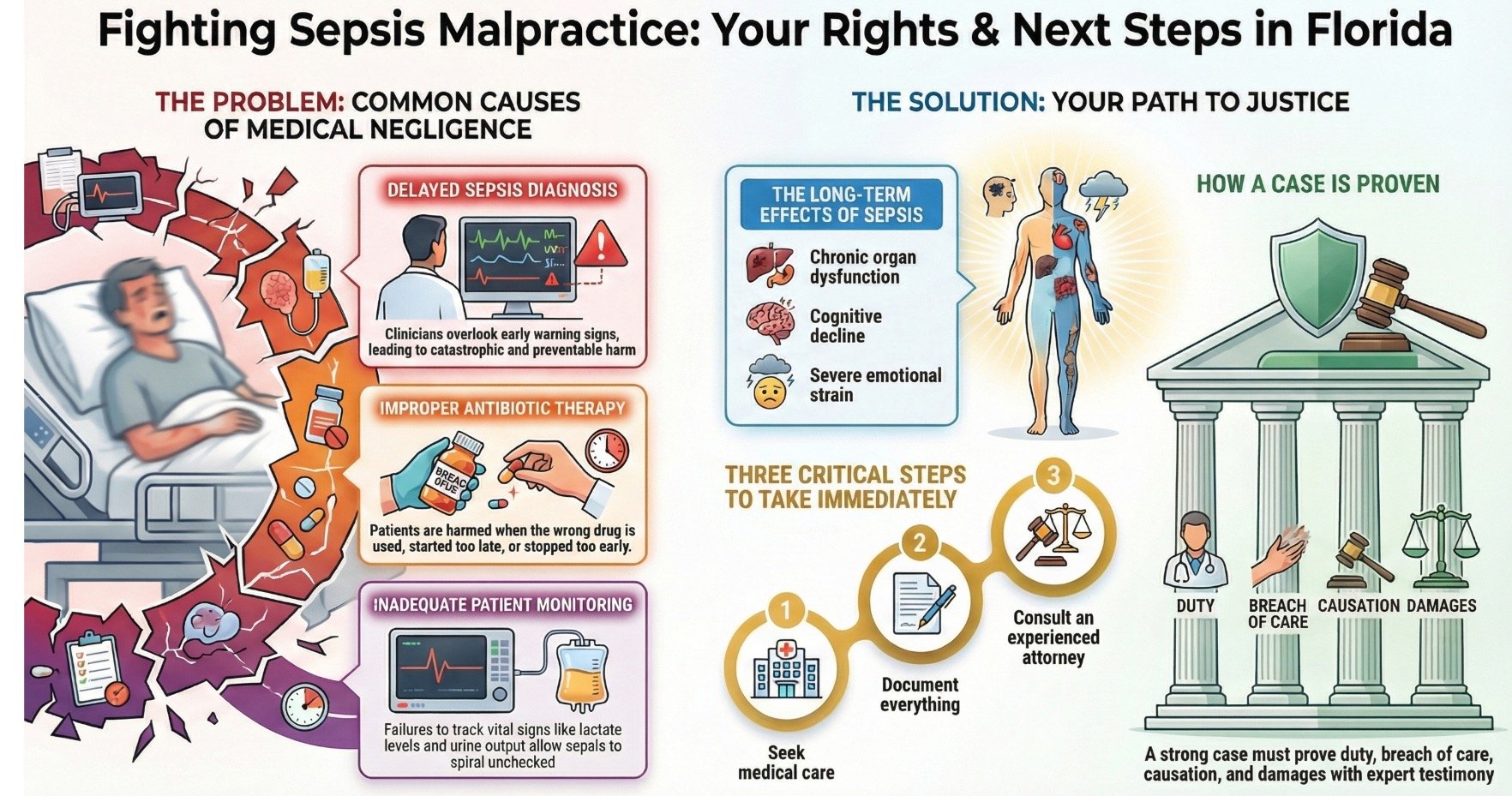
As we examine common causes of Florida hospital sepsis malpractice injuries, we focus on delayed sepsis diagnosis, improper antibiotic therapy, inadequate monitoring protocols, and poor infection control.
We’ll explain how missed early warning signs, incorrect or late antibiotics, and failures in continuous crucial sign and lab monitoring can accelerate patient harm.
We’ll also address how lapses in sterilization, hand hygiene, and device management allow preventable infections to take hold and progress.
Delayed Sepsis Diagnosis


Although sepsis can progress rapidly, delayed diagnosis remains one of the most preventable causes of catastrophic harm in Florida hospitals. We see delays when clinicians overlook early warning signs, minimize critical sign abnormalities, or fail to escalate care during shift changes.
Delayed recognition often stems from fragmented communication, inadequate sepsis screening, and incomplete documentation that obscures trends.
Diagnostic bias further prolongs action, as providers may anchor on a benign explanation, discount patient reports, or assume improvement without objective reassessment. Time lost during transfers, imaging queues, and lab verification can compound risk when protocols aren’t triggered promptly.
We work to uncover these breakdowns through records, timelines, and expert review, demonstrating how earlier identification and coordinated response would have prevented deterioration, multi‑organ injury, and extended hospitalization.
Improper Antibiotic Therapy
Delays in identifying sepsis often set the stage for a second, preventable failure: improper antibiotic therapy.


When hospitals choose the wrong drug, start too late, or stop too early, patients lose vital time. We see harm when broad coverage isn’t started promptly, cultures aren’t obtained correctly, or therapy isn’t narrowed once pathogens are known.
Equally dangerous are dosing errors, including underdosing in obesity or renal failure and overdosing that triggers toxicity.
Effective care requires antibiotic stewardship that balances urgency with accuracy. Clinicians must match likely sources and local resistance patterns, then adjust as data emerge. When institutions lack protocols, communication breaks down, and avoidable injuries follow. We analyze records, guidelines, and pharmacy logs to show how improper therapy breached standards and caused preventable harm.
Inadequate Monitoring Protocols
Even when clinicians suspect infection and start treatment, inadequate monitoring lets sepsis spiral unchecked. We see this when vital signs aren’t tracked at proper intervals, lactate levels aren’t repeated, and urine output isn’t trended.
Timely reassessment is pivotal because sepsis can deteriorate in minutes, not hours.
Breakdowns often stem from weak protocols, poor staff training, and inconsistent escalation pathways. When nurses and physicians don’t share clear action thresholds, early warning scores go unheeded. Alarm fatigue compounds the risk, as frequent nonactionable alerts drown out genuine danger signals.
Reliable systems require standardized monitoring bundles, documented reassessments, and rapid-response triggers tied to objective metrics. When hospitals ignore these essentials, patients suffer preventable harm.
We scrutinize records, timelines, and alarm data to prove negligence in monitoring.
Poor Infection Control
Monitoring failures often trace back to a deeper problem: pathogens spread because basic infection-control measures break down.
When hand hygiene is inconsistent, devices are inserted without sterile technique, or isolation protocols are ignored, vulnerable patients face preventable infections that can progress to sepsis. We evaluate whether the hospital enforced clear policies, supplied adequate protective equipment, and monitored compliance in real time.
We also scrutinize staff training, because policies mean little if caregivers aren’t prepared to implement them under pressure. Breakdowns often appear in operating rooms, catheter care, wound management, and environmental cleaning.
We review audit logs, surveillance cultures, and incident reports to trace the source. If leadership failed to correct known gaps, we hold them accountable and pursue compensation that supports your recovery and safeguards future patients.
Legal Rights of Florida Hospital Sepsis Malpractice Injury Victims
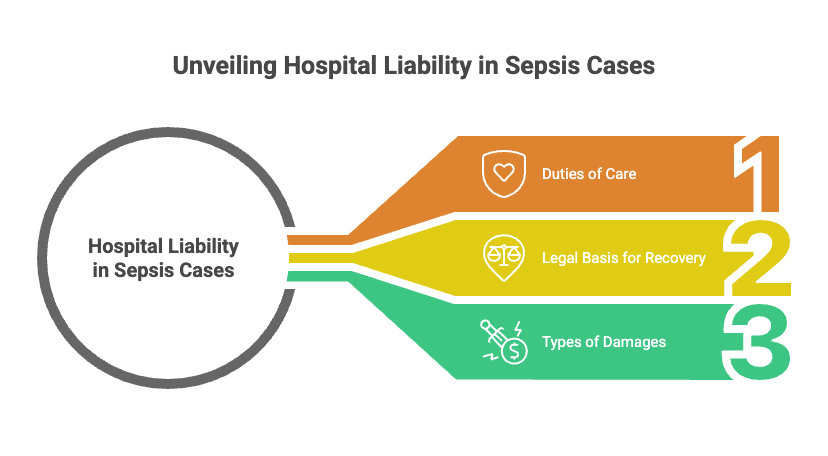
While the circumstances may feel overwhelming, Florida patients injured by hospital sepsis malpractice have clear legal rights and avenues for recovery. We can pursue compensation when hospitals fail to meet accepted standards of care, including timely diagnosis, proper monitoring, and coordination among providers.
Our civil justice system recognizes the profound harm sepsis causes, and it allows claims for medical expenses, lost wages, rehabilitation, and pain and suffering. Families may also seek wrongful death damages when negligent care results in loss of life.
Florida sepsis malpractice victims have clear rights to pursue compensation and accountability.
- Hospitals owe duties grounded in patient safety, including strong protocols, patient advocacy, and preventive training that reduce avoidable infections.
- Florida law permits recovery when breaches of duty directly cause injury, supported by expert testimony, medical records, and credible timelines.
- Damages can include future care, loss of earning capacity, and loss of consortium, reflecting the long-term effects of sepsis.
We stand with you to assert these rights, hold institutions accountable, and advance safer care for all.
Steps to Take After a Florida Hospital Sepsis Malpractice Injury
After a suspected sepsis malpractice injury in a Florida hospital, we should prioritize immediate medical care to stabilize health and prevent further harm.
We then need to document symptoms, timelines, communications, and obtain all relevant medical records to preserve essential evidence.
Finally, we should consult an experienced attorney promptly, so we can evaluate liability, protect our rights, and initiate the necessary legal steps without delay.
Seek Immediate Medical Care
Acting without delay can save a life and protect your legal rights. When sepsis is suspected after a hospital visit, we urge you to call 911 and request emergency recognition by first responders.
Early assessment, intravenous fluids, and broad-spectrum antibiotics are time-sensitive, and rapid transport to an appropriate facility can prevent organ failure. We should clearly state the concern for sepsis, describe recent hospital care, and report any sudden fever, confusion, shortness of breath, or extreme weakness.
At the hospital, we must request triage escalation and insist on prompt vital signs, labs, and sepsis protocols. We should inform clinicians of all recent medications, procedures, and allergies, ensuring no delay in treatment. By acting decisively, we prioritize safety, reduce complications, and preserve options for accountability.
Document Symptoms and Records
Immediate care sets the foundation; now we need to build a clear record of what happened and when.
We begin by preserving every document, including discharge papers, test results, medication lists, and imaging reports. We request complete medical records from the hospital and any subsequent providers, confirming dates, times, and signatures.
We create patient journals to capture daily observations, including fever readings, confusion, pain levels, heart rate, blood pressure, and oxygen saturation when available. We develop precise symptom timelines that note onset, escalation, and any delays in assessment or treatment.
We save photos of wounds, rashes, or lines, with timestamps. We record names and roles of clinicians, noting instructions and responses to concerns. We keep billing statements and insurance communications, which often corroborate treatment chronology.
Consult an Experienced Attorney
Though the medical crisis may feel overwhelming, we should promptly consult a Florida attorney who focuses on sepsis and hospital malpractice. Early guidance protects evidence, preserves deadlines, and clarifies our path.
An experienced lawyer evaluates medical records, timelines, and standards of care, then identifies negligent acts and potential defendants. We should ask about prior results, trial readiness, and resources for expert testimony, because sepsis cases demand rigorous proof.
We’ll also review fee structures, communication practices, and expected timelines. Client testimonials can reveal responsiveness, compassion, and results, while community outreach may reflect a firm’s commitment to service.
Let’s bring organized records to the consultation, prepare focused questions, and request a candid case assessment. Prompt engagement strengthens our claim and safeguards our rights.
How a Florida Hospital Sepsis Malpractice Injury Lawyer Can Help You
Handling a sepsis malpractice claim in Florida demands swift analysis, precise evidence gathering, and command of both medical and legal standards. We coordinate investigations that align clinical timelines with hospital policies, highlighting missed red flags and delayed interventions.
Swift, evidence-driven sepsis malpractice investigations align clinical timelines with policies to expose missed red flags and delays.
Our approach centers on Patient advocacy and Sepsis prevention, translating intricate records into clear proof of breach and causation. We secure expert testimony, quantify damages, and negotiate with insurers, all while preparing for trial from day one.
- We obtain and analyze medical records, lab data, protocols, and staffing logs to map deviations from the standard of care.
- We engage board-certified experts to address diagnosis delays, treatment errors, and preventable deterioration, building credible, courtroom-ready opinions.
- We orchestrate communications with insurers and hospitals to protect your rights and pursue full compensation for medical costs, lost income, and pain.
We keep you informed, meet deadlines, and file strategically. Our disciplined process advances your case efficiently, while honoring your voice and goals.
Long-Term Effects of Florida Hospital Sepsis Malpractice Injuries
As we assess the long-term impact of sepsis malpractice in Florida hospitals, we must account for chronic organ dysfunction that can impair daily living and limit independence.
We also consider cognitive and memory decline, which may hinder employment, decision-making, and quality of life.
Jointly, these medical challenges create sustained emotional and financial strain, requiring strategic planning and rigorous advocacy to secure necessary care and compensation.
Chronic Organ Dysfunction
Endurance often defines the aftermath of sepsis, because the injury doesn’t end when the infection clears. Many clients face chronic organ dysfunction that reshapes daily life and care needs. When hospitals delay diagnosis or treatment, the risk of long-term organ failure rises, affecting the kidneys, heart, lungs, and liver.
Persistent fatigue, breathlessness, fluid imbalance, and pain often follow, requiring coordinated monitoring and timely interventions.
We work to document how immune suppression compounds these injuries, increasing infections and slowing recovery. Clear medical timelines, lab trends, and expert evaluations help show how malpractice triggered ongoing harm.
We collaborate with clinicians to quantify losses, secure rehabilitative support, and plan for durable medical equipment. Our role is to hold facilities accountable, stabilize resources, and protect the continuum of care.
Cognitive and Memory Decline
Though the infection may resolve, the brain often bears lasting wounds, and cognitive and memory decline can emerge as one of sepsis’s most disabling outcomes.
We see survivors struggle to focus, process information, and remember recent conversations or appointments. These deficits disrupt work, caregiving, and daily safety, and they often surface months after discharge.
We guide clients toward timely cognitive assessment, which documents deficits, informs treatment, and preserves evidence of harm. Early identification supports targeted therapies, including memory rehabilitation, occupational strategies, and structured routines that reduce cognitive load.
We coordinate expert evaluations, track progress, and guarantee providers follow best practices. When hospital errors caused or worsened sepsis, we build a record linking negligent care to measurable cognitive decline, protecting your rights while supporting practical recovery.
Emotional and Financial Strain
Cognitive injuries rarely occur in isolation, and the same sepsis-related failures that impair memory often set off a prolonged cycle of emotional and financial strain. When a loved one struggles to process information, families shoulder intricate decisions, constant supervision, and disrupted routines.
Over time, the pressure fuels caregiver burnout, erodes household stability, and undermines everyone’s well‑being.
We see how wage loss, unexpected medical bills, and reduced earning capacity compound grief with financial devastation. Counseling, home health aides, and adaptive equipment help, yet insurers may delay or deny coverage, deepening stress.
Our role is to document these burdens with precision, translate them into recoverable damages, and pursue resources that restore breathing room. By addressing both emotional injuries and economic harm, we help families serve and heal.
Proving Liability in Florida Hospital Sepsis Malpractice Medical Malpractice Injury Cases
Establishing liability in a Florida hospital sepsis malpractice case starts with proving a deviation from the accepted standard of care and a causal link to the patient’s harm.
Establishing liability begins by proving a breach of care and a direct causal link to harm.
We begin by identifying what competent providers should have done—timely recognition of sepsis, prompt antibiotics, fluid resuscitation, and escalation of care—and then documenting where the hospital or staff fell short.
We gather records, timelines, and policies to show how delays or failures occurred.
Proving medical causation is crucial. Through expert testimony from board-certified physicians, we demonstrate that the breach likely allowed the infection to progress, resulting in organ dysfunction or death.
We connect essential signs, laboratory trends, and sepsis bundles to the clinical outcome, showing that earlier intervention is more likely to have prevented the injury.
We also assess institutional liability, including understaffing, inadequate protocols, or negligent supervision.

Compensation for Florida Hospital Sepsis Malpractice Damages
While every case turns on its facts, compensation in Florida hospital sepsis malpractice claims aims to make patients and families whole by addressing both economic and non-economic losses. We assess how negligent delays or failures in diagnosis and treatment created measurable harm, then build a damages model that reflects the full impact.
Economic damages encompass past and future medical expenses, hospitalization, rehabilitation, in-home care, lost wages, and diminished earning capacity. We also document out-of-pocket costs for medical equipment, medications, and transportation.
Non-economic losses recognize pain and suffering, loss of enjoyment of life, mental anguish, and loss of consortium. When sepsis leads to disability, amputations, or organ injury, we collaborate with medical and vocational experts to quantify lifetime needs.
Sepsis settlements should account for liens, insurance subrogation, and structured payouts where appropriate. We present clear evidence, negotiate firmly, and, when necessary, try cases to secure fair, durable compensation that supports continued healing and dignity.
The Statute of Limitations for Florida Hospital Sepsis Malpractice Injury Cases
Because deadlines can quietly determine the fate of a claim, we move quickly to evaluate the statute of limitations that governs Florida hospital sepsis malpractice cases. Florida law generally allows two years from when the incident is discovered, or should have been found, to file.
However, a four‑year overall cap may still apply, subject to limited exceptions. Sepsis cases often involve delayed recognition, so we examine statute nuances carefully, aligning medical records and symptom timelines with legal deadlines.
We also analyze discovery tolling, which may extend the period during which the injury wasn’t reasonably discoverable despite diligent efforts. Fraud, concealment, or misrepresentation can toll the statute, but courts apply these rules narrowly.
If the patient is a minor or if death occurs, different timing frameworks can govern, requiring prompt review.
To protect your rights, we preserve evidence early, send required presuit notices, and calendar every deadline, ensuring your claim is timely and procedurally sound.
Why You Need an Experienced Florida Hospital Sepsis Malpractice Injury Lawyer
Deadlines set the pace, but the lawyer you choose determines the strategy and outcome.
In sepsis malpractice, timing, medicine, and law intersect quickly, and errors compound harm. We bring disciplined investigation, consult qualified experts, and translate intricate records into a clear narrative. Our focus is accountability and restoration, grounded in medical ethics and rigorous evidentiary standards.
We understand how hospitals should triage infection, escalate care, and document crucial changes. When systems fail, we establish causation and damages with precision. We coordinate with clinicians, preserve proof, and confront insurers that undervalue catastrophic losses.
Our approach centers on patient advocacy, ensuring your voice is heard, your needs are prioritized, and your recovery plan is fully documented.
We pursue compensation for medical costs, lost income, and long-term support services. We also address future risks, including disability and recurrent infection. With sepsis, experience matters, because the smallest oversight can decide liability, value, and justice.
How to Choose the Right Florida Hospital Sepsis Malpractice Injury Lawyer for Your Case
Amid the urgency of a sepsis injury, choosing the right Florida hospital malpractice lawyer demands clear criteria and disciplined evaluation. We start by verifying focused experience in hospital sepsis cases, including proof of results, medical expert networks, and litigation readiness.
We examine case strategies, asking how the firm investigates delays in diagnosis, protocol breaches, and causation.
Client interviews matter. We schedule consultations to assess communication style, clarity, and responsiveness, ensuring the attorney listens, educates, and provides a practical roadmap.
We request written explanations of fee structures, including contingency percentages, costs advanced, and scenarios that change fees. Transparent billing protects the family and preserves resources for care.
We confirm capacity and support, reviewing caseloads, team composition, and access to nurse consultants. We evaluate reputation through peer ratings, court records, and references.
Finally, we align values, selecting counsel who prioritizes patient dignity, timely action, and rigorous advocacy from intake through resolution.
About the Law Offices of Anidjar and Levine
At the Law Offices of Anidjar & Levine, we focus on complex medical negligence and hospital malpractice, including sepsis cases that demand rapid investigation and decisive litigation.
We bring disciplined case development, prompt evidence preservation, and focused advocacy to each matter.
Our team understands the clinical timelines and systemic failures that allow sepsis to escalate, and we build cases that clarify accountability and damages.
We practice patient advocacy with rigor, guiding clients through treatment documentation, expert evaluation, and insurer negotiations.
We coordinate with medical professionals, ensuring every crucial lapse is identified and supported by credible testimony.
Our approach is collaborative, strategic, and responsive to your needs.
We also invest in community outreach, offering educational resources on early sepsis recognition and hospital safety.
By engaging families, caregivers, and professionals, we help prevent harm while holding institutions to recognized standards.
When you enter your case, we pursue results with precision, discretion, and unwavering commitment.

Frequently Asked Questions
What Medical Records Should I Collect Before My Consultation?
You should collect complete medical summaries, admission and discharge notes, lab results, imaging reports, medication lists, and timelines of symptoms and treatments.
Bring operative reports, progress notes, consultation letters, and nursing records, including crucial signs charts.
Include prior medical history, allergies, and immunizations.
Gather billing records, insurance communications, and any incident reports.
Assemble emails or messages with providers, plus a personal chronology.
Organize everything by date, label clearly, and retain copies for reference.
Can I Switch Lawyers Mid-Case Without Harming My Claim?
Yes, you can switch lawyers mid-case without harming your claim, if handled correctly.
We evaluate whether a change in counsel benefits outcomes, then manage timing considerations to avoid delays, missed deadlines, or prejudice.
We review your fee agreement, coordinate lien resolution, and secure your complete file, including expert materials.
We notify the court and all parties to ensure a seamless changeover.
We’ll protect momentum, preserve evidence, and safeguard strategy, prioritizing your interests and the people you serve.
Will Filing a Claim Affect My Ongoing Medical Care?
Yes, filing a claim shouldn’t disrupt your care when we plan carefully. We prioritize treatment continuity by coordinating with your providers to ensure your medical needs remain central.
We manage provider communication, efficiently request records, and protect your privacy through proper authorizations. We also avoid scheduling conflicts, minimize administrative burdens, and address billing concerns proactively.
If any insurer interference arises, we intervene promptly, so your care plan proceeds uninterrupted while we diligently and responsibly advance your claim.
How Are Expert Witness Fees Handled in These Cases?
Expert witness fees are typically advanced by our firm, then reimbursed from any recovery. We retain consultants to provide expert testimony and pay for record reviews, reports, and depositions.
You won’t face fee splitting with experts; ethical rules prohibit splitting legal fees with nonlawyers. Instead, experts are paid flat or hourly rates under written agreements.
If there’s no recovery, many firms absorb or negotiate these costs, aligning resources with your service-focused goals.
Can Families Outside Florida Pursue Claims for In-State Treatment?
Yes, families living out of state can pursue claims for in-state treatment.
We evaluate interstate jurisdictional issues, including where the negligence occurred, where the defendants reside, and where evidence and witnesses are located.
We also assess choice-of-law and venue intricacies, then select the most advantageous forum.
Crucially, we track each applicable statute of limitations and pre-suit requirements to avoid dismissal.
We coordinate filings, service, and discovery across borders, ensuring compliance and protecting your family’s interests.
——————-
We’re ready to protect your rights after a hospital sepsis malpractice injury.
Our team investigates quickly, secures evidence, consults medical experts, and pursues full compensation for your losses.
We guide you through each step, meet all deadlines, and handle insurers and providers so you can focus on recovery.
If negligence caused your harm, we’ll hold the responsible parties accountable.
Contact the Law Offices of Anidjar & Levine today for a free consultation and a clear, strategic path forward.
Learn more: Medical Malpractice Injury Lawyer


We Can Help.