



At the Law Offices of Anidjar and Levine, we help Floridians injured by failed surgeries preserve essential evidence from day one, coordinate independent medical reviews, and meet Florida’s strict presuit and statute deadlines.
We secure complete records, audit trails, and imaging, consult qualified experts to prove breach and causation, and quantify damages for medical costs, wage loss, and pain and suffering.
We manage insurer communications, prepare every case for trial, and pursue full accountability through disciplined advocacy.
Continue to see how we protect your rights and maximize compensation, and learn more here: Medical Malpractice Injury Lawyer
Key Takeaways
- We investigate failed surgeries statewide in Florida, preserve critical evidence, and consult top experts to prove duty, breach, causation, and damages.
- Immediate post-surgery guidance: seek urgent care for red flags, get independent evaluations, and document symptoms, imaging, and communications.
- We handle presuit requirements, expert corroboration, and notice of intent, tracking Florida’s two-year discovery rule and four-year outer limit.
- Our team differentiates unavoidable complications from negligence using operative records, consent forms, imaging, and disciplined causation analysis.
- We pursue full compensation: medical bills, future care, lost wages, diminished earning capacity, pain and suffering, and punitive damages when warranted.
How We Can Help With Your Florida Failed Surgery Malpractice Injury Claim
Although every case is unique, we help clients pursue failed surgery malpractice claims in Florida by investigating what went wrong and building a precise, evidence-driven strategy. We start by listening closely, documenting your medical history, and collecting operative reports, imaging, and nursing notes.
Dig deeper into our in-depth case study: An Analytical Framework for Florida Failed Surgery Malpractice Claims
We consult qualified experts who can identify breaches of the standard of care, and we preserve crucial evidence before it’s lost.
We manage communications with insurers, protect you from premature statements, and position your claim for maximum leverage. We map clear settlement timelines, explain decision points, and provide candid risk assessments so you can choose confidently.
Our team prepares every matter as if it will proceed to trial, drafting persuasive demands, calculating damages with rigor, and anticipating defenses.
We value accountability and transparency. Client testimonials reflect our diligence, responsiveness, and results-focused advocacy. Throughout the process, we coordinate medical liens, monitor ongoing treatment, and keep you informed with concise, timely updates.
Understanding Florida Failed Surgery Malpractice Injury Cases
Grasp the fundamentals of a Florida failed surgery malpractice case by focusing on what the law requires and how evidence proves it.



We begin by establishing duty, breach, causation, and damages. The surgeon and hospital owed a professional duty, measured against the accepted standard of care. Medical negligence occurs when actions fall below that standard, and the deviation directly causes harm.
Establish duty, breach, causation, and damages to prove medical negligence and resulting harm.
We then examine surgical consent. Informed consent requires disclosure of material risks, alternatives, and likely outcomes. If consent was incomplete or coerced, and a reasonable patient would have declined the procedure, liability may follow. We document this through consent forms, chart notes, and preoperative counseling records.
Next, we align expert testimony with objective proof. Operative reports, imaging, lab results, and postoperative notes help show what happened and why. We quantify losses with medical bills, wage records, and life‑care plans.
Throughout, we preserve evidence, meet statutory deadlines, and present a coherent, credible case.
Common Causes of Florida Failed Surgery Malpractice Injuries
When failed surgeries lead to serious harm, we often find preventable causes such as surgical errors, anesthesia complications, and postoperative negligence.
We also examine whether the surgeon obtained adequate informed consent, ensuring you were told the material risks, alternatives, and likely outcomes.
Surgical Errors
Even with careful planning and skilled teams, surgical errors remain a leading cause of preventable harm in Florida hospitals and ambulatory centers. We see wrong-site surgery, retained sponges or instruments, and lacerations to nearby organs when protocols break down.
A properly executed operative checklist should verify the patient, procedure, site, and instruments, yet rushed handoffs or poor communication can create gaps.
Documentation errors, inadequate imaging review, and failure to escalate concerns during time-outs also contribute to avoidable injuries.


We investigate whether training deficiencies, staffing shortages, or equipment malfunction played a role, and whether the hospital enforced its safety policies. By preserving evidence and consulting independent experts, we identify each breach in the surgical process, connect it to your injury, and pursue accountability that promotes safer care for others.
Anesthesia Complications
Although modern anesthesia is designed to be safe, preventable errors still cause some of the most devastating surgical injuries in Florida. We see failures in preoperative assessment, inaccurate dosing, and poor monitoring lead to catastrophic outcomes.
Patients may suffer anesthesia awareness, awakening during surgery while paralyzed, a traumatic event often linked to improper sedation depth or equipment malfunction.
Errors in neuromuscular blockade can suppress breathing while masking pain, demanding vigilant observation and timely reversal. Airway mismanagement, allergic reactions, and overlooked medication interactions compound the risks.
When providers disregard standards for monitoring oxygenation, ventilation, and circulation, brain injury, cardiac events, and death can follow.
We gather records, consult experts, and hold negligent actors accountable, seeking resources for long‑term care and recovery.
Postoperative Negligence
Guarding a patient’s recovery after surgery demands disciplined postoperative care, and lapses in this phase often turn a successful procedure into a preventable injury.
We focus on failures in monitoring, documentation, and timely intervention, because these oversights often fuel complications that escalate quickly.
When clinicians miss early signs of a postoperative infection, sepsis, or wound dehiscence, a patient’s condition can deteriorate, requiring additional procedures, more extended hospitalization, or permanent harm.
We examine whether essential signs were tracked, labs were ordered, antibiotics were administered, and discharge instructions were tailored and explained.
We assess pressure injury prevention, blood clot prophylaxis, medication reconciliation, and prompt response to alarming symptoms. If negligent care breached Florida’s standards and caused injury, we build a precise record, consult qualified experts, and pursue accountability to safeguard future patients and secure just compensation.
Inadequate Informed Consent
When surgeons and hospitals rush consent or omit essential risks, patients lose the chance to make an informed choice, and preventable injuries follow.
We take inadequate informed consent seriously because it undermines Patient autonomy and violates Florida’s standards of care.
Proper consent requires clear Risk disclosure, alternatives, likely outcomes, and the option to decline.
It also requires time for questions, not just a few minutes before surgery.
We investigate whether providers explained material risks that a reasonable patient would consider significant.
We examine consent forms, chart notes, interpreter use, timing, and any deviations from stated plans.
If consent was incomplete or misleading, we connect the failure to the injury and pursue accountability.
Our approach safeguards community trust, promotes ethical practice, and seeks compensation that restores dignity and stability.
Legal Rights of Florida Failed Surgery Malpractice Injury Victims


Even after a surgery goes wrong, Florida law protects your right to seek accountability and compensation. We stand with you to assert patient rights, pursue fair damages, and make certain your voice is heard. Our role centers on principled medical advocacy, supported by clear evidence and careful legal analysis.
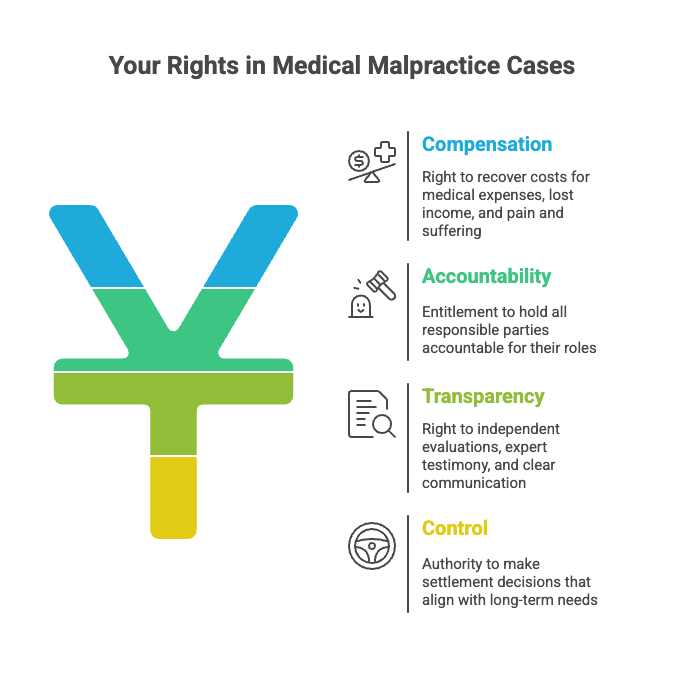
You’re entitled to bring a malpractice claim when a provider’s breach of the standard of care causes injury, and to recover losses that restore dignity and stability.
Florida safeguards your voice and recovery after surgical errors—pursue accountability, fair damages, and principled medical advocacy.
- You have the right to pursue compensation for medical costs, lost income, diminished earning capacity, and pain and suffering, when negligence is proven.
- You may seek accountability from all responsible parties, including surgeons, hospitals, anesthesia teams, and post-operative providers, based on their specific roles.
- You’re entitled to independent evaluations, expert testimony, and transparent communication about risks, causation, and damages.
- You retain control over settlement decisions, and you can demand terms that reflect your long-term needs, rehabilitation goals, and access to future care.
Steps to Take After a Florida Failed Surgery Malpractice Injury
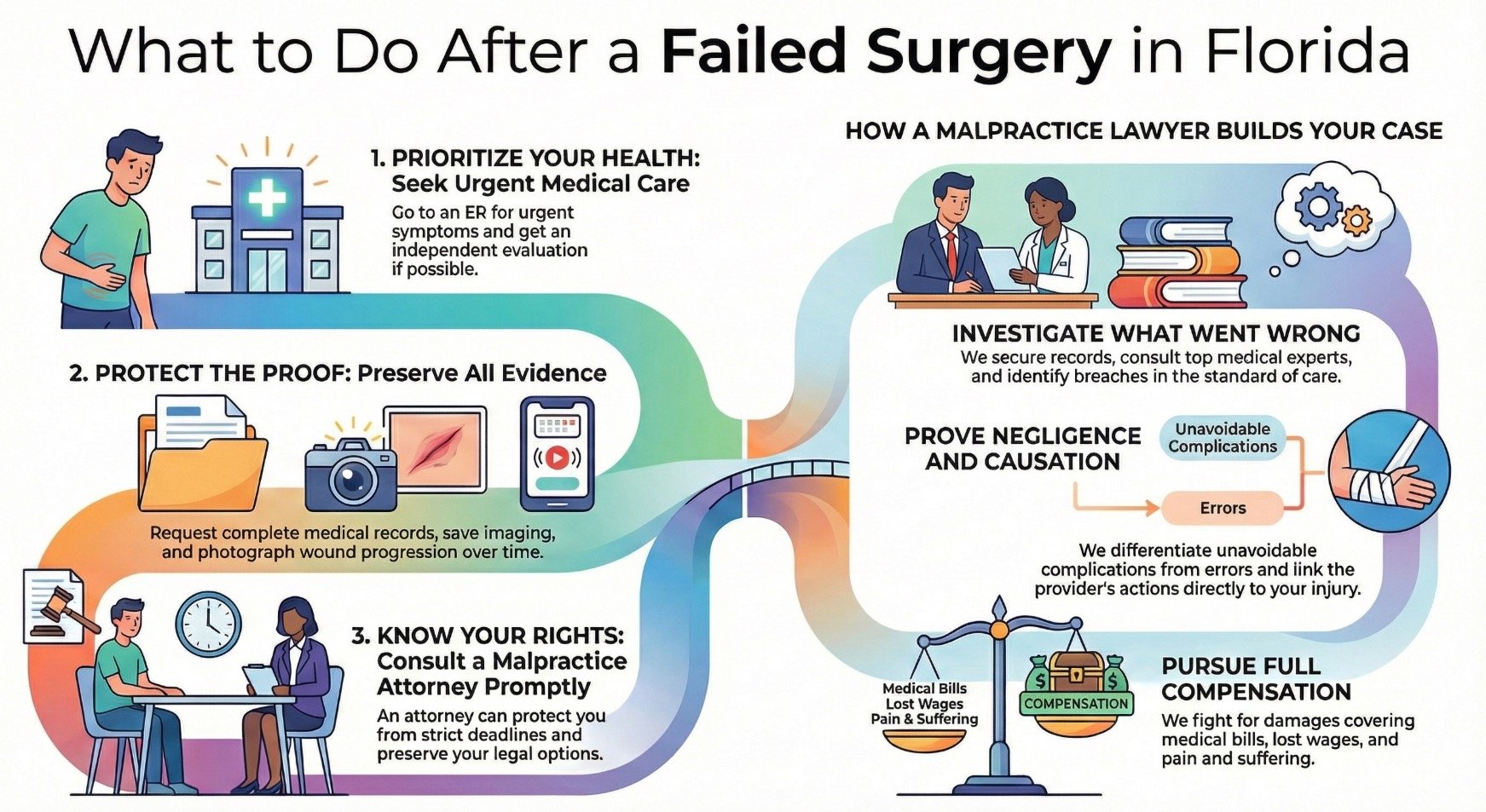
After a failed surgery in Florida, we first prioritize your health by seeking urgent medical care to stabilize your condition and document complications.
We then help you preserve vital medical evidence, including records, imaging, prescriptions, and communications, ensuring nothing is altered or lost.
Finally, we promptly consult a malpractice attorney to evaluate the facts, protect deadlines, and position your claim for a strong legal strategy.
Seek Urgent Medical Care
Recognizing warning signs and securing prompt medical care protects your health and your legal rights. If post-surgical symptoms escalate—fever, uncontrolled pain, shortness of breath, severe swelling, or bleeding—we act immediately.
We call 911 for urgent transport or proceed to the nearest emergency department, and we clearly report the surgery, timeline, and symptoms. We request evaluation by a clinician not involved in the original procedure, when possible, to reduce bias.
At the hospital, we advocate for complete assessments, including essential signs, imaging, and lab tests, and ask for triage reassessment if conditions worsen.
We document symptom onset and any changes, and we follow discharge instructions precisely. Prompt care limits complications, creates reliable medical documentation, and positions us to make informed decisions about next steps with confidence and resolve.
Preserve Medical Evidence
In the vital hours and days following a failed surgery, we move quickly to preserve medical evidence that will anchor your claim in facts, timelines, and objective data.
We request complete medical records, operative reports, nursing notes, medication logs, and internal incident documentation.
We secure and catalog physical items, such as implants, removed tissue, or hardware, maintaining an unbroken chain of custody that withstands scrutiny.
We coordinate immediate imaging preservation, capturing and archiving X‑rays, CT scans, MRIs, and PACS metadata before systems purge or overwrite files.
We obtain audit trails that record access and changes to electronic health records, thereby protecting the integrity of entries.
We document wound progression with time-stamped photographs, track lab trends, and collect communications, ensuring each item is authenticated, organized, and verifiable.
Consult Malpractice Attorney
With evidence preserved and timelines secured, we take the next decisive step and urge you to consult a Florida malpractice attorney without delay. Early counsel allows us to protect your rights, evaluate liability, and identify experts before memories fade.
It also aligns your recovery with a clear legal plan grounded in facts, deadlines, and ethical duties to serve your interests.
During the client interview, we listen carefully, document the surgical course, and assess damages with disciplined attention. We then outline a tailored case strategy, mapping the pre-suit investigation, medical reviews, and potential settlement pathways.
We explain risks, costs, and expected milestones so you can make informed decisions. By acting promptly, we preserve leverage, maintain evidentiary integrity, and position your claim for a measured, effective pursuit of justice.
How a Florida Failed Surgery Malpractice Injury Lawyer Can Help You
Few events disrupt life more than a surgery that goes wrong, and a Florida failed surgery malpractice injury lawyer can guide you through the path to accountability and recovery. We evaluate what happened, identify breaches of the standard of care, and build a clear strategy to seek compensation.
Our approach centers on Patient advocacy, rigorous evidence gathering, and decisive case management, so you can focus on healing while we safeguard your rights.
- Case investigation and expert review: We secure records, consult medical experts, and establish causation with disciplined analysis.
- Strategic Settlement negotiation: We quantify damages, present compelling proof, and negotiate from a position of strength to maximize value.
- Litigation preparation and trial advocacy: We draft precise pleadings, take focused depositions, and try the case when fair resolution is refused.
- Coordinated support and communication: We keep you informed, align resources, and ensure deadlines and procedural rules are met.
We stand beside you, pursue accountability, and work to deliver the resources your recovery requires.
Long-Term Effects of Florida’s Failed Surgery Malpractice Injuries
When surgery goes wrong, we must address lasting harm such as chronic pain and disability that can limit mobility, work capacity, and daily living.
We also consider permanent organ damage, which may require ongoing treatment, monitoring, and lifestyle changes.
Equally important, we recognize psychological trauma and PTSD, which can impair sleep, concentration, and relationships, and often necessitate sustained mental health care.
Chronic Pain and Disability
Enduring chronic pain and unexpected disability after a failed surgery can upend every facet of life, from work and mobility to sleep and mental health. we recognize the daily strain and the duty many of us feel to keep serving family, colleagues, and community despite setbacks.
Our role is to help you secure all-inclusive care and the resources needed to move forward.
We document symptoms meticulously, coordinate pain management, and consult experts to establish future medical needs. We also address durable medical equipment, home modifications, and transportation barriers. When employment is disrupted, we pursue wage loss and support vocational rehab to rebuild earning capacity.
By aligning medical evidence with legal strategy, we position your claim to reflect fundamental limitations, protect your independence, and safeguard the long-term quality of your life.
Permanent Organ Damage
Irreversible harm to a vital organ changes not only health status but the course of a lifetime, and we address these cases with precision and urgency.
Permanent organ damage after failed surgery can mean renal insufficiency, liver failure, or loss of cardiac function. It often triggers cascading complications, including metabolic disruption, infection risk, and prolonged hospitalization. Some clients face dialysis or an organ transplant evaluation, while others require lifelong medication management.
When endocrine organs are injured, hormone imbalance can impair energy, fertility, temperature regulation, and bone health. We work with medical experts to document causation, quantify future care, and establish full economic and non-economic damages.
Our approach includes life care planning, insurance coordination, and recovery of costs for medications, assistive devices, and home modifications, promoting stable, dignified independence.
Psychological Trauma and PTSD
Resilience meets its limits after a failed surgery, and psychological trauma can persist long after physical wounds close.
We see clients experience hypervigilance, nightmares, and intrusive memories that disrupt daily life and strain caregiving roles. PTSD may emerge when trust in medical professionals collapses, intensifying fear and avoidance. For some, Childhood Triggers resurface, magnifying distress and complicating recovery.
We also witness Attachment Disruption, as family systems absorb stress, miscommunication, and role shifts. Patients may withdraw, while loved ones overcompensate, eroding confidence.
Effective care requires prompt diagnosis, trauma‑informed therapy, and coordinated support. We document symptoms, treatment timelines, and functional limitations, linking them directly to malpractice. By building credible evidence and connecting clients with resources, we protect rights, stabilize recovery, and restore long‑term dignity.
Proving Liability in Florida Failed Surgery Malpractice Medical Malpractice Injury Cases
Although every surgical outcome carries some risk, proving liability in a Florida failed surgery malpractice case turns on whether a provider breached the applicable standard of care and caused the injury.
We begin by gathering operative records, consent forms, and postoperative notes, then aligning them with authoritative guidelines. We retain an expert witness in the relevant specialty to opine on what a reasonably prudent provider would have done and whether the conduct fell short.
Next, we establish causation through a disciplined analysis. We differentiate unavoidable complications from errors, link the breach to the specific harm, and rule out alternative explanations such as preexisting conditions or known surgical risks.
We also evaluate informed consent, verifying whether material risks were disclosed in a timely, comprehensible manner.
Finally, we preserve evidence, interview staff, and secure imaging for independent review. By synthesizing medical facts with expert testimony, we build a clear narrative that satisfies Florida’s evidentiary standards and honors our duty to serve.
Compensation for Florida Failed Surgery Malpractice Damages
Compensation in Florida failed surgery malpractice cases aims to make you whole by addressing the full scope of losses tied to the provider’s negligence. We evaluate every category of damages, documenting medical billing, hospital charges, rehabilitation, and anticipated future care. We also seek wage loss, diminished earning capacity, and necessary home or vehicle modifications. When injuries require revision procedures, specialized equipment, or long-term therapy, we quantify those costs with expert support.
We don’t overlook non-economic harms. Pain and suffering, loss of enjoyment of life, and the strain on family relationships merit careful valuation. We address emotional recovery, coordinating evidence from treating clinicians and counselors to connect your psychological harms to the surgical failure.
Where appropriate, we pursue punitive damages to deter egregious misconduct.
Our process is methodical. We assemble records, consult medical economists, and build a damages model that stands up to scrutiny, ensuring your compensation reflects both present needs and future consequences.
The Statute of Limitations for Florida Failed Surgery Malpractice Injury Cases
Before we file a failed surgery malpractice claim in Florida, we carefully evaluate the statute of limitations and the related pre-suit requirements that control your timeline. Florida generally imposes two years from when the injury is discovered or should have been found with due diligence.
A four-year outer limit typically applies, even if discovery is delayed, but statute nuances can extend or shorten deadlines in specific circumstances.
We assess when the medical facts were knowable, whether concealment occurred, and if a foreign object was left in the body, because filing exceptions may arise. We also calculate tolling tied to the mandatory pre-suit investigation, expert corroboration, and the notice of intent, which can pause the clock for defined periods.
We track every date, verify medical records, and document discovery milestones. By anchoring the claim to defensible timelines, we preserve your rights, avoid procedural traps, and position the case for timely, compliant litigation.
Why You Need an Experienced Florida Failed Surgery Malpractice Injury Lawyer
Even when the facts seem clear, failed surgery malpractice cases in Florida demand seasoned counsel who understands both medicine and the state’s complex legal framework.
Malpractice in failed surgery in Florida demands seasoned counsel fluent in medicine and the state’s complex legal framework.
We step in to connect complex clinical records with legal standards, building a coherent narrative that links breaches of care to poor surgical outcomes. We coordinate with qualified experts, frame causation with precision, and guarantee damages are fully documented, including future care and loss of earning capacity.
We also safeguard deadlines, preserve critical evidence, and manage communications with insurers who aim to minimize exposure. Our patient advocacy is proactive and meticulous, protecting your voice while we pursue accountability through negotiation or trial.
We anticipate defenses, address consent and complication issues, and present facts in a persuasive, fact-driven manner.
How to Choose the Right Florida Failed Surgery Malpractice Injury Lawyer for Your Case
Strong advocacy matters only if the lawyer you choose has the right mix of medical insight, courtroom skill, and Florida-specific malpractice experience.
We should start by evaluating the firm’s track record with failed surgery cases, including verdicts, settlements, and expert networks.
We then evaluate how the attorney explains causation, damages, and the standard of care, because clear patient communication reflects mastery and respect.
We ask about litigation strategy, timing, and resources to ensure the firm can fund experts and depositions without delay.
We confirm the lawyer’s familiarity with Florida presuit screening, statutes of limitations, and comparative fault.
We also review fee structures in writing, asking about contingency percentages, case costs, and what happens if we don’t recover.
We prefer lawyers who provide prompt updates, return calls, and set realistic expectations.
Finally, we look for independent reviews, bar discipline history, and client references, choosing counsel whose integrity aligns with our commitment to serve.
About the Law Offices of Anidjar and Levine
Often serving clients statewide, we at the Law Offices of Anidjar and Levine focus on elaborate medical malpractice litigation with a disciplined, client-centered approach.
We’re committed to restoring dignity after failed surgery, and we measure our success by meaningful results and respectful service.
Our firm’s history reflects steady growth, rigorous case preparation, and a culture of accountability to every client we represent.
We pair trial readiness with meticulous investigation, consulting leading medical experts to clarify standards of care and causation.
Our attorneys coordinate with treatment teams, insurers, and courts to move cases efficiently, while keeping you informed at every stage.
Client testimonials consistently highlight our responsiveness, clear communication, and persistence in complicated matters.
Service means both practical guidance and advocacy.
From preserving evidence to negotiating liens, we manage details so you can focus on recovery.
When litigation is required, we pursue maximum compensation with strategic precision and unwavering ethics.
Frequently Asked Questions
Can I Switch Lawyers During a Malpractice Case Without Harming My Claim?
Yes, you can switch lawyers during a malpractice case without jeopardizing your claim if we handle the transition carefully. Your client rights allow you to change counsel at any stage, though your former lawyer may assert a lien for fees and costs.
We coordinate file transfers, ensure that deadlines are met, and maintain case momentum. We also evaluate strategy, communicate with insurers and experts, and preserve evidence, safeguarding your interests while advancing a focused, service‑oriented approach.
How Do I Handle Unexpected Medical Bills While the Case Is Pending?
We start by creating a medical budgeting plan, prioritizing vital care and deferring non-urgent services.
We request itemized bills, verify coding, and dispute errors.
We pursue negotiations with insurers for preauthorization, out-of-network exceptions, and payment corrections.
We ask providers for hardship discounts, interest-free payment plans, and lien agreements tied to case recovery.
We coordinate benefits, use secondary coverage, and explore charity programs.
We document all communications, preserving leverage and protecting your credit.
Will Pursuing Malpractice Affect My Ongoing Treatment With the Same Providers?
Yes, pursuing malpractice can affect ongoing treatment, though it shouldn’t compromise care. We advise addressing continuity concerns early: request a neutral provider within the system, or shift to an independent expert.
We’ll protect patient privacy through proper authorizations, limiting disclosures to what’s necessary. Communicate respectfully with your clinicians, document interactions, and avoid discussing legal strategy during visits.
If any provider withdraws, we’ll coordinate referrals, guarantee the prompt transfer of records, and maintain uninterrupted treatment.
Can I Use Telemedicine Records as Evidence in a Malpractice Case?
Yes, we can use telemedicine records as evidence. Secure video logs, visit summaries, chat transcripts, telemedicine consent forms, and remote monitoring data can establish timelines, symptoms, and clinical decisions.
We verify authenticity, make specific complete metadata, and compare entries against in-person notes and prescriptions. We also obtain provider policies and platform audit trails to confirm standards of care.
Preserve all digital files promptly, avoid altering devices, and document the chain of custody to strengthen admissibility.
What Should I Bring to My First Consultation to Save Time and Costs?
Bring all medical records, billing statements, consent forms, medication lists, and a timeline of events.
Include imaging, lab results, discharge summaries, and referrals.
Gather correspondence with providers, insurance explanations of benefits, and any telemedicine notes.
Prepare a witness list, your current symptoms, and lost income documentation.
Bring identification and your insurance card.
Organize documents chronologically, clipped and labeled.
We’ll review efficiently, identify crucial gaps, and advise next steps while minimizing delays and costs.
——————
We’re ready to protect your rights and pursue the compensation you deserve after a failed surgery. Our team will investigate liability, preserve vital evidence, and build a compelling claim while you focus on recovery.
We’ll handle insurers, meet all deadlines, and advocate for full damages.
If you or a loved one suffered harm, contact the Law Offices of Anidjar & Levine today for a free consultation.
Explore your options with our Medical Malpractice Injury Lawyer and let’s take decisive action on your behalf.


We Can Help.