




Know Your Legal Rights After a Daytona Speedway Accident or Injury
If you’re injured at the Daytona 500, you may be able to pursue compensation when a preventable hazard caused it, such as spilled drinks and wet steps, poor lighting, loose railings, crowd surges, falling debris, or unsafe parking traffic.
Report the incident immediately, request an incident report number, photograph the scene, gather witness contact information, save your tickets and receipts, and seek medical care right away.
Depending on the circumstances, liability could rest with the track, event organizers, security, or vendors. For guidance on next steps, you can contact the Law Offices of Anidjar and Levine or learn more here: Daytona Beach Personal Injury Lawyer.
Main Takeaways
- Get medical care immediately, notify venue staff, and request an incident report number to document what happened and when.
- Preserve evidence: photos of hazards, debris, fencing, lighting, and injuries; save tickets, wristbands, parking receipts, and damaged items.
- Identify the injury cause, from slip-and-falls to crowd surges, falling debris, structural failures, or parking-lot collisions.
- Liability may involve track owners, promoters, security, parking operators, or vendors, depending on who controlled the area and safety measures.
- Avoid recorded insurer statements without counsel, and collect witnesses and a written timeline before conditions or memories change.
Common Types of Injuries at the Daytona 500
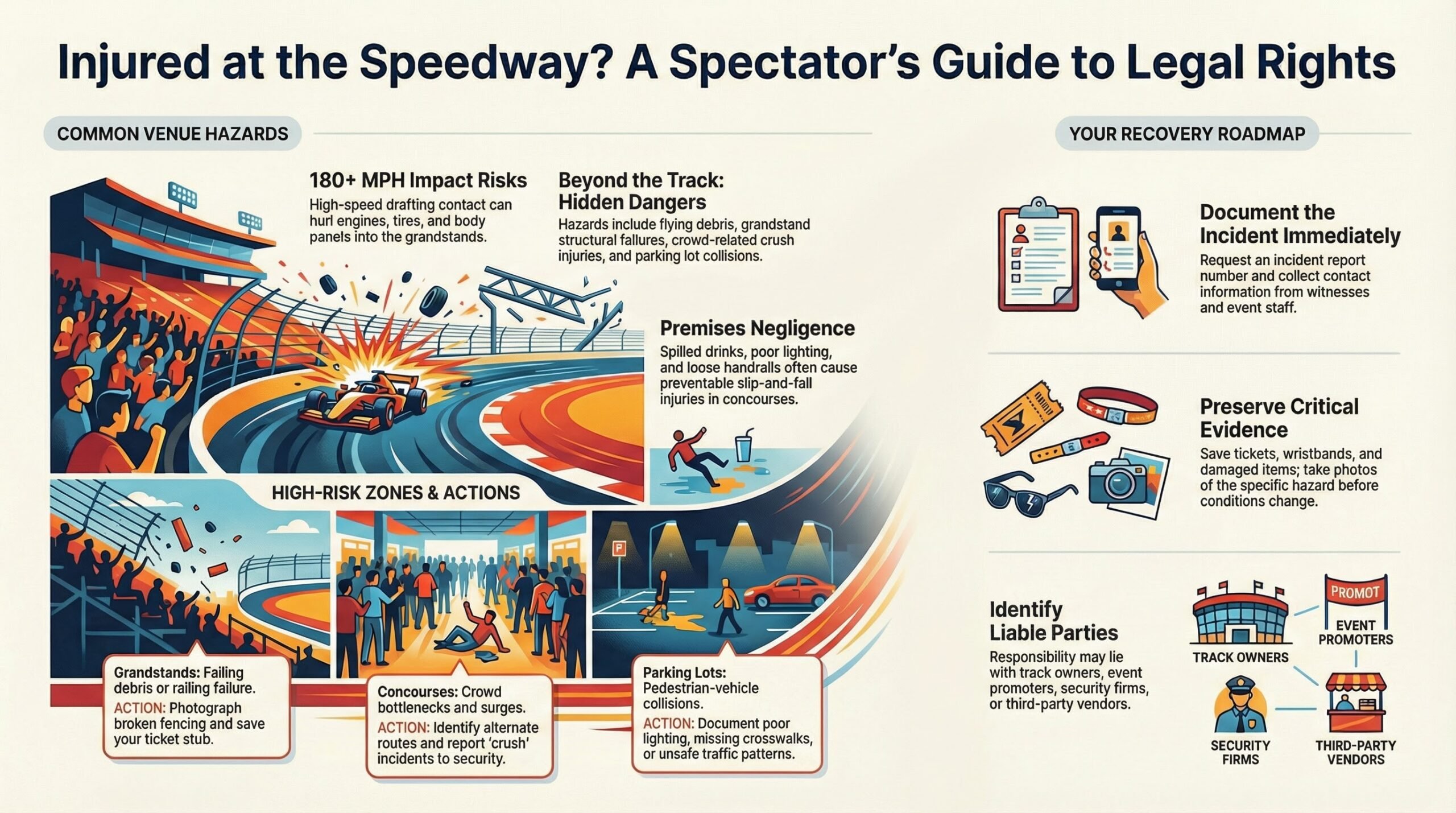
When you attend the Daytona 500, you can face more than on-track danger—you can get hurt in everyday situations around the venue. You might suffer slip and fall injuries, crowd-related crush injuries, or falling-object head injuries in the stands and concourses.
You can also get injured in a parking lot collision while arriving, tailgating, or leaving.
Daytona Speedway Slip And Fall Injuries
Although most people associate Daytona 500 injuries with high-speed crashes and flying debris, slip and fall accidents can hurt you just as easily in crowded concourses, stairwells, parking areas, and grandstands.
Spilled drinks, rainwater, uneven pavement, poor lighting, loose handrails, and blocked walkways can send you down fast, causing fractures, sprains, back injuries, or head trauma.
If you’re hurt, report it immediately, ask staff to document the hazard, and take photos and witness names before conditions change. Get medical care even if you think you’ll “walk it off,” because symptoms can surface later.
A Daytona International Speedway injury lawyer can investigate maintenance records and surveillance to prove negligence in a spectator injury at a racing event. A Daytona 500 personal injury attorney can pursue damages.
Crowd-Related Crush Injuries
Even if you never set foot near the track, dense Daytona 500 crowds can still put you at risk for crush injuries in entry gates, stairwells, concourses, and exit routes after a big wreck or the checkered flag. You can suffer rib fractures, sprains, panic-related breathing issues, or compartment syndrome when movement stops, and the body presses forward.
Tell security immediately, and get medical care so your symptoms are documented if you’re injured at Daytona International Speedway.
| Risk spot | What happens | What to do? |
|---|---|---|
| Gates | surges | step aside |
| Stairs | piling | use rails |
| Concourse | bottlenecks | find an alternate route |
| Exits | trampling | wait for lull |
Photos, witness names, and incident reports support a Daytona 500 accident injury claim or a Daytona 500 crowd injury lawsuit.
Daytona Speedway Falling Object Head Injuries
Crowd surges aren’t the only danger in and around Daytona International Speedway—objects can fall or fly and cause serious head injuries.
A dislodged sign, loose railing parts, or crash debris can strike without warning, leading to concussions, skull fractures, or traumatic brain injury. If you suffer a grandstand falling debris head injury, get evaluated immediately, document symptoms, and report the incident to venue security so there’s a record.
You may have a claim under sports event premises liability if the speedway failed to maintain seating areas, inspect fencing, or address known hazards.
Save your ticket, take photos, collect witness names, and keep medical bills. Those steps can support a demand for Daytona spectator injury compensation, including treatment costs and lost income.
Daytona Speedway Parking Lot Collision Injuries
Watch your step once you leave the grandstands—Daytona 500 parking lots and access roads can turn chaotic fast, and a low-speed crash can still leave you with serious injuries. You might suffer whiplash, back strains, broken wrists from bracing, or a concussion after a sudden stop.
Pedestrians face knee, ankle, and hip fractures when a driver doesn’t see them between rows.
After Florida sports event parking injuries, documenting parking lot collision liability matters. Get the driver’s info, photograph skid marks, signage, lighting, and traffic-control staff, and report the crash to security. If poor design, inadequate lighting, missing crosswalks, or unsafe traffic patterns contributed, you may also have a claim under premises liability at Daytona International Speedway. Seek care quickly and keep all records.
How Accidents Happen at Major Racing Events Like the Daytona 500
Although NASCAR has poured years of research into making cars and tracks safer for drivers, major events like the Daytona 500 can still produce violent crashes where debris—engines, tires, and body panels—breaks free at high speed and reaches the grandstands.
Despite NASCAR’s safety advances, Daytona 500 crashes can hurl engines, tires, and panels into the grandstands at high speed.
When packs run inches apart, one bump can trigger a chain-reaction wreck, launching cars into the catchfence and sending fragments over or through barriers.
You can also face danger away from the racing line when emergency responses, crowd movement, and limited sightlines create confusion after a major impact, increasing the chance of secondary injuries.
- High-speed drafting packs: Contact at speeds over 180 mph can cause a car to spin and scatter parts.
- Barrier and fencing failures: Broken tethers or stressed mesh can allow debris to escape, raising concerns about liability for track debris.
- Venue conditions: Tight concourses, stairs, and congested exits can worsen spectator injuries at the Daytona 500 and raise sports event premises liability concerns.
Who May Be Liable for a Daytona 500 Injury?
If you’re injured at the Daytona 500, liability may extend beyond the driver involved in the crash. You may have a claim against track owners and operators for unsafe premises, event organizers and promoters for inadequate safety planning, and third-party vendors onsite for negligent setup or operations.
Identifying who controlled the area, the safety measures in place, and the warnings you received helps you pinpoint potential responsible parties.
Daytona Speedway Track Owners And Operators
When debris escapes the racing surface and reaches the grandstands, the track owners and operators—such as Daytona International Speedway—can face liability for a Daytona 500 injury because they control the premises and the safety measures that protect fans.
Under sports event premises liability rules, you may have a claim if unsafe conditions contributed to a Daytona Speedway spectator injury and the risk went beyond what you reasonably assumed.
Track owners’ legal responsibility often centers on whether they inspected, maintained, and upgraded protections as hazards became known.
You’ll want evidence showing what the track knew and what it did before and after the incident.
Focus on:
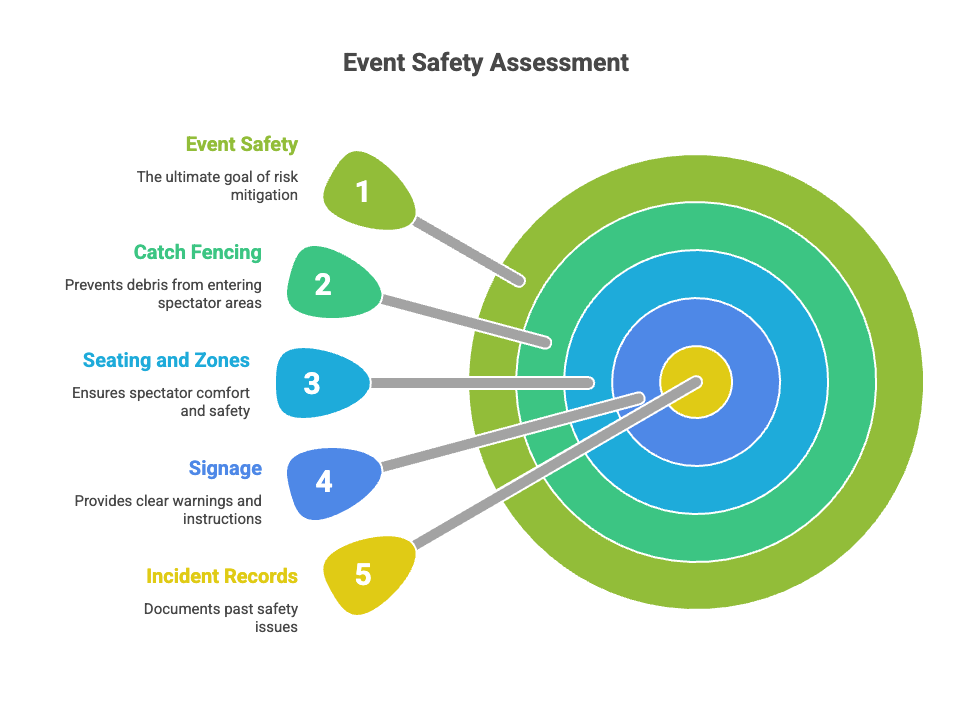
- Catch fencing, barriers, and debris-containment design and maintenance
- Seating placement, protected zones, and warning signage adequacy
- Prior similar incidents, inspections, and repair or upgrade records
Daytona 500 Event Organizers And Promoters
Event organizers and promoters don’t just put on the show—they set the safety plan fans rely on at Daytona. If you’re hurt, their decisions may matter: crowd flow, emergency staffing, pre-race inspections, communication about restricted areas, and coordination with safety officials. When they ignore known debris risks, delay repairs, or fail to enforce safety rules, you may argue they contributed to a grandstand accident daytona 500.
Under the sports event premises liability Florida theories, you can claim they had a duty to run the event with reasonable care and to warn you about foreseeable hazards. That can support claims for medical bills, lost income, and pain and suffering, and it may strengthen your request for nascar event injury compensation after the crash and the chaos that followed.
Daytona Speedway Third-Party Vendors Onsite
Organizers and promoters set the overall safety plan, but they don’t control every moving piece on race day—third-party vendors onsite can also create hazards that lead to a Daytona 500 injury. If a contractor’s actions or equipment put you at risk, you may have a separate florida sporting event injury claim against that business, not just the speedway.
Vendor liability often turns on who created the danger, who knew about it, and who had the power to fix it.
- Food and beverage sellers: spills, poor crowd control, or blocked walkways near concessions.
- Merchandise and display teams: unstable racks, tripping cords, or unsafe pop-up structures.
- Security, parking, and shuttle operators: negligent traffic direction, collisions, or unsafe loading zones.
Injuries Caused by Grandstand, Crowd, or Venue Hazards at the Daytona 500
If you’re hurt at the Daytona 500, the danger may come from the venue itself—not just the race. You can suffer serious harm from grandstand structural failures or from slips, trips, and falls in aisles, stairs, or concourses.
You can also get injured in a crowd surge or crush when foot traffic bottlenecks and event staff don’t control the flow.
Daytona Speedway Grandstand Structural Failures
Safety can unravel fast when the grandstand itself becomes the hazard. If a section shifts, railings give way, seating collapses, or barriers fail to contain debris, you can suffer traumatic injuries in seconds. You don’t have to accept “that’s racing” when the venue’s structure didn’t perform as it should.
- Document the failure: Photograph broken seats, bent rails, damaged fencing, and warning signs, and get witness names.
- Get medical care and records: Ask providers to note how the collapse or impact occurred and keep discharge papers and bills.
- Push for preservation: Request that the track keep surveillance video, maintenance logs, inspection reports, and repair histories.
Structural failures often trigger premises liability and negligent maintenance claims, especially when prior issues existed.
Slips, Trips, And Falls
Even when the race stays on the track, you can get hurt in the stands when wet steps, spilled drinks, loose cables, poor lighting, or sudden crowd surges cause a slip, trip, or fall.
If you’re injured, seek medical care and report the hazard to venue staff immediately so there’s a record. Take photos of the condition, your footwear, and any missing warning signs, and collect names of witnesses who saw what happened.
Keep your ticket, receipts, and discharge papers, and write down when the area was last cleaned or inspected if you’re told.
You may have a premises-liability claim if the speedway knew or should’ve known about the danger and didn’t fix it or warn you. Don’t give recorded statements until you’ve spoken with counsel.
Crowd Surge And Crush
When the crowd shifts fast after a crash, finish-line moment, or sudden announcement, a surge can pin you against railings, fold you into a bottleneck, or knock you down as people pile in. These crush events can cause broken bones, head trauma, and suffocation, and they often follow poor crowd control, blocked exits, or unsafe queuing designs.
Even at Daytona, where officials focus on debris and fencing, the venue still must manage fan flow and prevent predictable surges.
If you’re hurt, protect your claim by doing this:
- Get medical help immediately and document bruising, pain, and breathing issues.
- Report the incident to security, request an incident number, and identify witnesses.
- Photograph railings, stairs, signage, and choke points before conditions change.
What to Do Immediately After Being Injured at the Daytona 500
Getting hurt at the Daytona 500 can happen in seconds—from flying debris, collapsing barriers, or chaotic crowd movement—so act fast to protect your well-being and your legal rights.
First, move to a safe area and notify nearby staff that you’re injured. Accept on-site medical help, and if symptoms feel serious or worsening, request transport to a hospital. Don’t “tough it out”; adrenaline can mask head, neck, or internal injuries.
As soon as you can, document everything. Take photos or video of your injuries, the scene, broken fencing, debris, spilled liquids, or poor lighting. Note the time, section, seat, and gate.
Get the names and contact information for witnesses, including other fans and event staff. Report the incident to venue security and ask for an incident report number. Save tickets, wristbands, receipts, and parking passes. Avoid detailed statements or social posts about fault while you’re still being evaluated.
Can You File a Personal Injury Claim After a Racing Event Accident?
After the dust settles, you may be able to file a personal injury claim for harm you suffered at a racing event like the Daytona 500.
Even though crashes feel like “part of racing,” you don’t have to absorb medical bills, missed work, or lasting pain on your own—especially when debris, crowd impacts, or facility conditions cause real injuries, like past Daytona incidents that sent fans to hospitals.
To protect your right to seek compensation, focus on three practical steps:
- Preserve evidence quickly: keep tickets, wristbands, photos, videos, clothing, and receipts, and document what happened while it’s fresh.
- Document your injuries: follow medical advice, track symptoms, and save discharge papers, prescriptions, and therapy notes.
- Report and identify witnesses: request incident reports, note staff names, and collect contact info from nearby fans.
If you act quickly, you’ll strengthen any claim you decide to pursue later.
Understanding Negligence and Liability at Daytona Speedway Sporting Events
Although racing carries obvious risks, the law doesn’t excuse careless safety decisions—so if you’re hurt at a sporting event like the Daytona 500, your case often turns on negligence and who’d control over the hazard (the track, the sanctioning body, a team, or a contractor).
Racing is risky, but negligence isn’t excused—liability often depends on who controlled the hazard: track, sanctioning body, team, or contractor.
You’ll look at whether someone failed to act reasonably under the circumstances, such as maintaining catch fencing, inspecting barriers, managing debris containment, or following safety protocols.
You may hear “assumption of risk,” but that doesn’t give organizers a free pass for preventable dangers or code violations. Your claim strengthens when you can show prior similar incidents, ignored warnings, skipped maintenance, poor crowd control, or unsafe seating areas.
Liability can also be shared if multiple parties contributed, like a contractor’s faulty installation or a team’s negligent handling that creates a dangerous condition.
You’ll need proof: incident reports, video, witness statements, and safety records.
Compensation Available for Daytona 500 Injury Victims
When an injury at the Daytona 500 turns your life upside down, the law may let you pursue compensation that covers both the costs you can measure and the harm you can’t.
If debris, crowd-control failures, or unsafe conditions leave you hurt, you can seek money that helps you rebuild and stay afloat while you recover.
- Medical and recovery costs: You can claim ER care, surgery, prescriptions, rehabilitation, future treatment, medical devices, and related travel expenses.
- Income and work impact: You can pursue lost wages, reduced earning capacity, missed opportunities, and the value of sick days or PTO you’d like to burn.
- Human losses: You can request damages for pain and suffering, emotional distress, scarring, disability, loss of enjoyment of life, and harm to family relationships.
If a loved one dies, you may also pursue wrongful-death damages, including funeral costs and lost support.
How Evidence Is Preserved After a Daytona Speedway Accident
Pursuing compensation often depends on what you can prove, so evidence preservation becomes a top priority right after a speedway accident.
Compensation often hinges on proof, so preserving evidence is your top priority immediately after a speedway accident.
If you’re able, take wide and close photos and video of the scene, your injuries, damaged seating, fencing, and any debris. Capture time stamps, section numbers, and distances to catch fencing or barriers. Get names and contact info for witnesses, including nearby fans, ushers, medics, and security. Save your ticket, wristband, parking receipt, and any event emails that show where you were and when you entered.
Request copies of incident reports and note which agency or track prepared them. Seek medical care promptly and keep discharge papers, imaging, and bills. Preserve clothing, helmets, or personal items with visible damage.
Don’t post speculative statements online, and write a quick timeline while memories are fresh.
How a Daytona Personal Injury Lawyer Can Help After a Daytona 500 Injury
In the aftermath of a Daytona 500 injury, a personal injury lawyer can step in fast to protect your claim and take the pressure off you. You’re dealing with treatment, missed work, and confusion about who’s responsible—track owners, event operators, security vendors, or other parties.
A lawyer helps you move quickly and strategically by:
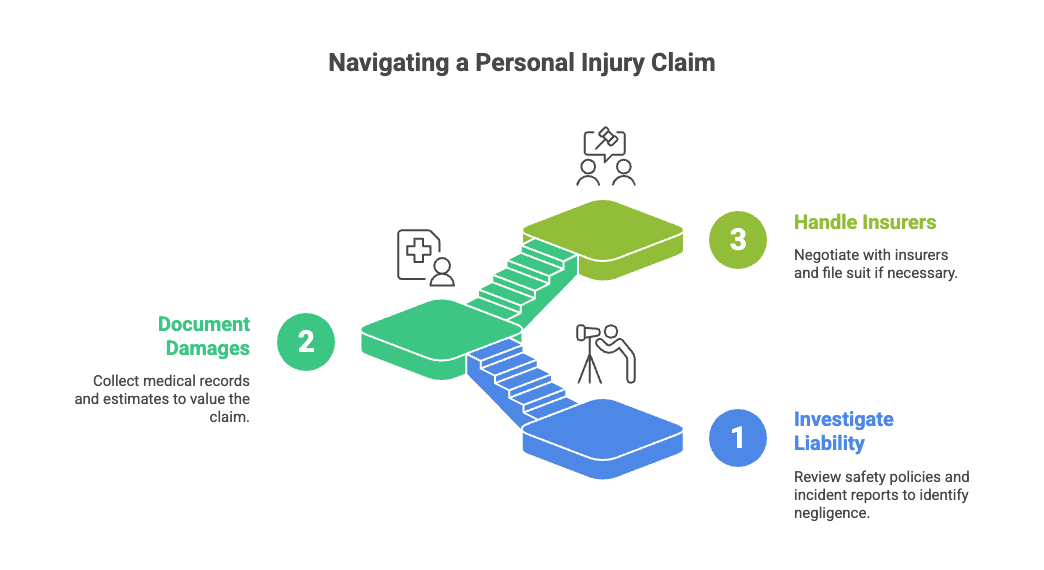
- Investigating liability by reviewing safety policies, incident reports, and surveillance, and identifying negligent maintenance, crowd control, or barrier failures.
- Documenting damages by collecting medical records, wage loss proof, and future care estimates, then valuing pain, limitations, and long-term impacts.
- Handling insurers and deadlines by stopping recorded-statement traps, negotiating for full payment, and filing suit if talks stall or time limits near.
You keep control of your recovery while your attorney pushes for answers, accountability, and fair compensation.
Why Choose Anidjar & Levine After a Daytona 500 Injury Accident or Injury
Choose Anidjar & Levine because you’ll get a team that moves fast to protect your rights after a Daytona 500 injury—preserving evidence, identifying every liable party (track owners, event operators, and vendors), and building a claim that reflects the full cost of your medical care, lost income, and long-term limitations.
You won’t face insurers alone; you’ll have lawyers who push for answers when debris, fencing, seating, or security failures injure fans.
You’ll get clear updates, help scheduling treatment, and direct access to your legal team.
| What you face | What we do | What you gain |
|---|---|---|
| Flying debris, broken fencing | Secure video, reports, witnesses | Proof that holds up |
| Confusing liability | Map responsibilities and contracts | More paths to recovery |
| Mounting bills and missed work | Document damages and future needs | Stronger settlement leverage |
FAQs
1. What should I do if I am injured while attending the Daytona 500?
If you are injured at the Daytona 500, your first priority should always be your health and safety. Seek medical attention immediately, even if your injuries appear minor at first. Large sporting events can involve adrenaline and excitement that may mask symptoms such as concussions, internal injuries, or soft-tissue damage. Prompt medical evaluation also creates important documentation connecting your injuries to the incident.
After receiving care, report the accident to event staff, security personnel, or venue management and request that an official incident report be completed. If possible, take photos or videos of the accident scene, hazardous conditions, crowd conditions, or any objects involved. Collect the names and contact information of witnesses who saw what happened. Avoid making statements about fault or signing documents presented by insurance representatives before speaking with an attorney. Preserving evidence early can significantly strengthen a potential personal injury claim.
2. Can I file a personal injury claim if I was hurt at the Daytona 500?
Yes, in many situations you may be able to pursue a personal injury claim if your injury resulted from negligence rather than the normal risks associated with attending a racing event. While spectators assume certain inherent risks—such as loud noise or minor debris—event organizers, vendors, and property operators still have a legal duty to maintain reasonably safe conditions.
If an injury occurs due to unsafe seating, inadequate crowd control, poorly maintained walkways, defective barriers, negligent security, or dangerous vendor operations, liability may exist. Each case depends on specific facts, including how the injury occurred and whether reasonable safety measures were followed. An investigation may involve reviewing surveillance footage, maintenance records, safety procedures, and witness statements to determine whether negligence contributed to the incident.
3. Who could be responsible for an injury at Daytona International Speedway?
Liability for a Daytona 500 injury is not always limited to a single party. Depending on the circumstances, multiple entities may share responsibility. Potentially liable parties may include the speedway property owner or operator, event organizers, security companies, concession vendors, maintenance contractors, equipment manufacturers, or third-party drivers whose conduct created unsafe conditions.
For example, a slip-and-fall caused by spilled liquids may involve a vendor or cleaning contractor, while injuries caused by structural issues could involve maintenance providers or property management. Determining liability often requires reviewing contracts, safety policies, staffing procedures, and inspection records. A thorough investigation helps identify all responsible parties so injured spectators can pursue compensation from every available source of insurance coverage.
4. What types of injuries commonly occur at large racing events like the Daytona 500?
Large-scale sporting events can present a variety of hazards due to crowd size, fast-moving vehicles, and complex venue logistics. Common injuries include slip-and-fall accidents on stairs or walkways, injuries caused by overcrowding or pushing, heat exhaustion, falling objects, seating collapses, and injuries from debris entering spectator areas.
Motor racing environments also create unique risks such as flying fragments, sudden loud noises leading to hearing damage, or accidents occurring in parking areas before or after the event. Some injuries may not become fully apparent until days later, particularly concussions or spinal injuries. Because symptoms can develop gradually, medical evaluation and documentation are essential even when discomfort initially seems minor.
5. Does buying a ticket mean I waived my right to file a lawsuit?
Ticket language often includes liability disclaimers or assumption-of-risk statements, but these provisions do not automatically prevent injured spectators from pursuing legal claims. While attendees may accept certain known risks associated with motorsports, event operators cannot avoid responsibility for negligence or unsafe conditions that go beyond those expected risks.
Courts typically evaluate whether the injury resulted from inherent event dangers or from preventable hazards caused by careless conduct. If organizers failed to maintain safe premises, ignored known hazards, or violated safety standards, liability may still exist despite ticket disclaimers. An experienced attorney can review the language printed on the ticket and evaluate how it applies to the specific circumstances of the injury.
6. What compensation may be available after a Daytona 500 injury accident?
Compensation in a personal injury claim is intended to address both financial losses and the personal impact of an injury. Injured spectators may seek damages for medical expenses, emergency treatment, rehabilitation costs, prescription medications, and future medical care related to the incident. Lost wages or reduced earning capacity may also be recoverable if the injury affects a person’s ability to work.
In addition to economic losses, claims may include compensation for pain and suffering, emotional distress, reduced quality of life, and long-term physical limitations. The value of a claim depends on factors such as injury severity, recovery time, permanent impairment, and available insurance coverage. Proper documentation and medical records play a critical role in demonstrating the full extent of damages.
7. How is negligence proven in a sporting event injury case?
To establish negligence, an injured person must generally show that a responsible party owed a duty of care, breached that duty, and caused injuries as a result. At large events like the Daytona 500, organizers are expected to take reasonable steps to protect attendees by maintaining safe facilities, providing adequate security, and addressing hazards promptly.
Evidence used to prove negligence may include surveillance footage, incident reports, maintenance logs, inspection records, witness testimony, and expert analysis of safety procedures. Attorneys may also examine whether the venue followed industry safety standards or prior complaints about dangerous conditions. Demonstrating negligence often requires detailed investigation and preservation of evidence before it disappears.
8. How long do I have to file a claim after being injured at the Daytona 500?
Florida law generally places time limits—known as statutes of limitations—on filing personal injury claims. While the specific timeframe can vary depending on the type of claim and circumstances involved, waiting too long may result in losing the right to pursue compensation entirely.
It is important to act quickly because evidence at large events can disappear rapidly. Surveillance footage may be overwritten, witnesses may become difficult to locate, and accident scenes change soon after the event ends. Consulting with an attorney soon after an injury allows for timely investigation and helps ensure important legal deadlines are not missed.
9. What if my injury did not appear serious until after I returned home?
It is common for injuries sustained at high-energy events to worsen or become noticeable days after the incident. Adrenaline and travel fatigue can mask symptoms such as head injuries, ligament damage, or internal trauma. If symptoms develop later, you should seek medical attention immediately and inform your provider that the injury occurred at the Daytona 500.
Medical records linking delayed symptoms to the original accident can still support a claim, especially when early documentation shows you attended the event and experienced an incident. Keeping receipts, photos, and communication records from the day of the accident can help establish a timeline connecting your injury to the event.
10. How can a personal injury lawyer help after a Daytona 500 accident?
A personal injury lawyer can handle the legal and investigative aspects of a claim while you focus on recovery. This may include gathering evidence, obtaining surveillance footage, interviewing witnesses, consulting safety experts, reviewing insurance policies, and identifying all potentially responsible parties. Attorneys also communicate with insurance companies and help protect clients from accepting unfair settlement offers.
Legal representation can be especially valuable in complex cases involving multiple defendants or corporate entities associated with large sporting events. By organizing medical records, calculating damages, and presenting a well-supported claim, an attorney works to pursue fair compensation through negotiation or litigation when necessary. Early legal guidance can also help prevent costly mistakes that could weaken a case.


—————————
If you’re injured at the Daytona 500, don’t assume it’s just bad luck. You may have a valid claim for medical costs, lost income, and pain and suffering, even if a ticket waiver is involved.
Act fast: get medical care, report the incident, photograph the scene, and collect witness details.
Evidence can disappear quickly, and deadlines can cut off your rights.
Contact the Law Offices of Anidjar and Levine or speak with a Daytona Beach Personal Injury Lawyer to protect your case.


We Can Help.