




If you suffered a heart attack in Miami due to delayed diagnosis, medication errors, or unsafe conditions, Law Offices of Anidjar and Levine can move fast to secure EMS timelines, EKGs, triage notes, medication logs, and witness statements.
You’ll have to prove duty, breach, and causation, often through qualified medical reviewers and forensic cardiology experts.
A Miami Medical Malpractice Lawyer can calculate damages, negotiate with insurers, and file suit before Florida deadlines expire.
Continue for essential steps and selection tips.



Main Takeaways
- A Miami heart attack injury lawyer investigates quickly, preserving EMS timelines, EKGs, triage notes, medication logs, and incident reports.
- Counsel identifies liable parties, including hospitals, ER staff, ambulances, employers, property owners, and drug manufacturers, before evidence disappears.
- Proving the case requires showing duty, breach, and causation, often through forensic cardiology and qualified medical experts.
- Your attorney documents damages such as medical bills, rehab, medications, lost wages, reduced earning capacity, and future care costs to support a strong demand.
- A lawyer negotiates with insurers and files suit if needed, countering claims of preexisting conditions and keeping you informed under a contingency fee.
How We Can Help With Your Miami Heart Attack Injury Claim
Although a heart attack can feel sudden and overwhelming, you don’t have to handle the legal and financial fallout on your own.
You can focus on recovery while protecting your ability to support others at home, at work, and in your community.
A heart attack can change everything fast—focus on recovery while we help protect your financial stability and responsibilities.
You can rely on us to take prompt, disciplined action on your claim.
You’ll receive clear client communication, including what we need from you, what we’re doing next, and why each step matters.
You’ll also get a practical case timeline, so you can plan around medical care, missed income, and ongoing responsibilities.
We gather records, preserve critical documents, and coordinate with appropriate professionals, then present a well-supported demand that reflects your losses.
If the other side delays or minimizes your harm, you won’t face that pressure alone.
You’ll have steady guidance, measured advice, and advocacy aimed at a fair resolution.
Understanding Miami Heart Attack Injury Cases
Once you’ve secured support to protect your claim, it helps to understand what makes a Miami heart attack injury case legally actionable and how these claims typically unfold.
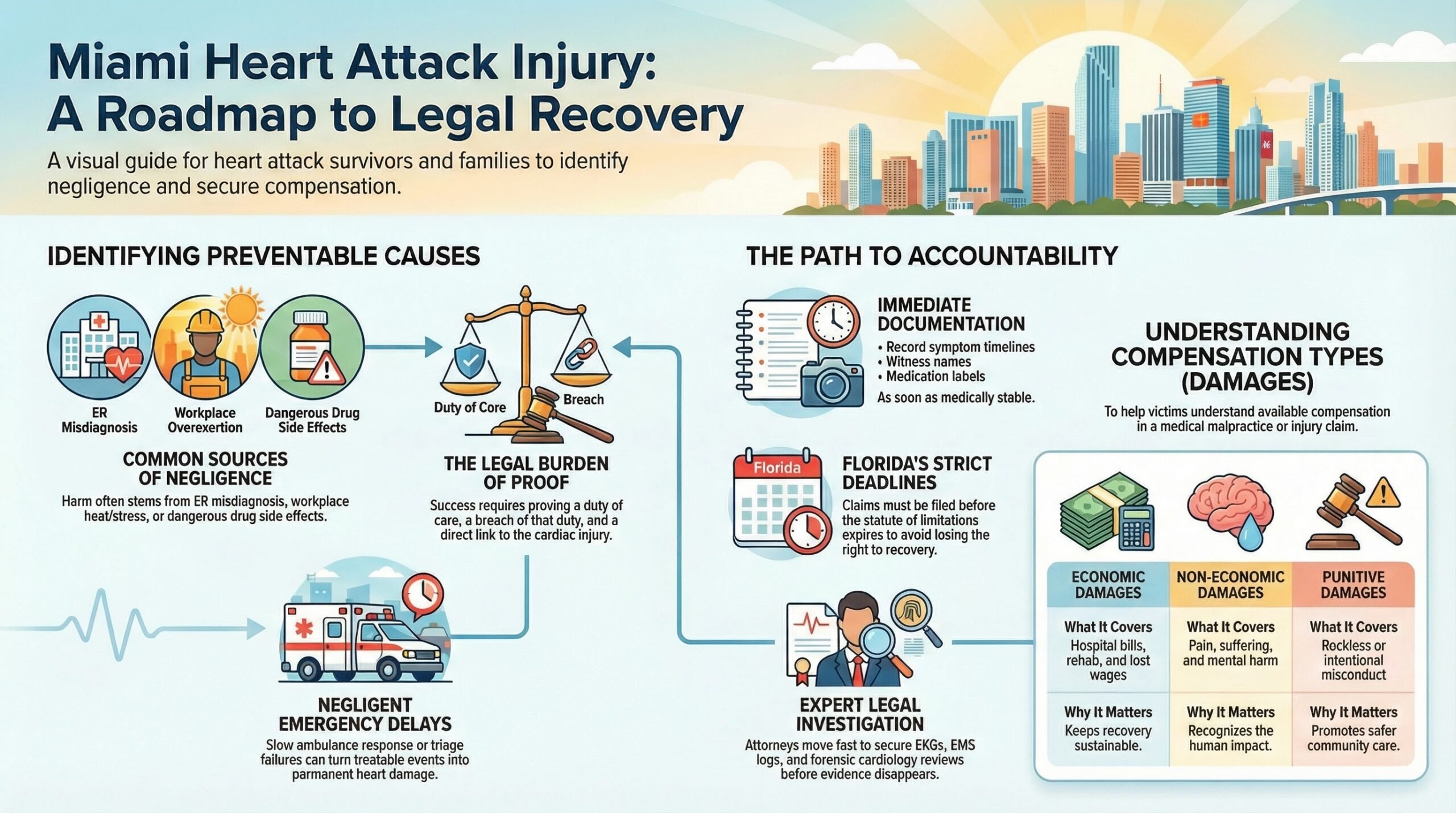
You generally must show a duty of care, a breach of that duty, and a clear link between the breach and your cardiac injury, supported by records and credible testimony.
You’ll also document measurable losses, including medical expenses, reduced earning capacity, and the practical limitations that affect how you serve your family and community.
Your lawyer typically gathers timelines, communications, and clinical data, then works with qualified professionals to explain risk stratification and whether warning signs warranted a different response.
From there, the claim proceeds through notice, investigation, negotiation, and, if needed, litigation with targeted discovery and expert review.
Throughout the process, you can rely on community resources for transportation, caregiving support, and follow-up care, which helps you stabilize while your case moves forward efficiently.



Common Causes of Miami Heart Attack Injuries
In Miami heart attack injury claims, you may trace the harm to medical malpractice misdiagnosis, where providers miss warning signs or misread test results.
You may also face workplace stress and overexertion, dangerous drug side effects from improperly prescribed or monitored medications, and other preventable risk factors.
When negligent emergency care delays timely evaluation or treatment, you can suffer avoidable cardiac damage that forms the basis of a serious injury case.
Medical Malpractice Misdiagnosis
When a doctor or emergency provider misreads warning signs or dismisses your symptoms as indigestion, anxiety, or muscle strain, a heart attack can progress unchecked and cause far more severe damage.
You may arrive seeking help, yet Cognitive Biases can misdirect providers toward a convenient diagnosis, especially when you’re young, female, or present with atypical pain.
Even when the team orders tests, Test Limitations may hide danger, including early or intermittent ECG changes and troponin levels that haven’t risen.
If staff fail to repeat evaluations, review risk factors, or consult cardiology, urgent treatment can be delayed.
Workplace Stress And Overexertion
Although many people associate heart attacks with long-term health conditions, intense workplace stress and overexertion can trigger a sudden cardiac event, especially if your job demands heavy lifting, rapid pacing, heat exposure, or extended shifts with limited recovery time. You may push through to serve others, yet your body can’t sustain relentless strain, poor hydration, and skipped meals.
| Risk factor | Practical safeguard |
|---|---|
| Heavy lifting | Ergonomic interventions, mechanical aids |
| High heat | Water access, cooled rest areas |
| Long shifts | Break policies, staffed coverage |
| Fast pace | Task rotation, realistic quotas |
| Chronic stress | Supervisor support, workload planning |
If your employer ignores warnings, denies rest, or discourages reporting symptoms, you can document schedules, conditions, and complaints, then seek help to protect your health and those who depend on you.
Dangerous Drug Side Effects
Workplace strain isn’t the only factor that can set off a cardiac emergency; medications can also trigger heart attack injuries through dangerous side effects and drug interactions.
If you serve patients, clients, or neighbors, you can protect them by watching for warning signs and encouraging careful medication reviews.
Some prescriptions and over-the-counter drugs may raise blood pressure, disrupt heart rhythm, or increase clotting risk, especially when combined with stimulants, decongestants, or certain supplements.
You should take black box warnings seriously, ask why they apply, and confirm dosage and monitoring requirements.
Don’t dismiss allergic reactions, because swelling, hives, and breathing difficulty can strain the heart and reduce oxygen.
By documenting symptoms, medication changes, and timelines, you help create a clearer path to accountability and safer care.
Negligent Emergency Care Delays
Because a heart attack is a race against time, negligent emergency care delays can turn a treatable event into a catastrophic injury.
If you serve others, you know that every minute matters, and you expect systems to protect life with disciplined urgency.
When ambulance response is slow, crews take the wrong route, or dispatch mislabels symptoms, your heart muscle loses oxygen and damage spreads.
Inside the emergency department, triage failures may push you to the waiting room, overlook atypical signs, or delay an EKG and blood tests.
Staff may also postpone clot-busting drugs, catheterization, or transfer to a capable facility.
These gaps can leave you with heart failure, arrhythmias, or lasting disability.
Legal Rights of Miami Heart Attack Injury Victims
Your core legal rights often include:
- The right to demand proof-based answers about what happened and why.
- The right to recover damages that reflect present and future harm.
- The right to challenge improper treatment decisions and consent failures.
- The right to confidentiality, with remedies for unauthorized disclosure.



Steps to Take After a Miami Heart Attack Injury
After a Miami heart attack injury, you should seek immediate medical care because prompt treatment protects your health and creates a necessary clinical record.
You’ll also want to document your symptoms and the events leading up to the episode, including dates, times, witnesses, and any communications.
As soon as you’re medically stable, you should contact a Miami lawyer so you can protect your rights and preserve vital evidence before it’s lost.
Seek Immediate Medical Care
Even if your symptoms seem to ease, you should seek immediate medical care at the first sign of a heart attack.
Call 911 right away, because paramedics can start treatment en route and alert the receiving team, which often improves outcomes.
Don’t attempt to drive yourself, and don’t rely on a friend unless dispatch instructs it, since delays can put others at risk.
Be deliberate about your Facility Choice. When you can, prioritize a hospital equipped for cardiac emergencies and rapid intervention.
Ask dispatch about Transport Options, including ambulance transport versus directed routing to a capable center, especially if traffic or distance could affect timing.
Document Symptoms And Events
Prompt medical treatment protects your health, and careful documentation protects your account of what happened.
As soon as you’re stable, write a Symptom Timeline with dates, times, triggers, and how symptoms limited your ability to serve others.
Record chest pressure, shortness of breath, nausea, fatigue, and any medication taken, then note who witnessed each event.
Use Photo Documentation to preserve visible signs, medication labels, discharge papers, and any hazards or work conditions tied to the incident.
Keep everything in one folder, and update it daily while your memory stays clear.
| Record | Purpose |
|---|---|
| Symptoms, time, duration | Clarifies progression and urgency |
| Witness names, contact, notes | Confirms observations and context |
| Photos of injuries, meds, environment | Preserves objective details |
| Receipts, travel, missed duties log | Shows practical impact and losses |
Contact A Miami Lawyer
Contact a Miami heart attack injury lawyer as soon as you can do so safely, because early legal guidance helps you protect evidence and avoid costly missteps.
You’ll learn what records to request, which communications to avoid, and how to preserve witness information while your health remains the priority.
A lawyer can also coordinate timelines with your medical providers, so your claim reflects the full impact of treatment and recovery.
When you reach out, you can ask about virtual consultations if travel is difficult or you’re caring for someone else.
If you can attend in person, confirm office parking and accessibility, then bring your symptom notes, discharge papers, and any workplace or incident reports.
How a Miami Heart Attack Injury Lawyer Can Help You
When a heart attack stems from another party’s negligence, a Miami heart attack injury lawyer can step in to protect your rights and bring structure to a situation that often feels uncertain.
When negligence triggers a heart attack, a Miami injury lawyer can protect your rights and bring order to uncertainty.
You’ll get clear guidance on deadlines, evidence needs, and next steps, so you can focus on serving your family and community with steadiness.
Strong Client communication keeps you informed, prepared, and respected at every stage.
A capable lawyer can help you by:
- Investigating what happened, securing records, witness statements, and incident reports.
- Identifying liable parties, including businesses, property owners, or contractors, and preserving proof.
- Calculating damages and presenting a demand that reflects medical costs, lost income, and related losses.
- Negotiating with insurers and, if necessary, filing suit and managing court requirements.
You’ll also receive a transparent Fee structure, typically contingency-based, so you understand costs before decisions are made.
Long-Term Effects of Miami Heart Attack Injuries
After a Miami heart attack injury, you may face chronic cardiac complications that require ongoing monitoring, medication, and activity limits.
You can also experience cognitive and emotional changes, such as memory issues, reduced concentration, anxiety, or depression, that affect your work and relationships.
These medical realities often have serious financial and lifestyle impacts, and you’ll need to plan for long-term care costs, reduced earning capacity, and lasting adjustments to your daily routine.
Chronic Cardiac Complications
Although the immediate crisis may pass, a heart attack can leave you with chronic cardiac complications that reshape your health for years, and they often require ongoing treatment and careful monitoring.
You may face heart failure, recurrent angina, or arrhythmias that limit stamina and demand strict medication adherence.
Microvascular dysfunction can reduce blood flow even when major arteries appear normal, while Autonomic neuropathy may disrupt heart rate and blood pressure control, increasing the risk of falls and fainting.
You’ll serve others best by honoring rehabilitation, tracking symptoms, and keeping follow-up visits, so you can remain steady for your family and community.
| What you may live with | What can it cost you |
|---|---|
| Shortness of breath | Missed moments of service |
| Chest tightness | Hesitation to lead |
| Irregular heartbeat | Constant vigilance |
| Medication side effects | Daily tradeoffs |
| Repeat hospital visits | Interrupted commitments |
Cognitive And Emotional Changes
Chronic cardiac complications don’t just strain your body; they can also change how you think, feel, and cope day to day.
You may notice memory lapses, slower processing, or trouble concentrating during conversations and service tasks that once felt routine.
These shifts can stem from reduced oxygen delivery, medication side effects, disrupted sleep, or persistent stress responses after the event.
Emotionally, you might experience anxiety, irritability, or emotional numbness that dulls your usual compassion and patience.
You can still lead with integrity by naming these changes, tracking triggers, and communicating needs clearly with your care team and those you serve.
Ask about cognitive screening, counseling, and structured rehabilitation, and practice pacing so you stay reliable without overextending yourself.
Financial And Lifestyle Impacts
Because a heart attack often changes what you can physically tolerate from one week to the next, it can also reshape your finances and daily routines in ways you didn’t anticipate.
You may need reduced hours or a different role, and that income shift can strain savings, insurance deductibles, and ongoing prescriptions.
When you’re committed to serving others, you may feel pressure to return too soon, yet pacing your recovery protects the people who depend on you.
You’ll likely face practical costs, including transportation to appointments, cardiac rehab fees, and home modifications to reduce fall risk and conserve energy.
If bills accumulate, you can’t ignore debt management; you must track expenses, communicate with lenders, and document losses. A clear plan supports stability and keeps your focus on recovery.
Proving Liability in Miami Heart Attack Medical Malpractice Injury Cases
How do you prove a Miami provider caused a heart attack injury instead of merely failing to prevent an unavoidable event?
You build a disciplined narrative that links a specific lapse in care to a foreseeable, preventable outcome.
Start by identifying the standard of care for chest pain triage, ECG timing, lab testing, medication, and transfer decisions, then show where the provider deviated.
You’ll rely on Forensic cardiology to interpret rhythms, biomarkers, and imaging, and to explain how earlier intervention would likely have limited damage.
Gather complete records, EMS reports, medication logs, and timestamped vitals to expose delay patterns or missed warnings.
Strong Causation evidence often includes differential diagnosis, guideline comparisons, and expert testimony that rule out alternative causes, such as preexisting disease progression.
You should also document communication failures, handoff gaps, and inadequate informed consent, because these facts can establish negligence and connect it to the injury.
Compensation for Miami Heart Attack Damages
When a preventable heart attack leaves you with lasting harm, what kinds of damages can you recover in a Miami medical malpractice claim?
You can pursue compensation that restores stability, supports your family, and helps you continue serving others.
Economic damages often cover hospital bills, cardiac rehab, medications, and reduced earning capacity.
Non-economic damages address pain, emotional distress, and loss of enjoyment of life, especially when fatigue or limitations change how you volunteer, work, and care for others.
| Damage Type | What It Covers | Why It Matters |
|---|---|---|
| Economic | Treatment, wages, future care | Keeps recovery sustainable |
| Non-economic | Pain, suffering, mental harm | Recognizes human impact |
| Punitive Damages | Punishes reckless misconduct | Promotes safer care |
If future needs are substantial, you may choose Structured Settlements to provide reliable, long-term payments.
Your claim can also include out-of-pocket costs and needed home or workplace modifications, documented through clear records.
The Statute of Limitations for Miami Heart Attack Injury Cases
Recovering full compensation also depends on filing your claim on time, and Florida’s statute of limitations can bar recovery even in strong heart attack malpractice cases.
Full compensation depends on timely filing—Florida’s statute of limitations can block recovery, even in strong heart attack malpractice claims.
You should treat time as a vital resource, because delay can prevent your family and community from receiving the support needed to restore stability after a medical crisis.
In many Miami heart attack injury matters, the clock begins when the injury occurs, yet medical malpractice rules can complicate that starting point.
If you couldn’t reasonably discover the negligence right away, Discovery Tolling may extend the period, but it doesn’t create unlimited time.
You must still act promptly, gather records, and document when you learned essential facts.
You also need to respect strict Filing Deadlines, including notice requirements and any special limits for claims involving public entities.
Why You Need an Experienced Miami Heart Attack Injury Lawyer
Although a heart attack can appear sudden and unavoidable, many Miami injury cases turn on whether a provider missed clear warning signs, delayed urgent testing, or failed to follow accepted cardiac protocols.
When you’re pursuing accountability, experience matters because medical and hospital defendants move quickly to shape the record, limit disclosures, and frame your symptoms as unavoidable.
An experienced Miami heart attack injury lawyer helps you act with purpose and care, so you can protect your family while honoring the duty to prevent similar harm to others.
You’ll benefit from a disciplined Case strategy, including preserving EKGs, triage notes, medication logs, and EMS timelines, then coordinating qualified medical reviewers who can explain causation in plain terms.
You’ll also need skilled Insurance negotiation, since insurers often dispute damages, shift blame to preexisting conditions, or undervalue future care.
With experienced guidance, you can pursue fair compensation and principled change.
How to Choose the Right Miami Heart Attack Injury Lawyer for Your Case
Because heart attack injury claims rise or fall on medical proof and strict timelines, you should choose a Miami heart attack injury lawyer who can investigate fast, communicate clearly, and litigate decisively if settlement talks fail.
Start by evaluating experience with cardiac-related causation issues, including medication errors, unsafe working conditions, or negligent medical care.
Ask how the attorney secures records, consults cardiology experts, and preserves witness statements before evidence disappears.
Set Communication Expectations early, so you’ll know who returns calls, how often you’ll receive updates, and what decisions require your approval.
Insist on Fee Transparency in writing, including contingency terms, litigation costs, and what happens if you switch counsel.
Review results in comparable cases, but also evaluate judgment and professionalism, because you may need trial readiness, not just negotiation.
Choose someone who treats your case as a chance to protect others by holding wrongdoers accountable with discipline and respect.
About the Law Offices of Anidjar and Levine
The Law Offices of Anidjar and Levine represent people in Miami who’ve suffered heart attack injuries linked to negligence, and the firm approaches these cases with a clear focus on fast investigation and disciplined case building.
You receive structured guidance from intake through resolution, with attention to medical evidence, timelines, and accountable parties.
Your case benefits from prompt record requests, targeted witness outreach, and coordinated communication to reduce avoidable delay.
You’ll find the Firm’s history reflects a commitment to practical advocacy and consistent client access.
You’re treated as a partner in the process, because informed decisions help you protect your family and serve those who rely on you.
The team emphasizes responsive updates, clear next steps, and respectful collaboration with providers and experts.
With convenient Office locations, you can meet in person when needed, while also using phone and digital options to keep momentum.
Your goals remain central, and the firm builds your claim to withstand scrutiny.

Frequently Asked Questions
What Does Hiring a Miami Heart Attack Injury Lawyer Cost Upfront?
Upfront, you’ll often pay nothing if you hire counsel on a contingency basis, but you may still cover limited case costs.
Some firms require Retainer Fees, especially when liability is uncertain, or you want added services.
If you choose Hourly Rates, you’ll typically pay an initial deposit and then receive monthly invoices.
You should request a written fee agreement, clarify cost advances, and confirm how reimbursement will work.
How Long Does a Heart Attack Injury Lawsuit Usually Take in Miami?
In Miami, your heart attack injury lawsuit usually takes 12 to 24 months, though complicated cases can run longer.
You’ll move faster when you meet Filing Deadlines, preserve records promptly, and respond quickly to requests.
The Discovery Timeline often drives the schedule, as medical reviews, depositions, and expert opinions take time.
If you pursue fair accountability to protect others, you’ll benefit from steady, organized documentation and consistent communication.
Will I Need to Appear in Court for My Heart Attack Injury Claim?
You usually won’t need to appear in court, because most heart attack injury claims resolve through negotiation or settlement.
If a dispute remains, you may attend a deposition, mediation, or trial, and the court may allow remote hearings for certain steps.
You’ll still support your case by cooperating with document requests and preparing for questions.
Medical testimony often comes from your treating physicians or hired experts, not from you.
Can I Switch Lawyers if I’M Unhappy With My Current Representation?
Yes, you can switch lawyers if you’re unhappy, and you should do it promptly to protect your claim.
You’ll typically sign a new agreement, then request your file and coordinate the Withdrawal Process with your current counsel.
Address Retainer Issues in writing, including any refund balance or outstanding costs, and confirm how any lien or fee claim will be handled.
You should prioritize continuity, deadlines, and ethical communication.
Are Heart Attack Injury Settlements Taxable Under Federal or Florida Law?
Most heart attack injury settlements aren’t taxable federally or in Florida if you recover for physical injuries, including related medical costs and pain.
You must usually report punitive damages and any interest, since they’re taxable income.
If you use structured settlements, you’ll typically keep the same tax character, but you should confirm allocation language to avoid unintended tax exposure.
When you aim to serve others, document damages carefully and seek tax guidance.
—————————
After a heart attack injury, you can’t afford delays or uncertainty, because crucial evidence and deadlines may control your recovery.
You should document symptoms and treatment, follow medical advice, and avoid giving recorded statements without counsel.
With an experienced Miami Medical Malpractice Lawyer, you can identify liable parties, calculate full damages, and pursue negotiations or litigation from a position of strength.
If you’re ready to act, the Law Offices of Anidjar and Levine can help you move forward.


We Can Help.