




If a missed or delayed diagnosis in Miami worsens your injury, you need a failure-to-diagnose lawyer who can act fast—such as the Law Offices of Anidjar and Levine.
You’ll get prompt case review, rapid medical record collection, and a clear timeline that preserves evidence and Florida deadlines.
Your attorney can work with qualified medical experts to prove the standard of care, identify the lapse, and link the delay to measurable harm and losses.
Learn more by visiting our Miami Medical Malpractice Lawyer page, then continue below to see crucial steps, damages, and how to choose counsel.
Main Takeaways
- A Miami failure-to-diagnose lawyer can quickly review your case and gather complete medical records to preserve timelines and evidence.
- They use qualified medical experts to prove the standard of care, explain diagnostic lapses, and connect the delay to worsened outcomes.
- They identify responsible providers, manage communications with insurers and hospitals, and protect your claim from defense tactics.
- They help document symptoms, follow-ups, lost income, and out-of-pocket costs to support economic and pain-and-suffering damages.
- They track Florida deadlines and notice requirements, pursue settlement, and file suit when needed to maximize accountability and recovery.
How We Can Help With Your Miami Failure to Diagnose Injury Claim
When a missed or delayed diagnosis in Miami causes your condition to worsen, you need a legal team that can act quickly and build a clear, evidence-based claim.
You’ll receive prompt case review, organized medical record collection, and careful timeline development, so the facts remain clear and persuasive.
You can count on disciplined communication with providers and insurers while you stay focused on recovery and supporting those who rely on you.
You’ll also get practical guidance on documenting symptoms, follow-up visits, and out-of-pocket losses, which strengthens your demand for fair compensation.
If expenses put pressure on you, Case financing may help you pursue justice without sacrificing necessary care or family obligations.
With Multilingual support, you can share details in the language you trust, reducing errors and delays.
Throughout the process, you’ll work with a team that treats your case with urgency, integrity, and respect.
Understanding Miami Failure to Diagnose Injury Cases
Although a missed diagnosis may look like an unavoidable medical outcome, Miami’s failure to diagnose injury cases often turns on whether a provider departed from the accepted standard of care and whether that lapse caused measurable harm.
Miami failure-to-diagnose cases often hinge on a provider’s departure from accepted standards—and whether that lapse caused measurable harm.
You’ll typically evaluate what information the clinician had, what testing or referrals should’ve followed, and how timely recognition could’ve changed your outcome.
You can also expect close attention to documentation, because medical records often show what was reported, what was ruled out, and what warnings were or weren’t given.
When you ground your claim in clear facts, you help protect not only your family, but also future patients who rely on careful, accountable practice.
Statistical trends may support the case for why certain diagnostic errors warrant scrutiny, yet your case still depends on individualized proof.
Through community outreach and education, you can promote safer systems, encourage early evaluation, and reinforce a culture that doesn’t ignore preventable harm.

Common Causes of Miami Failure to Diagnose Injuries
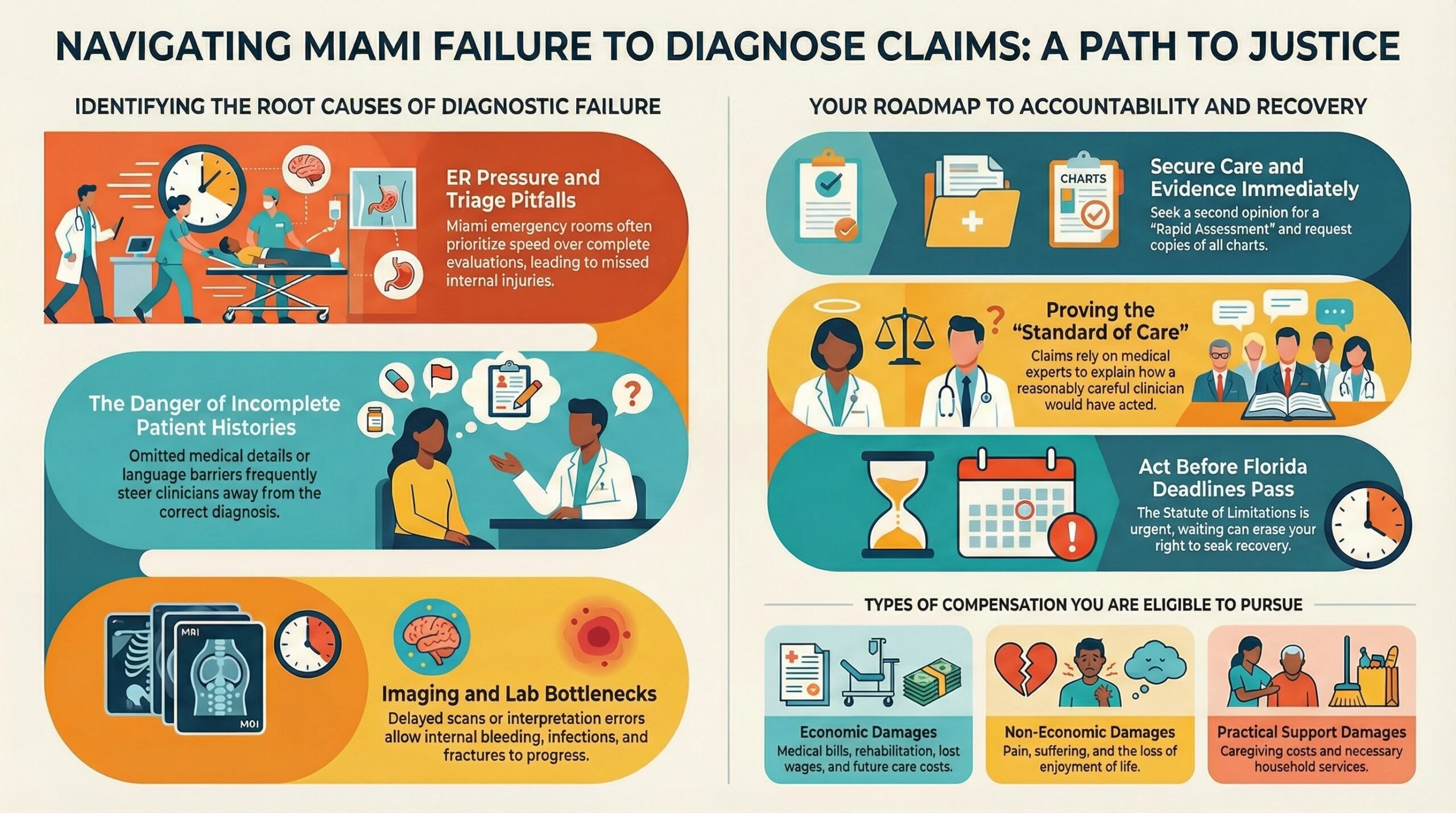
In Miami injury cases, you’ll often see missed diagnoses start in the emergency room, where providers misread symptoms or prioritize speed over a complete evaluation.
You can also encounter problems when your patient’s history is incomplete, as omitted details may lead clinicians astray from the correct diagnosis.
Even when the right concerns are raised, delayed diagnostic testing and imaging interpretation errors can still keep your injury hidden until it worsens.
Emergency Room Misdiagnosis
Because emergency departments in Miami operate under relentless time pressure, ER misdiagnosis remains a leading cause of failure to diagnose injuries that later become far more serious.
When you arrive in pain, clinicians must prioritize quickly, and triage protocols can unintentionally downplay subtle signs of internal bleeding, spinal trauma, or evolving head injury.
Crowding and frequent handoffs increase the risk that imaging is delayed, tests are read too narrowly, or symptoms are attributed to minor strain.
You also face the hidden cost of staff burnout, which can dull vigilance and shorten bedside assessments even among dedicated professionals.
If you serve others, you know that timely, accurate care protects families and communities. When an ER misses an injury, prompt follow-up evaluation and legal review may help secure accountability and safer systems.
Incomplete Patient History



When clinicians don’t capture a complete history at intake, they can miss the clues that turn a vague complaint into a clear injury diagnosis. You can help prevent that outcome by describing the incident, the timing of symptoms, prior injuries, and any recent changes in function, even if they seem minor.
Medication omissions often distort the clinical picture because pain relievers, blood thinners, and sedatives can mask signs or raise bleeding risk after trauma.
Language barriers also create gaps, especially when staff rely on shortcuts instead of qualified interpretation, and you may leave with misunderstood instructions or an incomplete record.
When you advocate calmly, ask clarifying questions, and make sure your history is documented, you support safer care and protect others from avoidable harm.
Delayed Diagnostic Testing
An accurate intake history can still lead to a missed injury if diagnostic testing doesn’t happen on time. When you don’t order labs or studies promptly, you leave essential questions unanswered, and your team can’t match symptoms to objective findings.
In Miami’s busy care settings, telehealth delays may slow referrals, disrupt follow-up, and postpone in-person exams that trigger necessary tests. You may also face laboratory bottlenecks, where backlogs, specimen-handling issues, or limited staffing extend turnaround times and push decisions to later visits.
These delays can allow internal bleeding, infection, or fractures to progress, increasing pain and complicating treatment. To serve patients well, you should track pending results, set clear escalation steps, and confirm someone owns the next action when results arrive.
Imaging Interpretation Errors
Even if you order the right scan on time, an imaging interpretation error can still derail an injury diagnosis and delay treatment. When you serve patients, you must watch for misinterpretation of artifacts, subtle fractures read as normal, and observer variability between radiologists or shifts.
You can reduce harm by confirming clinical history, requesting addenda, and escalating discrepancies, so care stays aligned with the patient’s needs.
| What can go wrong | What you can do |
|---|---|
| Motion or metal artifacts | Ask for repeat views |
| Subtle bleed missed | Request urgent reread |
| Wrong side labeled | Verify identifiers |
| Observer variability | Seek second opinion |
| Report lags symptoms | Correlate, document, escalate |
If you act early, you’ll protect recovery timelines and support fair accountability when delays create lasting injury outcomes.

Legal Rights of Miami Failure to Diagnose Injury Victims
Although a missed or delayed diagnosis can feel like a private medical crisis, Miami patients have clear legal rights under Florida law to pursue accountability and financial recovery.
Even a missed diagnosis isn’t just personal—Miami patients can pursue accountability and financial recovery under Florida law.
You can seek justice not only for yourself, but also to protect future patients and strengthen standards of care across the community.
Your claim may involve physicians, hospitals, clinics, or diagnostic providers whose actions fell below accepted medical practice.
- You have the right to pursue damages for medical bills, lost income, additional treatment, and pain and suffering tied to the diagnostic failure.
- You have the right to expect patient privacy throughout the legal process, with sensitive records handled in accordance with lawful requests and protective safeguards.
- You have the right to raise concerns that implicate medical licensing, including patterns of unsafe practice that may warrant review by appropriate regulatory authorities.

If negligence caused avoidable harm, Florida law allows you to demand answers, accountability, and fair compensation within required deadlines.
Steps to Take After a Miami Failure to Diagnose Injury
After a Miami failure to diagnose injury, you should seek immediate medical care to protect your health and create clear documentation of your condition.
You’ll then want to gather all relevant records and evidence, including test results, treatment notes, prescriptions, and a timeline of symptoms and provider visits.
Finally, you should contact a Miami attorney promptly to preserve crucial evidence and evaluate whether you have a viable claim.
Seek Immediate Medical Care
When a missed or delayed diagnosis leaves you injured, you should seek immediate medical care to protect your health and establish a clear record of what went wrong.
Go to an emergency room, urgent care clinic, or a qualified consultant, and describe your symptoms and prior visits accurately, without minimizing changes you’ve noticed.
Ask for a Rapid Assessment so the team can identify time-sensitive conditions and stabilize you without delay.
Follow the treatment plan closely, including referrals, imaging, and prescribed medications, because consistent care supports recovery and helps prevent complications.
Request clear instructions for follow-up visits and warning signs that require returning promptly.
Arrange Family Notification so a trusted person can assist with transportation, medication schedules, and urgent decisions, especially if your condition worsens.
Gather Records And Evidence
Since a failure to diagnose a case often turns on what the medical team knew and documented at each stage, you should begin gathering records and evidence as soon as you’re medically stable.
Request complete copies of your medical chart, imaging, lab results, discharge instructions, and referral notes from every facility involved, and keep a log of who you contacted and when.
Save appointment reminders, portal messages, and pharmacy receipts to show timelines and missed warnings.
Take photos of visible symptoms or mobility limits, and preserve photo timestamps to support when changes occurred.
Ask supportive family members to write brief, dated observations about your condition and daily limitations.
Store everything in labeled folders, create digital backups, and protect originals from alteration or loss.
Contact A Miami Attorney


How do you protect your rights while the facts are still fresh and the medical records remain intact? You contact a Miami attorney promptly to preserve evidence, align care decisions, and advocate for fair accountability. A lawyer can request records, identify responsible parties, and guide you on communications that prevent misunderstandings.
If you serve others, timely legal action helps protect your family and community by promoting safer medical standards. Ask about virtual consultations, and confirm multilingual support so your story is documented accurately and respectfully.
| Action | Why it matters | Your next step |
|---|---|---|
| Call counsel | Preserve timelines | Schedule intake |
| Share records | Build proof | Upload copies |
| List witnesses | Confirm events | Provide contacts |
| Track symptoms | Show harm | Keep journal |
How a Miami Failure to Diagnose Injury Lawyer Can Help You
Why take on a failure-to-diagnose injury claim alone when the medical records, timelines, and standards of care can quickly become overwhelming?
A Miami failure to diagnose injury lawyer gives you structure, protects deadlines, and builds a case that honors your commitment to care for others by seeking accountability and safer practices.
You’ll receive focused guidance through essential steps:
- You’ll organize records, identify missing tests or referrals, and create a clear timeline that shows where the process broke down.
- You’ll benefit from expert collaboration, with qualified medical professionals explaining the proper standard of care and how the lapse occurred.
- You’ll gain strength in settlement negotiation, as your lawyer values damages, prepares persuasive demand materials, and presses insurers to respond with serious offers.

If the other side refuses to act reasonably, your lawyer can file suit, manage discovery, and present your case with disciplined advocacy.
Long-Term Effects of Miami’s Failure to Diagnose Injuries
When a Miami provider fails to diagnose your injury, you can face chronic pain and lasting disability that limits your work, mobility, and independence.
You’re also more likely to experience a worsened prognosis, because delays allow conditions to progress and reduce the effectiveness of later treatment. As complications accumulate, you’ll often incur increased medical treatment costs, including additional testing, specialty care, and prolonged rehabilitation.
Chronic Pain And Disability
Although some injuries seem minor at first, a missed or delayed diagnosis can set the stage for chronic pain and lasting disability that disrupts your work, mobility, and independence.
When damage goes unrecognized, you may compensate with poor movement patterns, strain adjacent joints, and lose strength, turning routine tasks into daily obstacles.
You might cycle through appointments, prescriptions, and procedures, yet still struggle to find stable pain management that lets you serve your family and community.
Persistent symptoms can limit sleep, concentration, and stamina, which affects performance and safety in service-oriented roles.
As activities shrink, you may withdraw from colleagues and friends, and social isolation can quietly deepen stress and reduce resilience.
With proper support and documentation, you can protect your future and dignity.
Worsened Prognosis From Delays
Because time often determines the outcome, a delayed injury diagnosis can worsen your prognosis by allowing internal damage to progress beyond the point where simple treatment would’ve worked.
When warning signs are missed, bleeding, swelling, infection, or nerve compression can intensify, leaving you with fewer effective options and a longer path to stability.
These progression risks can also reduce the body’s ability to compensate, leading to secondary complications that are harder to reverse.
You may face recovery setbacks that limit your ability to care for others, serve your family, and remain dependable at work or in ministry.
A timely, accurate diagnosis supports early intervention, protects function, and preserves dignity. If delays occurred, you’ll need clear documentation and informed advocacy to show how the lapse changed your long-term outlook.
Increased Medical Treatment Costs
Even if your initial symptoms seemed manageable, a missed or delayed diagnosis in Miami can drive long-term medical costs far beyond what early treatment would’ve required.
You may need advanced imaging, specialty consults, and corrective procedures that wouldn’t have been necessary with prompt care.
As complications grow, visits multiply, prescriptions change, and rehabilitation extends, creating a cumulative financial burden.
You also face medical inflation, which increases prices for hospital services, supplies, and follow-up appointments over time.
When insurers question coverage or shift costs, you may rely on treatment financing, including payment plans or medical liens that reduce flexibility and add stress.
If you’re committed to serving others, protecting your health and resources lets you stay present for your family, patients, or community without interruption.
Proving Liability in Miami Failure to Diagnose Medical Malpractice Injury Cases
In Miami failure to diagnose cases, proving liability turns on whether a provider’s missed or delayed diagnosis fell below the accepted medical standard of care and directly caused avoidable harm.
You must show what a reasonably careful clinician would’ve done when faced with the same symptoms, history, and test results, and then demonstrate how your provider departed from that practice.
Show what a careful clinician would have done with those symptoms and results, then explain exactly how your provider deviated.
You’ll typically rely on Expert Witnesses to explain the proper diagnostic steps, interpret records, and address why earlier action was required.
You also need a disciplined Causation Analysis that connects the delay to a worsened outcome, such as disease progression, reduced treatment options, or preventable complications.
You can strengthen your claim by documenting timelines, follow-up gaps, uninvestigated abnormal findings, and missed referrals.
When you approach the case with accuracy and service-minded purpose, you help protect future patients while seeking accountability for preventable medical errors.
Compensation for Miami Failure to Diagnose Damages


When a missed or delayed diagnosis changes the course of your health, Miami law may allow you to pursue damages that reflect both the financial and human impact of that error. You can seek recovery for added medical bills, future treatment costs, lost income, and reduced earning capacity, along with pain, disability, and loss of enjoyment of life.
If your family carried the burden, you may also claim related caregiving and support losses.
| Damage category | What it can cover |
|---|---|
| Economic | Bills, rehab, wages, future care |
| Non-economic | Pain, suffering, diminished life |
| Practical support | Caregiving costs, household services |
You’ll strengthen your claim by documenting expenses and showing how the delay worsened outcomes. Your lawyer can also address Tax implications and Settlement structuring, so the resolution supports long-term stability and responsible stewardship. By pursuing fair compensation, you’re better positioned to continue serving others without sacrificing your own recovery needs.
The Statute of Limitations for Miami Failure to Diagnose Injury Cases
Because missed-diagnosis injuries often unfold over time, Florida’s statute of limitations can determine whether you still have the legal right to bring a Miami failure to diagnose claim. In many medical negligence cases, you must file within a defined period, and waiting can deprive you of the ability to seek accountability and resources for care.
You should treat the deadline as urgent, even if your symptoms seem manageable today.
Florida law may apply the Discovery Rule, which measures time from when you knew, or reasonably should’ve known, that the missed diagnosis caused harm.
Even so, additional outer limits can still restrict late filings, so careful timeline tracking matters. In limited situations, Tolling Exceptions may pause or extend the running of time, such as when required information was concealed or when other legally recognized barriers prevented earlier action.
If you act promptly, you protect your voice, safeguard patient safety, and help prevent similar harm to others in Miami communities.
Why You Need an Experienced Miami Failure to Diagnose Injury Lawyer
Although a missed diagnosis can look straightforward on the surface, these cases often hinge on medical standards, detailed records, and tightly contested timelines, so you can’t afford guesswork.
Missed diagnoses may seem simple, but they turn on standards, records, and timelines—leaving no room for guesswork.
An experienced Miami failure to diagnose injury lawyer helps you prove what competent care required, when symptoms should’ve triggered action, and how delays changed the outcome.
You need counsel who can secure complete records, identify gaps, and work with qualified medical experts to translate nuanced care into clear, credible evidence.
Your lawyer also manages notice requirements, insurers, and defense strategies designed to shift blame or minimize harm.
With disciplined courtroom tactics, you can present a coherent timeline, challenge unreliable testimony, and protect your credibility under pressure.
Beyond your case, skilled representation supports policy advocacy by holding systems accountable, encouraging safer practices, and helping prevent similar harm to others.
That service-minded focus strengthens your pursuit of fair compensation and meaningful change in Miami communities today.
How to Choose the Right Miami Failure to Diagnose Injury Lawyer for Your Case
Skilled representation can strengthen a failure to diagnose claim, but your outcome often depends on selecting counsel who fits the medical facts, the legal demands, and the pace of Miami litigation. Begin by confirming relevant case experience with delayed diagnosis harms, and ask how your lawyer will work with medical experts and records.
Use the guide below to compare candidates:
| Selection factor | What you should confirm |
|---|---|
| Case experience | Similar diagnoses, hospitals, timelines |
| Strategy | Clear liability theory, damages plan |
| Communication Preferences | Update frequency, point of contact |
| Resources | Expert network, staffing, trial readiness |
| Personality Fit | Respectful, mission-minded, decisive |
You should also evaluate responsiveness during the consult, because early delays often predict later neglect. Request a plain-language explanation of strengths, risks, and expected milestones, so you can serve your family with informed choices. Finally, review fee terms, costs, and settlement authority, then choose the lawyer who treats your matter with disciplined urgency.
About the Law Offices of Anidjar and Levine
The Law Offices of Anidjar and Levine represent injured clients across South Florida, and you can expect a structured approach to failure-to-diagnose claims that prioritizes medical proof and litigation readiness.
You’ll work with a team that gathers records promptly, consults qualified medical professionals, and builds a timeline that connects delayed diagnosis to avoidable harm and measurable losses.
A focused team gathers records fast, consults medical experts, and builds a timeline linking delay to avoidable harm and losses.
You can also rely on the firm’s history of advocating for people harmed by preventable medical errors, while maintaining disciplined case preparation from intake through trial.
You’ll receive clear updates, practical guidance, and support that respects your goal of protecting others from similar outcomes.
Through community involvement, the firm supports local initiatives and reinforces a service-minded commitment to safety and accountability.
If negotiations don’t reflect the evidence, you’ll have counsel prepared to pursue litigation, present persuasive medical testimony, and seek fair compensation consistent with the facts.
Frequently Asked Questions
What if My Injury Was Misdiagnosed Rather Than Not Diagnosed at All?
If your injury was misdiagnosed, you still may have a viable claim, because the wrong diagnosis can delay proper treatment and worsen outcomes.
You should gather your medical records, document symptoms, and note when care changed or escalated.
A review can determine whether the provider missed clear signs, ordered unnecessary tests, or ignored results.
You’ll also need to connect the misdiagnosis to delayed complications, additional procedures, or lasting harm.
Can I Sue if I Signed a Hospital Consent Form?
Yes, you can still sue even if you signed a hospital consent form. You don’t waive your rights when care falls below professional standards or when providers fail to obtain true informed consent.
If material risks, alternatives, or expected outcomes weren’t explained, the form may carry limited weight.
You may also argue consent revocation if you withdrew permission or objected, and treatment continued. Act promptly, preserve records, and seek counsel.
How Do Contingency Fees and Case Costs Work in These Cases?
You’ll typically pay nothing upfront because your lawyer collects a contingency percentage only if you recover compensation. That percentage is set in your agreement, and it’s taken from the settlement or verdict.
Separately, you may still be responsible for litigation expenses, such as filing fees, expert reviews, and medical records. You should ask whether those costs come out before or after the fee, and get it in writing.
Will My Immigration Status Affect My Ability to File a Claim?
Your immigration status usually won’t prevent you from filing a claim, and you can often pursue compensation regardless of status.
You should still consider the deportation risk, since any case may create records that authorities could later review.
A civil injury claim generally doesn’t trigger public charge issues, because damages aren’t a means-tested benefit.
You’ll serve your family and community best by consulting both counsel and an immigration attorney early.
Can I Switch Lawyers if My Current Attorney Isn’T Responsive?
Yes, you can switch lawyers if your current attorney isn’t responsive.
You have the right to change representation through Firing Counsel, and you should request your file promptly to avoid delays in helping others.
Ask for a clear accounting of fees and costs, then arrange a Retainer Transfer with your new lawyer.
You’ll want the new lawyer to notify the court or insurer, so deadlines stay protected and your service-minded goals remain supported.
—————————
If you’ve suffered harm because an injury wasn’t diagnosed in time, you can’t afford delays or uncertainty.
You should preserve records, follow medical advice, and document how the error affected your health, work, and daily life. You’re also bound by strict filing deadlines, so prompt legal action is essential to protect your rights.
With the Law Offices of Anidjar and Levine and an experienced Miami Medical Malpractice Lawyer, you can build a focused claim, pursue full compensation, and hold negligent providers accountable.


We Can Help.