

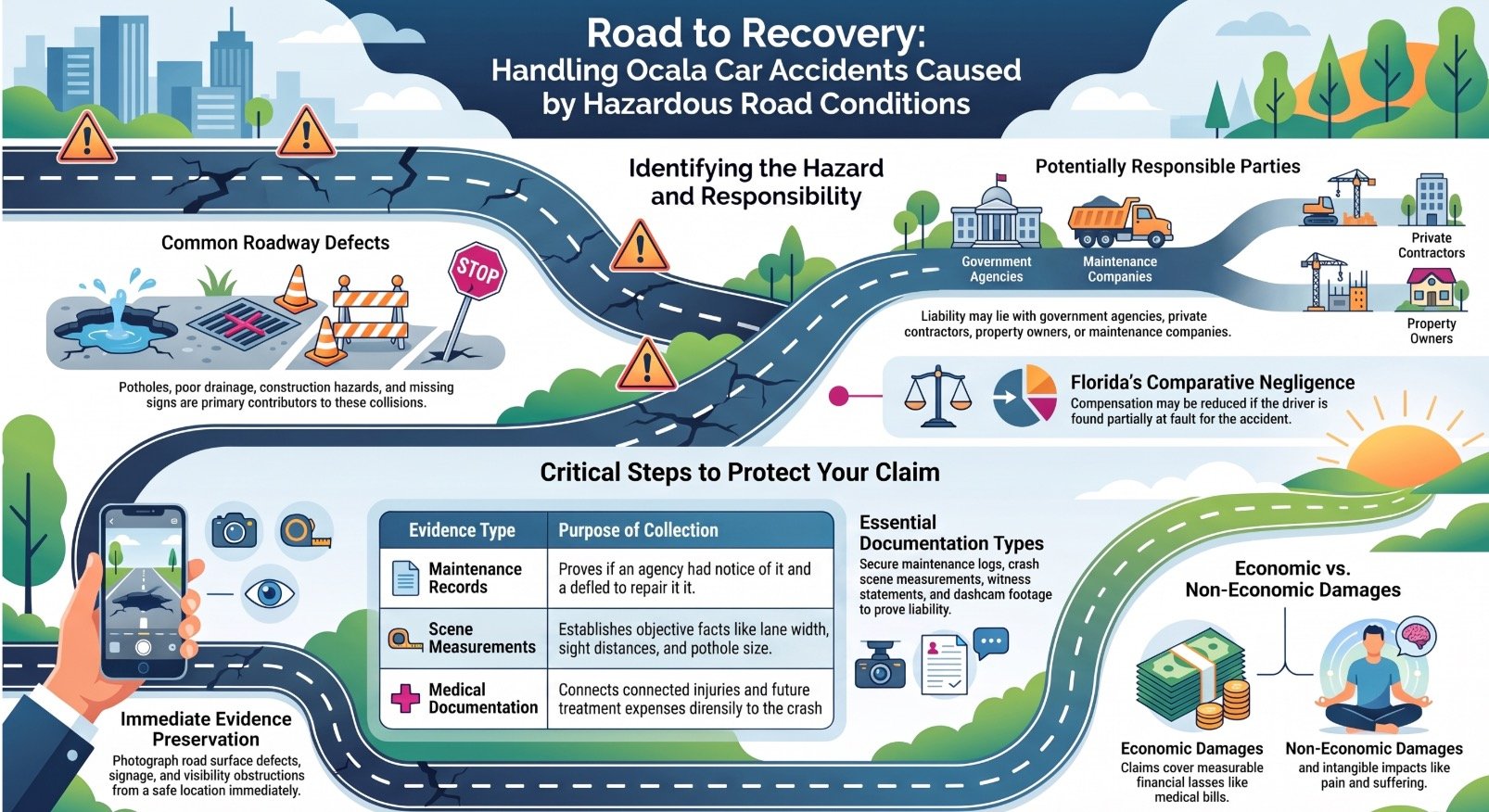
An Ocala car accident road and highway conditions lawyer at The Law Offices of Anidjar and Levine can investigate whether potholes, poor drainage, construction hazards, missing signs, defective signals, or inadequate maintenance contributed to a collision. Potentially responsible parties may include government agencies, contractors, property owners, or maintenance companies. Counsel can preserve roadway evidence, obtain maintenance records, document medical damages, communicate with insurers, and address Florida’s comparative negligence rules. For guidance after a roadway-related crash, contact an Ocala Personal Injury Lawyer to discuss available evidence, deadlines, and potential liability.
Main Takeaways
- An Ocala road-conditions lawyer investigates whether potholes, poor maintenance, construction hazards, signage, flooding, or signals contributed to your crash.
- Potentially responsible parties may include government agencies, contractors, property owners, maintenance companies, or negligent drivers.
- Important evidence includes photographs, crash reports, witness information, traffic footage, inspection records, maintenance logs, and expert opinions.
- Seek medical care promptly and preserve records connecting your injuries, treatment, lost income, and future expenses to the collision.
- Florida comparative negligence rules may reduce compensation, making timely evidence preservation and careful insurer communications important.
How We Can Help With Your Ocala Car Accident Road & Highway Conditions Injury Claim
When unsafe road or highway conditions contribute to an Ocala car accident, an experienced attorney can investigate the incident and identify the parties potentially responsible for the resulting injuries. Counsel may coordinate Evidence preservation by obtaining photographs, roadway records, maintenance histories, witness statements, and available surveillance footage before key information disappears.
The legal team can organize medical documentation to link diagnosed injuries, treatment needs, and expected expenses to the collision. This record may help present the client’s needs accurately while reducing confusion during insurance negotiations. Attorneys can communicate with insurers, evaluate proposed offers, and protect injured individuals from pressure to resolve claims prematurely.
A thoughtful settlement strategy considers medical costs, lost income, ongoing limitations, and other legally recoverable losses. If negotiations do not produce a fair resolution, counsel may prepare the claim for litigation and explain each procedural decision. Throughout the process, the firm can provide informed guidance, maintain clear communication, and pursue accountability on the client’s behalf.
Understanding Ocala Car Accident Road & Highway Conditions Injury Cases
Understanding an Ocala car accident involving unsafe road or highway conditions requires examining how the roadway contributed to the collision and which parties may bear legal responsibility. Injury cases often depend on evidence showing the condition existed, was connected to the crash, and that a responsible entity had notice and reasonable time to respond. Potentially involved parties may include governmental agencies, contractors, property owners, or other drivers, depending on the roadway’s ownership and maintenance obligations.
Medical records, photographs, witness accounts, crash reports, and repair documentation can help establish liability and damages. Florida’s Comparative negligence rules may reduce recovery when an injured person is assigned a share of responsibility. Insurance coverage disputes may also arise over available policies, exclusions, notice requirements, or competing claims. A careful review helps clarify procedural deadlines, responsible parties, and compensation options while supporting a fair resolution for those affected by roadway-related collisions.
Don’t Wait. Call Our Florida Personal Injury Lawyers Now!
Common Causes of Ocala Car Accident Road & Highway Conditions
Ocala car accidents may result from poor road maintenance, including potholes, uneven pavement, and insufficient repairs. Hazardous highway construction and inadequate signage can create confusion, restrict visibility, or expose motorists to unexpected traffic changes. Weather-related hazards, such as heavy rain, standing water, and reduced visibility, may further increase collision risk.
Poor Road Maintenance
Poor road maintenance can create hazardous conditions for drivers throughout Ocala, particularly when potholes, deteriorating pavement, inadequate drainage, or damaged traffic signs remain unrepaired. These defects may cause tire damage, unexpected swerving, loss of vehicle control, or collisions, especially in rain or at night. Faded lane markings and malfunctioning signals can further confuse motorists and increase risks at intersections. Maintenance-related crashes differ from incidents involving drunk driving or speeding tickets because the dangerous condition may arise from a public entity’s failure to inspect, repair, or warn about known roadway defects. Evidence may include photographs, repair records, witness statements, and reports documenting prior complaints. Injured individuals and families may benefit from prompt legal guidance while preserving relevant evidence. Careful investigation can help determine responsibility and support fair compensation for medical expenses, lost income, and other losses.
Hazardous Highway Construction
When highway construction is poorly planned, marked, or maintained, changing traffic patterns can create serious collision risks for Ocala drivers. Narrowed lanes, uneven pavement, temporary barriers, and shifting work areas may reduce reaction time and make ordinary driving movements more difficult. Contractors and public agencies must maintain Construction zone safety, control hazards, and protect motorists, workers, and pedestrians. Inadequate lighting or blocked sightlines can also reduce pedestrian visibility near access routes, creating additional dangers for people walking through or beside construction areas. Drivers remain responsible for adjusting speed, following temporary traffic controls, and avoiding driver negligence, including distraction or unsafe lane changes. When normal routes are disrupted, Alternative road safety measures should provide reasonably safe travel. Evidence from the work zone may help identify contributing failures after a collision.
Inadequate Road Signage
Unclear, missing, or improperly placed road signs can make it difficult for Ocala drivers to understand speed limits, lane assignments, right-of-way rules, and sudden changes in traffic patterns. When signage fails to provide adequate warning, motorists may merge unexpectedly, enter restricted lanes, or misjudge an intersection, increasing the risk of collisions. Poor visibility, inconsistent placement, or outdated information may also complicate efforts to determine whether a driver or governmental entity contributed to an accident. Law enforcement officers may issue citations even when confusing signs influenced the conduct, creating potential Traffic citation disputes. After a crash, individuals seeking assistance should preserve photographs, witness information, and roadway details. Accurate documentation can help prevent claims filing mistakes and support a fair evaluation of liability, damages, and available legal remedies.
Weather-Related Road Hazards
Rain, fog, strong winds, and occasional flooding can reduce visibility, diminish tire traction, and make road surfaces hazardous for Ocala motorists. Drivers may lose control when water accumulates in travel lanes, hydroplaning occurs, or fallen branches obstruct the roadway. Heavy rain can also conceal potholes, faded markings, and damaged shoulders, increasing the likelihood of collisions. Fog requires reduced speeds and greater following distances because limited visibility can prevent motorists from recognizing stopped traffic or roadway hazards. Strong winds may affect high-profile vehicles and scatter debris across highways. A drunk driving risk can become even more dangerous during severe weather because impaired motorists may be unable to respond appropriately to changing conditions. Additionally, vehicle safety defects, including worn tires or faulty windshield wipers, can intensify weather-related hazards and complicate accident investigations.
Legal Rights of Ocala Car Accident Road & Highway Conditions Injury Victims
Generally, Ocala car accident victims injured by dangerous road or highway conditions may have legal rights to seek compensation for medical expenses, lost income, property damage, and other losses. Potential claims may involve a negligent driver, government agency, contractor, or another responsible party, depending on the evidence and applicable deadlines.
Victims and their advocates should consider these crucial protections:
- Seek prompt medical evaluation and follow prescribed treatment, documenting injuries and limitations.
- Report the collision, obtain the crash report, and preserve photographs, repair records, medical bills, and communications.
- Practice Preserving Evidence by retaining damaged vehicle parts, roadway images, surveillance information, and maintenance records.
- Protect Witness Credibility by collecting accurate contact information and recording timely, consistent accounts.
Florida law may impose notice requirements and limits on claims involving public entities. An attorney can assess liability, calculate damages, communicate with insurers, and pursue an appropriate resolution. Careful legal guidance helps injured individuals protect their rights while supporting fair accountability for unsafe conditions.
Why Do Ocala Car Accident Road & Highway Conditions Injuries Happen?
Road and highway condition injuries in Ocala often occur when roadway defects, poor maintenance, or inadequate traffic controls create hazards that drivers cannot reasonably anticipate. Potholes, uneven pavement, crumbling shoulders, and missing signs can disrupt vehicle control or reduce the time available to respond. Standing water caused by inadequate drainage may lead to hydroplaning, particularly during severe Florida storms. Construction zones can add risk when lane markings, barriers, or warnings are unclear or poorly maintained.
Road debris, including fallen cargo, tire fragments, and tree limbs, may force sudden swerving or braking. Driver distraction can magnify these hazards by preventing timely recognition of changing roadway conditions. Excessive speed, following too closely, or impaired driving may further contribute, even when a roadway defect initiates the incident. In some situations, negligent maintenance, unsafe design, or delayed repairs can create recurring dangers for motorists, passengers, pedestrians, and emergency responders who depend on reasonably safe transportation routes.
What Should You Do After an Ocala Car Accident Involving Road & Highway Conditions?
After an Ocala car accident involving road or highway conditions, the injured party should seek immediate medical care, even if symptoms seem minor at first. Photographs, witness information, weather details, and records of roadway hazards can help document the conditions that contributed to the collision. Consulting an experienced lawyer may clarify your legal options and help evaluate potential liability.
Seek Immediate Medical Care
When a collision occurs on an Ocala road or highway, injured individuals should seek immediate medical care, even if symptoms initially appear minor or absent. Prompt evaluation can identify internal injuries, concussions, or soft-tissue damage that may worsen without treatment. Medical professionals can provide appropriate care, set restrictions, and explain which symptoms require further attention. Individuals should accurately describe pain, dizziness, numbness, or other changes, follow all discharge instructions, and attend recommended appointments. Documenting injuries through photographs, treatment notes, and symptom records may help preserve an accurate account of the physical effects. Getting medical records can support communication with insurers and legal representatives. Those assisting should prioritize transportation, emergency services, and patient safety. Photographing road hazards and keeping witness contact information are separate documentation steps that may be completed only when medically safe.
Document Road Conditions
From a safe location, individuals involved in an Ocala car accident should document relevant road and highway conditions as soon as reasonably possible. Photographs may show lane markings, traffic signals, signs, debris, potholes, standing water, construction barriers, lighting, and visible obstructions. Images should include broad views establishing location and closer views capturing specific hazards. If witnesses are available, record their names and contact information, provided doing so does not interfere with emergency response. Individuals should note weather, visibility, traffic flow, and the approximate time of each observation. A written traffic light timeline can preserve recollections about signal changes and vehicle movements. This evidence may support driver negligence documentation and help clarify whether roadway conditions contributed to the collision. Original files should remain unaltered and securely preserved.
Consult A Lawyer
Why should an injured person consult an Ocala car accident lawyer after a collision involving road or highway conditions? A lawyer can evaluate whether defective pavement, inadequate signage, poor lighting, flooding, construction, or negligent maintenance contributed to the crash. This liability assessment may involve public entities, contractors, property owners, or other responsible parties, each subject to distinct legal requirements and deadlines.
Prompt legal guidance also helps preserve evidence. Counsel may help secure photographs, traffic-camera recordings, maintenance records, inspection reports, witness statements, vehicle data, and medical documentation before evidence disappears or conditions change. A lawyer can explain insurance procedures, identify available claims, and protect the injured person from premature statements or settlement offers. By consulting counsel promptly, an injured individual can better understand legal options and support a fair resolution that supports personal recovery and community accountability.
Critical Evidence in an Ocala Car Accident Road & Highway Conditions Injury Case
Evidence can establish whether road or highway conditions contributed to the collision and resulting injuries, making the following materials particularly important:
- Road condition photos
- Crash scene measurements
- Maintenance records
- Witness statements
Together, these sources may clarify hazardous conditions, roadway dimensions, responsible parties, and the events leading to the crash.
Road Condition Photos
Photographs of road conditions can provide critical, objective documentation in an Ocala car accident case involving hazardous roadway conditions. Images may show standing water, potholes, debris, faded markings, missing signs, poor lighting, or obstructed visibility before conditions change. A person who safely photographs the scene should capture wide views, close details, nearby landmarks, and relevant warning devices without entering traffic or disturbing evidence. Metadata, weather records, and timestamps may help establish when and where each image was taken. How we build timelines often depends on comparing photographs with witness accounts, maintenance records, and incident reports. Why dashcam matters becomes apparent when continuous footage documents roadway conditions, traffic movement, and visibility immediately before impact. Attorneys may preserve original files and identify witnesses who can authenticate them, helping decision-makers evaluate roadway responsibility.
Crash Scene Measurements
When roadway conditions may have contributed to a collision, crash scene measurements can establish objective facts that photographs alone may not show. Investigators may document lane widths, shoulder drop-offs, roadway grades, sight distances, skid marks, debris fields, and the position of vehicles after impact. These measurements can help determine whether a driver encountered an unexpected hazard, lacked sufficient stopping distance, or had limited room to maneuver. They may also clarify how Lane closure delays affected traffic patterns, visibility, or a driver’s ability to respond safely. Measurements near damaged pavement can show the dimensions and location of a pothole, helping evaluate whether pothole resurfacing was needed to address a dangerous condition. Properly collected measurements preserve the scene’s physical evidence and assist attorneys, experts, and affected families in evaluating responsibility and damages.
Maintenance Records
Maintenance records can provide a documented history of the roadway conditions that preceded an Ocala car accident. These files may show inspection dates, reported hazards, repair requests, work orders, and the government agency or contractor responsible for corrective action. They can also identify recurring problems, including faded lane markings, damaged pavement, blocked drainage, defective traffic signals, or inadequate lighting. Records concerning crosswalk safety may reveal whether warning signs, pavement markings, and pedestrian signals received timely maintenance. Documentation addressing vehicle speed limits can help establish whether signs were properly posted, visible, and consistent with roadway conditions. A careful review may compare maintenance schedules with collision dates and determine whether known dangers remained uncorrected. Preserving these records can support accountability and help injured individuals pursue appropriate remedies through informed legal representation.
Witness Statements
Witness statements can provide important evidence about the road and highway conditions that contributed to an Ocala car accident. Drivers, passengers, pedestrians, and nearby workers may describe standing water, inadequate lighting, missing signs, debris, potholes, or construction hazards observed before and after the collision. Their accounts can clarify whether a dangerous condition existed, how long it appeared to be present, and whether responsible parties had notice. Prompt interviews are valuable because memories may change, and witnesses may become difficult to locate. Photographs, contact information, and written or recorded statements can help preserve relevant details. During an expert investigation, witness accounts may be compared with maintenance records, crash evidence, and roadway design standards. This information can support liability determination and help present an accurate claim for injured individuals.
Don’t Wait. Call Our Florida Personal Injury Lawyers Now!
Long-Term Effects of Ocala Car Accident Road & Highway Conditions Injuries
Road and highway condition injuries from Ocala car accidents may produce chronic pain that persists long after initial treatment. Some injured individuals also face ongoing mobility challenges that affect work, household responsibilities, and daily independence. These physical limitations can contribute to significant emotional and financial strain, particularly when medical expenses and lost income continue over time.
Chronic Pain Conditions
When an Ocala car accident damages muscles, joints, nerves, or the spinal structures, the resulting pain may persist long after visible injuries have recovered. Chronic pain can involve burning, aching, stiffness, or recurring sensitivity that disrupts sleep, concentration, employment, and family responsibilities. Some individuals require injections, prescription medication, counseling, or continuing physical therapy to manage symptoms. Medical documentation can help distinguish accident-related conditions from prior complaints and establish the likely duration of treatment. A person whose condition limits employment may also face reduced earnings and increased household burdens. Although a Work injury may arise in a different setting, similar records can demonstrate how persistent symptoms affect daily functioning. An informed settlement strategy should account for future medical care, pain-related limitations, and the possibility that symptoms may remain even when diagnostic findings appear limited.
Ongoing Mobility Challenges
Although some injuries from Ocala car accidents and road or highway conditions improve with treatment, others can create lasting mobility challenges. Fractures, ligament damage, spinal injuries, and nerve impairment may limit walking, standing, bending, or using stairs. Some individuals require mobility devices, home modifications, or assistance with routine activities. Persistent weakness and reduced coordination can also make driving or traveling independently unsafe. These limitations may continue despite surgery, rehabilitation, medication, and consistent medical follow-up. A collision involving distracted driving or a vehicle exceeding the posted speed limit can produce injuries that affect movement for years. Detailed medical records, diagnostic studies, and rehabilitation reports can help document the condition’s progression and functional impact. Legal professionals serving injured individuals may evaluate whether roadway conditions or another party’s conduct contributed to these ongoing physical restrictions.
Emotional And Financial Strain
Limited mobility can extend beyond physical restrictions, creating significant emotional and financial strain for individuals injured in Ocala car accidents involving hazardous road or highway conditions. Persistent pain, dependence on others, and uncertainty about recovery may affect employment, relationships, and confidence. Professional counseling can assist with coping with trauma, while supportive family members and community resources may reduce isolation. Financial pressure often develops through medical expenses, rehabilitation costs, transportation needs, and lost wages. Individuals may also struggle to pay bills when injuries prevent a return to work or require ongoing care. Organized records, benefits evaluations, and informed legal guidance can help identify available compensation and assistance. A lawyer may investigate roadway conditions, preserve evidence, and pursue responsible parties, supporting injured individuals and their families during long-term recovery and financial planning.
Proving Liability in Ocala Car Accident Road & Highway Conditions Injury Cases
Proving liability in an Ocala car accident caused by road or highway conditions requires evidence showing that a dangerous condition existed and that a responsible party knew or should have known about it. Potentially responsible entities may include governmental agencies, contractors, property owners, or maintenance companies, depending on the roadway and the condition involved. Relevant proof can include photographs, traffic-camera footage, crash reports, inspection records, maintenance logs, witness statements, and testimony from qualified roadway or accident experts. Prompt evidence preservation is vital because weather, repairs, traffic, and routine maintenance may alter or remove key conditions. A careful investigation can identify whether inadequate warnings, poor lighting, defective drainage, debris, potholes, or unsafe construction contributed to the collision. Comparative fault analysis may also assess whether another driver’s conduct contributed to the injuries. Clear documentation of medical consequences, vehicle damage, and accident circumstances helps establish causation and supports a fair evaluation of responsibility.
Dealing With Insurance Companies After an Ocala Car Accident Road & Highway Conditions Injury
After investigators assess roadway conditions and contributing parties, communications with insurance companies require careful handling. An injured person should provide accurate information while avoiding speculation, admissions of fault, or statements minimizing pain and limitations. Insurers may request recorded interviews, medical authorizations, photographs, employment records, and other materials. Review each request carefully to protect privacy and preserve your ability to document losses.
A recorded incident timeline can help organize roadway observations, emergency responses, medical visits, conversations, and changes in symptoms. Supporting materials may include photographs of surface defects, repair notices, weather records, witness details, and available dashcam footage. Retain copies rather than surrendering original evidence.
An attorney may communicate with adjusters, identify incomplete investigations, and challenge inaccurate interpretations of the collision. Prompt notice to applicable insurers remains important, including personal automobile coverage that may apply despite another driver’s involvement. Careful documentation and respectful communication help prevent avoidable disputes while preserving the injured person’s interests.
What to Expect During an Ocala Car Accident Road & Highway Conditions Injury Claim Process
An Ocala car accident injury claim typically begins with an initial assessment of the collision, injuries, insurance coverage, and potential liability. The evidence-gathering process may include medical records, crash reports, photographs, witness statements, and documentation of road or highway conditions, followed by negotiations with the insurance company. If settlement efforts fail, the claim may proceed to trial, where a judge or jury determines liability and damages.
Initial Claim Assessment
The initial claim assessment determines how road or highway conditions may have contributed to an Ocala car accident and the resulting injuries. A legal professional reviews the reported location, collision circumstances, medical impact, and potential responsibility of drivers, contractors, or public entities. This early evaluation helps determine whether roadway design, construction, debris, flooding, inadequate lighting, missing warnings, or maintenance failures may be relevant. The injured person may be asked to provide a clear account of events, identify treatment received, and explain how injuries affect daily responsibilities. Photograph evidence and efforts to gather witness names can help preserve important details for later review. The assessment also considers filing deadlines, available insurance coverage, and procedural requirements. Its purpose is to clarify viable paths toward fair compensation and informed representation.
Evidence Gathering Process
When roadway conditions may have contributed to a crash, evidence gathering focuses on preserving reliable information about the location, events, and resulting injuries. A legal team may inspect pavement, lane markings, lighting, signage, drainage, construction zones, and sight distances before conditions change. Photographs, measurements, maintenance records, weather reports, and roadway design documents can help establish whether a hazard existed and whether responsible parties received notice. Witness statements may clarify traffic movements, visibility, and warnings present before impact. Video evidence from traffic cameras, nearby businesses, vehicles, or residences can preserve important timing and environmental details. Accident reconstruction may then be used to evaluate speed, vehicle paths, impact forces, and how roadway conditions affected the collision. Medical records and injury documentation connect the crash circumstances to the claimant’s losses and recovery needs.
Insurance Company Negotiations
Once roadway evidence has been preserved, insurance negotiations typically focus on liability, injury documentation, and the full value of the claim. Adjusters review photographs, crash reports, witness accounts, medical records, and roadway maintenance information before evaluating responsibility. In some cases, slip liability or premises fault may affect how insurers evaluate a roadway defect, hazard, or property owner’s conduct. Claim representatives may request recorded statements, authorizations, or additional documentation, although responses should remain accurate, consistent, and limited to relevant facts. Settlement valuation generally considers medical expenses, lost income, treatment needs, property damage, and how injuries affect daily responsibilities. A lawyer may organize supporting evidence, address disputed facts, identify inadequate offers, and communicate with insurers on the injured person’s behalf while protecting the claim’s credibility throughout negotiations.
Settlement Or Trial
Settlement or trial represents a significant decision in an Ocala car accident claim involving alleged road or highway conditions. After reviewing medical records, crash reports, photographs, maintenance histories, and witness accounts, the injured party and legal counsel assess whether a fair settlement is achievable. A sound Negotiation strategy considers liability evidence, anticipated treatment, lost income, property damage, and the governing roadway standards. If negotiations do not produce adequate compensation, the claim may proceed to litigation. Trial preparation then includes identifying expert witnesses, organizing exhibits, preparing testimony, and addressing arguments concerning driver conduct or government responsibility. The process can require substantial time and careful participation. Throughout, counsel explains potential outcomes, expenses, and risks so the injured individual can make informed decisions while protecting personal recovery and supporting accountability for unsafe conditions.
Don’t Wait. Call Our Florida Personal Injury Lawyers Now!
Compensation for Ocala Car Accident Road & Highway Conditions Injury Damages
A person injured in an Ocala car accident caused by dangerous road or highway conditions may be entitled to compensation for medical expenses, lost income, property damage, and pain and suffering. Potential recovery depends on evidence establishing that a government entity, contractor, property owner, or another responsible party failed to address a hazardous condition or provide adequate warning.
Preserving photographs, witness information, crash reports, repair records, and roadway communications can help show responsibility. Injured individuals should also prioritize documenting medical expenses, treatment recommendations, travel costs, and work absences. Insurance carriers or opposing parties may raise comparative negligence defenses, alleging that the injured person contributed to the collision or failed to exercise reasonable care. Florida’s negligence rules may reduce recovery according to an assigned percentage of fault.
A lawyer can evaluate applicable deadlines, identify responsible parties, communicate with insurers, and seek a resolution supported by reliable evidence. Prompt legal guidance may help protect an injured person’s rights while keeping the focus on recovery and family obligations.
Economic vs Non-Economic Damages in Ocala Car Accident Road & Highway Conditions Cases
Economic damages may include medical expenses, lost wages, property damage, and future financial losses resulting from roadway or highway conditions. Non-economic losses can encompass pain and suffering, emotional distress, reduced quality of life, and permanent impairment. Proving these damages generally requires medical records, employment documentation, repair estimates, witness testimony, and other reliable evidence connecting the losses to the accident.
Economic Damage Categories
Two primary categories of damages may arise in an Ocala car accident involving hazardous road or highway conditions: economic and non-economic losses. Economic damages represent measurable financial harm caused by the collision and resulting injuries. They may include emergency transportation, hospital care, physician visits, surgery, medication, rehabilitation, and other medical expenses. A claim may also include anticipated future treatment when qualified evidence establishes continuing needs. Lost wages, reduced earning capacity, and income lost while attending appointments can form additional economic damages. Vehicle repair or replacement costs, towing, rental transportation, and damaged personal property may also be recoverable. Accurate records, employer documentation, repair estimates, and Expert witness testimony can substantiate these amounts. During settlement negotiations, organized financial evidence helps clarify the claimant’s documented losses and supports a fair resolution.
Non-Economic Losses
When hazardous road or highway conditions cause a collision, non-economic losses address the personal impact of the resulting injuries rather than documented financial expenses. These damages may include physical pain, emotional distress, diminished enjoyment of life, disfigurement, disability, and disruption of family relationships. Their value depends on the injury’s severity, duration, treatment burden, and effect on ordinary activities and future well-being. In Ocala cases, a careful evaluation should also consider whether a public entity, contractor, or another driver shares responsibility for unsafe conditions. Comparative negligence disputes can reduce a claimant’s recovery when conduct contributed to the collision or resulting harm. A statute compliance check helps identify applicable deadlines, notice requirements, and procedural limits before pursuing a claim. Counsel serving injured individuals may explain these issues with compassion while maintaining realistic expectations about non-economic compensation.
Proving Accident Damages
Establishing accident damages in an Ocala car accident case requires evidence that connects the road or highway condition, the collision, and the claimant’s losses. Economic damages may include emergency treatment, continuing care, medication, rehabilitation, vehicle repairs, lost wages, and reduced future earning capacity. Receipts, employment records, repair estimates, and medical documentation costs can help establish these measurable amounts. Non-economic damages address pain, emotional distress, loss of enjoyment, and diminished quality of life. Testimony from the claimant, relatives, medical professionals, and counselors may support these less tangible losses. Photographs, crash reports, maintenance records, witness statements, and expert analysis can clarify whether inadequate signage, dangerous surfaces, or poor lighting contributed to the incident. Preserving evidence promptly also supports insurance claim timelines and helps ensure responsible parties assess damages fairly.
When an Ocala Car Accident Road & Highway Conditions Injury Case Goes to Trial vs. Settlement
Because road design, maintenance, lighting, drainage, or other highway conditions may contribute to a crash, an Ocala car accident injury case may require settlement negotiations or trial. A settlement may provide a faster, more predictable resolution while allowing an injured person to focus on treatment and recovery. Negotiations often depend on documented injuries, repair records, photographs, witness accounts, and evidence connecting the roadway condition to the collision. Settlement negotiation leverage may increase when liability evidence is persuasive, and damages are clearly supported.
Trial timing factors include medical stability, witness availability, expert evaluations, court schedules, and the time required to complete discovery. Trial can let you present disputed facts to a judge or jury, but it also brings uncertainty, expense, and emotional demands. A case may proceed toward trial when offers do not reasonably address documented losses or when responsibility remains contested. Legal counsel can explain the process, evaluate risks, and help protect the injured person’s interests.
Florida Laws That May Affect Your Ocala Car Accident Road & Highway Conditions Case
Florida laws can substantially affect how an Ocala car accident road and highway conditions case is investigated, presented, and resolved.
Several legal principles guide the collection of proof and evaluation of responsibility:
- Evidence preservation may require timely requests for surveillance footage, photographs, vehicle data, and roadway inspection materials before they are lost or altered.
- Eyewitness affidavits can document weather, lighting, warnings, traffic flow, and visible hazards while memories remain reliable.
- Comparative negligence rules may reduce a recovery when an injured person’s conduct contributed to the collision, requiring careful analysis of every party’s actions.
- Documentary maintenance logs can help establish whether a public agency, contractor, or property owner inspected, repaired, or warned about a dangerous condition.
Florida statutes, regulations, and governmental-immunity provisions may also influence available claims and required proof. A qualified Ocala attorney can organize records, consult appropriate safety professionals, and present the facts clearly. This disciplined approach supports injured individuals and their families while promoting accountability and fair treatment for all affected parties.
The Statute of Limitations for Ocala Car Accident Road & Highway Conditions Injury Cases
When a roadway defect or highway condition contributes to a collision, the injured person must file a claim within the applicable statute of limitations. In Florida, the deadline for a negligence claim generally depends on when the injury occurred, though special rules may apply when a governmental entity may be responsible. Claims against public agencies can involve shorter notice periods and distinct procedural requirements, making prompt evaluation crucial. Statute deadline calculation should account for the accident date, the nature of the claim, applicable governmental protections, and any legally recognized interruption or extension. A Tolling exceptions overview may include circumstances involving a minor claimant, incapacity, concealment, or other conditions recognized by Florida law. These exceptions are limited and fact-specific; they should not be assumed to preserve an otherwise expired claim. Medical documentation, crash records, photographs, and witness information can help establish relevant dates and circumstances. Timely attention supports fair treatment and protects the opportunity to seek accountability for preventable roadway hazards.
How an Ocala Car Accident Road & Highway Conditions Lawyer Can Help You
Prompt attention to filing deadlines allows a lawyer to focus on building the roadway-condition claim and identifying each responsible party. A lawyer can serve injured individuals by coordinating evidence, clarifying legal duties, and presenting facts that support fair compensation.
- Investigate roadway design, maintenance records, lighting, signage, drainage, and construction activity that may have contributed to the collision.
- Analyze whether distracted driving, unsafe pedestrian conditions, or vehicle defects interacted with the roadway hazard.
- Collect photographs, traffic-camera footage, medical records, crash reports, and eyewitness tips before evidence becomes unavailable.
- Identify potentially responsible drivers, contractors, maintenance entities, manufacturers, and insurers, then organize claims against each appropriate party.
Counsel can also consult engineers, accident-reconstruction professionals, and medical providers when technical testimony is necessary. This process helps distinguish roadway negligence from unrelated conduct while preserving the injured person’s account. Attention to Pedestrian safety may reveal overlooked design failures, while careful review of vehicle defects can identify additional causes. By coordinating communications and evaluating documented losses, the lawyer helps protect clients and families seeking accountability without shifting responsibility onto those already harmed.
When to Contact an Ocala Car Accident Road & Highway Conditions Lawyer
Schedule a consultation with an Ocala car accident road and highway conditions lawyer as soon as possible after a collision involving a dangerous roadway condition. Early guidance can help preserve photographs, vehicle data, witness information, medical records, and reports concerning construction, lighting, drainage, signage, or pavement defects.
Legal assistance is particularly important when injuries require continuing treatment, an insurance carrier requests a recorded statement, or multiple parties may share responsibility. Prompt review can also identify applicable filing deadlines and help determine whether a public entity, contractor, maintenance company, or another driver may be involved.
An attorney can evaluate available evidence and develop a negotiation strategy suited to the circumstances, while addressing anticipated liability defenses raised by insurers or other responsible parties. Contact becomes more urgent when evidence may be repaired, removed, or lost through ordinary roadway maintenance. A timely consultation helps the injured person or family understand their options and make informed decisions while protecting a potential claim.
Why You Need an Experienced Ocala Car Accident Road & Highway Conditions Lawyer
Because road and highway condition cases often involve overlapping duties, an experienced Ocala car accident lawyer can identify the parties, evidence, and legal issues that may affect recovery. A roadway collision may involve a driver, a government agency, a contractor, a maintenance company, or a property owner. Determining responsibility requires careful review of design standards, inspection records, repair histories, weather conditions, warnings, and accident reports.
Counsel can develop liability evidence while pursuing preservation tips that protect photographs, vehicle data, surveillance footage, witness statements, and roadway records before they disappear. This work helps clarify whether a dangerous defect, inadequate warning, negligent maintenance, or another condition contributed to the crash. An experienced lawyer also evaluates medical documentation, financial losses, and applicable deadlines without losing sight of the injured person’s broader needs.
When negotiations do not produce fair results, informed trial strategy and courtroom readiness become vital. Preparation may include retaining qualified experts, challenging unsupported defenses, presenting clear causation evidence, and explaining intricate roadway issues in terms a jury can understand.
How to Choose the Right Ocala Car Accident Road & Highway Conditions Lawyer for Your Case
Selecting the right Ocala car accident lawyer for a roadway or highway conditions case requires more than comparing advertisements or settlement claims. A qualified attorney should demonstrate experience investigating unsafe road design, inadequate maintenance, missing warnings, poor lighting, and other contributing conditions. The lawyer should explain how responsibility may involve public agencies, contractors, property owners, or multiple insurers.
During an initial consultation, prospective clients should ask about Client communication expectations, including response times, case updates, and the primary contact. They should also request a clear explanation of the contingency fee structure, litigation expenses, and any potential charges if the claim does not succeed.
Prompt evidence preservation is vital because surveillance footage, roadway conditions, vehicle data, and witness recollections may disappear or change. The attorney should describe procedures for documenting the scene, consulting qualified experts, and retrieving crash reports. A careful evaluation of investigative resources, professional judgment, and commitment to the injured person’s interests can guide an informed decision.
About The Law Offices of Anidjar & Levine
With roadway evidence and liability issues often requiring prompt, organized attention, The Law Offices of Anidjar & Levine represents individuals pursuing compensation after car accidents in Ocala and throughout Florida. The firm helps clients facing medical expenses, vehicle damage, lost income, and uncertainty about their legal options. During Ocala case intake, attorneys and staff gather information about the collision, roadway conditions, injuries, witnesses, and available insurance coverage. A legal consultation can help clarify potential claims and explain the process for seeking compensation without creating unrealistic expectations. Through evidence review, the firm may examine photographs, crash reports, traffic signals, maintenance records, medical documentation, and other materials relevant to liability. Attorneys then develop a claim strategy based on the facts, applicable law, and the client’s objectives. The firm’s work emphasizes responsive communication, careful preparation, and service to individuals and families facing difficult consequences after a roadway accident. Its approach remains focused on accountability and informed decisions.
Frequently Asked Questions
Can I Still Recover Damages if I Was Partially at Fault for the Accident?
Yes, an injured person may still recover damages when partially responsible, depending on the applicable state law. Comparative negligence reduces compensation according to the person’s percentage of fault; for example, 20 percent responsibility may reduce a $50,000 award to $40,000. Shared liability can involve multiple drivers, roadway conditions, or other parties. Evidence, insurance policies, deadlines, and fault allocation substantially affect recovery, so qualified legal guidance can protect the person’s interests and support a fair evaluation.
What Happens if the Dangerous Road Condition Was Caused by Severe Weather?
Severe weather may reduce or eliminate a government agency’s liability when officials lacked reasonable notice or time to address resulting road hazards. However, immunity is not automatic. A claim may remain viable if negligent design, delayed maintenance, inadequate warnings, or prior knowledge contributed to the collision. Through prompt proof collection, including photographs, weather records, witness statements, and maintenance logs, an injured person can clarify causation and preserve potential recovery under applicable Florida law.
Can Road Construction Companies Be Held Responsible for Unsafe Highway Conditions?
Road construction companies can be held responsible for unsafe highway conditions when their work creates unreasonable hazards or fails to meet applicable safety standards. Contractor Liability may arise from inadequate warnings, improper barriers, defective traffic control, or leaving debris in travel lanes. Negligent Maintenance can also support a claim when hazards remain uncorrected. Responsibility depends on contracts, inspections, causation, and notice, so injured individuals should preserve evidence and seek qualified legal guidance.
Will My Case Be Affected if the At-Fault Driver Was Uninsured?
The case may proceed even if the at-fault driver was uninsured, although available compensation can change. An injured person may pursue Uninsured coverage options through their own automobile policy, subject to policy limits, exclusions, and notice requirements. Evidence of negligence remains critical, including collision reports, photographs, witness statements, medical records, and other documentation. Prompt legal review can help preserve claims, identify responsible parties, and guide fair recovery while serving the injured person’s interests.
Can I Pursue Compensation for Damage to Personal Belongings Inside My Vehicle?
A claimant may pursue compensation for personal belongings damaged in a collision, although recovery depends on applicable insurance coverage, liability, and proof of value. Evidence preservation is crucial: photographs, receipts, repair estimates, and records identifying each item can substantiate the loss. Insurance claims should clearly separate vehicle damage from personal property damage. If the at-fault driver was uninsured, available uninsured-motorist coverage or other applicable policies may provide compensation, subject to policy terms.
—————————
Ocala roadway and highway conditions can contribute to serious crashes, particularly when inadequate maintenance, hazardous construction, or poor signage is involved. Victims may have grounds to pursue compensation for medical expenses, lost income, property damage, and other losses. The Law Offices of Anidjar and Levine can evaluate the circumstances, identify responsible parties, and protect an injured person’s legal interests. Prompt consultation with an experienced Ocala Personal Injury Lawyer may help preserve evidence and support a well-prepared injury claim.